ON THIS PAGE
Progress0%

Our Global Presence :





As of 2025, reports from Strategy and Search Insider estimated the global blockchain supply chain market at just USD 3.96 billion. However, since then, the market has grown at a staggering compound annual growth rate of 48.88% and is now estimated to reach an astonishing USD 95.52 billion by 2033.
Why this astronomical growth?
Well, the rising demand for transparency, traceability, and fraud prevention across trade networks led to the deployment of a staggering 12,500 blockchain supply chain solutions in 2025 alone! And while these numbers are significant, they do not fully explain why supply chain startups using blockchain are attracting serious venture capital, enterprise partnerships, and regulatory attention simultaneously.
The real reason is that the industry is ripe for what blockchain has to offer right now: the data integrity problem that most supply chains face. With blockchain technology, most businesses can easily address the data integrity issue that plagues many legacy systems. The problem and solution fit perfectly like a hand and a glove, and it’s happening at the right time, too.
Think we’re exaggerating?
Come examine some 16 supply chain startups using blockchains in 2026 with us right quick. These are companies with verified deployments, named clients, and documented momentum. In doing this, you’ll see where the market is heading, the challenges these blockchain startups are navigating, and what the AI-blockchain convergence means for the next phase of startup supply chain innovation.
Ready?
Let’s unpack blockchain in supply chain – it’s simpler and cooler than it sounds.
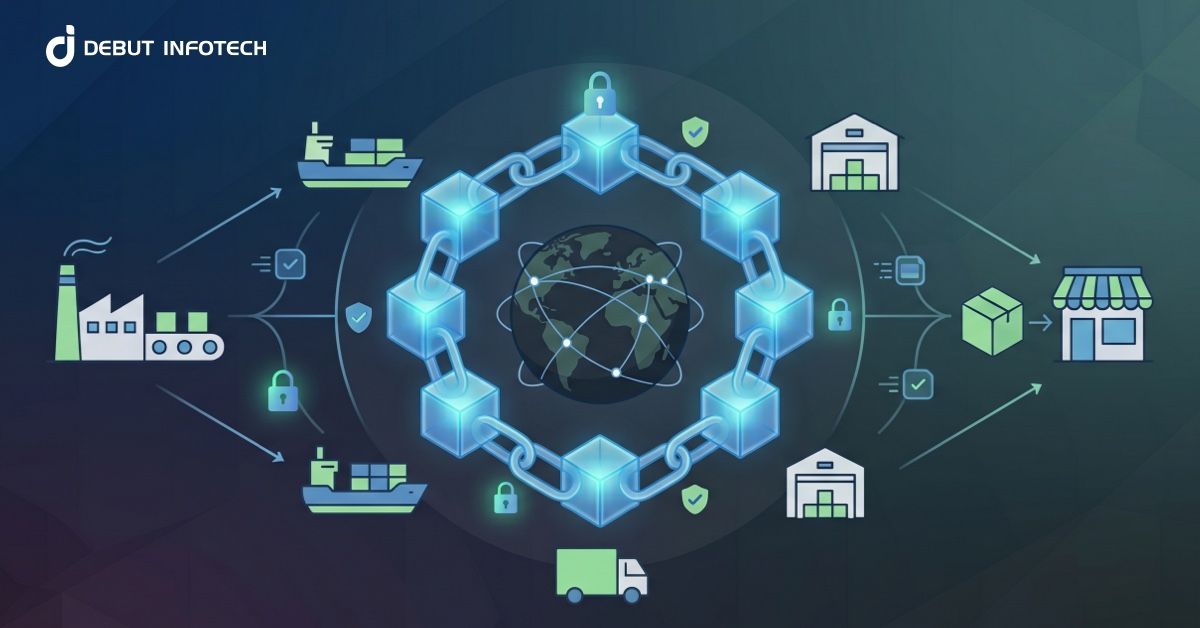
Imagine blockchain as a digital chain of blocks (hence the name!). Each block stores data such as transactions, and once it’s filled, it’s locked and linked to the next block. This creates a super-secure, unchangeable record – like a digital diary that can’t be tampered with.
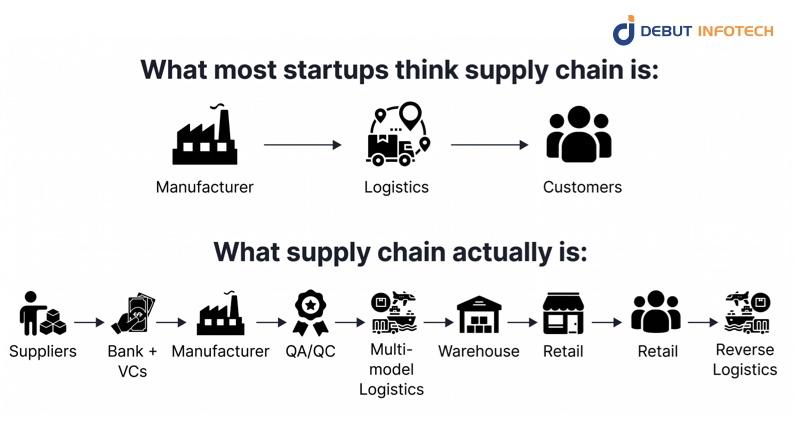
Bring in the supply chain – think goods moving from manufacturers to stores.
Blockchain steps in as a trusty sidekick. It brings transparency, allowing everyone to track products from farm to shelf, a concept further elaborated in this insight on the role of blockchain in the agricultural supply chain. No more guessing games about where your stuff comes from! Plus, it’s secure, so no worries about data tampering or fraud, which is a big deal for supply chain startups, especially in tech-heavy areas like Bangalore or the Bay Area.
Efficiency? Oh, it’s top-notch! Blockchain reduces paperwork, speeds up transactions, and cuts costs. It’s like giving the supply chain a super-speed boost! So, blockchain in supply chains? It’s all about trust, security, and making things run like a well-oiled machine.
Here are our top picks for the best companies using blockchain in supply chain:
Founded: 2016 | HQ: Singapore | Focus: Land transport logistics and carbon reduction
Yojee’s SaaS platform connects shippers, carriers, and logistics operators via a blockchain-integrated layer, bringing transparency and accountability to land transport operations. The platform’s focus on reducing carbon emissions through optimised route management makes it one of the few blockchain supply chain startups venture capital in which sustainability outcomes are as measurable as operational outcomes. Active across the Asia-Pacific region, Yojee represents the new generation of blockchain startups in which ESG reporting and supply chain visibility are built into the same infrastructure.
Founded: 2016 | HQ: Hungary | Focus: Food supply chain traceability
Te-Food delivers end-to-end farm-to-consumer traceability across food supply chains, with particular strength in livestock and fresh produce. Its blockchain infrastructure records every movement, inspection, and ownership transfer in real time, giving both regulators and consumers verifiable access to a product’s complete history. With food safety regulations tightening across the EU and US, Te-Food’s documented traceability infrastructure positions it as much a compliance tool as an operational one — a combination increasingly required of startup blockchain supply chain partners.
Founded: 2016 | HQ: Belgium | Focus: Maritime logistics and secure container release
T-Mining has built a blockchain-based Secure Container Release system that eliminates one of the most persistent fraud vectors in maritime logistics: the paper-based container release process, which has historically been vulnerable to theft and impersonation. By replacing paper documents with blockchain-verified digital releases, T-Mining has modernised port operations across several European terminals. For pharmaceutical and high-value goods shippers, the immutable container custody record addresses both security and compliance requirements that analogue systems cannot meet.
Founded: 2018 | HQ: United States | Focus: Web3 supply chain integration
Suku builds the connectivity layer between traditional supply chain operations and Web3 infrastructure. Its platform reduces the technical barrier for enterprises adopting blockchain supply chain tools by abstracting the complexity of on-chain integration — making it practical for mid-market companies that lack the in-house blockchain development capacity of large enterprises. As a startup blockchain company focused on accessibility rather than verticalisation, Suku addresses the gap preventing most supply chain operators from independently capturing blockchain’s benefits.
Founded: 2013 | HQ: Slovenia | Focus: Decentralised knowledge graph for supply chains
OriginTrail has built a protocol-level solution for supply chain data integrity that goes beyond simple traceability. Its Decentralised Knowledge Graph (DKG) allows supply chain data to be structured, connected, and verified across multiple systems without centralised control — addressing the interoperability problem that prevents most enterprise supply chains from achieving genuine end-to-end visibility. Technology suppliers are increasingly prioritising interoperability and modular architectures, and OriginTrail’s protocol is one of the most mature solutions in this space.
Founded: 2016 | HQ: Canada | Focus: ESG supply chain compliance
Peer Ledger helps companies meet the growing corporate social responsibility and ESG disclosure requirements now embedded in supplier contracts across most major industry sectors. Its blockchain platform maintains verifiable records of human rights performance, environmental data, and ethical sourcing practices across supply chain tiers — allowing companies to prove compliance to auditors, buyers, and regulators rather than merely assert it. With the EU Corporate Sustainability Due Diligence Directive (CSDDD) coming into force, Peer Ledger is one of the blockchain supply chain startups for which regulatory timing is driving a structural surge in demand.
Founded: 2018 | HQ: Australia | Focus: Fuel and mining sector traceability
Blockhead Technologies delivers blockchain-based SaaS solutions specifically for the fuel and mining sectors — industries where chain-of-custody documentation is both a regulatory requirement and a commercial necessity. Its platform provides tamper-proof, auditable records of fuel movement and mining output at every stage. Blockhead’s open, interface-agnostic integration architecture means it connects to existing operational systems without requiring infrastructure replacement — a critical requirement for resource industry operators running complex legacy environments.
Founded: 2018 | HQ: Slovenia | Focus: Blockchain document transfer for international trade
CargoX operates one of the most active blockchain document transfer platforms in international trade, processing Bills of Lading and other critical shipping documents through a blockchain-secured system that makes them instantly transferable, tamper-proof, and permanently auditable. The Egyptian government’s adoption of CargoX for import documentation processing — covering millions of shipments — is one of the most significant government-scale blockchain supply chain deployments by any startup globally, and confirms that supply chain startups using blockchain can win sovereign contracts at scale when the use case is production-ready.
Founded: 2014 | HQ: San Francisco | Focus: Pharmaceutical supply chain and DSCSA compliance
Chronicled administers the MediLedger Network — the pharmaceutical industry’s primary blockchain infrastructure for DSCSA compliance and supply chain integrity. The August 2025 wholesale distributor DSCSA deadline marked the end of the FDA’s stabilisation period and the beginning of full enforcement for electronic, package-level traceability — making Chronicled’s infrastructure no longer optional for pharmaceutical supply chain participants. Participants include Pfizer, AstraZeneca, Johnson & Johnson, McKesson, and AmerisourceBergen. Among all blockchain supply chain startups, Chronicled has the clearest regulatory demand driver: DSCSA compliance is now mandatory, and MediLedger is the most production-proven solution available.
Founded: 2016 | HQ: Israel | Focus: Paperless maritime trade documentation
WAVE BL’s blockchain-based digital courier platform transfers Bills of Lading and other trade documents electronically, eliminating the paper-based processes that currently cost the maritime industry an estimated $6.5 billion annually in document handling and delays. With over 100 banks, shippers, and freight forwarders on the platform, WAVE BL has achieved the network scale required for blockchain document transfer to deliver real operational value — making it one of the blockchain supply chain startups where network adoption has been the determining factor in commercial success.
Founded: 2017 | HQ: Canada | Focus: Global supply chain middleware and automation
Morpheus Network’s multi-award-winning supply chain middleware platform has over 150 integrations with leading companies, including SAP, DHL, FedEx, Cargowise, Telefonica, and Swift. The company was accepted into the European Blockchain Sandbox in 2024, collaborating with Italian logistics startup ReLOG3P to develop a fully automated, blockchain-verified certificate management system aligned with EU sustainability objectives. Morpheus. Network won a prestigious AI Challenge at the Canadian AI Summit in 2024 for its integration of blockchain, AI, and automation in supply chain operations, and has documented partnerships with Coca-Cola and the Argentine government’s agricultural agency SENASA. Its SAP-certified Brand Protection solution and 5,000+ node staking network confirm active commercial momentum heading into 2026.
Founded: 2013 | HQ: McAllen, Texas | Focus: Agricultural commodity supply chain
GrainChain is one of the most active and well-funded blockchain supply chain startups in the agricultural sector. Having raised $29 million in its most recent funding round from investors including Overstock.com’s Medici Ventures, Pelion Venture Partners, and BYU Cougar Capital, bringing total funding to $39.7 million, GrainChain operates across the US, Mexico, Brazil, Honduras, and Central America, and expanded into Guatemala in October 2025. Its platform combines blockchain with IoT sensors to automate commodity measurement, ownership transfer, and payment settlement for agricultural producers, eliminating intermediary fraud and payment delays. With over 22.5 billion pounds of commodities processed, GrainChain is one of the few supply chain startups using blockchain with transaction volume that proves production-scale deployment.
Founded: 2017 | HQ: United States | Focus: Healthcare data supply chain
Akiri specialises in the secure movement of health data across the US healthcare supply chain — ensuring that patient information and clinical records move only between authenticated, policy-authorised parties. Rather than storing data, Akiri governs its real-time transmission, creating an immutable log of every data movement event. As one of the blockchain supply chain startups operating in a HIPAA-governed environment, Akiri’s architecture — where personal data never touches the blockchain, only governance records do — resolves the compliance tension that prevents most general-purpose blockchain platforms from operating in healthcare.
Founded: 2015 | HQ: Colorado | Focus: Health data supply chain management
BurstIQ embeds privacy, permissions, and consent directly into health data assets at the point of creation — making it one of the most architecturally distinctive blockchain supply chain startups in the healthcare vertical. The Colorado Department of Health Care Policy and Financing uses BurstIQ’s LifeGraph platform within its Medicaid Enterprise Solutions Integration system to manage data for 1.5 million Medicaid beneficiaries. The platform achieved TX-RAMP Level 2 Certification in 2024 and expanded into real-time claims processing in May 2025, confirming active commercial momentum.
Founded: 2007 | HQ: Tallinn, Estonia | Focus: Data integrity and cybersecurity
Guardtime is the most established company on this list and one of the foundational blockchain supply chain companies globally. Its KSI® Blockchain verifies data integrity without ingesting customer data — a privacy-preserving architecture that has made it the infrastructure of choice for government-scale supply chains. Active across pharmaceutical, defence, and energy supply chains, Guardtime’s partnerships with Roche and nine other leading pharmaceutical companies for outcomes-based contracting represent one of the most commercially significant blockchain supply chain deployments in the life sciences sector.
Founded: 2016 | HQ: Knoxville, Tennessee | Focus: Fleet telematics and supply chain visibility
A note on accurate categorisation: Konexial is an active, growing supply chain technology company — it launched its Ki™ Geo-Operations platform in September 2025, announced a Bosch FleetME integration in October 2025, and was named to the FreightTech 100 list from 2019 to 2024. However, blockchain is no longer a primary feature of Konexial’s current platform positioning, which centres on edge computing, AI-powered telematics, and real-time freight matching. It was included in earlier versions of this list based on its 2019 BiTA membership and blockchain load-matching announcement. Organisations seeking a dedicated blockchain supply chain startup in the fleet telematics space should evaluate this distinction before proceeding.
The blockchain supply chain market is estimated at USD 1.77 billion in 2026 and is projected to reach USD 12.41 billion by 2031 at a CAGR of 47.65%, with demand strongest in food, automotive, and high-value electronics sectors. Three forces are shaping where that growth flows.
Regulation is the most underappreciated driver. The pharmaceutical industry’s DSCSA enforcement milestone passed in August 2025, making electronic package-level traceability mandatory for wholesale distributors. Similar tailwinds are building in food safety (FSMA 204), sustainability (EU CSDDD), and cross-border trade documentation. For startup blockchain companies that built ahead of these mandates, the enforcement calendar is a commercial opportunity.
AI integration is transforming what blockchain supply chains can do. Morpheus Network’s 2024 AI Challenge win demonstrated the practical value of combining blockchain’s immutable audit trail with AI-powered automation across complex multi-party supply chains. The pattern emerging across supply chain startups using blockchain is consistent: blockchain provides the immutable data layer, AI provides the analytical and predictive layer on top of it, and together they create capabilities that neither achieves independently.
Consortium blockchain is becoming the dominant architecture. The consortium blockchain segment is projected to expand at the fastest CAGR of 53.67% through 2026–2033, reflecting multi-party adoption in logistics and trade finance. The MediLedger model — where multiple competitors participate in a shared, governance-distributed consortium — is the architecture enterprise supply chains are converging on.
60% of small businesses cite high implementation costs as a significant barrier, 30% struggle with interoperability between blockchain and existing systems, and 58% of supply chain professionals cite a lack of skilled blockchain personnel as a limiting factor.
Three challenges consistently determine whether deployments succeed or stall. Legacy system integration is the most underestimated aspect — connecting blockchain infrastructure to existing ERP, WMS, and logistics platforms requires middleware investment that most initial scopes fail to account for. Regulatory complexity varies by jurisdiction and industry vertical, and compliance architecture decisions made at the outset determine whether a deployment can scale across borders. Talent scarcity is real: the pool of developers with both blockchain expertise and domain knowledge in the startup supply chain is limited, which is why most successful startup blockchain deployments are delivered in partnership with specialist development firms rather than built entirely in-house.
Blockchain’s potential in revolutionizing startup supply chain management is immense, offering unparalleled transparency, security, and efficiency. Startups are at the forefront of this innovation, adapting to the changing landscape and actively shaping it. Their pioneering solutions are setting new standards, heralding a future of more resilient and agile supply chains.
A. The blockchain in supply chain market is valued at USD 3.96 billion in 2025 and is projected to reach USD 95.52 billion by 2033 at a CAGR of 48.88%. Demand is strongest in food, pharmaceutical, automotive, and high-value electronics sectors, where traceability requirements are both regulatory and commercial imperatives for supply chain startups using blockchain.
A. The Drug Supply Chain Security Act’s August 2025 wholesale distributor deadline made electronic package-level traceability mandatory across the US pharmaceutical supply chain. FDA pilots using blockchain achieved recall notifications 25,920 times faster than legacy EDI systems.
A. A global study of over 150 blockchain supply chain implementations found that organisations achieve ROI within 18-24 months, reducing supply chain costs by 20–30%, improving traceability by 75%, and decreasing documentation processing time by 85%.
A. Blockchain provides an immutable, tamper-proof record of every supply chain transaction and movement event. AI analyzes that data to generate predictions, detect anomalies, and automate decisions.
Our Latest Insights
USA
2501 Chatham, Rd Suite R Springfield, IL 62704
+1-708-515-4004
info@debutinfotech.com
UK
7 Pound Close, Yarnton, Oxfordshire, OX51QG
+44-770-304-0079
info@debutinfotech.com
Canada
154 Eden Oak Trail, Kitchener, ON N2A 0H9
+1-708-515-4004
info@debutinfotech.com
INDIA
Sector 101-A, Plot No: I-42, IT City Rd, JLPL Industrial Area, Mohali, PB 140306
9888402396
info@debutinfotech.com