


AI Clinical Documentation System To Automate High-Volume Telehealth Operations
OVERVIEW
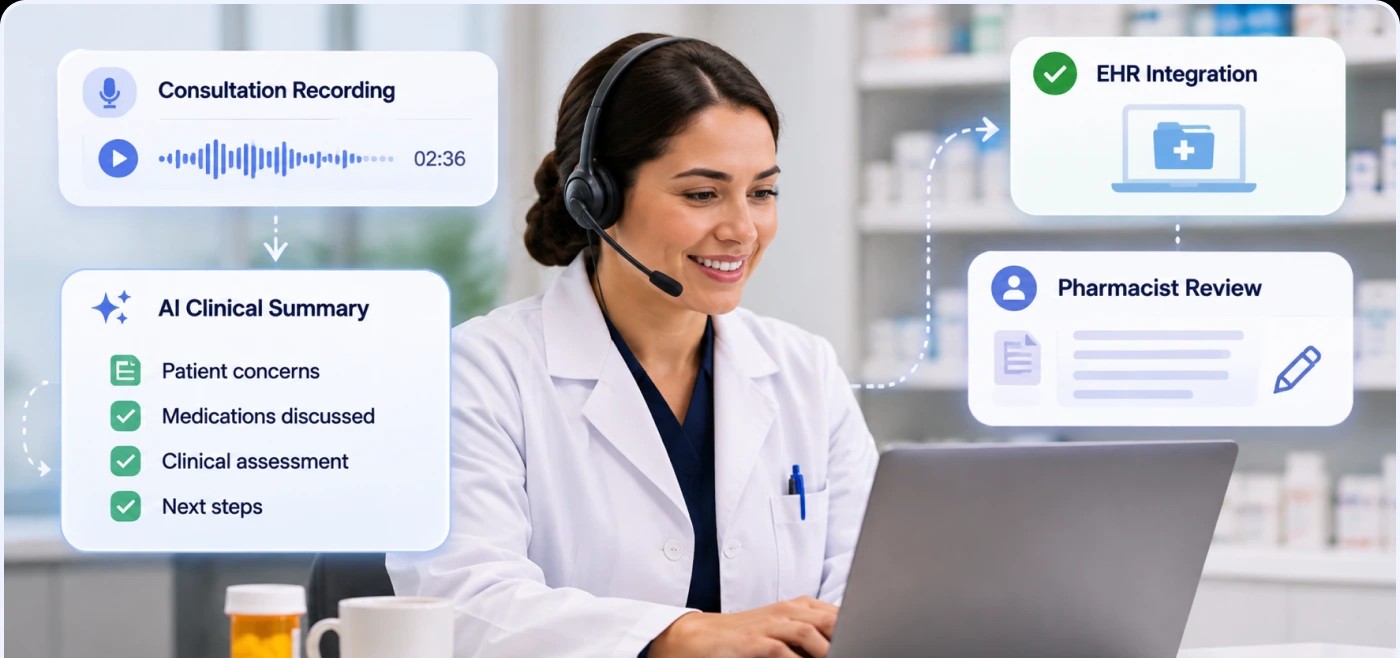
Automating Clinical Documentation Without Disrupting Patient Care
Growing Consultation Demand
AI-Powered Clinical Documentation
Pharmacist-Controlled EHR Workflow
PROBLEM STATEMENT
Addressing Manual Documentation and High Consultation Volumes
Key Challenges


HOW IT WORKS
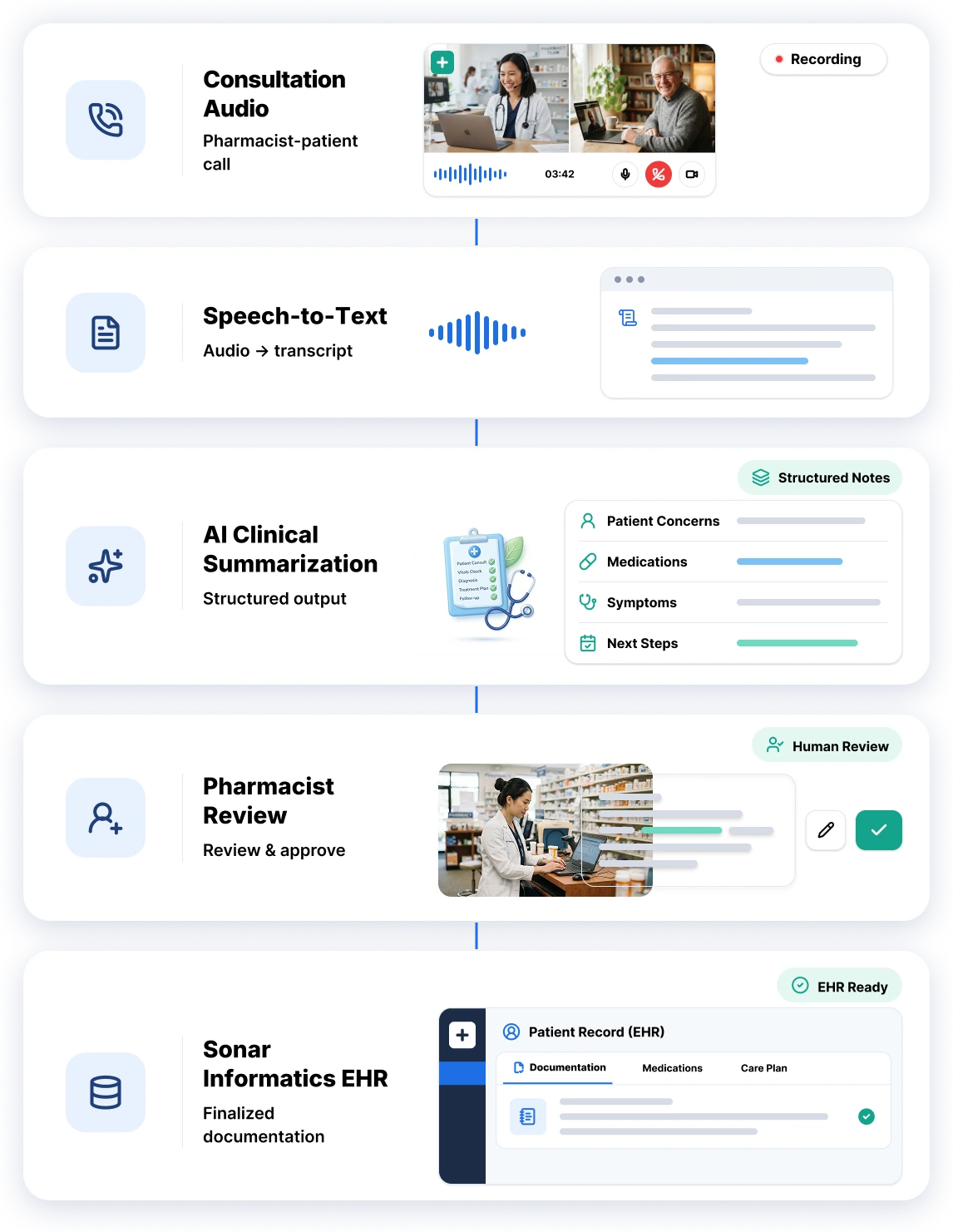
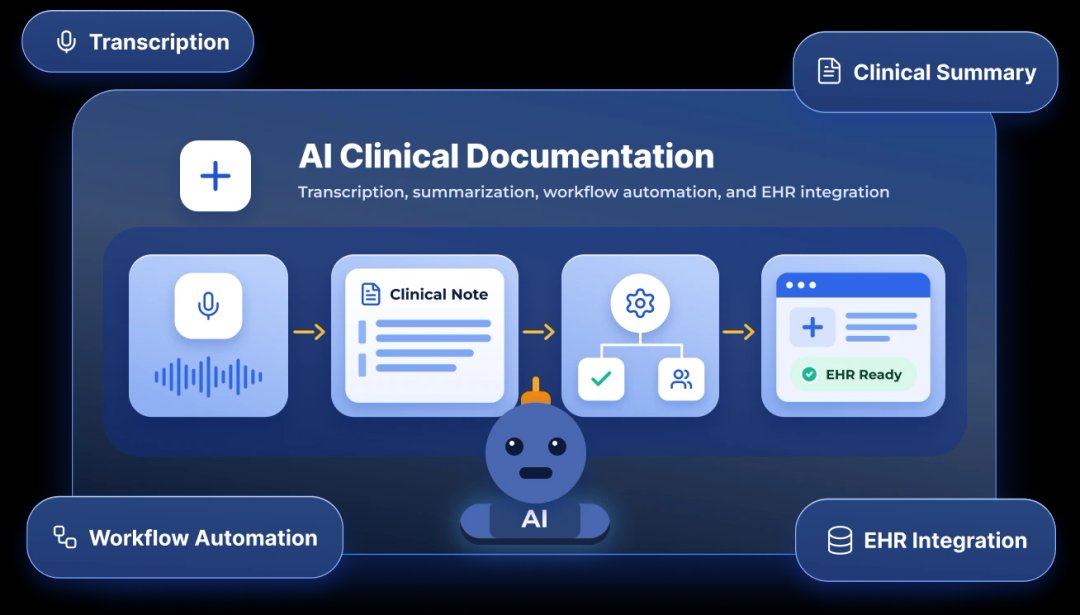
How AI Converts Patient Conversations Into Clinical Documentation
SOLUTION
An Integrated AI Clinical Documentation and Summarization Platform
Automated Consultation Recording and Transcription
- Automatic consultation audio capture
- Speech-to-text transcript generation
- Patient-pharmacist conversation processing
- Transcript input for AI summarization
- Full transcript access for clinical review
- Reduced manual transcription requirements
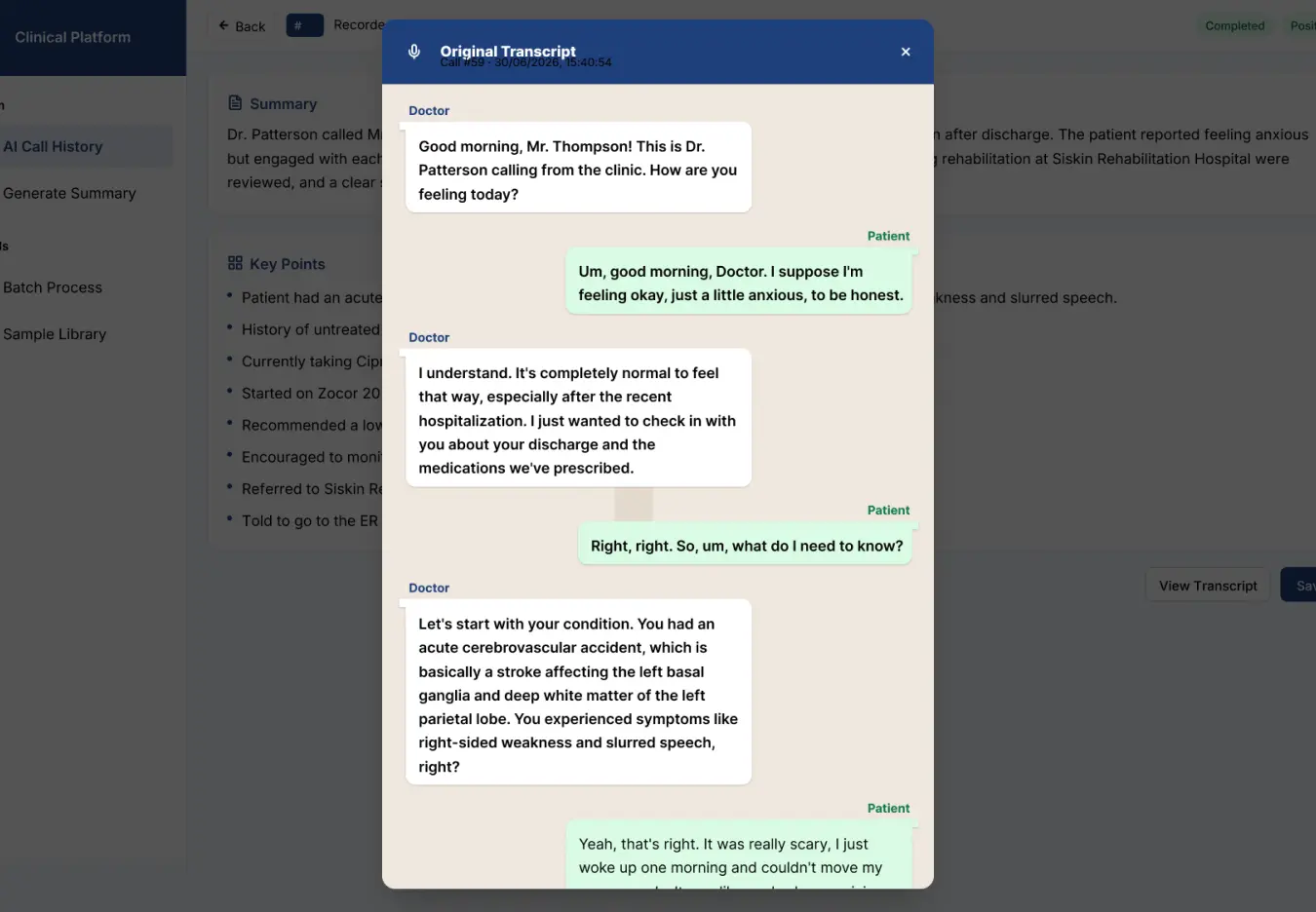
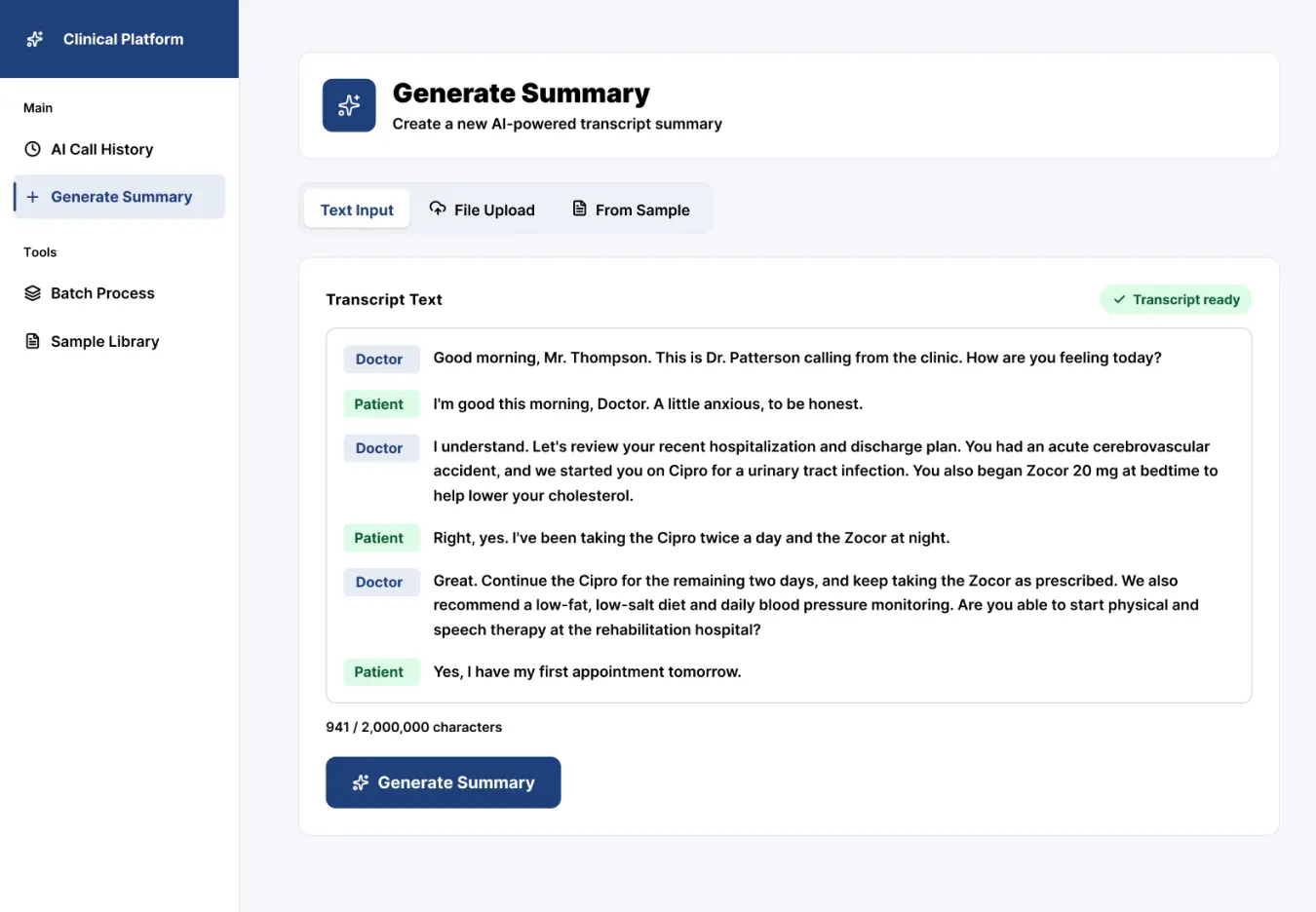
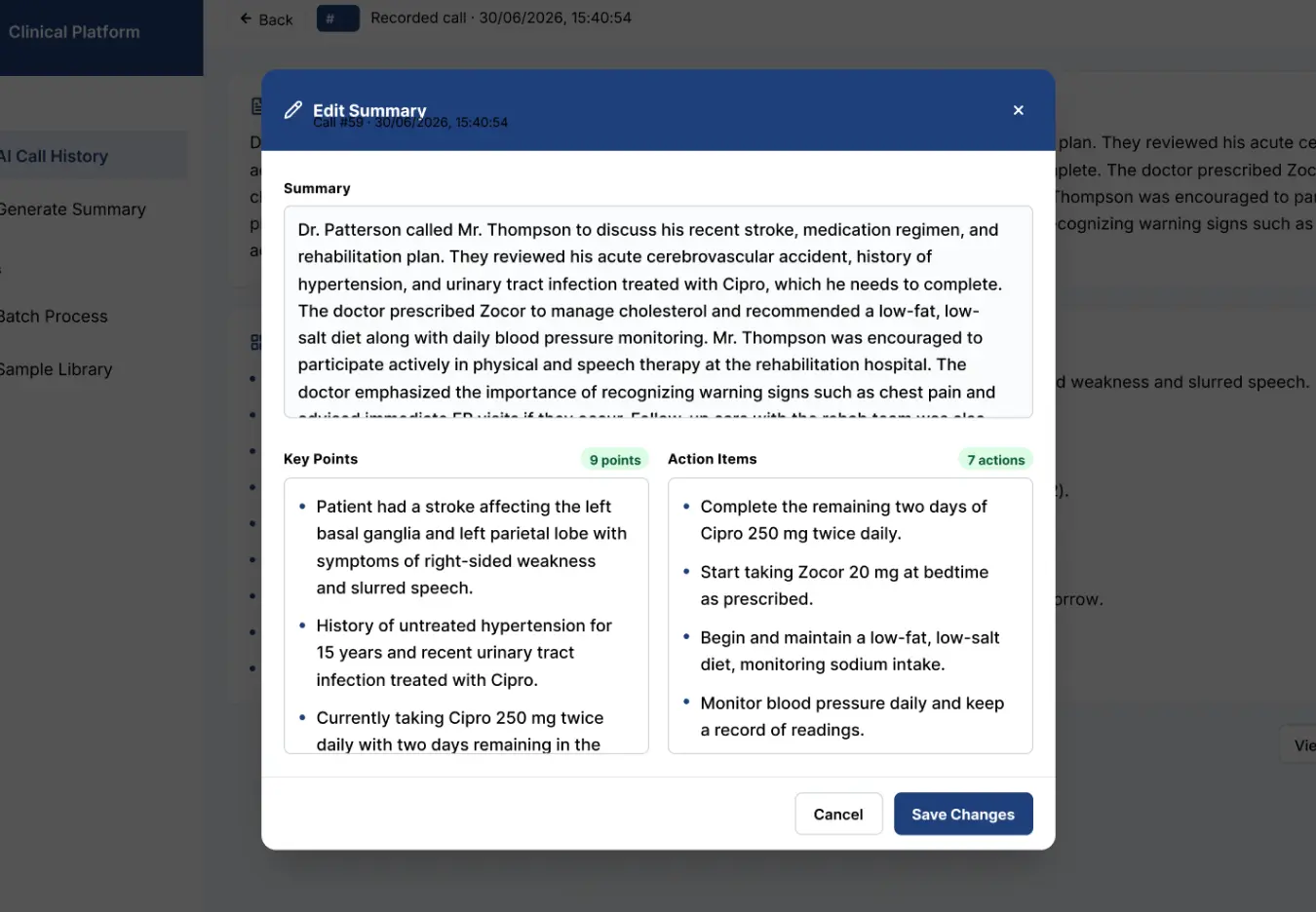
AI-Powered Medical Transcript Summarization
- Text-based medical transcript input
- File-upload option for transcript submission
- Sample-based summary generation
- AI-generated consultation summaries
- Clinical key-point identification
- Action-item extraction and organization
Pharmacist Review and EHR Documentation Integration
- Integration with Sonar Informatics EHR
- AI-generated clinical note preparation
- Full transcript reference during review
- Pharmacist editing and finalization
- Structured documentation of patient concerns
- Reduced dependence on manual note drafting
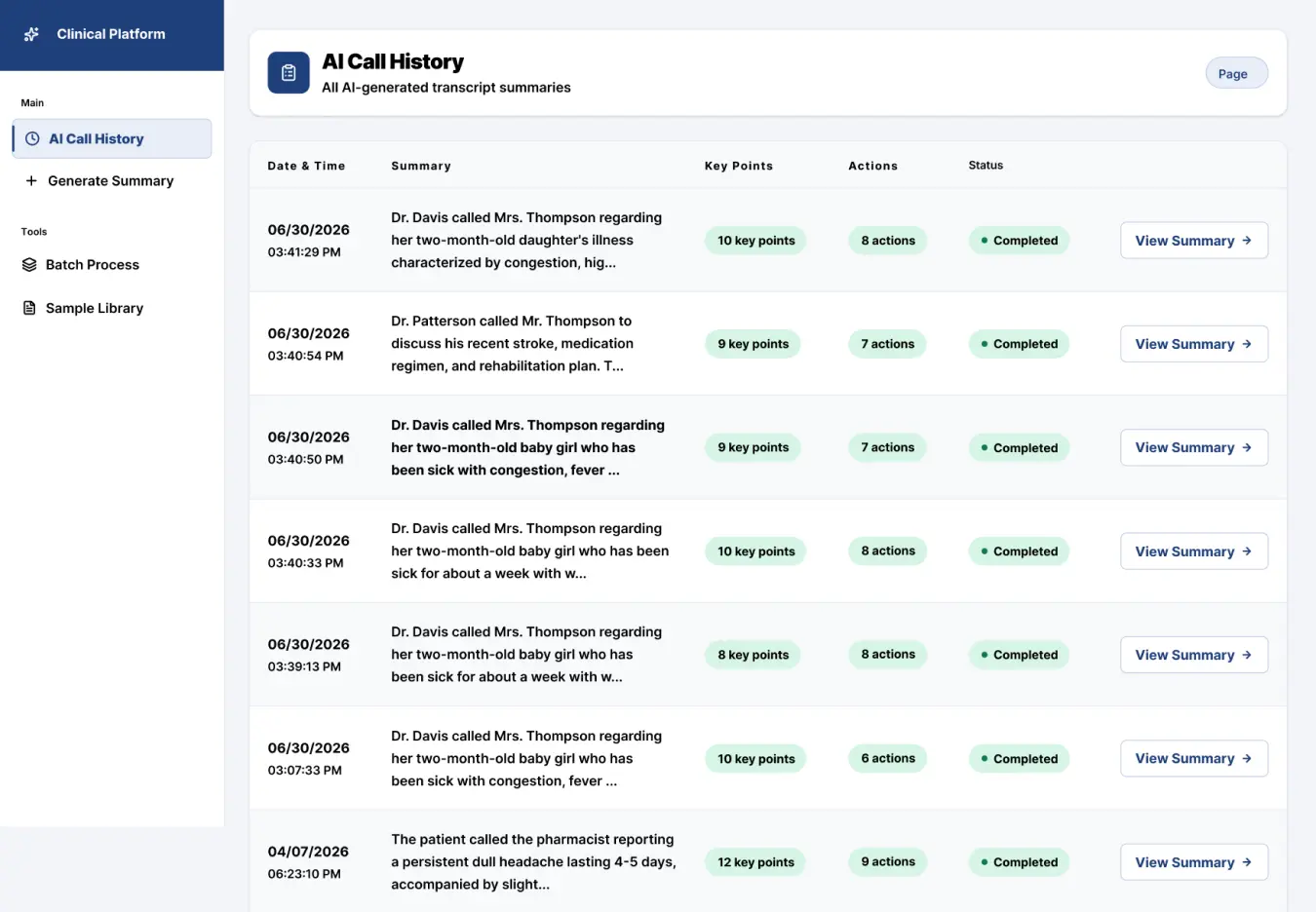
Centralized AI Call History and Summary Management
- Chronological AI summary history
- Consultation date and time display
- Generated summary previews
- Clinical key-point counts
- Action-item counts and completion status
- Individual summary access and pagination
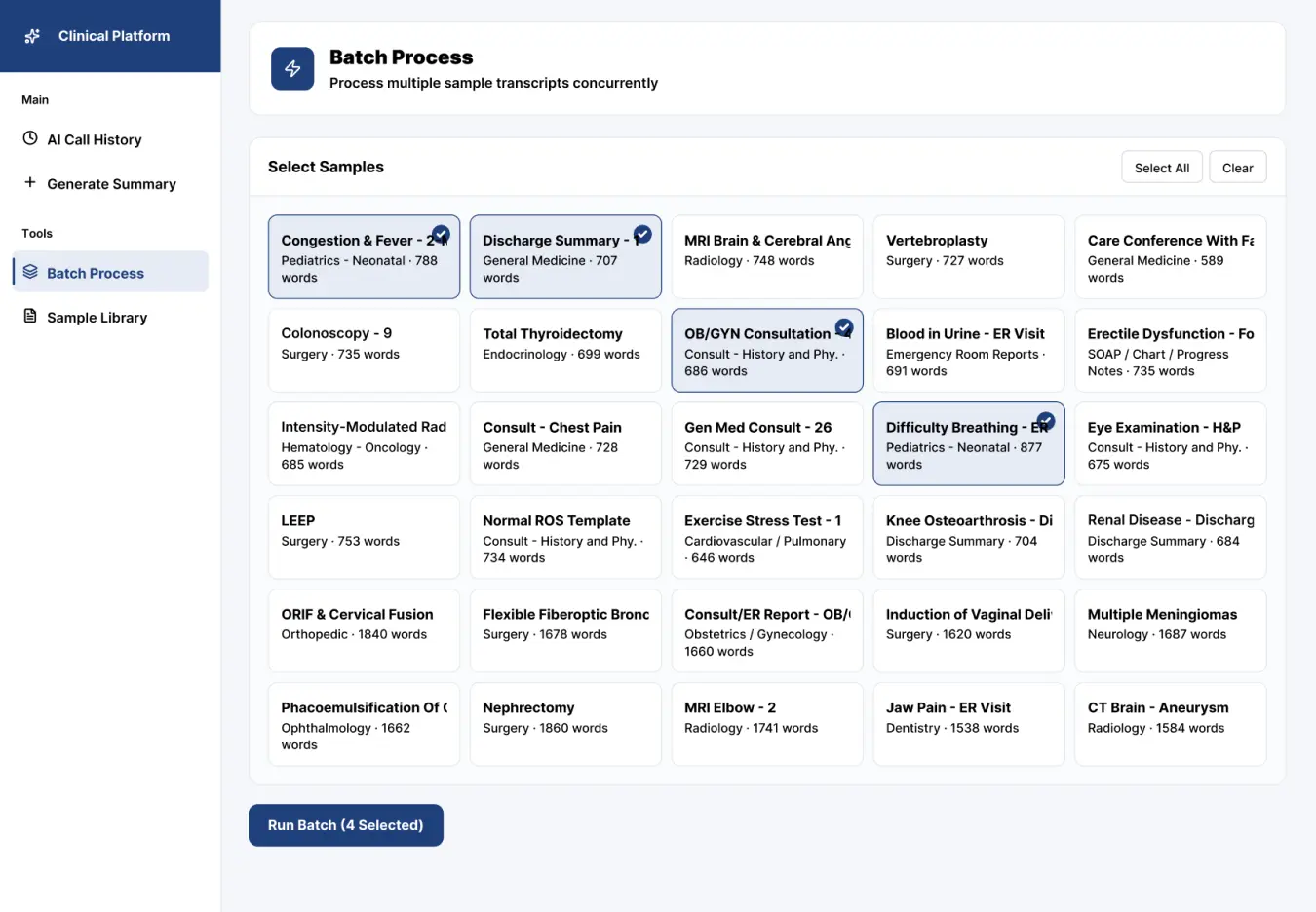
Batch Processing for Multiple Medical Transcripts
- Multiple transcript sample selection
- Individual sample selection controls
- Select All and Clear options
- Batch summarization initiation
- Medical category and word-count visibility
- Centralized batch submission workflow
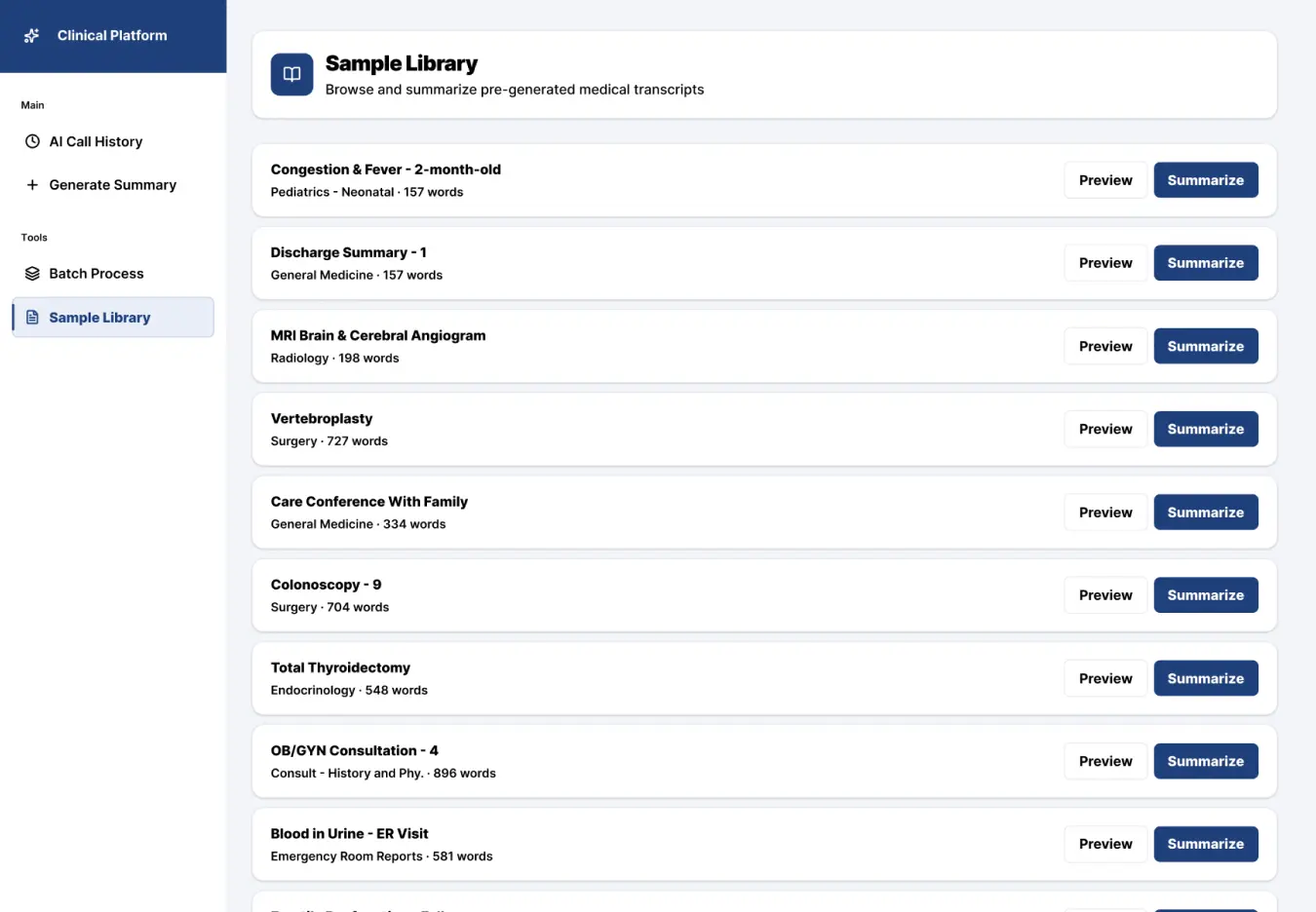
Specialty-Based Medical Transcript Sample Library
- Preloaded medical transcript samples
- Pediatrics and neonatal consultation records
- Radiology and diagnostic report samples
- General medicine and surgery transcripts
- Medical category and word-count display
- Preview and Summarize actions
TECHNOLOGY STACK
Technology Architecture for AI-Powered Clinical Documentation Workflows
 FastAPI
 Uvicorn
 Caddy
 PostgreSQL (Production)SQLite (Development)
 Azure OpenAI
 GPT-4.1, GPT-5-mini
 Azure Blob Storage
 DigitalOcean Spaces
 DigitalOcean VPS
 Azure App Service
OPERATIONAL TRANSFORMATION
Before and After: How AI Changed Clinical Documentation
RESULTS
Streamlined Clinical Documentation and Improved Pharmacist Availability
Reduced Manual Documentation
Improved Pharmacist Availability
Standardized Clinical Records
Improved Clinical Review
Better Patient Engagement
Simplified Transcript Management
Ready to Automate Clinical Documentation With AI?
Frequently Asked Questions
What is AI clinical documentation automation?
AI clinical documentation automation uses speech-to-text, NLP, and large language models to convert patient conversations into structured notes that healthcare professionals can review, edit, and finalize.
How does an AI medical scribe help pharmacists?
An AI medical scribe reduces manual note-taking after patient consultations. It allows pharmacists to focus on patient care while AI prepares consultation summaries and documentation for review.
How does AI automate clinical documentation in telehealth?
AI clinical documentation systems record patient consultations, transcribe audio using speech-to-text, then pass the transcript through an NLP model — such as Azure OpenAI GPT-4.1 — to generate structured clinical notes covering patient concerns, discussion points, and action items. These notes are pushed directly into the EHR system, eliminating manual data entry. Pharmacists or clinicians review and sign off on the AI-generated output before it is filed.
What is automated SOAP note generation?
Automated SOAP note generation uses AI to convert raw consultation audio or transcripts into structured clinical notes in the SOAP format — Subjective, Objective, Assessment, and Plan. The AI extracts relevant clinical information from the conversation and organizes it into the correct fields, which clinical staff then review, edit if needed, and finalize before EHR submission.
Can AI transcription software integrate with EHR systems?
Yes. AI transcription and clinical documentation systems can integrate with EHR platforms through secure APIs, allowing reviewed notes to be saved into patient records and internal clinical workflows.
Is AI-generated clinical documentation reviewed by humans?
In this workflow, pharmacists retain full oversight. AI generates the draft summary and transcript, but clinical staff review, edit, and approve the final documentation.
How much time does AI for clinical documentation save per consultation?
AI-driven clinical documentation reduces post-call wrap-up to a brief review rather than full manual note writing — typically recovering 10–20 minutes per consultation. Across a high-volume telehealth operation, this unlocks significant additional consultation capacity and reduces the administrative burden driving staff burnout.