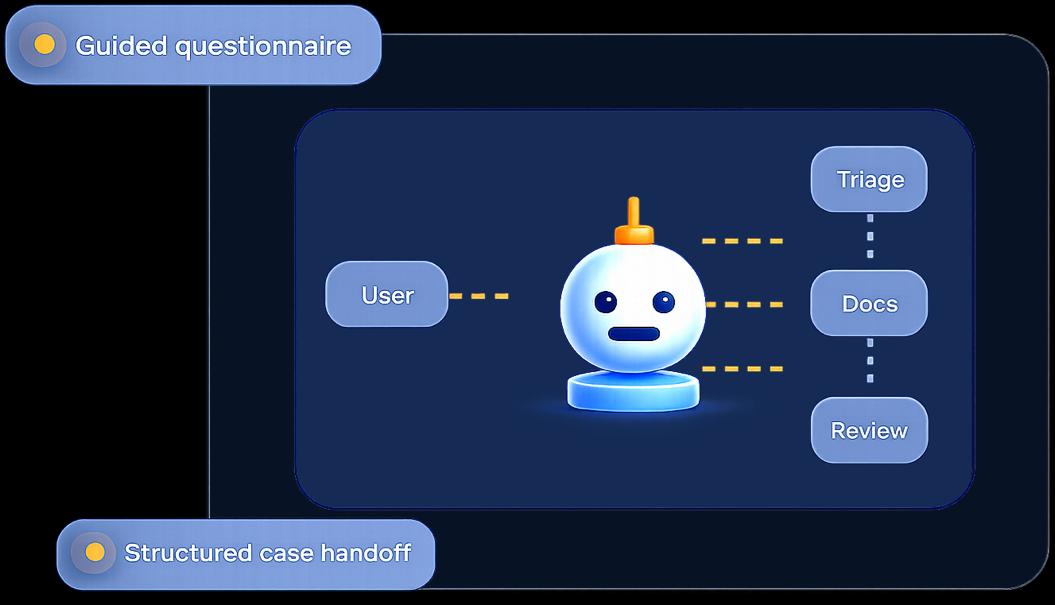
Enterprise AI Chatbot
Legal Services
Enterprise AI Chatbot & Legal Automation Platform for Immigration Case Management
Client: Confidential (Legal Services Organization)
Industry: Legal Services / Non-Profit / Immigration
Timeline: Ongoing
Category: AI / Legal Services
OVERVIEW
Managing High-Volume Immigration Cases Without Limiting Access to Legal Support
Immigration legal organizations face growing pressure to serve multilingual applicant populations while maintaining accuracy, confidentiality, and timely access across every stage of the client journey. Phone-based intake, manual eligibility checks, document-heavy workflows, and disconnected systems create delays that reduce service capacity and strain legal teams.
01
High-Volume Intake Demand
Appointments and initial intake were managed over the phone, resulting in long waits and limiting staff capacity. Repetitive questions, scheduling requests, and manual data collection consumed time that could otherwise support substantive legal work.
02
Multilingual Access Barriers
Applicants required guidance across different languages, locations, household circumstances, and immigration categories. Existing phone-based processes could not deliver consistent multilingual support, making services harder to understand and access.
03
Fragmented Document Workflows
Required documents were not collected before consultations, leaving legal teams underprepared. Scheduling records, applicant details, documents, and case information remained spread across separate tools, increasing administrative effort, errors, and turnaround time.
CHALLENGE
Manual Intake, Zero Self-Service, and Fragmented Document Workflows
The primary objective was to eliminate inefficiencies associated with manual legal workflows while ensuring accuracy, compliance, and scalability across immigration case handling. Modern legal organizations struggle with high consultation volumes, manual documentation, and inconsistent intake processes, making it difficult to scale operations without increasing costs and resources.
Immigrants seeking legal help were waiting on hold while staff were spending hours on routine scheduling and intake calls. We needed a system that could answer questions, book appointments, and collect documents — so our team could focus entirely on legal work.
— Program Lead, Client Organization
Key challenges

No Digital Intake
All appointment scheduling and client intake were handled via phone, creating bottlenecks and limiting capacity.

High Staff Workload on Repetitive Tasks
Staff spent significant time answering common queries about services, eligibility, and processes — work suitable for automation.

No Structured Document Collection
Documents required for consultations were not collected or validated upfront, leaving staff underprepared.

Multilingual Access Gaps
The client’s diverse client base required multilingual support that existing phone-based systems could not reliably provide.

No Client-Facing Portal
Clients had no visibility into their appointments, household profiles, or case status outside of direct staff contact.

Fragmented Systems
No centralized system connected scheduling, intake data, document management, and the client’s legal server.
CHOOSING THE RIGHT VENDOR
Navigating the Path to Execution: Engineering an AI-First Legal Platform
To bring this vision to life, a structured engineering approach was followed to design a scalable AI platform capable of handling complex legal workflows.
The system architecture was built using modern web technologies combined with AI models for natural language understanding, classification, and document processing. The platform was designed to integrate multiple input channels, process structured and unstructured data, and deliver consistent outputs across workflows.
A layered architecture ensured separation of concerns between input handling, AI processing, workflow execution, and system outputs. This approach enabled flexibility, scalability, and reliability across the platform.
The focus remained on building a system that integrates seamlessly into existing legal operations while significantly reducing manual effort and improving processing efficiency.
SOLUTION
A Three-Layer AI Platform: Chatbot, Self-Service Portal, and Document Automation
To address the challenges of manual workflows and fragmented systems, Debut Infotech designed and developed a scalable AI-powered legal automation platform. The solution combines conversational AI, workflow automation, and distributed system architecture to enable end-to-end legal intake and case processing from a single interface.
SOLUTION 01 · AI LEGAL ASSISTANT
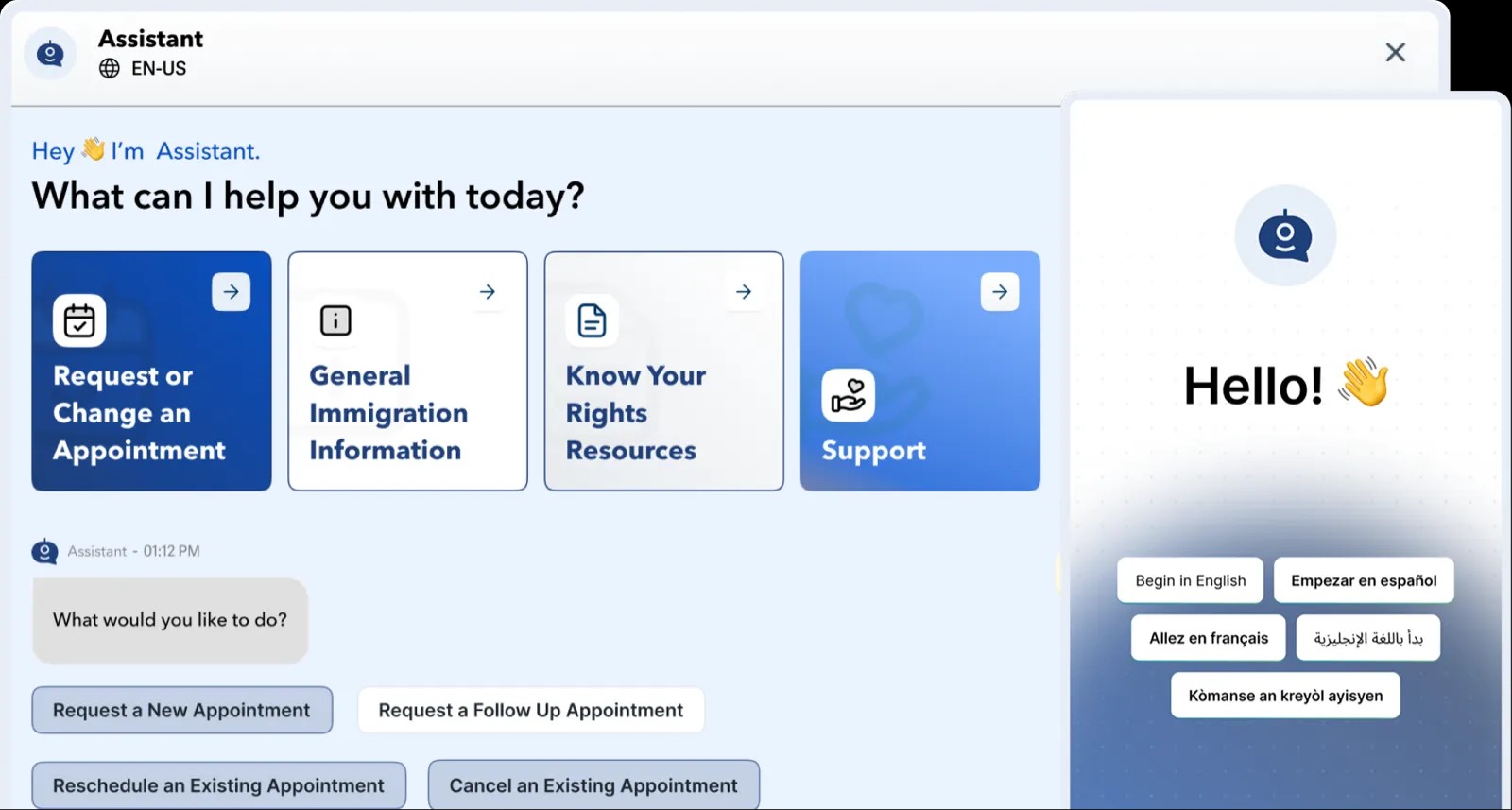
AI Legal Assistant and Query Handling
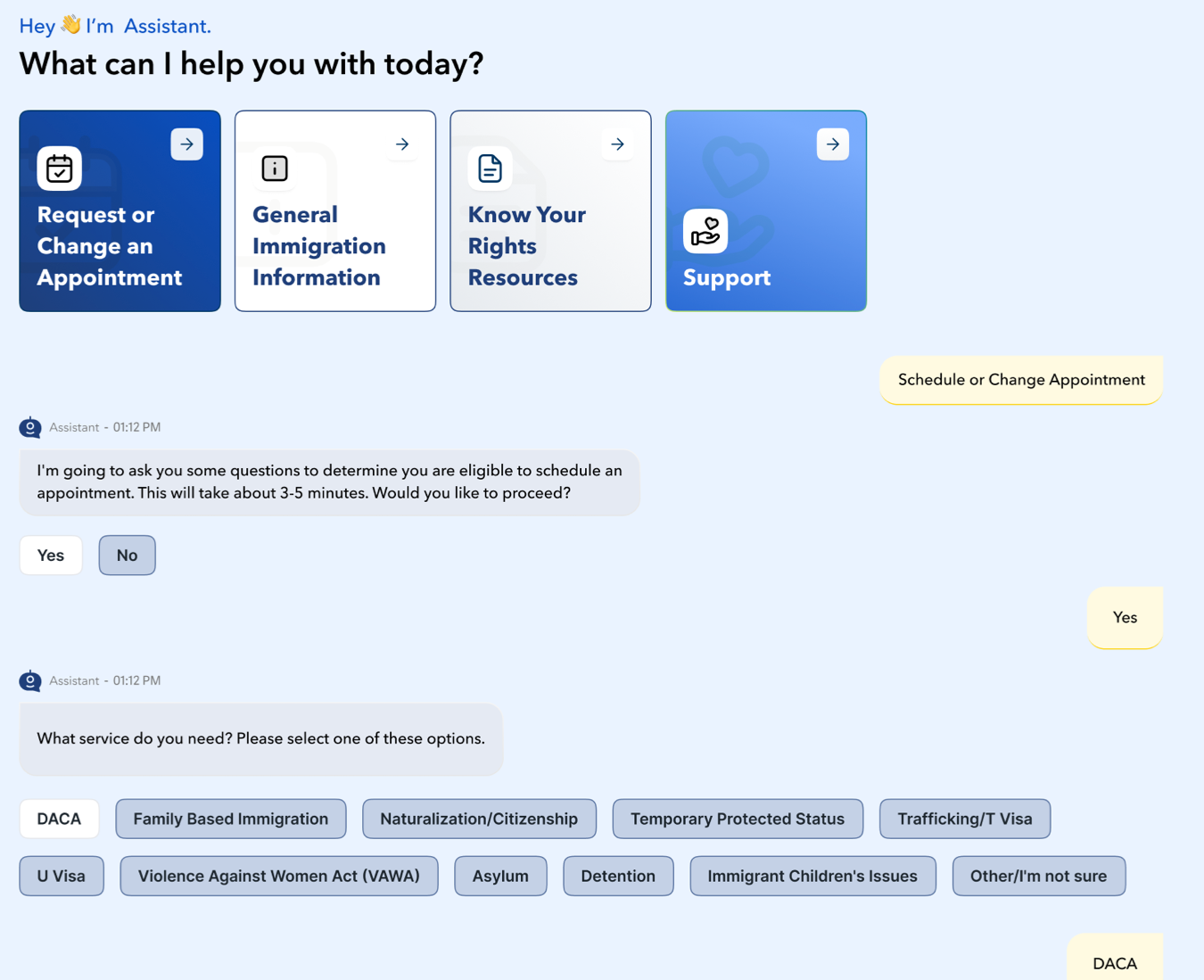
The assistant helps users schedule appointments, ask immigration-related questions, access resources, and get support through a conversational interface.
- Appointment scheduling and change requests
- General immigration information support
- Know Your Rights resource access
- Support request option
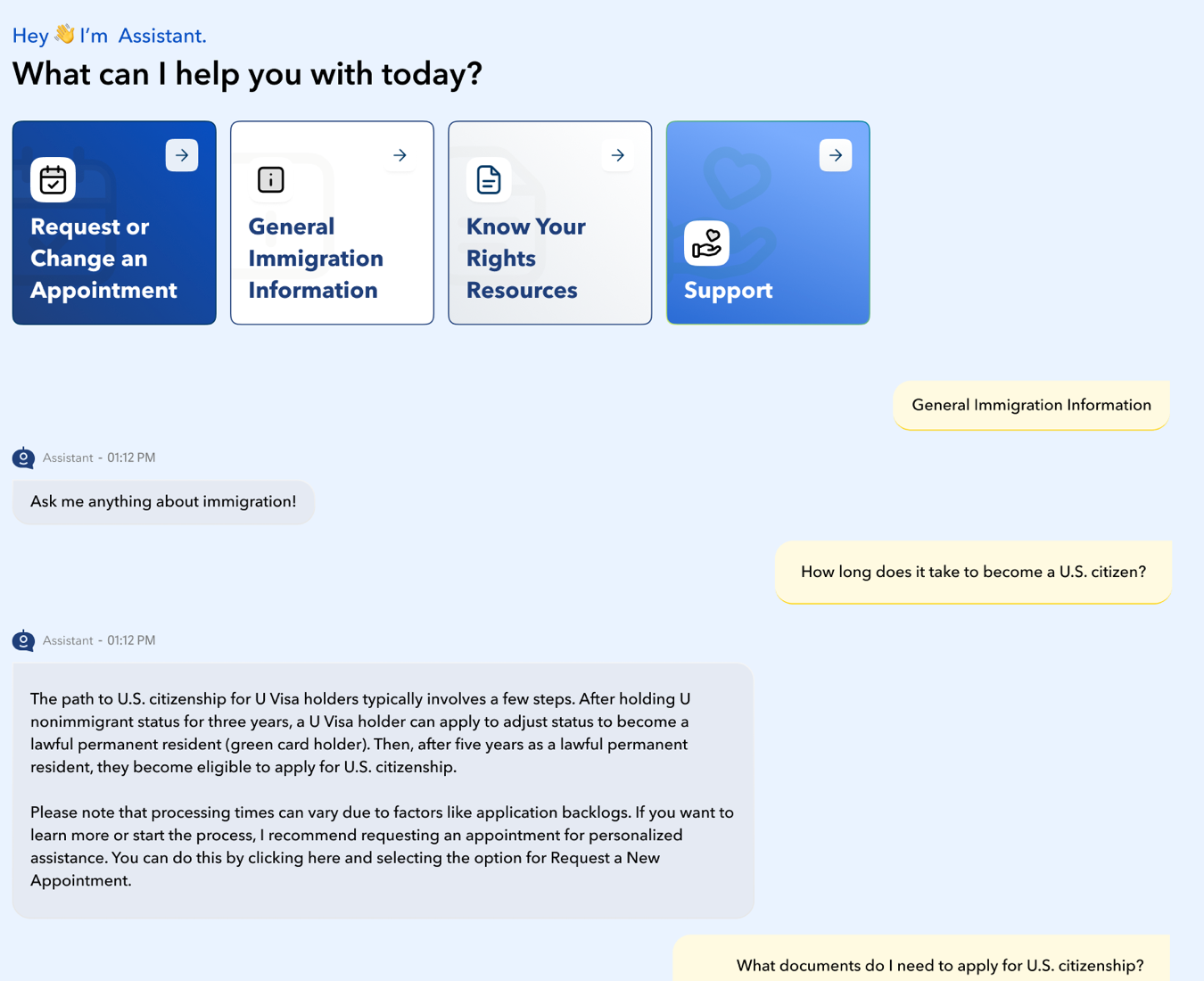
- Context-based immigration query responses
- Document guidance for appointment preparation
SOLUTION 02 · APPOINTMENT SCHEDULING
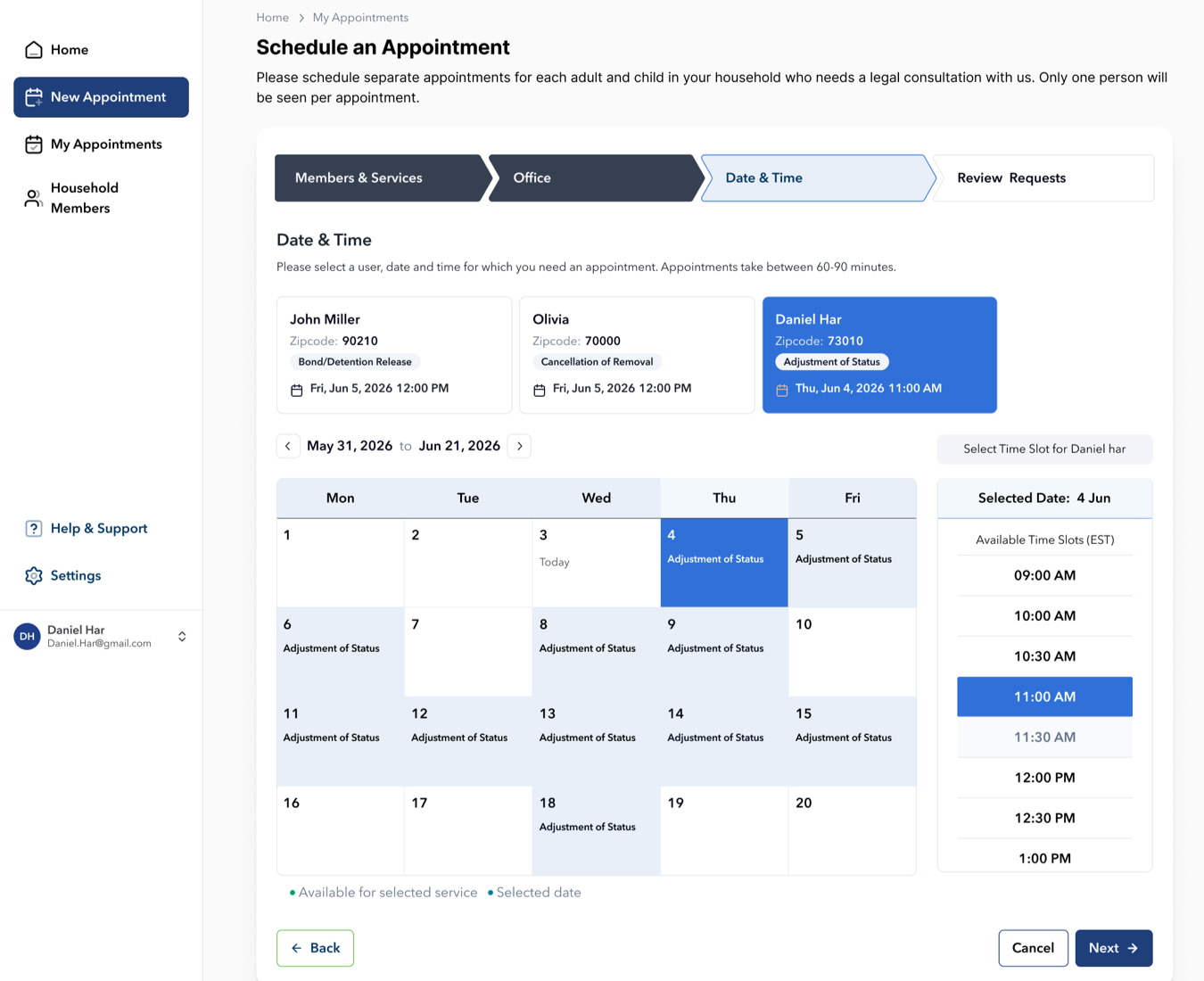
Appointment Scheduling Workflow
Users can book legal consultations through a guided flow covering applicant selection, service type, office, date, time slot, and final review.
- Separate appointment booking for each household member
- Applicant cards with case type, zip code, and appointment details
- Office-based appointment availability
- Selected date highlighted for easy confirmation
- Available time slots displayed for the chosen date
- Final review step before submitting the appointment request
SOLUTION 03 · ELIGIBILITY SCREENING
Eligibility Screening and Case Classification
The chatbot qualifies users through guided questions and routes them based on service type, location, and applicant details.
- Eligibility questions before appointment booking
- Service selection for DACA, U Visa, asylum, detention, VAWA, and more
- Country and state-based screening flow
- Household and dependent-related questions
- Yes/no qualification responses
- Case type mapping for appointment routing
SOLUTION 04 · DOCUMENT AUTOMATION
Automated Document Processing and Validation
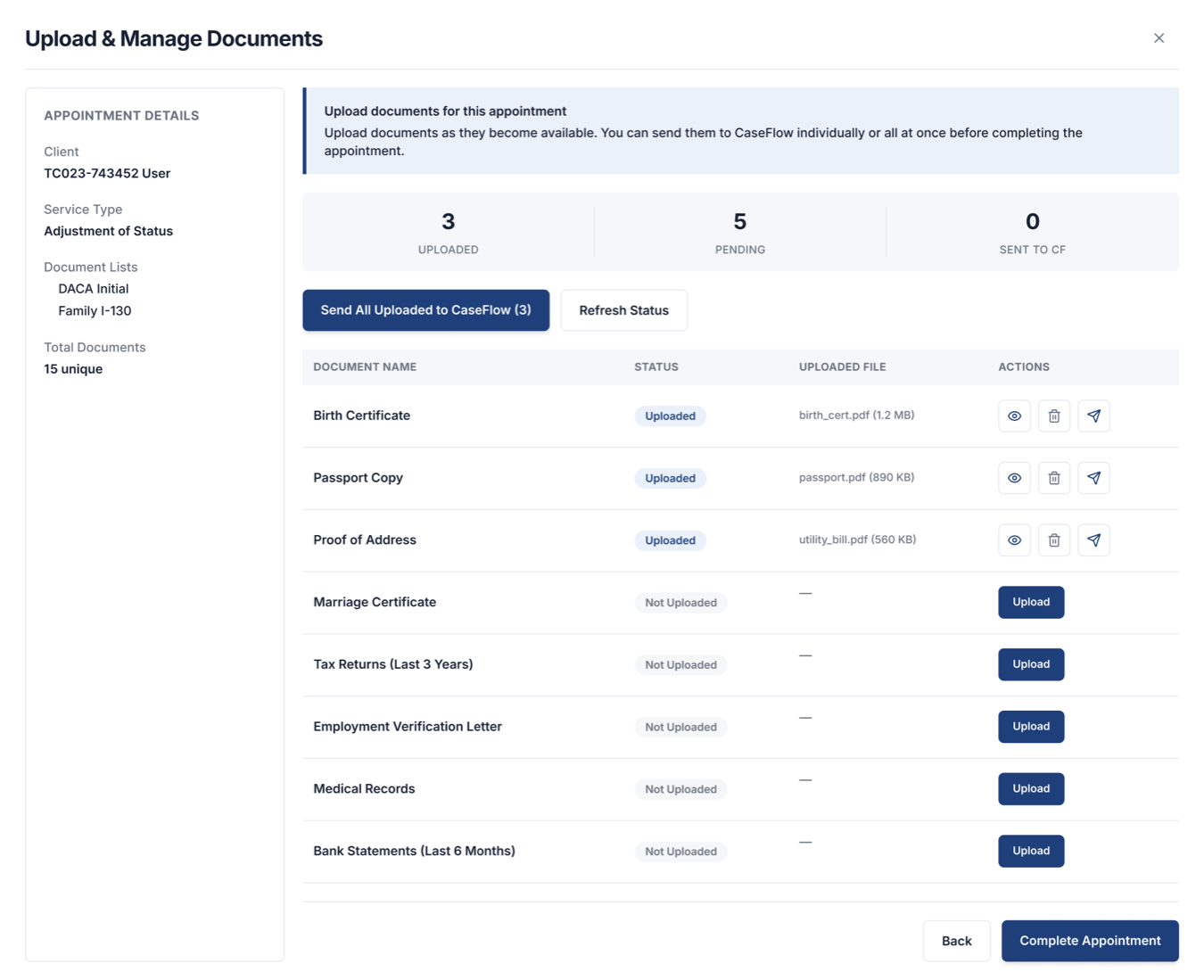
The platform lets users upload, track, manage, and submit required documents before completing an appointment request.
- Appointment-specific document checklist
- Uploaded, pending, and submitted file status
- Required document upload flow
- View, delete, and replace uploaded files
- Bulk submission to the case management system
- Appointment completion after document upload
SOLUTION 05 · ANALYTICS DASHBOARDS
Analytics and Case Management Dashboards
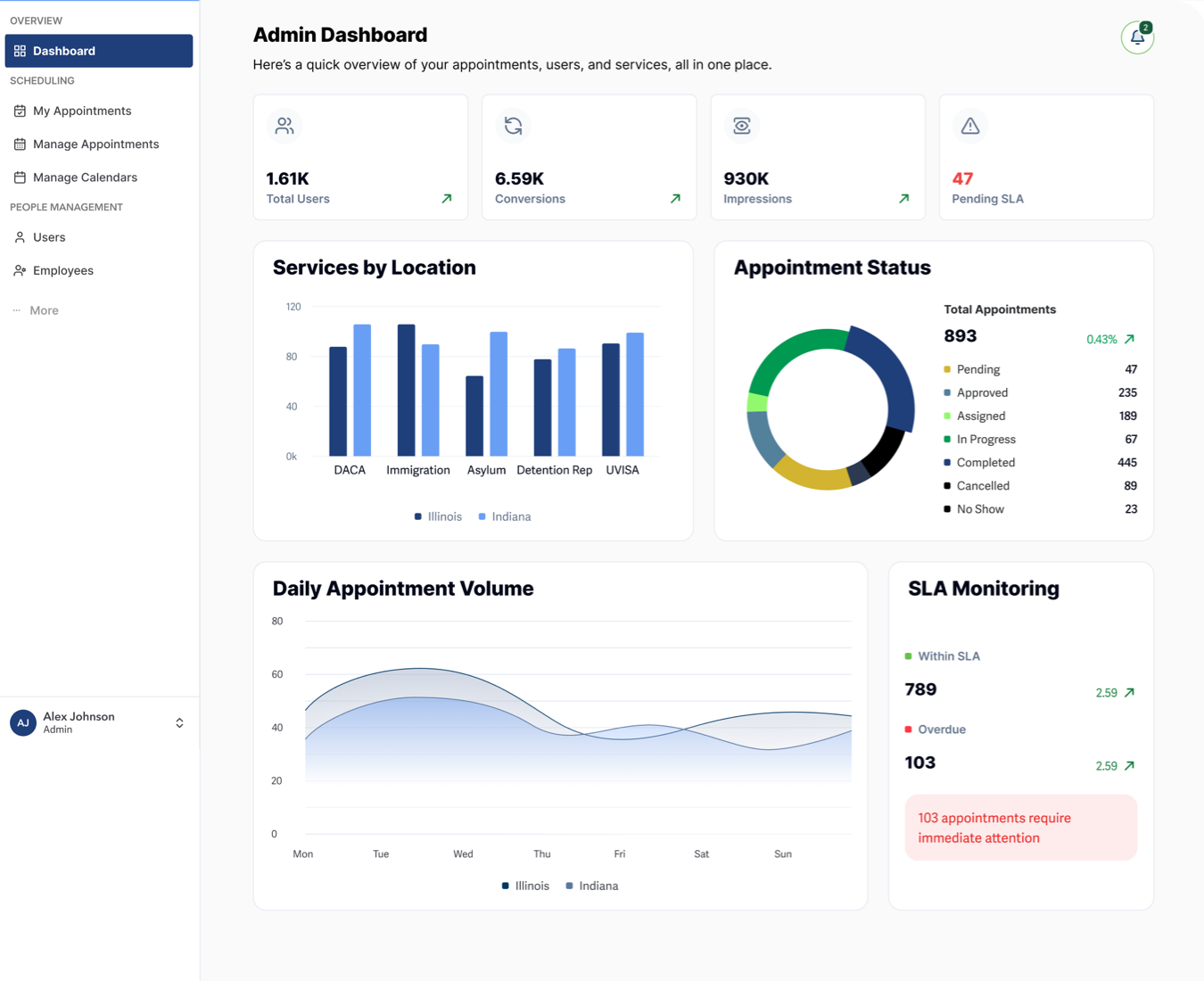
The admin dashboard gives teams visibility into chatbot usage, appointment activity, service demand, and operational performance.
- Total users, sessions, and impressions tracking
- New user activity monitoring
- Services by location analytics
- Appointment status breakdown
- Daily appointment volume tracking
- Average messages per session reporting
System Architecture and Engineering Design
The platform was built using a modular architecture to ensure scalability and performance.
1
Input Layer
Chat interfaces, voice inputs, structured forms
2
AI Layer
NLP models for intent detection and classification
3
Processing Layer
Document parsing, validation, and workflow logic
4
Integration Layer
CRM systems, communication platforms
5
Output Layer
Case routing, responses, dashboards
Execution Complexity and Engineering Challenges
Building this platform required solving multiple complex challenges:
✓
Ensuring legal-grade accuracy across AI-driven workflows
✓
Managing multilingual interactions with consistent output quality
✓
Handling sensitive immigration data securely
✓
Synchronizing chat, voice, and document workflows in real time
✓
Designing systems with minimal error tolerance
TECHNOLOGY
Architecture Built for Security, Scale, and Legal Compliance
The platform was engineered on a modern, modular stack selected for its ability to handle sensitive legal data securely, support multilingual interactions reliably, and scale as the client’s caseload grows.
Backend & API
Node.jsNestJSPostgreSQLJWTAuthentication
Frontend
React
AI & Automation
OpenAI APIOCR / Document ValidationWhatsApp ChatbotWeb Chatbot
Cloud & Infrastructure
Azure ACSAzure Key VaultAzure Queue StorageAzure Blob Storage
OPERATIONAL TRANSFORMATION
Before vs After Transformation
✕Before Debut Infotech
All appointment scheduling handled via phone calls
→
✓After Implementation
Clients self-book, reschedule, and manage appointments through the portal
✕Before Debut Infotech
Staff spent hours on repetitive intake calls and common queries
→
✓After Implementation
AI chatbot resolves the majority of information requests without staff involvement
✕Before Debut Infotech
No structured document collection prior to consultations
→
✓After Implementation
Dynamic document requirements engine collects and validates documents upfront via OCR
✕Before Debut Infotech
No multilingual self-service access for diverse clients
→
✓After Implementation
Full multilingual support across chatbot, portal, and document workflows
✕Before Debut Infotech
No centralized system for case tracking or admin oversight
→
✓After Implementation
Unified admin portal for calendar, appointments, documents, and user management
✕Before Debut Infotech
Legal server populated manually after phone intake
→
✓After Implementation
Structured intake data and validated documents integrate directly with the client’s legal server
Primary Use Cases
✓
Legal intake automation
✓
AI-based eligibility screening
✓
Document workflow automation
✓
Multilingual legal assistance
Delivery Timeline
✓
Phase 1: AI chatbot and intake automation
✓
Phase 2: Voice AI and document processing
✓
Phase 3: Analytics and system optimization
Security and System Reliability
✓
Secure handling of sensitive user data
✓
Role-based access control
✓
Validation pipelines for data accuracy
✓
Scalable and reliable system infrastructure
PROCESS
Project Launch: From Manual Intake to AI-Driven Legal Access
The initial phase focused on replacing phone-based scheduling with digital workflows and deploying the chatbot as the primary intake interface.
Early iterations prioritized accuracy, usability, and system reliability under real usage conditions.
As adoption stabilized, the platform expanded into document management and validation, extending its role from intake facilitation to intake completion.
The system continues to evolve as part of a multi-phase roadmap aligned with long-term operational goals.

Step 1: Manual Intake
Phone-based scheduling

Step 2: AI Chatbot Intake
Primary intake interface

Step 3: Document Validation
Intake completion layer

Step 4: Roadmap Evolution
Long-term operations
IMPACT
Business Impact
The implementation delivers measurable operational and service-level improvements:
✓
Increased appointment capacity without additional staffing
✓
Reduced workload associated with repetitive intake interactions
✓
Faster access to information and services for clients
✓
Improved consultation readiness through structured intake data
✓
Expanded accessibility through multilingual support
✓
Scalable infrastructure capable of supporting future growth
RESULTS
Measurable Outcomes Across Capacity, Efficiency, and Access
Multi
Languages supported, removing language as a barrier to access
↑
Higher appointment capacity without additional staffing
40%
reduction in consultation handling time
80%+
automated resolution of initial queries
2–3
hours saved per staff member per day
Since deployment, the platform has delivered measurable improvements across appointment capacity, staff efficiency, client experience, and consultation readiness. By shifting intake from manual coordination to system-driven workflows, the organization can operate with greater efficiency, consistency, and responsiveness. Ongoing enhancements continue to strengthen system performance and expand capabilities in line with operational requirements.
Build an AI-Powered Legal Intake and Automation Platform
Whether you are modernizing a legal services organization, automating intake workflows, or building multilingual self-service infrastructure for high-demand environments, Debut Infotech engineers platforms built for execution at scale.