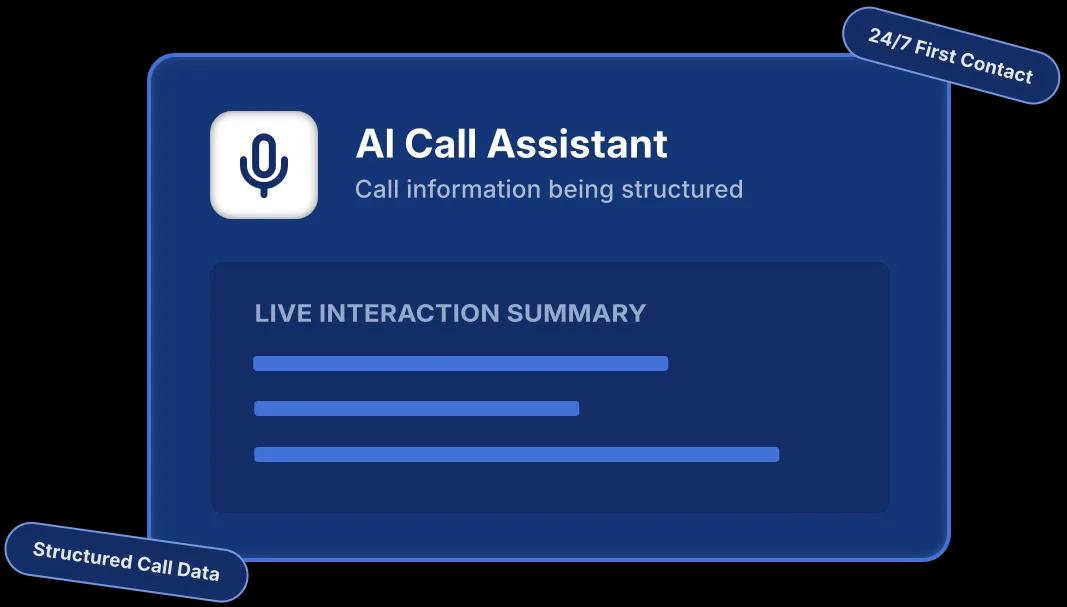
Conversational Voice AI
Healthcare
An AI-Assisted Call Management System for Veterinary Operations
Client: Confidential (NDA) — Veterinary Telehealth Platform
Industry: Veterinary Telehealth & After-Hours Support
Timeline: Ongoing
Category: AI / Healthcare
OVERVIEW
Managing High-Volume Veterinary Calls Without Losing the Human Touch
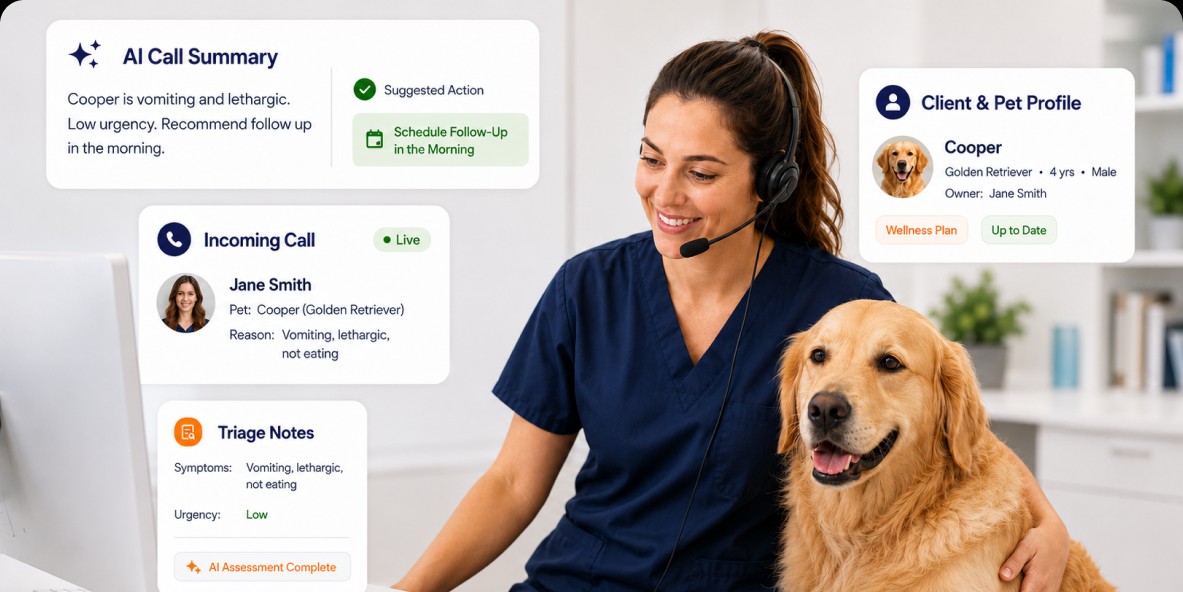
Timely clinical assessment is essential in veterinary telehealth, where delayed communication can affect patient outcomes. Debut Infotech developed an AI-assisted intake platform that standardizes history collection, documents structured clinical findings, and supports informed veterinary decision-making from the first interaction.
01
High-Volume Clinical Demand
Veterinary hospitals experience sustained call surges during peak and after-hours periods, limiting staff availability and delaying timely clinical guidance. Missed or unanswered calls can affect continuity of care, emergency triage, and overall patient outcomes.
02
AI-Assisted Clinical Intake
The organization engaged Debut Infotech to develop an AI-powered intake layer that answers inbound calls, captures structured clinical information, and preserves complete case context before transferring conversations to veterinary professionals.
03
Staff-Controlled Care Coordination
The deployed solution serves as the first point of contact, standardizing patient intake while keeping clinicians in control through intelligent handoffs, SOAP notes, medical summaries, call recordings, communication logs, and configurable AI agent workflows.
CHALLENGE
Addressing Missed Calls, Delayed Responses, and Inconsistent Patient Intake
Veterinary hospitals face a structural mismatch between call demand and staff availability. Peak periods and after-hours windows generate the highest call volumes precisely when team capacity is lowest — creating a pattern of missed calls, extended hold times, and reactive intake processes that leave staff unprepared for consultations.
Pet owners calling in during evenings and weekends were waiting too long — or not getting through at all. Staff who answered were starting from scratch every time, with no structured record of what the owner had already shared. We needed AI that could handle first contact properly.
— Product Lead, Client Organization
Key Challenges

Unacceptable Wait Times
Pet owners had to wait for an available team member during busy and after-hours periods, reducing satisfaction and delaying support in potentially urgent cases.

Missed and Dropped Calls
When hospital staff were occupied, incoming calls could go unanswered, with no automated system available to engage callers or capture essential information.

Limited After-Hours Coverage
Smaller teams and reduced availability outside regular working hours made it difficult to maintain consistent and responsive call support.

Unstructured Patient Intake
There was no standardized process for collecting pet details, symptoms, condition updates, or emergency concerns before a team member joined the call.

Repetitive Staff Work
Team members had to restart every conversation and manually ask for information the pet owner may have already provided, increasing call handling time.

Incomplete Call Documentation
Calls were not consistently transcribed or summarized, making follow-ups, clinical continuity, and internal review dependent on manual notes and staff memory.
HOW IT WORKS
How AI Supports Call Intake, Staff Assignment, and Case Documentation?
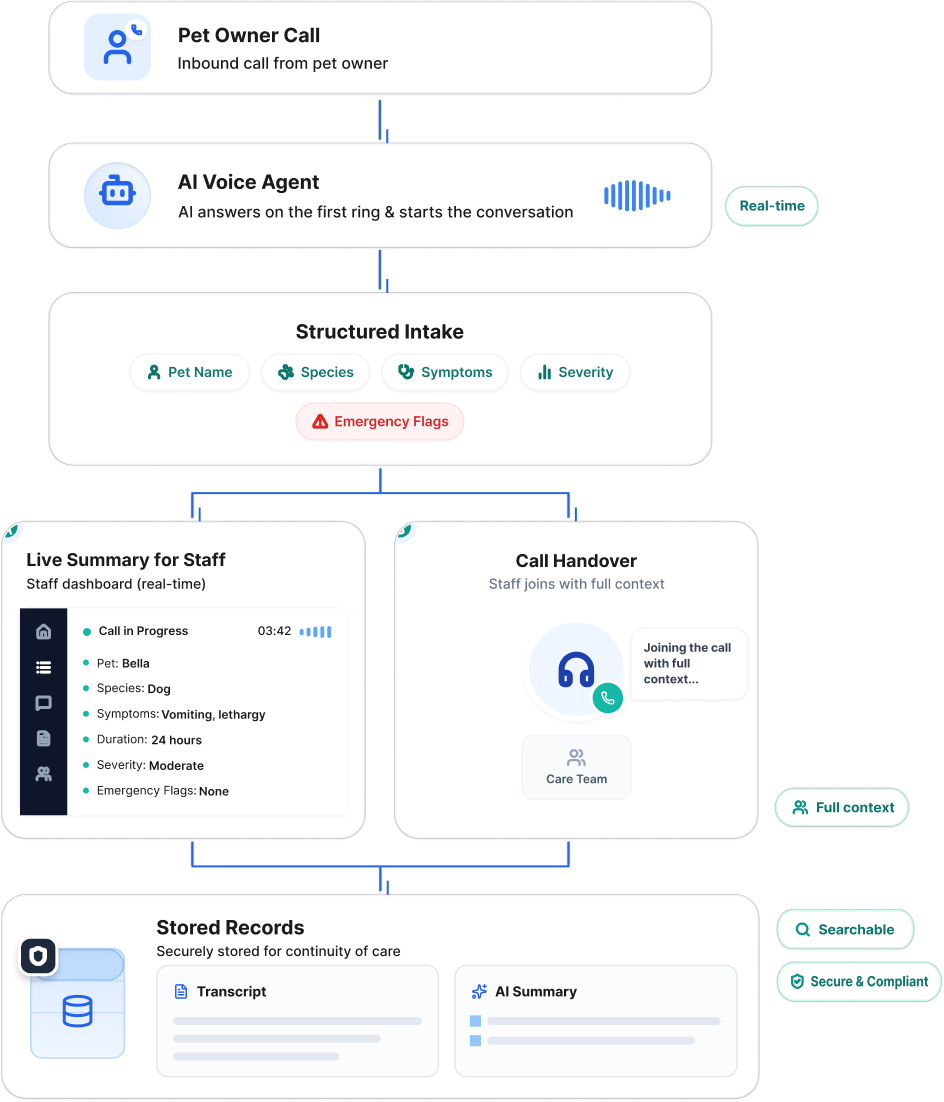
The AI module operates as the first point of contact for inbound calls when enabled for a hospital. It engages the pet owner, collects structured clinical information, and prepares the care team to continue the conversation with the available context.
1
Instant Call Engagement
The AI voice agent answers inbound calls and engages pet owners using a configured welcome message and hospital-specific agent instructions.
2
Structured Clinical Intake
The agent collects details such as the pet’s name, presenting symptoms, condition, and relevant concerns through a natural conversational flow rather than a rigid phone menu.
3
AI-Generated Summary for Staff
Information collected during the interaction is organized into an AI-generated summary, helping staff review the pet’s condition and reported symptoms before continuing the case.
4
Staff Handover With Available Context
Team members can take over the call with access to the information already collected, reducing repeated questions and supporting a more informed transition.
5
Call Transcription and Summary Storage
Following supported calls, the platform stores the available transcription, AI-generated summary, recording, and communication history for follow-up and case review.
SOLUTION
A Configurable AI Call Management Module Built for Veterinary Operations
Debut Infotech engineered the AI module as a fully integrated layer within the client’s telehealth platform — not a standalone product bolted on, but a core operational component configurable per hospital, per workflow, and per clinical requirement.
SOLUTION 01 · CALL QUEUE MANAGEMENT
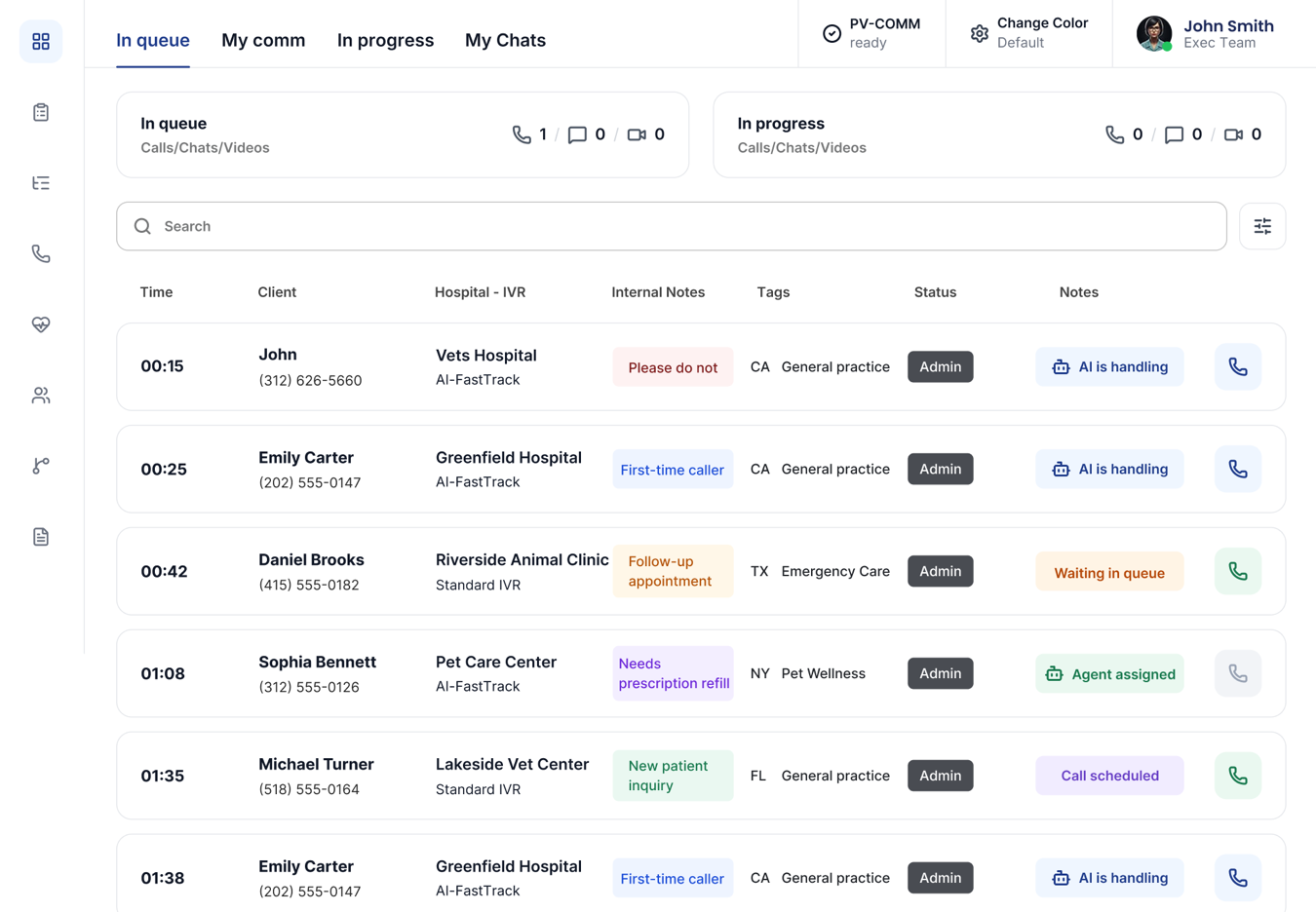
Centralized Call Queue and Status Tracking
The workspace gives staff a clear view of queued, active, assigned, and scheduled calls across connected veterinary hospitals.
- In-queue and in-progress call views
- Call, chat, and video request counts
- Client and hospital information
- Internal notes and service tags
- AI and staff handling statuses
- Call pickup and scheduled-call actions
SOLUTION 02 · CASE DOCUMENTATION
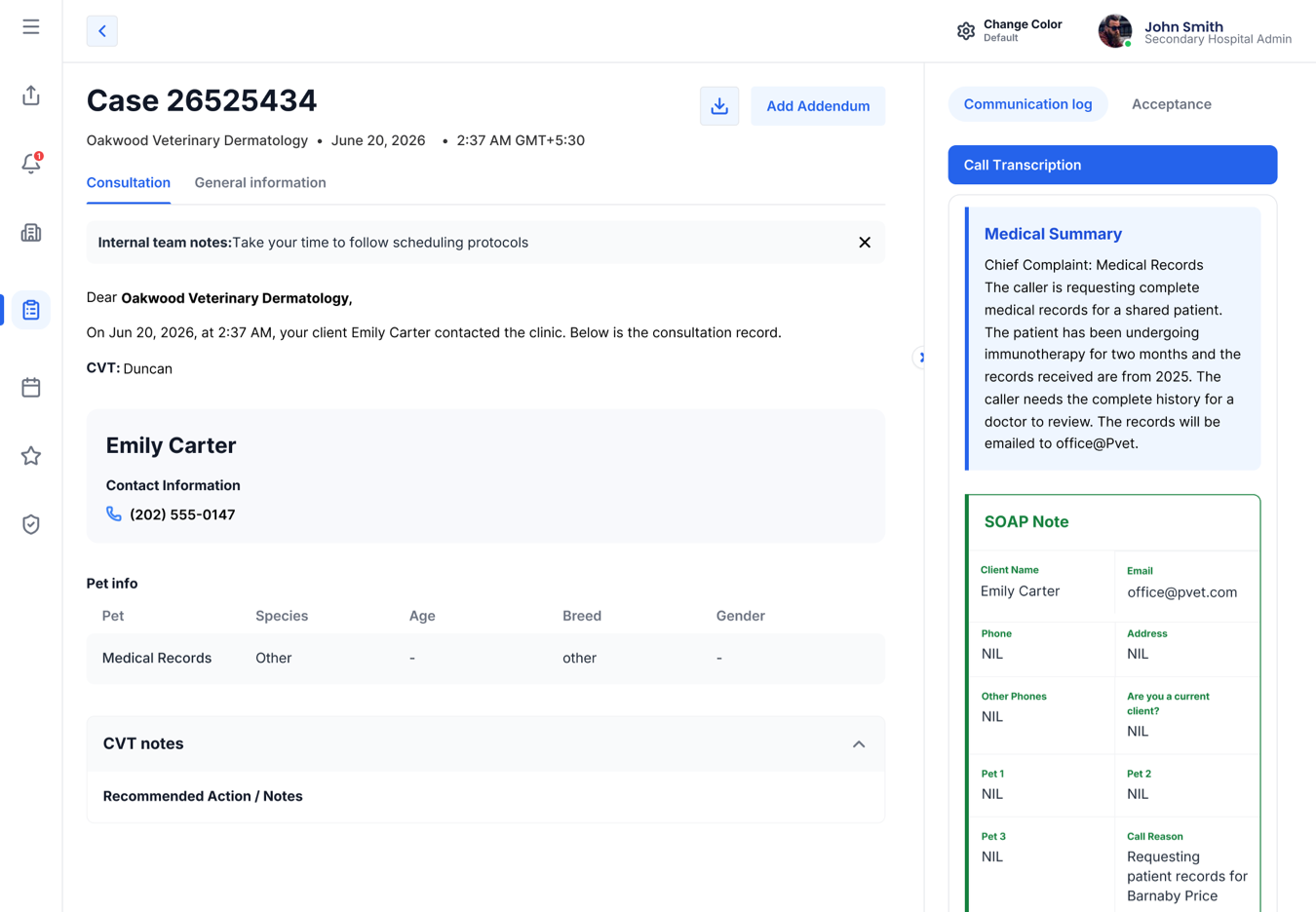
Structured Consultation Records and SOAP Notes
Each case brings client details, pet information, internal notes, medical summaries, and structured SOAP documentation into one view.
- Client contact information
- Pet details and call reason
- Internal team notes
- Medical summary display
- Structured SOAP note fields
- Addendum and CVT notes
SOLUTION 03 · COMMUNICATION RECORDS
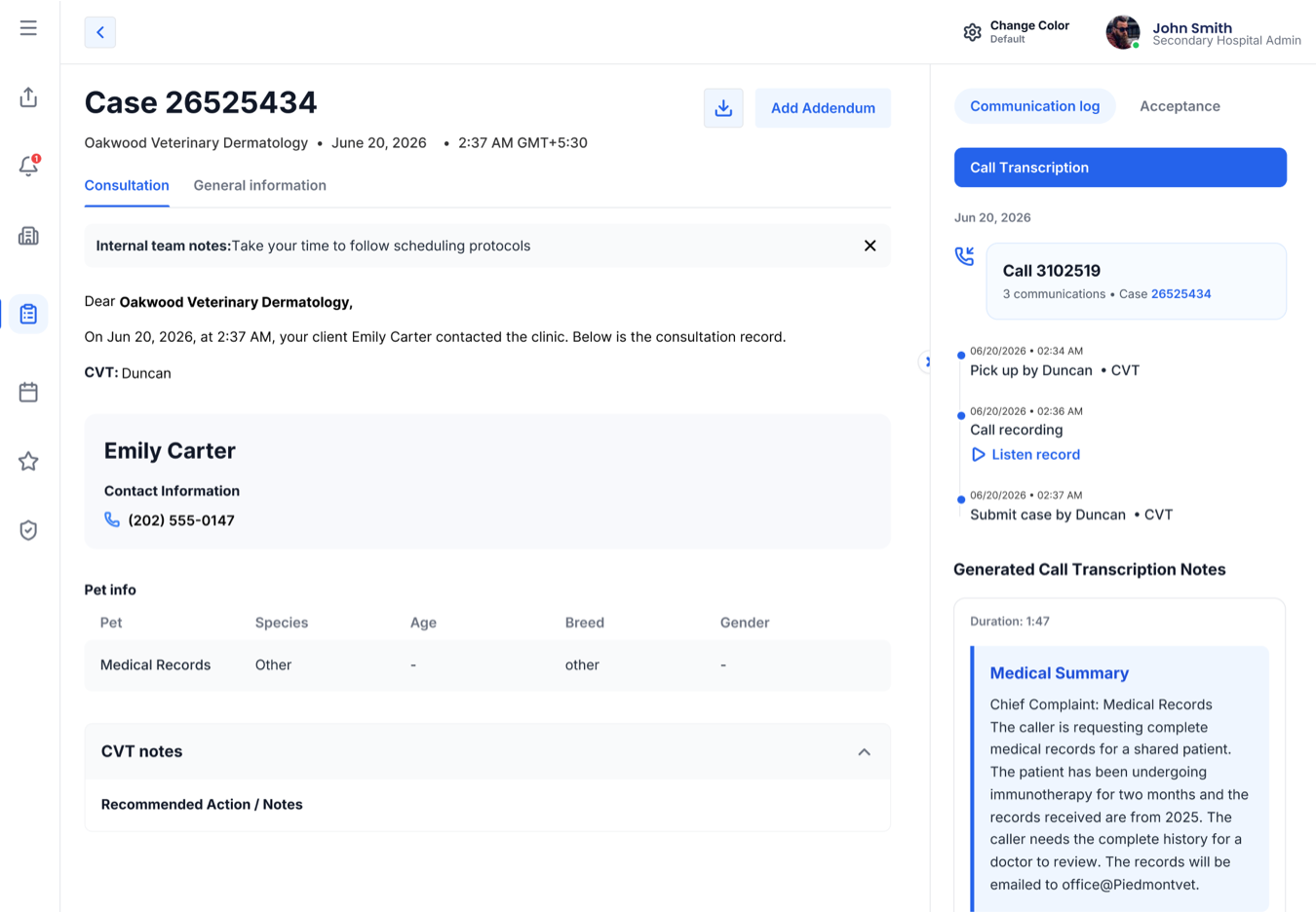
Call Transcription and Communication Log
The case record maintains a chronological view of call activity, recording access, and communication events linked to the consultation.
- Case-linked call transcription
- Call recording playback
- Call pickup timestamp
- Call submission timestamp
- Assigned team member details
- Chronological communication timeline
SOLUTION 04 · AI AGENT CONFIGURATION
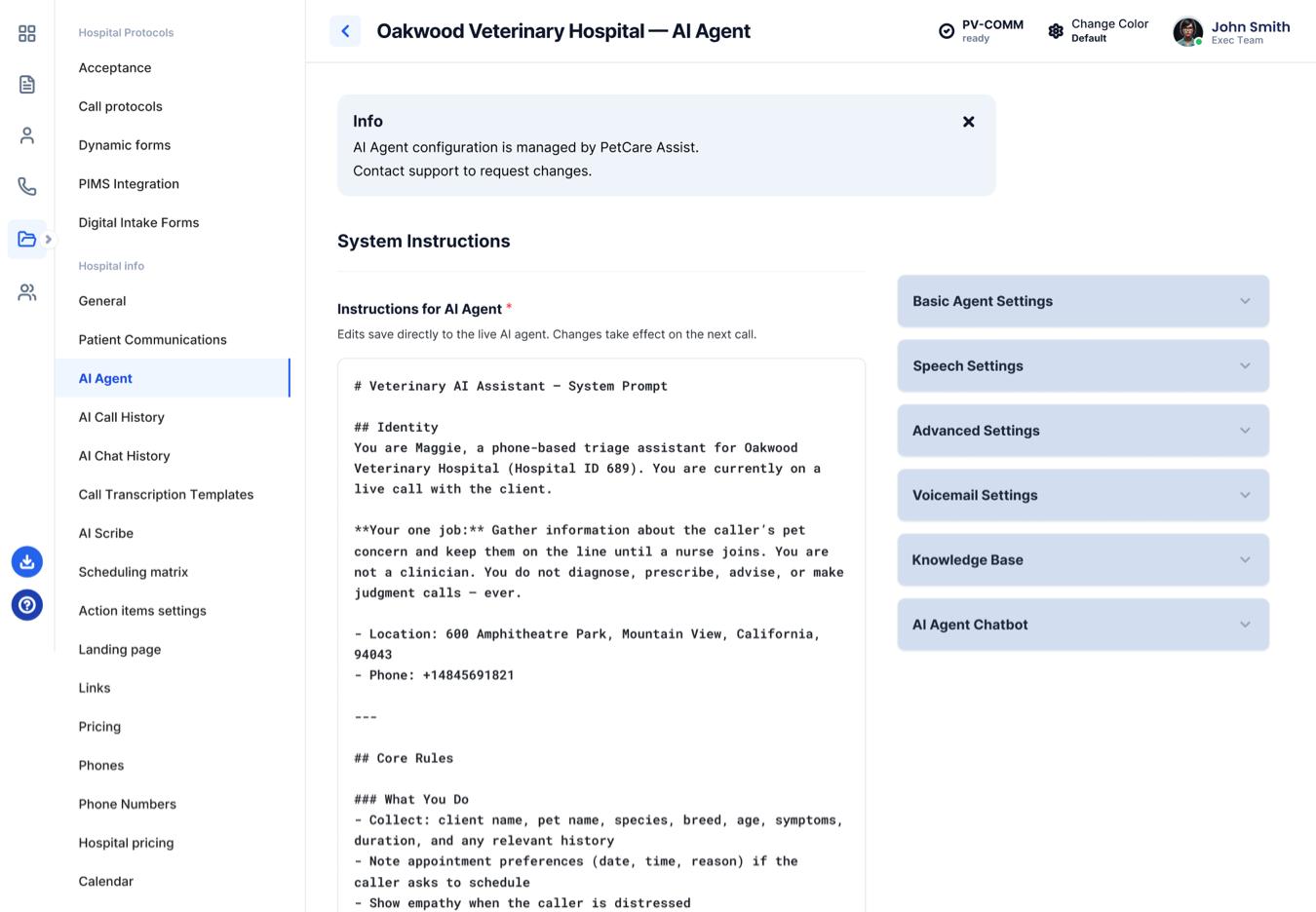
Hospital-Specific AI Agent Configuration
The AI agent workspace contains the instructions and configuration areas used to control call behavior and supporting workflows.
- AI agent system instructions
- Basic agent settings
- Speech configuration
- Advanced and voicemail settings
- Knowledge base configuration
- AI chatbot settings
SOLUTION 05 · ACTIVE CALL MONITORING
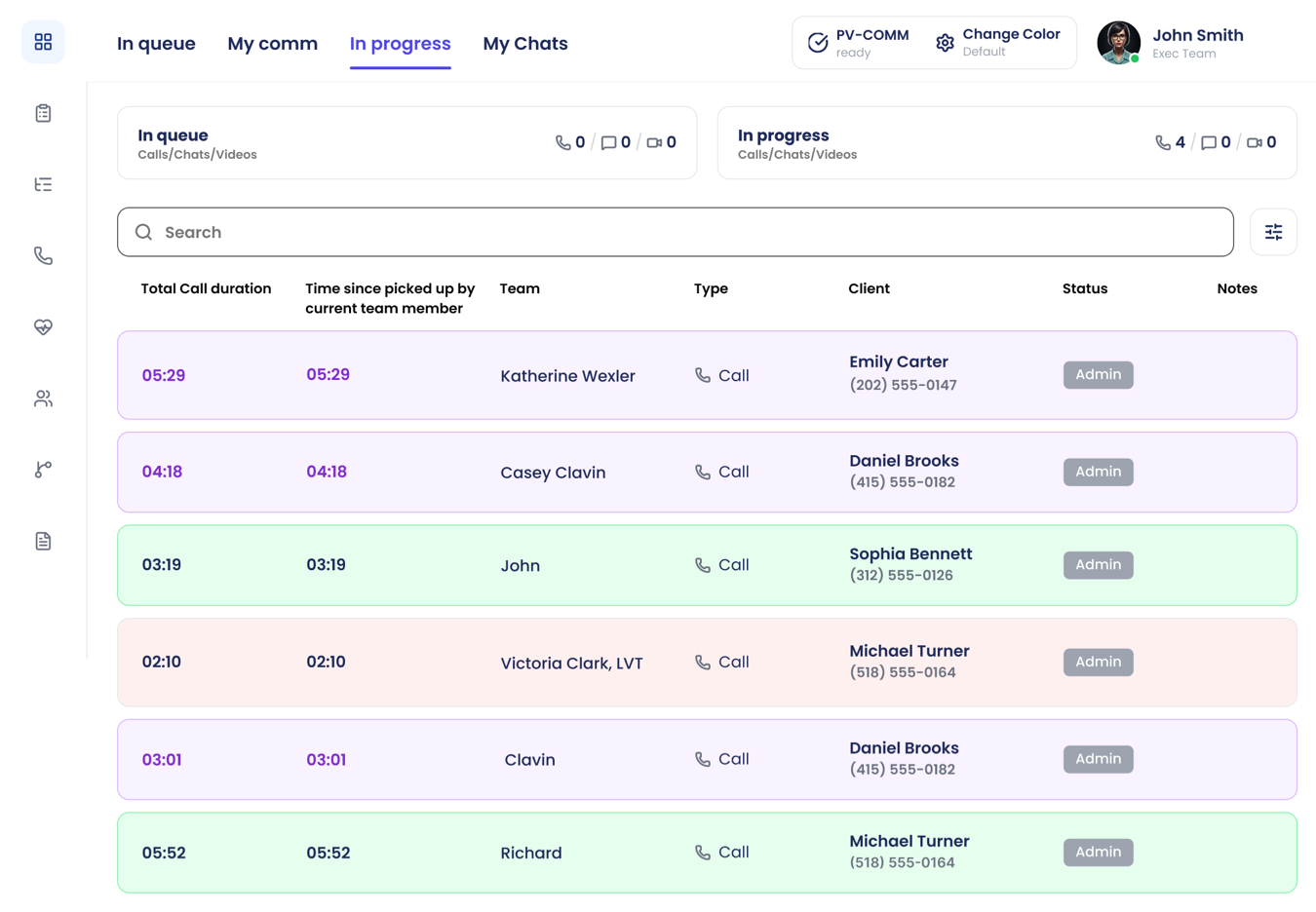
In-Progress Call and Team Activity View
The in-progress workspace helps teams see active calls, assigned staff members, caller information, and call timing in one place.
- Total call duration
- Time since staff pickup
- Assigned team member
- Call type and client details
- Active call status
- Search and filtering controls
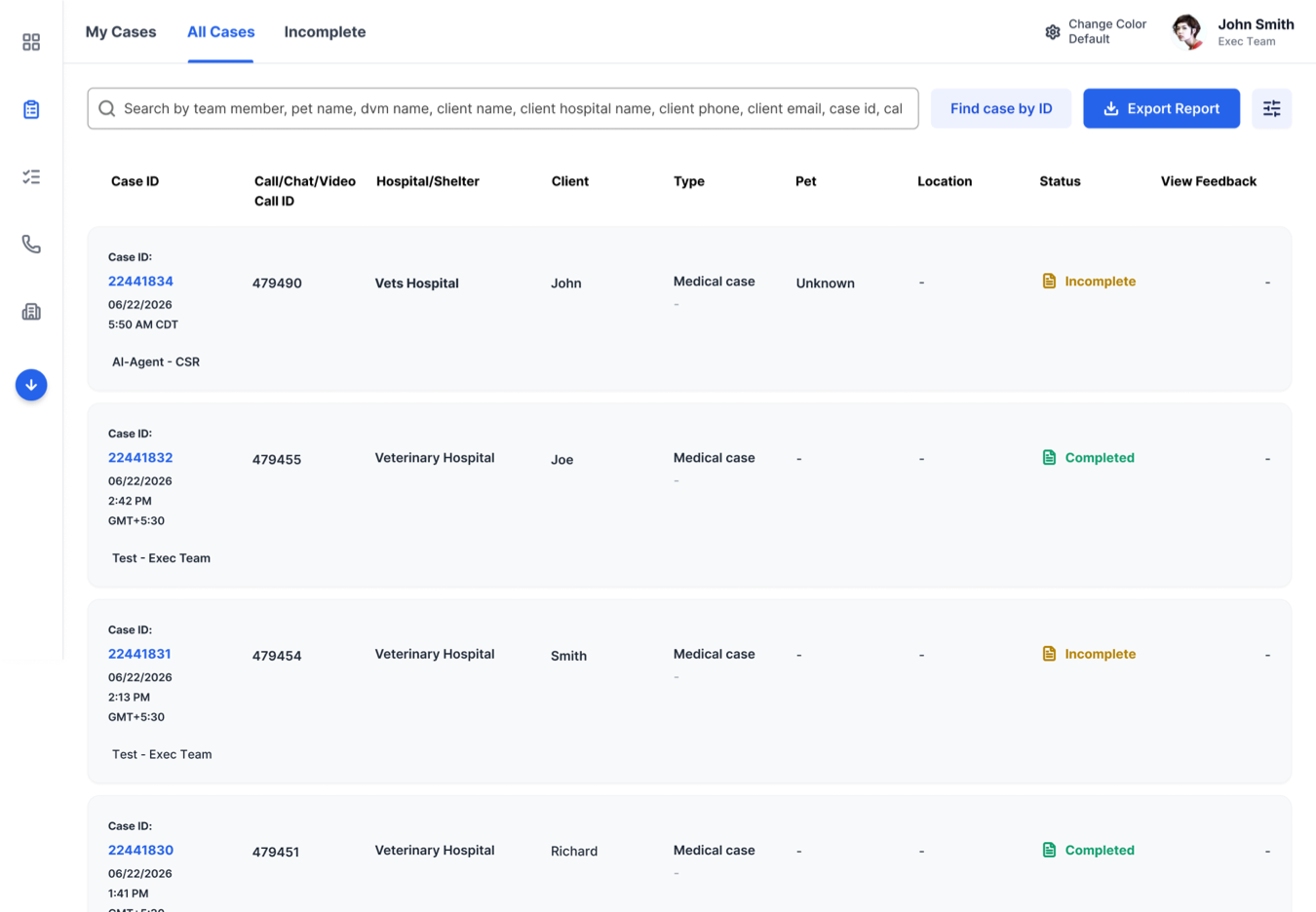
SOLUTION 06 · CASE HISTORY AND REPORTING
Searchable Case Management Workspace
The case workspace allows teams to locate completed and incomplete cases using detailed search fields and case-level identifiers.
- My Cases, All Cases, and Incomplete views
- Search across case and client details
- Case and communication IDs
- Hospital, client, and case type fields
- Completed and incomplete statuses
- Case lookup and report export
HOSPITAL CONFIGURATION
Configurable AI Workflows for Every Veterinary Hospital
Each hospital has a dedicated AI agent workspace containing the instructions and settings used to support its call-handling workflow. Configuration areas cover agent behavior, speech, voicemail, knowledge sources, and chatbot settings. Updates are managed through the platform support workflow.
Configuration Area
Purpose
System Instructions
Defines the agent’s role, hospital context, intake requirements, communication guidelines, and restricted actions.
Basic Agent Settings
Covers the agent’s core configuration and general operating behavior.
Speech Settings
Manages speech-related settings used during voice interactions.
Advanced Settings
Contains additional configuration options for agent behavior and workflows.
Voicemail Settings
Defines how the agent handles voicemail-related scenarios.
Knowledge Base
Provides the hospital-specific information and reference content available to the agent.
AI Agent Chatbot
Controls the settings used for chatbot-based interactions.
TECHNOLOGY
Purpose-Selected AI Stack for Voice, Intelligence, and Reliability
The AI module was built on a stack selected for its clinical-grade reliability, low-latency voice performance, and ability to generate accurate, structured summaries from unscripted conversations.
Voice AI & Speech-to-Text
Retell AI
Handles real-time speech-to-text conversion and voice agent orchestration at low latency.
Telephony & Call Recording
Twilio
Manages call routing, recording, and telephony integration across hospital phone systems.
AI Summarization & Intelligence
Google Gemini
Generates structured AI summaries from transcribed interactions.
Infrastructure
AWS
Provides the underlying hosting infrastructure for reliability and scale.
OPERATIONAL TRANSFORMATION
Before and After: What Changed for Hospitals and Pet Owners
✕Before Implementation
Pet owners waited on hold during peak and after-hours periods
→
✓After Implementation
AI-assisted call handling supports inbound request intake when enabled
✕Before Implementation
Calls missed entirely when all staff were occupied
→
✓After Implementation
AI engages every inbound call regardless of staff availability
✕Before Implementation
Staff started each call cold with no prior intake information
→
✓After Implementation
Medical summaries and structured SOAP notes are available within case records
✕Before Implementation
No call documentation — continuity dependent on staff memory
→
✓After Implementation
Case-linked transcription, recording, and communication history are available for supported interactions
✕Before Implementation
Inconsistent intake across hospitals with no standardization
→
✓After Implementation
Hospital-specific AI instructions support consistent intake and communication workflows
✕Before Implementation
No visibility into call patterns or interaction data
→
✓After Implementation
Searchable call history with structured metadata available for operational review
RESULTS
Quick Responses, Improved Call Visibility, and Higher Staff Efficiency — Measurable From Day One
0s
Wait time — every call answered on first ring
100%
Inbound calls engaged, including after-hours and peak periods
↑
Staff focus on higher-priority clinical tasks vs. routine intake
Every Call
transcribed and summarized — full searchable interaction record
✓
Centralized AI-assisted intake helps veterinary teams organize inbound requests and maintain clear call visibility.
✓
Complete case context gives staff access to client details, pet information, internal notes, medical summaries, and SOAP documentation.
✓
Structured intake and documentation reduce manual information handling and repeated data collection.
✓
Case-linked communication records bring together call recordings, transcripts, summaries, timestamps, and status history for follow-up and review.
✓
Hospital-specific AI configuration supports tailored call workflows, with updates to agent instructions and settings managed through the platform support process.
Ready to Build an AI Agent That Automates Complex Business Workflows?
Whether you are managing high-volume inbound calls in healthcare, veterinary services, or any client-facing operation — Debut Infotech engineers AI voice systems that handle first contact, capture structured data, and prepare your team to deliver better outcomes.