
Table of Contents
Our Global Presence :


How to Reduce Hiring Risk When Hiring Developers: Proven Strategies for Confident Hiring

by

February 27, 2026

by
February 27, 2026
Hiring developers is never only about a vacancy. It is trusting a person with your product, your deadlines and even your business development. That is why a lot of teams are concerned about the question of how to reduce hiring risk prior to making a commitment that is impossible to revoke.
In tech, the stakes are high. Developers switch jobs frequently, the skills on paper might look good, but fail in practice, and hiring decisions are often made in a hurry to meet some deadline. In cases where validation has been replaced by speed, expensive errors are likely to be experienced.
The point is plain and straightforward: the risk of hiring will never go away but it does not have to dominate your results. By having the right structure, ability verification, and flexible hiring model, you can significantly reduce the probability of a bad hire with a speedy process.
This guide helps you work through experience-proven methods of mitigating hiring risk in hiring developers, to build with confidence, rather than crossing your fingers once they are on board.
Why Hiring Developers Is Riskier Than Most Roles
To hire a developer is not only getting someone to fill a post. You are putting your product, and your schedules in the hands of someone, and in many cases, your business development. This is why tech hiring is more likely to be a risky experience than most other positions.
Here’s where the risk usually comes from:
Technical skills are hard to verify
Interviews do not necessarily reflect the manner in which one writes code, solves problems, or copes with a real-world problem. A developer may have a clear explanation of concepts and fail when it is time to build.
Tech changes faster than résumés
Tools, frameworks, and best practices develop fast. What seemed to be a relevant experience a year ago might not entirely meet the requirements of your project today.
Overconfidence is common
In competitive markets, resumé inflation occurs. Not all senior developers come with senior-level performance to the table. An effective discussion does not necessarily lead to clean code, usable schedules, and sustainable systems.
Why this matters:
The hiring of developers is more risky since technical skill, problem-solving and daily execution is hard to verify at the start itself. This is precisely the reason why minimizing the risk of hiring needs more than interviews, it needs structure, testing, and intelligent hiring models.
What Does a Bad Developer Hire Really Cost Beyond Salary?
A bad developer hire rarely feels expensive on day one.
But over time, the real cost adds up in ways most teams don’t expect.
Here’s where the damage usually shows up:
- Delayed product launches
Missed deadlines push releases back and slow business momentum.
- Rewrites and technical debt
Poor-quality code often needs to be fixed or rebuilt, draining time and resources.
- Team morale takes a hit
Other developers are pulled in to clean up issues, leading to frustration and burnout.
- Lost opportunities
While your team is fixing mistakes, competitors move faster and market windows close.
These expenses do not sprout up in a salary sheet but they are a reality.
This explains why the companies whose main concern is to minimize the risk of hiring tend to hire dedicated remote developers based on the vetted or trial-based models. This method enables teams to test skills, communication and delivery early before a long term commitment develops more significant issues.
When you factor in delays, rework, and lost momentum, replacing a failed developer can easily cost far more than their annual compensation.
Turn hiring risk into your greatest asset.
Build your team with our proven, vetted talent to drive growth with confidence.
What Steps Help Minimize Hiring Risk During the Recruitment Process?
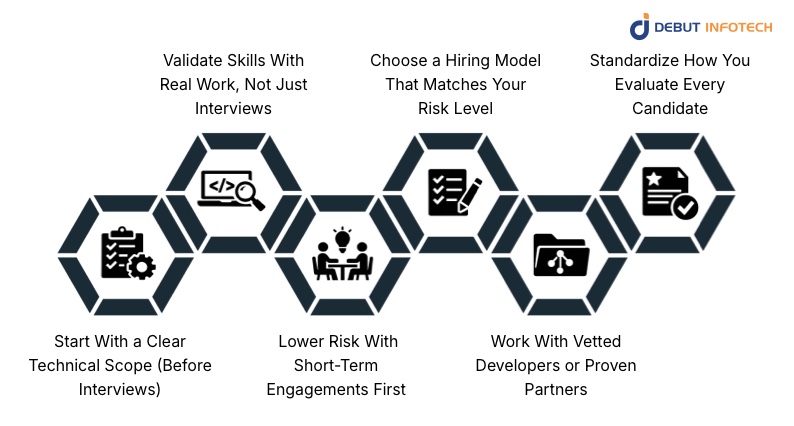
Minimizing hiring risk does not imply halting all processes and imposing endless rounds of interviews.
It entails being purposeful, knowing what you require, being realistic in assessing talent and being flexible enough to make changes before errors become costly.
Let’s break it down.
1. Start With a Clear Technical Scope (Before Interviews)
Prior to speaking with any candidates get particular regarding the work, not merely the job title.
Most teams claim that they require a developer, but are unable to answer the question of what exactly is to be built by the developer. That’s where risk begins.
Focus on defining:
- The features or systems the developer will work on
- The tools, frameworks, and technologies involved
- What success looks like in the first 30–90 days
- What’s a must-have versus what’s optional
When expectations are documented upfront, hiring becomes far less risky.
This is also why companies evaluating web development services tend to get better results, scope comes before resumes.
2. Validate Skills With Real Work, Not Just Interviews
Interviews are helpful, but not sufficient.
One may be able to give explanations in a confident manner and fail miserably when it comes to delivery.
- Paid trial tasks that mirror actual work
- Short take-home assignments tied to real problems
- Pair programming sessions to observe thinking and collaboration
- Reviewing real code from previous projects or repositories
The safest way to assess a developer is simple: watch them solve real problems instead of relying on theoretical answers.
3. Lower Risk With Short-Term Engagements First
Not every hire needs to be permanent from day one.
Many teams reduce hiring risk by starting small and scaling trust over time.
Common low-risk approaches include:
- Contract-to-hire arrangements
- Freelance trial periods
- Project-based onboarding
4. Choose a Hiring Model That Matches Your Risk Level
Full-time employment is not necessarily the safest choice.
Various hiring models are associated with different degrees of risk, but the wrong selection can slow the progress or even raise costs.
| Hiring Model | Hiring Risk Level | Best Used When |
| In-house (Full-time) Developers | High upfront | You’re building a long-term core product and have a stable roadmap and budget |
| Remote Developers | Medium–High | You need specialized skills but can manage communication, onboarding, and oversight |
| Contract Developers | Medium | Workloads are uncertain or time-bound and you want flexibility before committing |
| Staff Augmentation | Medium–Low | You need to scale your team quickly while keeping technical control in-house |
| Outsourcing / Development Partners | Lower | Speed, accountability, and predictable delivery matter more than direct management |
Why this matters:
The goal isn’t to choose what’s popular, it’s to choose what fits your timeline, budget, and risk tolerance.
5. Work With Vetted Developers or Proven Partners
Risk drops significantly when vetting is handled properly.
Look for developers or partners that provide:
- Structured technical screening
- Internal QA and peer review processes
- References and documented case studies
- Clear replacement or escalation policies
In the case of systematic vetting, you are not depending on luck, but rather you are depending on the process.
6. Standardize How You Evaluate Every Candidate
Lack of consistency in evaluation raises risk of hiring.
When each interviewer applies various criteria, the decisions will be subjective and unreliable.
To improve consistency:
- Score all candidates with the same scoring rubric.
- Assess technical skills and communication skills.
- Document feedback instead of relying on memory
Formal recruitment methods minimize favoritism, enhance transparency, and result in sound decisions in the long run.
Read more – Benefits of Hiring a Dedicated Development Team from Debut Infotech
What Are the Common Hiring Mistakes That Increase Developer Risk?
When deciding how to minimize the risk of hiring, it is often useful to begin by identifying the errors that sneakily raise the risk. These problems are typically not born out of ill will, they are born out of pressure, time and lack of clarity in processes.
Hiring too fast to meet deadlines
Making hiring decisions in a hurry is common when delivery timelines are involved. Teams only bypass additional assessments to put someone in the seat. Although this could be a short term solution, it tends to cause bigger problems in the future, such as missed expectations, rework or early exit.
Choosing cost over capability
It may seem like a safe financial decision when hiring the cheapest option, but it is not the safest most of the time. The low initial cost tends to result in slow delivery, poor code quality and increased time on troubleshooting. This is particularly unsafe in the case of creating a dedicated software development team when long-term reliability is more important, and short-term savings are of less value.
Skipping real technical validation
Interviews alone don’t show how a developer actually works. In the absence of practical work, code inspection, or field-problem solving, hiring is just a guesswork and guesswork is dangerous.
Overlooking communication and cultural fit
Good technical competence will not make up for the lack of good communication. Developers have to cooperate, justify their decisions and adjust to your operations. When this fit is neglected, friction accumulates silently and the chances of hiring risk increase as time goes by.
Elimination of these typical pitfalls will not make hiring risk free, however, it will help minimize the risk of making an expensive mis-hire.
Read more: How to Hire Web Developers: A Detailed Guide
How Different Companies Reduce Developer Hiring Risk
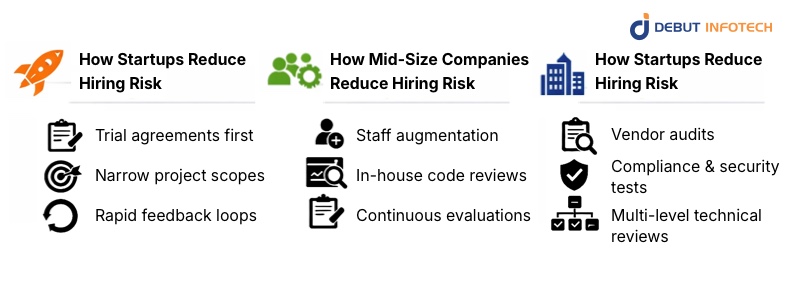
Not every company experiences similar hiring problems. The manner of mitigating the risk of hiring is very dependent on your size, speed, and in-house technical maturity. Established tech companies hiring developers at various levels have been taught that risk cannot be removed, it has to be handled by structure and flexibility.
How Startups Reduce Hiring Risk
Startups operate quickly, yet they cannot afford expensive hiring errors. To stay agile, they often:
- Begin with trial agreements rather than long-term agreements.
- Keep project scopes narrow to test real-world problem-solving
- Identify problems at an early stage with the help of rapid feedback loops.
This can enable startups to know how a given developer works before getting the relationship scaled up.
How Mid-Size Companies Reduce Hiring Risk
Growing teams need balance—speed without losing quality. Most mid-size firms mitigate risk by:
- Staff augmentation to close skill gaps fast.
- Dependence on in-house technology results in inspection code and justify judgments.
By having such an arrangement, new developers are encouraged and tested at every stage, not just during the interview phase.
How Enterprises Reduce Hiring Risk
Big organizations are concerned with continuity, stability, and durability. Their risk minimization plans tend to involve:
- Vendor audits to assess reliability and delivery standards
- Pre-onboarding compliance and security tests.
- Multi-level technical reviews to guarantee quality at all levels.
Although this is slower, it will greatly minimize the possibility of expensive misalignment in the future.
Eliminate costly hiring mistakes.
Let’s discuss your project and create a risk-free talent plan tailored for you.
Final Thoughts
Minimizing hiring risk does not mean replicating an existing hiring process of another company or enforcing a strict structure that does not match your reality.
It is a question of knowing what you are doing with your business now, how quickly you have to go, how much risk you can take, and matching the appropriate amount of validation and control.
This is where a more established development partner can come in.
Debut Infotech is a top web development company that assists companies to hire dedicated developers without the conventional hazy thinking. Debut Infotech provides companies with a chance to minimize the risk of hiring as well as stay fast, quality and flexible through pre-vetted talent, structured delivery processes, and continuous technical monitoring.
Ready to hire developers without the guesswork? Get started with Debut Infotech today.
Frequently Asked Questions (FAQs)
Q. How to Hire Good Developers
Good developers are not hired without a systematic process. Focus on three main areas: technical skills, practical experience, and soft skills.
Key strategies include:
1. Specialized job boards such as LinkedIn or Toptal can be used to seek experienced personnel.
2. Carry out technical tests and code inspection to ascertain practical competencies.
3. Check portfolios to verify the quality and consistency of the work done in the past.
4. Evaluate soft skills such as communication, adaptability, and cultural fit.
Key strategies include:
1. Specialized job boards such as LinkedIn or Toptal can be used to seek experienced personnel.
2. Carry out technical tests and code inspection to ascertain practical competencies.
3. Check portfolios to verify the quality and consistency of the work done in the past.
4. Evaluate soft skills such as communication, adaptability, and cultural fit.
Q. What Are the 5 C’s of Recruitment?
The 5 C’s of recruitment is a simplistic model that assists hiring managers to assess applicants beyond the technical expertise.
They focus on five key areas:
1. Competence – Does the candidate possess the necessary skills and experience required in the job?
2. Character – Are they truthful, dependable and professional?
3. Culture Fit – Can they survive in your company’s environment and principles?
4. Communication – Are they able to communicate clearly and work within the team?
5. Chemistry (or Career Direction) -Do they get along with the team and is the position compatible with their long-term objectives?
By applying the 5 C’s, companies can recruit well-rounded employees that are capable, aligned and are likely to perform well in the long-term
They focus on five key areas:
1. Competence – Does the candidate possess the necessary skills and experience required in the job?
2. Character – Are they truthful, dependable and professional?
3. Culture Fit – Can they survive in your company’s environment and principles?
4. Communication – Are they able to communicate clearly and work within the team?
5. Chemistry (or Career Direction) -Do they get along with the team and is the position compatible with their long-term objectives?
By applying the 5 C’s, companies can recruit well-rounded employees that are capable, aligned and are likely to perform well in the long-term
Talk With Our Expert
Our Latest Insights




USA

Debut Infotech Global Services LLC
2102 Linden LN, Palatine, IL 60067
+1-708-515-4004
info@debutinfotech.com
UK

Debut Infotech Pvt Ltd
7 Pound Close, Yarnton, Oxfordshire, OX51QG
+44-770-304-0079
info@debutinfotech.com
Canada

Debut Infotech Pvt Ltd
326 Parkvale Drive, Kitchener, ON N2R1Y7
+1-708-515-4004
info@debutinfotech.com
INDIA

Debut Infotech Pvt Ltd
Sector 101-A, Plot No: I-42, IT City Rd, JLPL Industrial Area, Mohali, PB 140306
9888402396
info@debutinfotech.com
Leave a Comment