ON THIS PAGE
Progress0%





Our Global Presence :





Hire Generative AI Engineers has become a strategic priority for organizations that want to move beyond experimentation and turn artificial intelligence ideas into scalable, real-world products. Across industries, leaders are discovering that generative AI is not just another automation layer. It is a new way to design software, build digital experiences, and unlock value from data. But while the promise is enormous, execution remains complex. The difference between a working prototype and a production-grade AI product often comes down to the people building it.
We are now at a point where generative AI systems influence how applications are designed, how data flows through platforms, and how businesses interact with users. From intelligent copilots and content engines to design automation and decision support tools, generative AI models are reshaping expectations. To realize these outcomes, organizations need specialized engineers who understand both advanced AI techniques and practical software engineering. This article explores what generative AI engineers do, why they are essential, and how hiring the right talent helps organizations turn concepts into deployable, secure, and maintainable AI products.
Generative AI engineers sit at the intersection of machine learning research and production software development. Their primary responsibility is to design, build, fine-tune, and deploy systems that can generate text, images, code, audio, or structured outputs based on learned patterns.
Unlike traditional AI roles that focus on classification or prediction, Generative AI engineers work with models that create new content. This requires a deeper understanding of probabilistic modeling, training dynamics, and evaluation strategies. At the same time, they must think like software engineers—designing APIs, ensuring scalability, managing infrastructure, and maintaining system reliability.
Their work typically spans:
This blend of skills is what makes hiring generative AI engineers different from hiring general AI practitioners or conventional software developers.
Generative AI for software development represents a significant change in how applications are built. Instead of writing deterministic logic for every scenario, engineers increasingly design systems that learn patterns and generate outputs dynamically.
This shift affects software architecture in several ways:
For teams without generative AI expertise, these changes can create bottlenecks. That is why hiring generative AI engineers is critical. They help traditional engineering teams adopt new development patterns without sacrificing stability, performance, or maintainability.
A common concern across the industry is will generative AI replace software engineers altogether. In practice, the opposite is happening. Generative AI is changing what engineers work on, not eliminating the need for them.
While generative tools can automate repetitive tasks such as boilerplate code generation or documentation, they still require human oversight. Engineers are needed to:
Generative AI engineers, in particular, play a crucial role in bridging automation and accountability. Rather than replacing engineers, generative AI increases demand for professionals who can guide, supervise, and productize intelligent systems.
To turn ideas into functional products, generative AI engineers rely on a broad technology stack. Understanding these technologies helps organizations evaluate talent and set realistic expectations.
At the heart of every solution are generative AI models. These may include large language models, image generation models, or multimodal systems. Engineers must understand how these models are trained, how they generalize, and where their limitations lie.
Generative adversarial networks remain relevant for specific use cases such as image synthesis, data augmentation, and simulation. Engineers working with GANs must manage training instability and evaluation challenges, which requires deep expertise.
Popular generative AI frameworks provide the building blocks for model training, fine-tuning, and deployment. Engineers choose frameworks based on scalability needs, ecosystem support, and compatibility with enterprise systems.
Beyond models, generative AI engineers design pipelines for data ingestion, model versioning, monitoring, and retraining. These capabilities are essential for moving from experiments to reliable AI products.
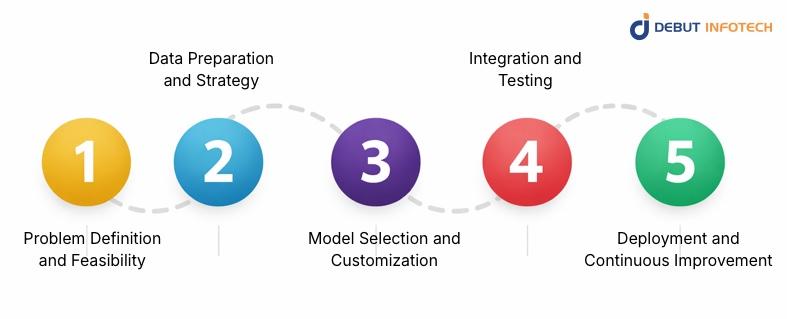
Turning a concept into a real-world AI product involves multiple stages. Hiring generative AI engineers ensures that each stage is executed with technical rigor and business alignment.
Every successful product starts with a clear problem statement. Generative AI engineers assess whether generative approaches are suitable and what data, infrastructure, and timelines are required.
High-quality data remains a cornerstone of effective generative systems. Engineers work closely with data teams, including specialists in the Generative AI for Data Engineers specialization, to prepare datasets that support training and evaluation.
Rather than building everything from scratch, engineers often adapt existing models. Fine-tuning, prompt optimization, and parameter-efficient techniques help align models with specific use cases.
This stage focuses on embedding models into applications. Engineers design APIs, manage latency, and conduct rigorous testing to ensure outputs meet quality standards.
Once deployed, generative AI systems require monitoring and iteration. Engineers track performance, user feedback, and drift, updating models as requirements evolve.
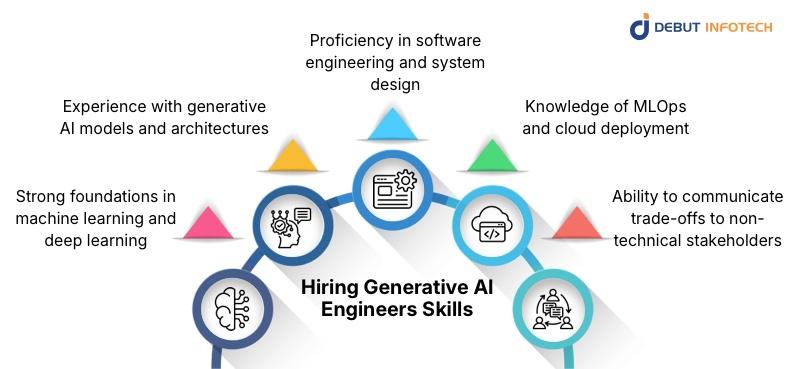
Hiring generative AI engineers requires looking beyond resumes and certifications. The most effective professionals combine technical depth with product thinking.
Key skills include:
Organizations that hire best generative AI engineers consistently prioritize adaptability, systems thinking, and problem-solving ability over familiarity with specific tools. This mindset ensures AI solutions remain effective as technologies, models, and business requirements continue to evolve.
Top generative AI engineers rarely work in isolation. They are part of cross-functional teams that include product managers, designers, data engineers, and platform specialists.
Common team structures include:
Choosing the right structure depends on organizational maturity and AI adoption goals.
For many organizations, the primary challenge is not building generative AI models but integrating them into complex, existing ecosystems. Most enterprises already rely on multiple platforms, legacy applications, data sources, and security frameworks. Generative AI Integration Services focus on making AI capabilities work seamlessly within these environments rather than operating as isolated tools.
Generative AI engineers lead integration efforts by designing secure and flexible integration layers that allow AI systems to interact with internal APIs, databases, and third-party services. They also manage data access and governance, ensuring that models only use approved data sources and that sensitive information is protected throughout the AI workflow. This is particularly important in regulated industries where data handling standards are strict.
Another critical responsibility is ensuring compliance with internal policies and external regulations. Generative AI engineers implement safeguards such as access controls, audit logs, and usage monitoring to support transparency and accountability. At the same time, they optimize performance across different environments, balancing response times, infrastructure costs, and scalability as usage grows.
This integration-focused work often distinguishes experimental prototypes from production-ready generative AI solutions. Without proper integration, even advanced models struggle to deliver consistent value at scale.
As demand grows, many organizations collaborate with generative AI development companies to accelerate delivery. A reliable generative AI development company provides access to experienced engineers, proven frameworks, and established processes.
When evaluating partners, organizations should assess:
The goal is not just faster delivery but sustainable AI capabilities.
In addition to engineers, generative AI consultants help organizations align technology with strategy. They translate business goals into technical roadmaps and guide decision-making around investment, risk, and governance.
Consultants often work alongside engineering teams to:
This collaboration ensures that technical execution supports broader business objectives.
Understanding generative AI trends helps organizations plan their hiring strategies. Current trends include:
Hiring generative AI engineers who are aware of these trends ensures that solutions remain relevant as the technology evolves.
As generative AI initiatives expand, organizations need scalable AI development services. This requires engineers who can standardize processes, document systems, and mentor teams.
Scalability depends on:
Hiring generative AI engineers with leadership potential supports long-term growth.
Beyond technical execution, hiring generative AI engineers delivers measurable business benefits. These include faster product development, improved user experiences, and new revenue opportunities.
Well-designed generative systems can:
By investing in the right talent, organizations position themselves to innovate responsibly and competitively.
As organizations navigate this evolving landscape, working with experienced partners becomes increasingly valuable. Debut Infotech supports enterprises by providing access to skilled generative AI engineers who understand both advanced AI techniques and real-world product development. Through tailored engagement models, we help organizations build, integrate, and scale generative AI solutions aligned with their business goals.
Our approach emphasizes collaboration, transparency, and long-term value creation. By combining technical expertise with a deep understanding of enterprise needs, we enable teams to move from experimentation to production with confidence.
Hiring generative AI engineers is no longer a niche decision reserved for research-driven organizations. It is a strategic investment for any business looking to transform ideas into intelligent, scalable products. From understanding generative AI models and frameworks to integrating systems securely and efficiently, these engineers play a central role in modern software development. They ensure that generative AI enhances human capability rather than replacing it, driving innovation while maintaining accountability.
As adoption accelerates, partnering with experienced teams becomes essential. Debut Infotech continues to help organizations hire generative AI engineers who can bridge the gap between concept and execution. By aligning technical excellence with business strategy, we empower enterprises to build real-world AI products that deliver lasting impact. Debut Infotech remains committed to supporting organizations at every stage of their generative AI journey, from early exploration to enterprise-scale deployment.
A. When you hire generative AI engineers, you bring in specialists who design, build, and deploy AI systems capable of generating content such as text, images, code, or structured data. Their role goes beyond experimentation and focuses on turning AI concepts into production-ready, scalable products.
A. Generative AI engineers combine advanced machine learning expertise with strong software engineering skills. While traditional software engineers focus on rule-based logic, generative AI engineers work with probabilistic models, fine-tuning, prompt design, and AI system integration within real-world applications.
A. Generative AI will not replace software engineers. Instead, it changes how software is built. Engineers are still essential for system design, quality control, security, and integration. Generative AI engineers help guide and supervise AI systems to ensure reliable and responsible outcomes.
A. Key skills include experience with generative AI models, knowledge of generative AI frameworks, strong foundations in machine learning, proficiency in software architecture, and hands-on experience with deployment and MLOps. Business understanding and communication skills are also important.
A. Timelines vary based on complexity, data availability, and integration requirements. Simple use cases may take a few weeks, while enterprise-grade generative AI products often require several months for development, testing, deployment, and optimization.
A. Yes. Generative AI engineers specialize in integration. They ensure generative AI solutions work smoothly with existing software, databases, and APIs while meeting security, performance, and compliance requirements.
A. A business should consider a generative AI development company when it lacks in-house expertise, needs faster time-to-market, or wants to scale AI initiatives efficiently. These companies provide access to experienced engineers, proven processes, and end-to-end AI development services.

Our Latest Insights
USA
2501 Chatham, Rd Suite R Springfield, IL 62704
+1-708-515-4004
info@debutinfotech.com
UK
7 Pound Close, Yarnton, Oxfordshire, OX51QG
+44-770-304-0079
info@debutinfotech.com
Canada
154 Eden Oak Trail, Kitchener, ON N2A 0H9
+1-708-515-4004
info@debutinfotech.com
INDIA
Sector 101-A, Plot No: I-42, IT City Rd, JLPL Industrial Area, Mohali, PB 140306
9888402396
info@debutinfotech.com