



How MiCA Stablecoin Regulation Is Reshaping Europe’s Crypto Ecosystem and What It Means for Businesses
Europe has taken a decisive step toward regulating digital assets through the Markets in Crypto-Assets (MiCA) regulation.
For years, businesses operating in the cryptocurrency industry faced a patchwork of national rules that created uncertainty around licensing, compliance, and consumer protection.
Stablecoins, in particular, attracted significant attention due to their growing role in payments, decentralized finance (DeFi), remittances, and cross-border commerce.
Now that MiCA stablecoin regulation is fully operational, companies now have a clearer legal framework that defines how stablecoins can be issued, managed, and offered across the European Union.
MiCA changes that landscape by introducing a single regulatory framework across the European Union. It establishes consistent standards for stablecoin issuers, crypto-asset service providers, and trading platforms while strengthening consumer safeguards and financial stability.
Businesses now have clearer expectations for launching, managing, and integrating stablecoins into their products and services. Although compliance requirements have become more demanding, the regulation also reduces legal uncertainty and creates a more predictable environment for investment and innovation.
For businesses, MiCA represents more than another compliance obligation. It marks the beginning of a more structured digital asset market where trust, transparency, and regulatory oversight play a central role.
Companies that understand the new rules and align their operations accordingly are better positioned to serve European customers, expand across member states, and build long-term credibility.
This article explains what MiCA is, why it matters for stablecoin adoption, how it is reshaping Europe’s stablecoin ecosystem, its impact on crypto exchanges, and the opportunities and compliance risks businesses should evaluate.
What is the MiCA Regulation?
The Markets in Crypto-Assets (MiCA) regulation is the European Union’s comprehensive legal framework for crypto assets that were previously outside existing financial services legislation. Its primary objective is to establish uniform rules governing the issuance, offering, trading, and custody of crypto assets across all EU member states.
By replacing fragmented national approaches with a harmonized regulatory framework, MiCA promotes consistency and reduces legal uncertainty for businesses operating across Europe.
A significant focus of MiCA is stablecoins, referred to within the regulation as Asset-Referenced Tokens (ARTs) and Electronic Money Tokens (EMTs). Asset-referenced tokens derive their value from one or more assets, such as currencies, commodities, or other crypto assets.
Electronic money tokens are linked to a single official currency, making them more suitable for digital payment applications. Issuers of both token categories must satisfy strict requirements covering authorization, reserve management, governance, disclosures, redemption rights, and operational resilience.
Beyond regulating stablecoin issuers, MiCA also establishes obligations for crypto exchanges, wallet providers, brokers, and other crypto-asset service providers. These organizations must obtain authorization, implement effective risk management practices, protect customer assets, and maintain transparent operations.
The regulation establishes a common legal framework that encourages responsible innovation, enhances market integrity, and strengthens confidence in Europe’s digital asset ecosystem.
Why is MiCA Important for Stablecoin Adoption in Europe?
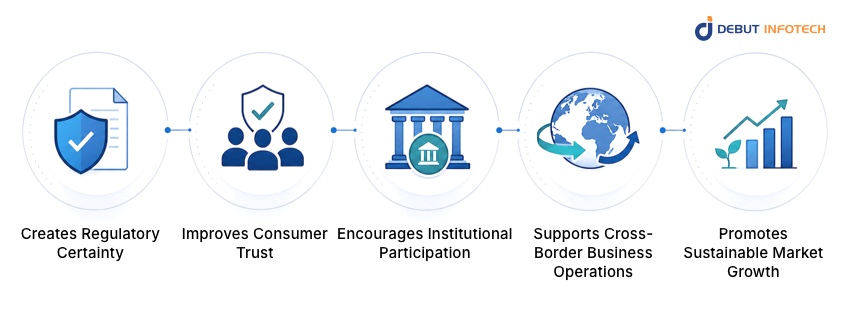
1. Creates Regulatory Certainty
Before MiCA, businesses expanding into Europe often encountered varying licensing requirements and regulatory interpretations across countries. This inconsistency complicated product launches and increased compliance costs.
MiCA replaces these fragmented rules with a unified framework, giving businesses greater confidence when developing stablecoin products and services for customers across the European Union.
2. Improves Consumer Trust
Trust remains one of the biggest barriers to widespread stablecoin adoption. MiCA addresses this challenge by requiring issuers to maintain sufficient reserves, provide transparent disclosures, and, where applicable, guarantee redemption rights.
These safeguards reduce uncertainty for users and businesses, encouraging greater confidence in regulated stablecoins for payments, settlements, and other financial activities.
3. Encourages Institutional Participation
Banks, payment providers, fintech companies, and enterprise organizations typically avoid operating in uncertain regulatory environments. MiCA provides clearer legal expectations, making stablecoins a more practical option for established financial institutions.
Increased institutional participation can improve liquidity, strengthen payment infrastructure, and support broader commercial adoption across European markets.
4. Supports Cross-Border Business Operations
One of MiCA’s most valuable benefits is regulatory harmonization across EU member states. Businesses that obtain authorization under the framework can expand into multiple European markets without having to navigate separate national crypto regulations.
This reduces operational complexity while creating new opportunities for cross-border payment services, stablecoin development, and digital financial products that comply with a single regulatory standard.
5. Promotes Sustainable Market Growth
Stablecoin markets grow more effectively when businesses and consumers operate within clear legal boundaries. MiCA establishes governance, risk management, and operational standards that discourage irresponsible market behavior while encouraging sustainable innovation.
Rather than limiting growth, the MiCA stablecoin regulation aims to create conditions where reputable businesses can compete fairly and build long-term customer confidence.
How MiCA is Reshaping Europe’s Stablecoin Ecosystem
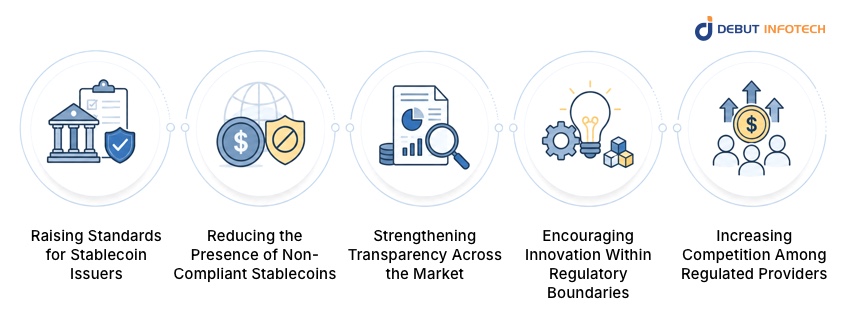
1. Raising Standards for Stablecoin Issuers
MiCA significantly increases the responsibilities placed on stablecoin issuers. Organizations must demonstrate financial stability, maintain adequate reserves, establish sound governance structures, and comply with extensive reporting obligations.
These higher standards encourage stronger operational discipline while reducing risks associated with poorly managed stablecoin projects.
2. Reducing the Presence of Non-Compliant Stablecoins
Many stablecoins previously available to European users may no longer satisfy MiCA’s regulatory requirements.
Exchanges and service providers are increasingly reviewing the supported assets they offer to ensure compliance. This transition gradually shifts market activity toward regulated stablecoins that meet European legal standards.
3. Strengthening Transparency Across the Market
MiCA requires issuers to publish detailed information regarding reserve assets, governance arrangements, redemption mechanisms, and associated risks.
Greater transparency enables businesses, investors, and consumers to make more informed decisions when selecting stablecoins for payments, treasury management, or digital asset investments.
4. Encouraging Innovation Within Regulatory Boundaries
Rather than preventing innovation, MiCA provides clearer parameters for developing compliant digital asset products.
Fintech companies, payment providers, and blockchain developers can design stablecoin-based solutions with greater confidence, knowing the regulatory expectations before launching new products in European markets.
5. Increasing Competition Among Regulated Providers
As regulatory certainty improves, more licensed businesses are expected to enter Europe’s stablecoin market.
Competition will increasingly focus on product quality, security, compliance, customer experience, and operational efficiency instead of regulatory arbitrage. This benefits businesses seeking reliable infrastructure while giving customers access to higher-quality digital financial services.
How MiCA Affects Crypto Exchanges Listing Stablecoins
Crypto exchanges operating in Europe now face greater regulatory oversight when listing stablecoins.
Instead of simply evaluating market demand and trading volume, exchanges must also determine whether the stablecoins they support comply with MiCA’s regulatory requirements. This includes verifying issuer authorization, regulatory classification, disclosure obligations, and ongoing compliance status.
Exchanges may need to delist stablecoins that fail to meet MiCA standards or restrict access to certain assets until compliance requirements are satisfied. While this may reduce the number of available stablecoins in the short term, it also lowers regulatory risk and helps create a safer trading environment for customers.
Compliance responsibilities extend beyond listing decisions. Exchanges must strengthen due diligence procedures, monitor regulatory developments, improve internal governance, and maintain appropriate customer protection measures.
Organizations that invest in robust compliance frameworks are better positioned to maintain regulatory approval as they expand their services across the European Union.
Businesses involved in crypto exchange development should incorporate these compliance checks into exchange architecture from the outset to avoid costly redesigns later.
What Are the Business Opportunities and Compliance Risks Under MiCA Stablecoin Rules?
1. Opportunity: Expansion Across the European Union
MiCA creates a unified regulatory environment that simplifies expansion across EU member states.
Businesses offering compliant stablecoin products can reach a larger customer base without navigating different national regulatory systems. This makes Europe a more attractive market for fintech companies, payment providers, and blockchain businesses seeking long-term growth.
2. Opportunity: Stronger Customer Confidence
Regulatory compliance can become a competitive advantage.
Businesses that operate under MiCA demonstrate higher standards of governance, transparency, and consumer protection. These qualities strengthen customer trust, improve brand credibility, and make partnerships with financial institutions more achievable.
3. Opportunity: Easier Access to Institutional Partnerships
Financial institutions, payment processors, and enterprise clients are more likely to work with businesses that operate within a recognized regulatory framework.
MiCA gives potential partners greater confidence that stablecoin-related services meet established legal and operational standards. This can accelerate strategic partnerships, expand distribution channels, and create new revenue opportunities across regulated financial markets.
4. Opportunity: Increased Demand for Compliance and Blockchain Services
As businesses adapt to MiCA, demand is growing for legal advisory, compliance consulting, blockchain development, smart contract auditing, custody solutions, and RegTech platforms.
Companies offering token development and related blockchain services can also benefit, as organizations increasingly seek compliant digital asset solutions that align with MiCA’s requirements while supporting secure and scalable business operations.
5. Risk: Higher Compliance Costs
Meeting MiCA requirements requires investment in legal expertise, governance frameworks, reserve management, cybersecurity, reporting systems, and regulatory monitoring.
Smaller businesses and startups may face higher operational costs as they build the infrastructure needed to meet ongoing compliance obligations.
6. Risk: Ongoing Regulatory Oversight
Compliance under MiCA is not a one-time exercise. Businesses must continuously monitor regulatory updates, maintain accurate reporting, conduct internal reviews, and adapt their operations as supervisory expectations evolve.
Organizations that treat compliance as an ongoing business function are less likely to face enforcement actions or operational disruptions.
7. Risk: Restrictions on Product Design and Market Entry
MiCA imposes detailed rules on stablecoin issuance, reserve management, governance, and disclosures, limiting how businesses can structure certain products.
Companies entering the European market may also face longer approval timelines before launching new stablecoins or related services. These requirements can delay innovation and increase the resources needed to bring products to market.
8. Risk: Penalties for Non-Compliance
Businesses that fail to meet MiCA requirements risk regulatory investigations, financial penalties, operational restrictions, or the suspension of certain services.
Non-compliance can also damage customer trust and investor confidence, making it harder to secure partnerships or expand within the European market. Maintaining strong governance and proactive compliance processes is essential to minimizing these risks.
Conclusion
MiCA stablecoin regulation represents one of the most significant regulatory developments in the global digital asset industry. By introducing consistent rules for stablecoin issuers, crypto exchanges, and service providers, it creates a more transparent and trustworthy market throughout Europe.
Although businesses face stricter compliance obligations, they also gain greater legal certainty, improved market access, and stronger consumer confidence.
Businesses planning to launch stablecoin products or expand into the European market should make regulatory readiness part of their long-term strategy. Working with an experienced blockchain software development partner such as Debut Infotech can simplify that process.
From designing compliant stablecoin solutions and integrating secure blockchain infrastructure to navigating MiCA requirements, the right technology partner helps reduce compliance risks, accelerate deployment, and support sustainable growth across the evolving European digital asset ecosystem.
Share:


