ON THIS PAGE
Progress0%






Our Global Presence :





You may have a sound app idea, a great feature list, and even a launch date in mind, but there is one question that almost always halts everything: What will the mobile app development cost be?
That question doesn’t have a simple, one-size-fits-all answer. The price of app development can be influenced by a lot of moving components, including the features that you want to add to your app and the platform that you develop on and the level of design and functionality that you require. Overlook a single detail and your budget may soon run out of course.
The good thing is that you do not have to work it out yourself. To this end, we won’t only take you through a clear, practical breakdown of mobile app development cost in this guide, but we will also clarify why exactly those numbers increase or decrease, and how to prepare your budget with certainty.
Let’s get into it.
When people ask about the cost of developing a mobile app, what they really want to know is how much they should budget. The truth is, there’s no fixed price, no two apps are exactly alike.
For a basic mobile app with limited functionality and simple design, you can expect costs between $30,000 and $80,000. These apps usually have straightforward features and minimal backend infrastructure.
As you add complexity like user accounts, third-party integrations, payment systems, or real-time updates, costs naturally increase. Mid-level apps typically range from $60,000 to $150,000, depending on the scope and technical requirements.
For large-scale or enterprise apps, especially those requiring robust security, complex infrastructure, or AI capabilities, costs can easily exceed $200,000. These projects demand extra planning, extensive testing, and scalable architecture.
It’s important to realize that mobile app costs in 2026 are driven as much by expectations as by code. Users now expect smooth performance, thoughtful design, and reliability across devices.
Your approach, whether using cross-platform tools or building custom solutions, also significantly impacts your budget.
This overview lays the groundwork for understanding where your money goes and how to plan smarter before development even begins
Related Read: How to Estimate Your Flutter App Development Cost
Cost is not often a single decision when it comes to planning a mobile app. Rather, the price of mobile app development depends on the complexity of your idea, the way it is developed, and the post-launch activity. Each of the following factors plays a direct role in determining how much you’ll need to invest.
1. App Complexity and Features
App complexity is the biggest cost determinant.
Simple apps with limited screens and static content are far cheaper to build than apps with real-time interactions, AI personalization, or advanced data processing.
| App Complexity | Typical Features | Estimated Cost Range |
| Simple | Static content, basic UI, no login | $10,000 – $25,000 |
| Medium | User accounts, APIs, dashboards | $25,000 – $60,000 |
| Complex | Real-time data, AI, geolocation | $60,000 – $150,000+ |
Key takeaway: More features = more logic, testing, databases, and edge-case handling, raising both build and maintenance costs.
2. Platform Choice: iOS, Android, or Cross-Platform
Your platform decision directly affects how much code needs to be written and maintained.
| Platform Approach | Cost Impact | Best For |
| Single platform (iOS or Android) | Lower cost | MVPs, early-stage startups |
| Native iOS + Android | Highest cost | Performance-critical apps |
| Cross-platform (Flutter/React Native) | 30–40% cost savings | Most business apps |
Decision insight: Cross-platform works well for most apps, but high-performance or hardware-intensive apps often require native development.
3. Design and User Experience (UX)
Design plays a major role in how users experience your app and it can impact development costs more than many people expect.
Simple designs that rely on standard UI components are generally more affordable. In contrast, custom interfaces, animations, and accessibility-focused UX require additional research, prototyping, and testing.
A well-designed app improves usability, reduces friction, and increases user retention. Over time, this can actually lower costs. Poor UX, however, leads to user drop-offs and often forces expensive redesigns later.
4. Development Team Location and Expertise
Hourly rates vary widely by region, but productivity matters more than price.
| Region | Avg. Hourly Rate |
| North America | $100–150/hr |
| Western Europe | $70–120/hr |
| Eastern Europe | $40–70/hr |
| Asia (India, SEA) | $25–50/hr |
Important: Experienced teams build faster, make better architectural decisions, and reduce long-term technical debt.
5. Backend Infrastructure
The backend is the engine that powers your app behind the scenes, and it’s a critical factor in cost estimation.
Apps that support user accounts, real-time updates, data storage, or admin dashboards need a robust backend system. Designing and building scalable infrastructure takes time and specialized expertise, especially when cloud services are involved.
Beyond development, backend costs also include ongoing expenses such as server usage, data storage, and network traffic, all of which should be factored into your total budget.
6. Third-Party Integrations
Most modern apps rely on third-party services to deliver key functionality, and each integration adds to development complexity.
Common examples include payment gateways, location services, analytics tools, and push notifications. These integrations must be carefully implemented and tested to ensure reliability and security.
While third-party tools can reduce development time by avoiding custom builds, they also introduce dependencies and recurring costs that increase long-term expenses.
7. Testing and Quality Assurance (QA)
Testing is essential for delivering a stable and reliable app, and it directly affects overall cost.
Every feature should be tested across multiple devices, operating systems, and usage scenarios. As app complexity grows, quality assurance efforts increase as well.
Thorough testing reduces the risk of post-launch bugs, negative user reviews, and costly fixes. It should be treated as a core part of cost planning, not an optional step.
8. Security and Compliance Requirements
Security requirements can significantly increase development costs, especially for apps handling sensitive user data or financial transactions.
Implementing secure authentication, data encryption, and access controls requires specialized expertise. In some cases, apps must also comply with regional or industry regulations, which adds development and audit overhead.
While these measures raise upfront costs, they protect both users and businesses from serious legal, financial, and reputational risks.
9. Project Management and Communication
Effective project management helps keep development on schedule and within budget.
Clear task organization, timeline management, and consistent communication reduce misunderstandings and scope creep. When project management is overlooked, delays and rework become more likely, increasing both costs and timelines.
10. Marketing and Launch Efforts
Although marketing is separate from development, it contributes to the total investment required for a successful app.
Launch preparation, app store optimization, and early user acquisition all add to overall costs. Without a clear launch strategy, even a well-built app may struggle to gain traction, reducing the return on your development investment.
11. Post-Launch Support and Updates
App development doesn’t end at launch. Ongoing maintenance is a significant long-term cost.
Regular updates, bug fixes, and performance improvements are necessary to keep up with OS updates, new devices, and evolving user expectations. Many businesses budget a portion of the initial development cost each year for maintenance.
Ignoring post-launch support leads to outdated apps, poor performance, and eventual user loss.
Getting an estimate of the cost of developing a mobile app does not need to be a guessing game. It is better broken down into steps so that you can plan your budget with more confidence. Here is a straightforward way of estimating costs in the process of planning app development for mobile:
Step 1: Determine the basis of Your App
Every accurate cost estimate starts with clarity.
Before any design or development begins, you need to understand:
This stage often includes discovery workshops, wireframing, and project planning. While it may seem optional, investing here helps prevent scope creep, missed requirements, and budget overruns later.
Typical Cost Range (Discovery Phase)
| Activity | Estimated Cost |
| Discovery workshops | $1,000 – $4,000 |
| Wireframes & user flows | $1,000 – $3,000 |
| Technical planning & roadmap | $500 – $3,000 |
| Total | $2,000 – $10,000 |
Step 2: Design the Experience (UX/UI)
Design directly affects how users interact with your app and how much development will cost.
Simple layouts and standard components reduce costs. Complex interfaces, custom animations, and interactive transitions increase both design and development time.
UX/UI Design Cost Breakdown
| Design Complexity | Estimated Cost |
| Basic UI (few screens, minimal animations) | $5,000 – $8,000 |
| Medium complexity (multiple user flows) | $8,000 – $15,000 |
| Advanced UI (custom animations, rich interactions) | $15,000 – $20,000 |
Step 3: Choose Your Tech & Team
Your technology stack and team structure have a major impact on cost and timeline.
Key Decisions That Affect Cost
Estimated Cost by Team & Tech Choice
| Option | Estimated Cost Range |
| Freelancers | $10,000 – $30,000 |
| Small agency | $20,000 – $50,000 |
| Mid-to-large agency | $40,000 – $80,000 |
| In-house team (annual) | $100,000+ |
Step 4: Estimate Core Development Costs
Development typically consumes the largest portion of the budget. Costs vary based on feature complexity, integrations, and backend requirements.
Mobile App Development Cost by Complexity
| App Type | Estimated Cost |
| Simple app (basic features) | $15,000 – $40,000 |
| Medium-complexity app | $40,000 – $80,000 |
| Complex app (marketplace, on-demand, fintech) | $80,000 – $120,000+ |
Step 5: Account for Hidden and Ongoing Costs
Many first-time app owners underestimate recurring and operational expenses.
Common Hidden Costs to Budget For
| Expense | Estimated Cost |
| App Store & Play Store fees | $25 – $99 |
| Third-party APIs & services | $500 – $5,000/year |
| Maintenance & updates | $2,000 – $10,000/year |
| Security audits & compliance | $500 – $5,000 |
Ignoring these costs can quickly strain your budget after launch.
Step 6: Review, Refine, and Re-Estimate
Before moving into full development, revisit your assumptions.
At this stage, teams often:
Spending a small amount here can prevent major budget overruns later.
Iteration & Validation Cost
| Activity | Estimated Cost |
| Scope review & reprioritization | $500 – $2,000 |
| Technical validation & testing | $500 – $3,000 |
| Total | $1,000 – $5,000 |
To estimate your mobile app development cost in a realistic way, there is one thing you must know first: what kind of app are you creating?
This is a significant initial move in the mobile app development process since not every app is developed identically. An easy to use app with minimal features is much cheaper than a feature-heavy, real-time data, and advanced integration platform. After knowing where your idea fits, costs are far easier to estimate.
Below is a practical breakdown of common app types and the cost ranges businesses typically expect.
Mobile App Development Cost by App Type (Quick Overview)
| App Type | Typical Cost Range | Best For |
| Simple / Basic Apps | $15,000 – $40,000+ | MVPs, idea validation |
| Mid-Size Apps | $40,000 – $120,000+ | Growing startups, SMBs |
| Complex Apps | $120,000 – $300,000+ | Scalable consumer platforms |
| Enterprise Apps | $300,000 – $1,000,000+ | Large organizations |
Basic apps focus on doing one thing well. They typically have a limited feature set, few backend requirements, single-platform deployment, and simple UI/UX design.
Examples include:
Estimated cost: $15,000 – $40,000+
These applications are suitable in testing an idea fast or in starting a lightweight MVP without investing heavily.
Mid-tier applications are more functional, visually appealing, and third-party connectors. They usually need a more powerful back-end and a more sophisticated user interface.
Common features include:
Examples include:
Estimated cost: $40,000 – $120,000+
These applications need proper planning, testing, and maintenance.
Advanced apps are built for scale and performance. They rely on complex backend systems, real-time functionality, and advanced technologies.
Typical features include:
Examples include:
Estimated cost: $120,000 – $300,000+
These apps require careful planning, testing, and long-term maintenance.
Enterprise apps are applications that are tailor-made and are only used by large organizations whose workflows are complex and have lots of data.They require scalability, compliance with security and integration with depth in the system.
Often integrated with:
Common industries:
Estimated cost: $300,000 – $1,000,000+
These are long term projects that are aimed at efficiency, automation and scalability of the operations.
To estimate your app cost more accurately:
The clearer your requirements, the more accurate your cost estimate will be.
Location is a significantly larger factor in regard to the cost of developing a mobile app than most people anticipate. Apps of identical features with identical scopes can retail at vastly different prices depending on your location of development team.
Why does this happen?
Due to the fact that app creation price is determined by the cost of local talent, infrastructure, regulations, and market maturity. Let’s break it down by region so you can see how the numbers really compare.
Mobile App Development Cost by Region (Overview)
| Region | Average Hourly Rate | Typical Project Cost |
| USA | $80 – $150+ | $15,000 – $300,000+ |
| UK | £60 – £120 | £20,000 – £250,000+ |
| India | $20 – $50 | $10,000 – $120,000 |
| UAE | $50 – $120 | $20,000 – $250,000+ |
| Australia | AUD 100 – AUD 250+ | AUD 20,000 – AUD 350,000+ |
| Saudi Arabia | SAR 150 – SAR 350 | SAR 30,000 – SAR 200,000+ |
Mobile App Development Cost in the USA
The United States remains among the most costly areas in development of apps and justifiably so. Teams here are usually associated with profound technical know-how, solid product thinking, and smooth communication.
U.S.-based teams are often chosen for:
For many businesses, U.S. development can cost 2–3× more than offshore alternatives.
Mobile App Development Cost in the UK
The UK is in the middle between the U.S. and Europe regarding prices. Agency fees in London are especially high because operational expenses are high and the agencies have access to senior talent.
UK teams are commonly preferred for:
Mobile App Development Cost in India
India remains one of the most cost-effective regions for mobile app development without compromising technical capability. It’s a popular choice for startups, MVPs, and businesses looking to scale efficiently.
Many global companies work with Indian teams to reduce costs while maintaining flexibility, especially when timelines and budgets are tight.
Mobile App Development Cost in the Middle East (UAE)
The UAE, especially Dubai, has become a fast-growing tech hub backed by strong government support and modern infrastructure.
Development costs are:
The UAE is a strong choice for companies seeking regional expertise, high-quality delivery, and proximity to Middle Eastern markets.
Mobile App Development Cost in Australia
Australia is a premium market with experienced developers and strong delivery standards, especially in cities like Sydney and Melbourne.
Australian teams are typically chosen for:
Mobile App Development Cost in Saudi Arabia
Saudi Arabia’s digital economy is expanding rapidly, driven by fintech, healthcare, and on demand development services.
Costs may increase for apps that require:
In the cost of developing mobile apps, there is one thing certain, not every app is created equal. The type of industry that you are developing plays a great part in the amount of money you are going to spend primarily due to the fact that every type of business will have its own requirements, risks, and expectations when it comes to the app development process.
Let’s break down what app development typically looks like across different industries and why the costs vary so widely.
Mobile App Development Cost by Industry (Quick Overview)
| Industry | Typical Cost Range (USD) | Cost Drivers |
| Healthcare | $20,000 – $500,000 | Compliance, data security, integrations |
| Fintech & Banking | $30,000 – $400,000+ | Encryption, fraud prevention, testing |
| E-Commerce | $25,000 – $250,000 | Payments, inventory, personalization |
| Education & E-Learning | $20,000 – $200,000 | Video, analytics, user roles |
| On-Demand Services | $50,000 – $300,000+ | Real-time tracking, matching logic |
| Social Networking | $40,000 – $250,000+ | Messaging, media, scalability |
| Travel & Booking | $30,000 – $200,000 | APIs, multi-currency, localization |
| Fitness & Wellness | $20,000 – $150,000+ | Wearables, AI insights |
| Real Estate | $25,000 – $180,000 | Maps, search filters, virtual tours |
| Enterprise & SaaS | $60,000 – $500,000+ | Custom workflows, integrations |
1. Healthcare Apps
Healthcare applications are frequently placed at the upper end of the price range and for good reason. Such features as telemedicine, appointment scheduling, electronic health records, and safe data storage are not optional; they are mandatory.
To make it even more challenging, there are strict compliance and data privacy requirements that further layer the process of app development.
Estimated cost: $20,000 – $500,000 (depending on complexity and compliance needs)
2. Fintech & Banking Apps
Financial applications should be quick, safe, and trustworthy. Be it the mobile banking, digital wallets or investing sites, security testing and encryption really play a big role in the cost of the total credits of developing the mobile app.
Estimated cost: $30,000 – $400,000+
3. E-Commerce Apps
Typically, e-commerce applications require product lists, payment systems, order management, and management dashboards. Prices increase with the addition of features such as customized recommendations, reward systems, or multi-vendor support.
Estimated cost: $25,000 – $250,000
4. Education & E-Learning Apps
Education Apps, whether online or inside a virtual classroom, typically feature video streaming, quizzes, student progress, and user roles of students and instructors. The more enriched the learning experience, the greater the cost of development.
Estimated cost: $20,000 – $200,000
5. On-Demand Service Apps (Delivery, Ride-Hailing, Home Services)
By nature, these are feature-heavy apps. Real-time tracking, in-app payments, notifications, and user-provider matching complicate the app development process.
Estimated cost: $50,000 – $300,000+
6. Social Networking Apps
What might appear as a mere social application on the surface, but in the background, social apps have to be supported by real-time messages, media sharing, and scalability to withstand the expansion of users, which directly influences the cost of mobile apps development.
Estimated cost: $40,000 – $250,000+
7. Travel & Booking Apps
Travel applications use third-party APIs to book accommodation, find direction, price, and availability. The necessity to support numerous currencies, languages, and payment methods also predisposes more effort to development.
Estimated cost: $30,000 – $200,000
8. Fitness & Wellness Apps
Fitness applications are quite diverse in terms of pricing, whether it is tracking your workouts, nutrition, or wearable integrations. Applications with AI-powered suggestions or gadget connections are on the upper end.
Estimated cost: $20,000 – $150,000+
9. Real Estate Apps
The features of real estate apps usually consist of real estate listings, sophisticated search filters, maps, virtual tours, and agent portals. The cost of overall development increases as the experience becomes more interactive.
Estimated cost: $25,000 – $180,000
10. Enterprise & SaaS Apps
Enterprise applications are designed to be scalable, high performing and long term. These apps are more costly at each phase of the app development process, with custom workflows, internal system integration, and continuous maintenance.
Estimated cost: $60,000 – $500,000+
When estimating your mobile app budget, don’t just look at the industry average. Consider:
A well-planned app may cost more upfront but it often saves money over time by reducing rework, security risks, and performance issues.
Below are nine mobile app development trends worth paying attention to, along with what they typically mean for your budget and mobile app development timeline.
1. AI-Powered Mobile Apps
AI has ceased to be a nice-to-have item and become an expectation. Businesses want apps that are intuitive and smart, not just smart chatbots and voice assistants but tailored recommendations and predictive analytics.
Nonetheless, AI-powered features demand more than usual development. They can be characterized by machine learning models, natural language processing, data pipelines, and continuous model training, which can contribute to the development work and time.
2. Augmented Reality (AR) & Virtual Reality (VR) Apps
AR and VR apps create immersive experiences, letting users visualize products, explore virtual spaces, or interact with 3D environments. Retail, gaming, education, and real estate apps increasingly rely on these technologies to stand out.
That immersion comes at a price. AR and VR apps require 3D modeling, advanced animations, specialized SDKs, and performance optimization for different devices.
3. Cross-Platform App Development
Many businesses now prefer building one app that works across iOS and Android instead of maintaining two separate codebases. Cross-platform tools can shorten the mobile app development timeline and reduce initial costs, especially for MVPs.
That said, complex apps may still need platform-specific optimizations, which can influence the final budget.
4. Internet of Things (IoT) Integration
Apps that connect to wearables, smart home devices, or industrial equipment are becoming more common. These apps must communicate with hardware in real time, manage data streams, and remain secure.
IoT features introduce added layers of complexity that directly impact mobile app development cost.
5. Blockchain-Based Mobile Apps
Blockchain is no longer limited to cryptocurrency. Mobile apps now use it for secure payments, digital identity verification, and decentralized data storage.
Because blockchain apps require custom architectures, smart contracts, and security testing, they often sit at the higher end of the cost spectrum.
6. On-Demand App Solutions
From ride-hailing and food delivery to healthcare and logistics, on-demand apps continue to grow. These apps typically include real-time tracking, payment processing, user dashboards, and admin panels.
Each of these components adds to both development time and cost.
7. Super Apps & Multi-Service Platforms
Super apps combine multiple services into one ecosystem, think payments, messaging, bookings, and shopping under a single app. While powerful, they require careful planning and phased development.
These apps often start with a core feature set and expand over time, which directly affects the mobile app development timeline and long-term costs.
8. Enhanced App Security & Privacy Features
With increasing data regulations and user awareness, apps now require stronger security measures, encrypted data storage, secure authentication, and compliance-ready infrastructure.
Security features may not be flashy, but they significantly impact development cost and maintenance.
9. Low-Code & No-Code App Development
Low-code and no-code platforms promise faster builds and lower upfront costs, especially for internal tools or simple applications. They can reduce development time, but often come with limitations around scalability and customization.
Mobile App Development Trends: Cost Comparison Table
| Trend | Typical Cost | Why It Costs More | Timeline Impact | Best For |
| AI-Powered Apps | $50,000 – $300,000+ | ML, NLP, data pipelines | High | Intelligent apps, recommendations |
| AR/VR Apps | $40,000 – $200,000+ | 3D modeling, animations | High | Gaming, retail, real estate |
| Cross-Platform Apps | $25,000 – $120,000 | Platform optimizations | Medium | MVPs, startups |
| IoT Apps | $40,000 – $150,000+ | Hardware integration, real-time data | High | Wearables, smart devices |
| Blockchain Apps | $60,000 – $250,000+ | Smart contracts, audits | High | Secure payments, digital identity |
| On-Demand Apps | $50,000 – $200,000+ | Real-time tracking, backend | High | Logistics, healthcare, food delivery |
| Super Apps | $100,000 – $300,000+ | Scalable architecture | Very High | Multi-service ecosystems |
| Security Features | $20,000 – $80,000 | Compliance, encryption | Medium | All apps handling sensitive data |
| Low-Code / No-Code | $10,000 – $50,000 | Limited custom coding | Low | Internal tools, simple apps |
Key Takeaways
AI has the potential to add complexity to development, it can also directly affect the average price of mobile app development, reducing it, adding to it, or remaining neutral, based on its application.
These trends can be used to know how to budget wiser and where AI will truly bring value.
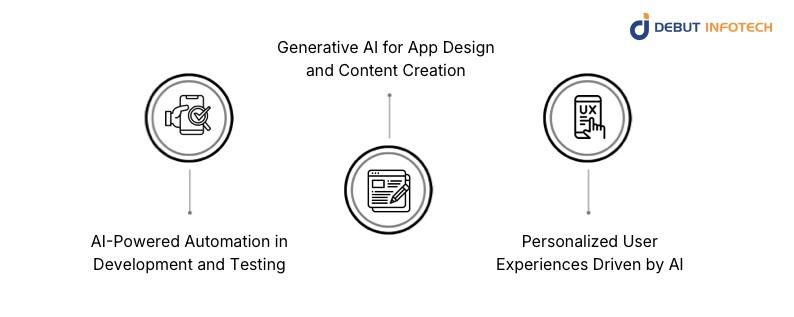
1. AI-Powered Automation in Development and Testing
AI is also contributing a larger role in the background. Development teams are utilizing machine learning to detect bugs at an earlier stage and to save up time spent on creating automated code reviews and AI-based testing tools.
This does not necessarily reduce the initial expenses, but it can considerably reduce the long-term costs (it avoids rework, post-launch bugs, and performance problems which are costly to correct after the fact) as well.
Cost impact:
2. Generative AI for App Design and Content Creation
Generative AI is transforming the speed at which apps can be developed as an idea to a prototype. Rather than creating each screen or typing out all the content, AI tools are currently being used to accelerate work at the beginning phase.
UI layouts can be created by designers, basic code can be scaffolded by developers and product teams can create onboarding content or in-app copy a lot faster. This is of great help, particularly in MVP development where speed and cost are most important.
Cost impact:
3. Personalized User Experiences Driven by AI
Personalization is becoming an expectation, not a bonus. Current apps are applying AI to suggest content, customize interfaces, and react to human behavior. Although this enhances exposure and retention, it causes technical complexity.
All these features demand additional data processing, back-end logic and continuous optimization all of which impact your budget.
Cost impact:
The development of an app is a significant investment, yet it does not have to empty your wallet. When you know where costs generally go out of control and how to keep ahead of them you can make a better decision and still deliver quality work. The trick lies in structuring your mobile application development service according to what really matters at each step.
The following are some of the practical methods that teams can use to ensure that the cost of developing a mobile app is contained:
Such strategies assist in making sure that your mobile application development cost remains under control of your objectives, your schedule, and your long-term growth perspectives.
On paper, your mobile app budget might look solid. You’ve scoped the features, chosen a timeline, and even compared quotes. Yet, many businesses still end up spending more than planned and it’s rarely because of “bad math.”
The real issue? Hidden costs that don’t show up in early estimates.
Mobile app development cost isn’t just about building screens and writing code. Decisions made along the way, especially around technology, scalability, and long-term maintenance, can quietly push your budget higher if you’re not prepared for them. Here are four commonly overlooked factors that can significantly impact your total cost.
1. Framework Limitations and Rework
Not all mobile app development frameworks are created equal. Some are great for quick MVPs but struggle as your app grows. If the framework you choose can’t support new features, performance demands, or integrations later on, you may end up rebuilding parts of the app, or even starting over.
That kind of rework doesn’t just cost money; it also delays growth.
2. Third-Party APIs and Usage Fees
APIs often feel like shortcuts: payments, maps, messaging, analytics, all handled for you. But many third-party APIs charge based on usage, not just setup. As your user base grows, so do those recurring fees.
What starts as a small monthly expense can quietly become a major part of your ongoing mobile app development cost.
3. Testing Across Devices and OS Versions
Your app won’t live on just one phone or operating system. Different screen sizes, OS updates, and device capabilities require extensive testing. Skipping proper testing may save money upfront, but it often leads to bugs, poor reviews, and expensive fixes after launch.
In the long run, underestimating testing costs usually costs more.
4. Post-Launch Improvements and Scaling
Launching the app is just the beginning. User feedback, performance optimizations, feature upgrades, and security updates all require ongoing development effort. If post-launch work isn’t included in your initial plan, your budget can quickly stretch beyond expectations.
Planning for growth early helps keep your mobile app development cost predictable and manageable.
Before talking numbers, there’s one important question every app founder should answer: how will this app actually make money?
Your monetization strategy plays a big role in your mobile app development cost because the way an app earns revenue directly affects the features, integrations, and technical complexity required to build it. A simple ad-based app won’t cost the same as a subscription platform with payment processing and user management.
Most mobile application development Companies design apps around the chosen revenue model from day one. Below are five proven ways mobile apps make money, and how each impacts development costs.
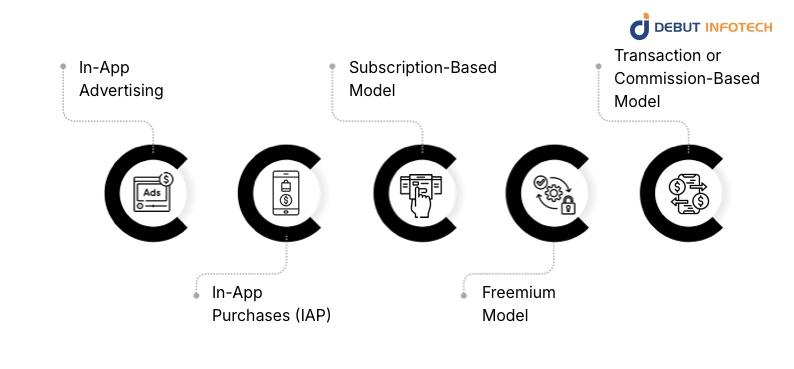
1. In-App Advertising
Apps earn revenue by displaying ads from networks like Google AdMob or Meta Audience Network.
Cost impact:
2. In-App Purchases (IAP)
Users buy digital items, premium features, or content within the app.
Cost impact:
3. Subscription-Based Model
Users pay monthly or yearly for ongoing access to content or services.
Cost impact:
4. Freemium Model
The app is free to use, with optional paid upgrades or premium features.
Cost impact:
5. Transaction or Commission-Based Model
Apps earn a percentage from every transaction made on the platform.
Cost impact:
Choosing the right monetization model early helps you avoid unnecessary features and control your mobile app development cost. A clear revenue plan allows your development team to focus only on what’s essential, saving time, money, and rework later on.
Curious how much it really takes to bring a big-name app to life? Let’s break down mobile app development cost using a few popular examples so you can see what goes into building apps like these:
Mobile App Development Cost Breakdown by App Type
| App Type | Example | Core Features | Estimated Cost | Cost Drivers |
| Fitness Tracking | MyFitnessPal | User profiles, workout logging, nutrition tracking, social sharing | $30,000 – $50,000 | Real-time data tracking, analytics, smooth UI/UX |
| E-Commerce | Shopify Lite, Amazon Lite | Product catalog, shopping cart, payment integration, order tracking | $60,000 – $120,000 | Secure payment systems, inventory management, robust backend |
| On-Demand Service | Uber | Real-time GPS tracking, ride booking, payment gateway, driver-customer chat | $150,000 – $300,000+ | Real-time functionality, scalable backend, mapping integration |
| Social Media | User profiles, feed, notifications, media uploads, chat | $100,000 – $250,000 | Large-scale media handling, feeds, messaging systems, cloud storage |
Why Mobile App Costs Vary
The cost of building a mobile app isn’t random, it comes down to complexity, user volume, and backend requirements. Here’s a quick guide to what impacts pricing:
Key Tip for App Planning
Creating a table of features, user volumes, and must-have functionalities can help you estimate costs more accurately. Pair this with clear MVP planning to launch faster and control your budget.
Figuring out the mobile app development cost isn’t always straightforward. There are a lot of moving parts, features, platforms, design, backend infrastructure and each can impact your overall budget. But understanding these factors is the key to estimating what it will really take to bring your app idea to life.
Finding a reliable mobile app development strategy can feel overwhelming, especially when you’re trying to balance quality, security, and cost. That’s where Debut Infotech comes in. With a team of experienced mobile app developers, we help businesses create secure, scalable, and cost-effective apps tailored to their needs.
Whether you’re planning your first MVP or a full-featured enterprise app, their experts guide you through every step, so you can stay within budget without compromising on quality.
A. Yes, making an app can still be profitable. The global app market is projected to reach hundreds of billions in the coming years.
Success, however, requires a clear strategy, a defined niche, and the right monetization model, subscriptions, ads, or in-app purchases. Most apps won’t earn much without careful planning.
Opportunities lie in solving real problems, leveraging AI or 5G, and creating high-quality experiences. Categories like finance, health, and gaming often offer the highest returns.
A. Building a simple mobile app can cost anywhere from a few hundred dollars for template-based solutions to $5,000–$80,000+ for custom development. Costs depend on features, developer rates, and platforms.
A basic MVP usually starts around $2,000–$10,000, while a simple app with custom design and a small backend can run $15,000–$30,000+.

Our Latest Insights
USA
2501 Chatham, Rd Suite R Springfield, IL 62704
+1-708-515-4004
info@debutinfotech.com
UK
7 Pound Close, Yarnton, Oxfordshire, OX51QG
+44-770-304-0079
info@debutinfotech.com
Canada
154 Eden Oak Trail, Kitchener, ON N2A 0H9
+1-708-515-4004
info@debutinfotech.com
INDIA
Sector 101-A, Plot No: I-42, IT City Rd, JLPL Industrial Area, Mohali, PB 140306
9888402396
info@debutinfotech.com