ON THIS PAGE
Progress0%





Our Global Presence :



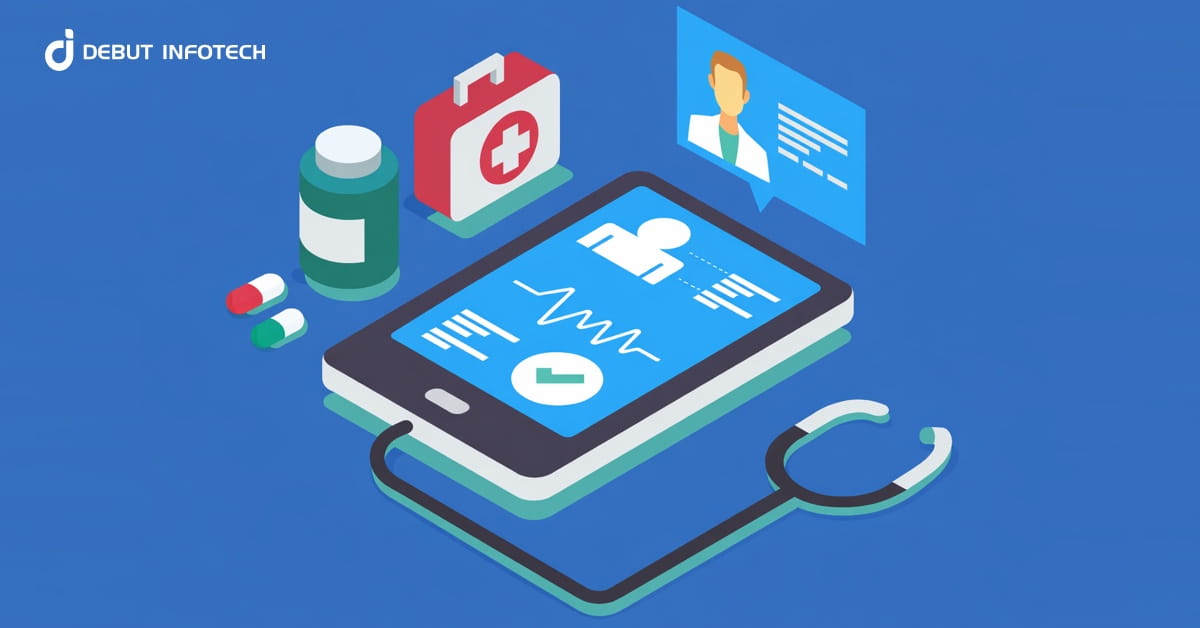


Getting access to healthcare services used to be slow, and it still is in some parts of the world. Patients had to wait for appointments, lab results, and even for their health records to be found before they could access healthcare services.
But today, there are more than 6.7 billion smartphone users worldwide, and that sheer volume of mobile devices has had a profound impact on modern healthcare services. We are seeing a gradual transition to what is now known as mobile health (mHealth), an emerging market that Grand View Research reports will reach USD 158.3 billion by 2030.
Thanks to mHealth app development, individuals can now schedule appointments on their mobile devices instead of waiting hours in waiting rooms. They can also monitor chronic diseases from the comfort of their homes, track symptoms with wearables, and communicate with doctors online. On the practitioner’s side, healthcare providers can access patient data in real time, review medical histories, provide care virtually, and collaborate with other practitioners.
It’s pretty mind-blowing stuff. And if you’re curious about these mhealth app development services or looking to invest in mobile healthcare technology, this article is a great place to start. This article provides a clear definition of mobile Health app development, explains why it matters, outlines the development process of healthcare applications, and shows how it has transformed modern healthcare services.
According to the World Health Organization, mHealth refers to the use of mobile wireless technologies for public health. This encompasses everything from patient monitoring devices to digital assistants. As such, by extension, mHealth app development is the comprehensive process of designing, coding, testing, and deploying these “mobile wireless technologies” for public health services.
However, the mHealth ecosystem of today does a little more than just tracking steps or reminding users to take their medications. In fact, they provide more sophisticated solutions, including
Through these services, mHealth app development enables patients and healthcare providers to connect in real time, facilitating quicker, more personalized healthcare.
Many people conflate these two ideas when comparing mhealth app development solutions. However, according to the WHO, eHealth refers to the cost-effective and secure use of information and communication technologies in support of health and health-related fields.
This definition effectively makes mHealth the “mobile arm” of eHealth. While mHealth focuses specifically on the use of wireless mobile technologies, eHealth is a broader term that encompasses both uses. This distinction is important, and many people confuse the two. And because mobile devices are ubiquitous, mHealth has become the most widely accessible gateway to digital healthcare.
If anything, the numbers tell us that mhealth app development solutions are becoming the backbone of healthcare delivery in both developed and developing countries, and we are able to tell this based on the following:
Here are some numbers that show how rapidly the mHealth market is expanding:
The entire healthcare industry is shifting from a slow, appointment-driven model to a mobile, on-demand, data-rich ecosystem—and mobile apps are at the heart of that shift.
Healthcare is evolving because both patients and providers want (and need) a better experience:
Combine this with advances in AI, blockchain, wearables, and telemedicine, and it becomes clear why custom mHealth app development is now a strategic investment.
While mHealth encompasses all wireless mobile devices used for public health services, there are still slight distinctions among these kinds of apps. Below, we have highlighted some key types of mHealth applications:
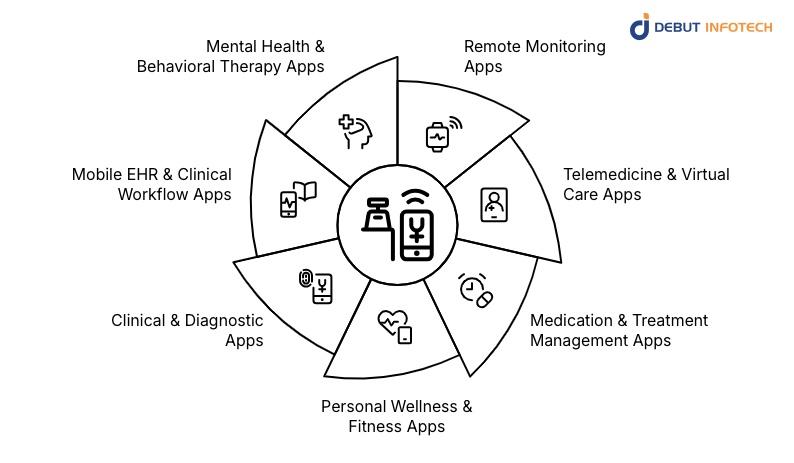
Remote monitoring apps help healthcare providers access real-time patient data from anywhere patients are. For example, they continuously monitor vital signs like heart rate, blood pressure, oxygen levels, glucose levels, and sleep by interfacing with wearables, medical sensors, and Internet of Things devices. Consequently, they are extremely important for managing chronic illnesses like diabetes and hypertension.
During the pandemic, telehealth increased by more than 150%, and it has continued to be the main form of care ever since. These apps facilitate digital follow-ups, remote examination tools, e-prescriptions, and video consultations.
This category of mHealth apps supports patients in managing their health and following their treatment plans by sending medication reminders, dosage-tracking alerts, pharmacy sync, and refill alerts. All these things make it easy for them to prevent missed doses, especially for chronic patients.
In this category, you have weight management apps, exercise monitoring applications, dietary advice updates, stress reduction updates, and even mindfulness and meditation apps. They all support individuals in living a healthy life. According to U.S. data, wellness apps account for more than 34% of mHealth usage studies.
Most clinical and diagnostic apps are often powered by AI and machine learning algorithms. They rely on these algorithms to detect health signals that help them assess symptoms, make early, accurate diagnoses, and support clinicians’ decision-making. Common examples include Ada Health, which showed how AI triage tools influence care paths.
Physicians use these apps to access lab results, patient history, imaging, and treatment plans directly from their phones. Think of them as being more useful on the healthcare provider’s side of things, as they are more applicable in healthcare organizations or settings.
Mobile cognitive-behavioral therapy (CBT), mindfulness, and telepsychiatry apps support an underserved segment of care.
Together, these categories show how mHealth apps now serve every layer of the healthcare ecosystem: patients, clinicians, caregivers, hospitals, insurers, and even public‑health agencies.
The following are some of the most important benefits of mHealth app development in modern healthcare:
Patients no longer need to commute for simple follow‑ups or routine inquiries. They can schedule visits, check records, and speak with clinicians directly from their mobile devices.
Over one‑third of Americans rely on mobile health apps for wellness, fitness, or chronic disease management. The advancement of mobile healthcare apps has made it easier for patients to stay on top of their health updates and maintain an effective relationship with their healthcare providers.
Custom AI mhealth app development provides AI insights, remote vitals, and continuous monitoring that gives clinicians a clearer, real‑time picture of patient health. Clinicians find it easier to conduct investigations and arrive at disgnosis.
mHealth apps have been shown to reduce hospital readmissions by up to 50%, especially among patients with chronic diseases.
The ability to monitor symptoms, behaviors, and vitals remotely helps clinicians intervene before conditions worsen.
Mobile access to patient records, messaging tools, and hospital systems reduces administrative burden and speeds up decision-making.
Clinicians, specialists, caregivers, and family members can all stay aligned through one connected mobile platform.
These benefits show why mHealth apps are no longer supplementary tech, they’re becoming core operational assets for healthcare organizations.
The mHealth app development process is a regulated and systematic process that incorporates some standard processes involved in mobile app development together with some standard regulatory checks due to the sensitive nature of patient data.
At Debut Infotech Pvt Ltd, our healthcare app development processes is executed by professional mHealth app developers and healthcare engineering teams with years of experience in the healthcare space. Below we have provided a summary of their custom processes:
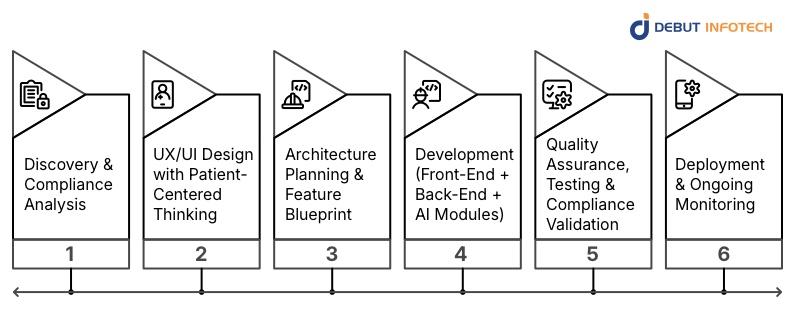
The first thing we do is define the roadmap, use case, and requirements for building the mHealth app to the best possible standards. This means defining requirements, identifying whether the primary users will be patients, doctors, or admins, mapping the clinical workflows and assessing the regulatory and compliance requirements (HIPAA, GDPR, HL7/FHIR).
Basically, we lay everything out to get a clear overview of what to do. This is how we reduce any unforeseen risks early on in the cycle. This stage defines the entire project.
In the first step above, we noted that the users of these mHealth app can be diverse. As a result, different users have different design preferences. So, once we’ve identified the target users, the design team starts structuring a design that is intuitive enough for that user base, be it elderly patients, clinicians, people managing chronic diseases, or caregivers.
The architecture planning and feature blueprint stage is where both the design team and functionality engineers create the full implementation plan for the mHealth plan. This basically means deciding the approach or choices for the following things:
The factors outlined above define the approach and technologies that will be used to implement the app’s core functionalities.
Having sorted the backend functionalities, we then circle back to the core decisions made regarding the design and we start implementing them.
This means developing the mobile frontend interface, incorporating the AI/ML prediction models (if any), and integrating that core spine to the wearables. Furthermore, we start implementing access controls with role-based authentication, making appropriate provisions for data privacy and security through encryption and tying everything together by implementing the healthcare compliance modules.
By now, you should have a skeletal working framework. Therefore, we start testing all components to ensure everything is working as expected. The testing process is a very vital one in healthcare due to the sensitivity of the information and the fact that patients’ health is literally at stake. Therefore, we need to make sure that prompts work as they should and data doesn’t leak. That’s why our QA teams implement multiple tests to validate security, ensure accessibility, maintain regulatory compliance, and ensure the app functions properly regardless of high load.
After testing and confirming that all components of the mHealth app are fully functional and working in the right conditions, the app can then be deployed, thus effectively entering the mobile app development cycle. At Debut Infotech Pvt Ltd, we understand that app development doesn’t end when the app goes live. Therefore, after deployment, we continuously engage in monitoring. This begins with security monitoring because security is the foundation of mHealth. Furthermore, we continuously carry out updates and patches, AI improvements, new feature releases (when necessary), and user support.
Also read this article – How Long Does It Take To Develop A Mobile App?
Remember, developing an mhealth app doesn’t end after development, instead it evolves with healthcare needs.
mHealth app development has now become a vital aspect of modern healthcare services. It started as something as simple as wellness tracking, heart rate monitoring, and counting steps. But advances in app development have made it a crucial part of how healthcare is delivered, coordinated, and experienced.
This means patients now want confidence in understanding their health status regardless of their location. Likewise, healthcare providers have become increasingly reliant on real-time insights, remote monitoring, and AI-powered decision support delivered through these apps. These expectations demand solutions that are not only user-friendly but clinically sound and technologically resilient.
These realities have clearly defined the role of any mHealth app company: every solution offered to patients and providers must be secure, compliant, and clinically reliable. Achieving that is far more complex than building a conventional mobile application. The regulatory, technical, and data security stakes are significantly higher.
That’s why organizations looking to hire mobile app developers for healthcare initiatives turn to specialized healthcare software development services like Debut Infotech Pvt Ltd. Our healthcare app development specialists understand the nuances of regulations such as HIPAA, GDPR, FHIR, and HL7. Beyond compliance, they design for diverse patient populations, securely integrate AI, wearables, and EHR systems, and follow mature development processes that ensure stability, scalability, and long-term optimization.
Our portfolio reflects this expertise in action. For instance, WellPoP, an intuitive healthcare-based web and mobile application, was developed to overcome fragmentation in healthcare delivery by enabling cohesive, connected care experiences across stakeholders.
Similarly, TEM, a health improvement app, delivers personalized tools for tracking fitness activities, monitoring nutrition, managing stress, and building sustainable healthy habits through data-driven insights.
Expanding beyond clinical environments, we also developed Nordic Strong, a boutique fitness app offering structured training programs, specialized equipment guidance, and community-driven resources that empower users to achieve their fitness goals through a connected digital ecosystem.
If your organization is ready to embrace mHealth innovation, now is the right time — and the right app development partner makes all the difference.
A. mHealth app development is the process of creating mobile applications that support healthcare delivery, wellness, remote monitoring, telemedicine, or clinical workflows. These apps help patients access care anytime, allow providers to make informed decisions, and enable healthcare organizations to modernize operations using mobile technology.
A. Telemedicine apps, remote monitoring apps, wellness and fitness apps, medication management tools, chronic disease management apps, clinical decision-support apps, mobile EHR platforms, and mental health apps are some of the main categories of mHealth apps. Each type has a distinct function in enhancing care quality, continuity, and access.
A. Depending on complexity, third-party integrations, AI features, device compatibility, and compliance requirements, mHealth app development can cost anywhere from $40,000 to $300,000 or more. Due to engineering and regulatory requirements, apps with EHR integration, wearables, analytics, or telemedicine features are at the upper end.
A. Yes, if properly developed. Access controls, multi-factor authentication, encryption, secure APIs, audit trails, and regulatory standards like HIPAA, GDPR, HL7, and FHIR are all used by mHealth apps. In order to safeguard sensitive patient data, security is integrated into the architecture from the very beginning.
A. Depending on the complexity, features, integrations, and regulatory considerations of the app, the development of a mobile app typically takes 12 to 30 weeks. To guarantee safety, accuracy, and compliance, apps requiring wearables, AI, remote monitoring, or hospital system integration need more time for development and testing.

Our Latest Insights
USA
2501 Chatham, Rd Suite R Springfield, IL 62704
+1-708-515-4004
info@debutinfotech.com
UK
7 Pound Close, Yarnton, Oxfordshire, OX51QG
+44-770-304-0079
info@debutinfotech.com
Canada
154 Eden Oak Trail, Kitchener, ON N2A 0H9
+1-708-515-4004
info@debutinfotech.com
INDIA
Sector 101-A, Plot No: I-42, IT City Rd, JLPL Industrial Area, Mohali, PB 140306
9888402396
info@debutinfotech.com