ON THIS PAGE
Progress0%






Our Global Presence :



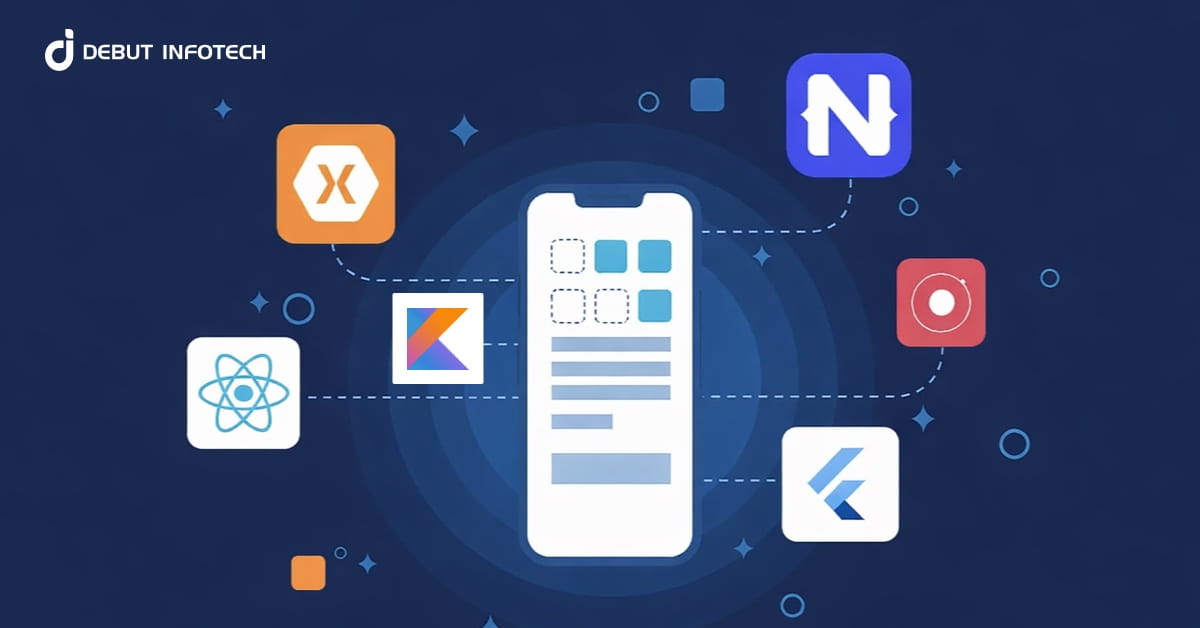


Cross-platform mobile app development frameworks have become a strategic necessity rather than a technical alternative. As businesses race to deliver consistent digital experiences across iOS and Android, the pressure to reduce development time, optimize costs, and maintain performance has never been higher. In 2026, the choice of the right cross-platform framework directly influences scalability, user experience, and long-term product viability.
Modern enterprises are no longer asking whether to adopt cross-platform development—but which framework best aligns with their business goals. With evolving mobile OS standards, stronger APIs, AI-driven tooling, and growing demand for faster go-to-market cycles, cross-platform mobile app development frameworks are entering a new phase of maturity. This guide explores the best frameworks for 2026, their strengths and limitations, and how businesses can make informed technology decisions.
Cross-platform mobile app development frameworks are software tools that allow developers to build applications using a single codebase that runs across multiple operating systems—primarily iOS and Android. Instead of creating and maintaining separate native apps, teams can reuse a significant portion of code, logic, and UI components.
This approach supports:
Cross-platform frameworks typically rely on either:
As mobile app development across platforms continues to evolve, modern frameworks now rival native development in performance, stability, and flexibility.
The importance of cross-platform mobile development services has grown significantly as business and technology trends shift.
In competitive digital markets, speed is critical. Cross-platform frameworks reduce the mobile app development timeline by enabling teams to build once and deploy everywhere. This is especially valuable for startups and enterprises launching MVPs, feature updates, or regional expansions.
Hiring separate iOS and Android teams increases development and maintenance costs. Cross-platform development allows businesses to:
For many organizations, this makes cross-platform solutions the best mobile app platform from a financial and operational standpoint.
Earlier concerns around performance and UI limitations have largely faded. In 2026, the best cross-platform mobile app development frameworks support:
This makes them suitable for complex, enterprise-grade applications.
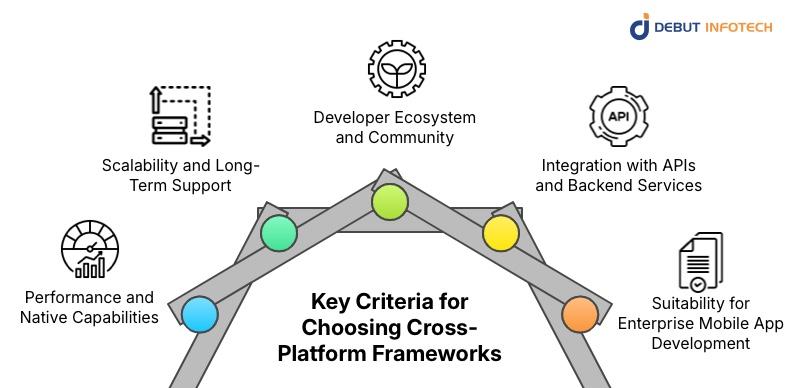
Before exploring the top frameworks, it’s essential to understand how they are evaluated.
Frameworks must deliver smooth UX, fast load times, and native-like responsiveness—especially for high-traffic or data-heavy apps.
The framework should support continuous updates, growing user bases, and evolving OS requirements without excessive refactoring.
Strong communities, documentation, plugins, and third-party integrations reduce risk and accelerate development.
Modern apps rely heavily on API development, cloud services, analytics, and third-party tools. Seamless backend integration is non-negotiable.
For businesses working with top mobile app development companies, frameworks must support security, compliance, and enterprise workflows.
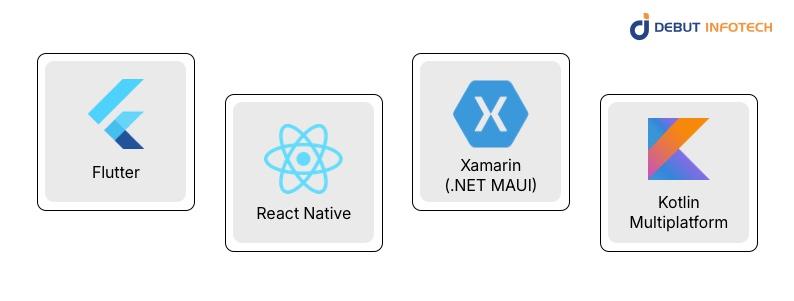
Flutter continues to lead the cross-platform ecosystem heading into 2026. Developed with a UI-first approach, Flutter enables teams to build visually rich, high-performance applications using a single codebase.
Why Flutter stands out in 2026:
Flutter is widely used by companies offering cross-platform mobile development services due to its scalability and consistent UI across devices.
Best suited for: Startups, enterprise apps, consumer-facing platforms, and MVPs requiring rapid iteration.
React Native remains one of the most widely adopted cross-platform mobile app development frameworks, especially among teams with JavaScript and web development expertise.
Key advantages:
In 2026, React Native continues to evolve with improved rendering engines and better native module support, making it a strong contender for long-term multiplatform mobile app development.
Best suited for: Content-driven apps, marketplaces, social platforms, and products with frequent UI updates.
Xamarin, now unified under .NET MAUI, remains a solid choice for organizations deeply invested in the Microsoft ecosystem.
Strengths include:
While it has a smaller community than Flutter or React Native, it excels in enterprise environments where stability and integration matter more than trend adoption.
Best suited for: Enterprise applications, internal tools, and Microsoft-centric organizations.
Kotlin Multiplatform has gained traction as a modern approach to cross-platform development, allowing teams to share business logic while maintaining native UI layers.
Why it’s growing in 2026:
This approach appeals to businesses that want cross-platform efficiency without fully sacrificing native experiences.
Best suited for: Complex applications, fintech, healthcare, and apps with advanced native requirements.
Ionic continues to be a popular hybrid solution, especially for applications that prioritize rapid development and broad device compatibility.
Core benefits:
While not always ideal for graphics-heavy apps, Ionic remains relevant in 2026 for specific business use cases.
Best suited for: Enterprise dashboards, internal tools, and content-focused apps.
A framework selection decision matrix is a structured comparison tool that helps businesses choose the most suitable development framework based on their specific goals, constraints, and priorities—not just popularity.
Instead of asking “Which framework is best overall?”, a decision matrix answers:
“Which framework is best for our product?”
It turns subjective opinions into an objective, weighted decision.
Choosing cross-platform development does not mean abandoning native approaches entirely. In 2026, many top mobile app development companies adopt hybrid strategies that combine cross-platform frameworks with native modules.
Cross-platform advantages:
Native advantages:
The right choice depends on product complexity, timeline, budget, and long-term scalability goals.
Cross-platform frameworks impact every phase of the mobile app development lifecycle:
This streamlined lifecycle is a major reason businesses increasingly hire dedicated mobile developers skilled in cross-platform technologies.
Selecting the right cross-platform mobile app development framework in 2026 requires a balanced evaluation of performance, scalability, ecosystem maturity, and business alignment. Below is a high-level comparison to help decision-makers assess which framework fits their goals.
| Framework | Performance | Code Reusability | Learning Curve | Enterprise Readiness | Best Use Cases |
| Flutter | Near-native, high FPS UI | High (single codebase) | Moderate | High | Consumer apps, MVPs, startups, and visually rich applications |
| React Native | Near-native with optimizations | High | Low–Moderate | High | Social apps, marketplaces, and content-heavy platforms |
| .NET MAUI (Xamarin) | Native-level performance | Medium–High | Moderate | Very High | Enterprise apps, internal tools, Microsoft-based ecosystems |
| Kotlin Multiplatform | Native performance | Medium (shared logic) | High | High | Fintech, healthcare, complex apps needing native UI |
| Ionic | Web-based (lower than native) | Very High | Low | Medium | Enterprise dashboards, MVPs, internal business apps |
Cross-platform frameworks significantly accelerate development when compared to native approaches.
For businesses looking to shorten the mobile app development timeline, Flutter and React Native remain top choices.
A strong ecosystem directly impacts development velocity and long-term support.
One of the strongest arguments for cross-platform development is cost efficiency. However, the actual cost of mobile app development depends on multiple factors.
While cross-platform solutions reduce duplication, enterprise-grade apps still require careful architectural planning to avoid technical debt.
On average, cross-platform development can reduce costs by:
This makes cross-platform frameworks particularly attractive for startups and mid-sized enterprises aiming to optimize ROI without sacrificing quality.
In 2026, cross-platform mobile app development frameworks will be widely adopted across industries.
Hybrid app development is often confused with cross-platform development, but they are not the same.
Most top mobile app development companies prefer modern cross-platform frameworks over traditional hybrid approaches for performance-critical applications.
That said, a hybrid app development company still plays a role in:
Cross-platform development is not a one-size-fits-all solution, but it excels in many scenarios.
For these scenarios, cross-platform frameworks represent the best mobile app platform from both technical and business perspectives.
Despite their advantages, cross-platform frameworks are not always the right choice.
Native development may be preferred when:
Many businesses adopt a hybrid strategy—using cross-platform frameworks for core functionality while implementing native modules where needed.
As demand grows, companies increasingly hire dedicated mobile developers with cross-platform expertise rather than maintaining separate iOS and Android teams.
Working with experienced providers of mobile app development services ensures access to skilled engineers, proven frameworks, and optimized delivery processes.
Modern cross-platform apps rely heavily on APIs to connect frontend experiences with backend systems.
Key API considerations include:
Strong API development practices are essential to ensuring that cross-platform apps remain responsive, secure, and scalable as user demand grows.
Framework selection alone does not guarantee success. The experience of the development partner plays a critical role.
When evaluating top mobile app development companies, businesses should consider:
A reliable partner helps align technology choices with long-term business objectives.
Cross-platform development continues to evolve rapidly, and 2026 brings several notable trends.
Cross-platform mobile app development frameworks have matured into enterprise-ready solutions that balance speed, cost efficiency, and performance. In 2026, frameworks such as Flutter, React Native, Kotlin Multiplatform, and .NET MAUI enable businesses to deliver high-quality mobile experiences without duplicating effort.
For organizations seeking faster launches, optimized budgets, and scalable architectures, cross-platform development is no longer a compromise—it’s a strategic advantage. By selecting the right framework and partnering with experienced mobile app development services providers, businesses can build future-ready mobile applications that scale with confidence.
A. Cross-platform mobile app development frameworks allow developers to build mobile applications using a single codebase that runs on multiple platforms, such as iOS and Android. This approach reduces development time, cost, and maintenance effort.
A. The best cross-platform mobile app development framework depends on project requirements. In 2026, Flutter, React Native, Kotlin Multiplatform, and .NET MAUI are among the most widely used frameworks for performance, scalability, and enterprise readiness.
A. Cross-platform frameworks reduce mobile app development cost by eliminating the need for separate iOS and Android codebases. This lowers development, testing, and maintenance expenses while enabling faster updates and releases.
A. Modern cross-platform mobile app development frameworks offer near-native performance for most use cases. While highly complex or hardware-intensive apps may still require native development, cross-platform solutions meet performance expectations for the majority of business applications.
A. Hybrid apps rely on web technologies rendered inside a web view, while cross-platform frameworks compile to native components or directly interact with native APIs. Cross-platform development generally delivers better performance and user experience than traditional hybrid apps.
A. The mobile app development timeline varies based on complexity, features, and integrations. However, cross-platform development typically reduces time-to-market by 30–40% compared to building separate native apps.
A. Working with an experienced mobile app development company ensures the right framework selection, optimized architecture, secure API development, and a streamlined mobile app development lifecycle—reducing risk and improving long-term scalability.

Our Latest Insights
USA
2501 Chatham, Rd Suite R Springfield, IL 62704
+1-708-515-4004
info@debutinfotech.com
UK
7 Pound Close, Yarnton, Oxfordshire, OX51QG
+44-770-304-0079
info@debutinfotech.com
Canada
154 Eden Oak Trail, Kitchener, ON N2A 0H9
+1-708-515-4004
info@debutinfotech.com
INDIA
Sector 101-A, Plot No: I-42, IT City Rd, JLPL Industrial Area, Mohali, PB 140306
9888402396
info@debutinfotech.com