ON THIS PAGE
Progress0%






Our Global Presence :





The cost of developing a Badoo clone app typically ranges from $40,000 to $300,000+. A basic MVP with profiles, discovery, matching, and messaging can fall near the lower end. A full-featured platform with AI matching, video calling, verification, live features, advanced moderation, and separate iOS and Android apps can move beyond $300,000.
The final Badoo app development cost depends mainly on the build approach, feature complexity, development region, team structure, integrations, infrastructure, and compliance requirements. A custom build costs more initially than a white-label solution, while advanced safety and real-time features can add substantial development and operating expenses.
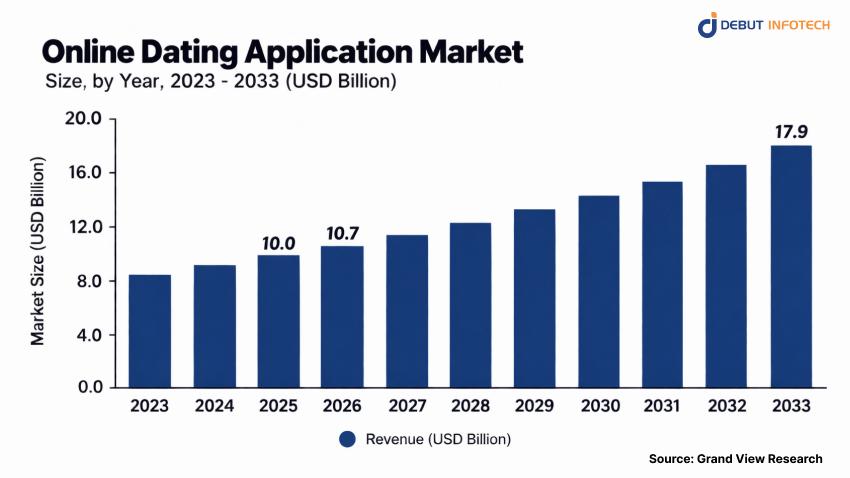
The market also gives businesses a reason to consider the opportunity carefully. Grand View Research estimates the global online dating application market at $10 billion in 2025, with the market projected to reach $17.9 billion by 2033. This guide breaks down the major costs involved so you can build a realistic budget before development begins.
The cost of developing a dating app like Badoo depends on whether you build a custom solution or use an existing platform. Custom development allows you to tailor the app to your business requirements, while white-label and low-code solutions can help reduce the initial investment. Each option offers a different balance of cost, flexibility, and scalability, making it important to choose an approach that aligns with your product goals.
A custom Badoo-like dating application generally costs 80,000–300,000+, depending on the feature set and technology requirements. A smaller custom MVP can cost around 40,000–80,000 when the first release focuses on essential dating functions.
This approach is best for businesses that want long-term control over the product. You can create custom matching rules, subscription plans, user flows, moderation systems, and integrations. You also own the application architecture instead of being tied to a third-party platform.
The downside is the initial investment. You also need more time for planning, development, testing, deployment, and maintenance.
White-label dating solutions can cost approximately $15,000–$60,000 for licensing, customization, setup, and deployment. Some vendors charge a one-time licensing fee, while others use monthly or annual subscriptions. Additional charges may apply for source-code access, hosting, support, custom features, and upgrades.
This option works when speed and initial cost are more important than complete control. Existing features such as registration, profiles, matching, chat, notifications, and administration may already be available.
The main limitation is customization. A script designed for general dating use may not support a unique matching model or unusual business rules without substantial modification.
No-code and low-code platforms can bring the initial Badoo-like app development cost down to roughly 5,000–30,000, including platform subscriptions, configuration, design, integrations, and professional assistance.
They are useful for quickly testing an idea. They become less suitable when the application needs large-scale real-time communication, advanced AI, high-volume media processing, complex payment logic, or custom infrastructure.
A platform that works for 5,000 users may become restrictive at 100,000 users. Migration to a custom stack at that point can also create additional costs.
Build Approach Comparison
| Build approach | Estimated cost | Typical timeline | Scalability ceiling | Best for |
| No-code/low-code | $5,000–$30,000 | 1–3 months | Low–Medium | Concept validation |
| White-label/clone | $15,000–$60,000 | 2–4 months | Medium | Fast market entry |
| Custom MVP | $40,000–$100,000 | 3–6 months | High | Startups testing a serious product |
| Full custom build | $80,000–$300,000+ | 6–12+ months | Very high | Long-term platforms |
The cheapest approach is not always the cheapest over several years. If the product will need major customization, moving from a restrictive platform to a custom architecture later can mean paying for development twice. Businesses expecting significant growth should compare the first-year cost with the likely three-year development and operating cost.
Platform selection can change the cost to develop a dating app like Badoo even when the feature list remains exactly the same.
A native iOS-only application generally costs around $40,000–$100,000 for an MVP, while a native Android-only version may fall within a similar $40,000–$100,000 range.
Building both platforms natively can push the combined budget to roughly $70,000–$180,000+, since much of the frontend and platform-specific work must be implemented separately.
Cross-platform development with React Native or Flutter can reduce the combined development effort by roughly 30% across many projects by enabling developers to share a substantial portion of the application code between iOS and Android.
A project that might require $120,000 for separate native implementations could therefore land around $84,000, depending on architecture and feature complexity.
The same principle can shorten development time by around 30%, although the actual savings vary depending on integrations, testing requirements, and platform-specific functionality.
| Platform strategy | Estimated MVP cost | Relative cost/time |
| Native iOS only | $40,000–$100,000 | Baseline |
| Native Android only | $40,000–$100,000 | Baseline |
| Both natively | $70,000–$180,000+ | Highest |
| React Native/Flutter | 50,000–125,000 | 30% lower in many cases |
Native development can still justify its premium when the product depends heavily on platform-specific capabilities, advanced camera functions, high-performance video, sophisticated background processing, or deep operating-system integrations.
Native development also gives teams greater control over platform-specific performance and behavior. For a standard dating MVP, however, cross-platform development can offer a practical balance between launch speed, development cost, and access to both major mobile platforms.
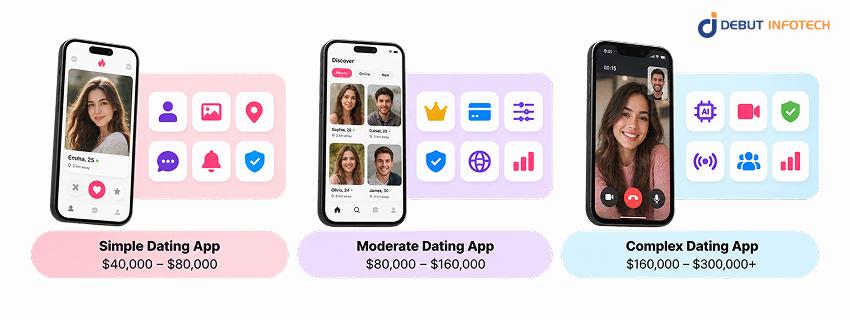
The cost of developing a dating app like Badoo depends on the features you want to include and how complex they are to build. A basic app with user profiles, matching, and messaging requires less development effort than a platform with advanced personalization and real-time communication.
Features such as AI-powered matching, video calling, identity verification, and automated moderation require additional engineering, testing, and third-party integrations. As these requirements increase, so does the overall development cost.
Let’s break down the estimated cost of building a dating app at different levels of complexity.
A simple dating app should focus on the basic user journey. Users need to register, create profiles, discover other users, match, and communicate.
A typical simple tier includes:
This scope is suitable for an MVP. It gives the business enough functionality to test demand before investing in advanced systems.
A moderate application adds functions that improve monetization, personalization, security, and user retention. These additions require more backend logic and third-party services.
The feature set may include:
At this stage, the product starts to resemble a commercial dating platform rather than a basic proof of concept.
A complex build adds functions that require a more sophisticated technical architecture. These can include AI-powered matching, live streaming, video calls, advanced fraud detection, identity verification, automated content moderation, real-time analytics, and multi-platform support.
The backend also has to handle higher traffic and more simultaneous activity. That affects database architecture, caching, media storage, cloud infrastructure, monitoring, and security.
Per-Feature Cost Breakdown
| Feature | Estimated development cost |
| Registration and authentication | $3,000–$8,000 |
| User profile and photo management | $5,000–$12,000 |
| Swipe/discovery engine | $8,000–$20,000 |
| Matching algorithm | $7,000–$20,000 |
| Search and advanced filters | $4,000–$10,000 |
| Real-time chat | $8,000–$20,000 |
| Video calling | $10,000–$25,000 |
| Profile/identity verification | $6,000–$18,000 |
| Push notifications | $2,000–$5,000 |
| Subscription and payments | $5,000–$15,000 |
| Location services | $4,000–$12,000 |
| Content moderation | $6,000–$20,000 |
| AI recommendations | $15,000–$40,000+ |
| Live streaming | $15,000–$40,000+ |
| Admin panel | $7,000–$18,000 |
| Analytics and reporting | $4,000–$12,000 |
These feature-level estimates should be treated as individual cost indicators rather than added together to calculate the total project budget. Several features rely on shared components, including databases, authentication systems, and backend services. Using third-party SDKs for chat, video calling, payments, and identity verification can also reduce development effort. The final cost depends on how these components are integrated and the level of customisation required.
UI/UX complexity should be budgeted separately from feature complexity because two dating apps can have identical functionality but very different design costs.
| UI/UX complexity | Typical cost | Common design scope |
| Basic | $8,000–$12,000 | Standard layouts, stock icons, simple UI |
| Moderate | $12,000–$20,000 | Custom graphics, animations, branded interactions |
| Complex | $20,000–$35,000+ | AR previews, custom illustrations, motion design |
A simple app using standard layouts, familiar navigation patterns, and stock icons requires less design work than a product with custom illustrations, animated interactions, or immersive experiences.
For a Badoo-like application, UI/UX design can therefore range from roughly $8,000 to $35,000+, depending on the visual direction and interaction requirements.
A basic design package can cost around $8,000–$12,000. This level generally uses standard mobile layouts, existing UI patterns, stock icons, simple typography, limited animations, and straightforward profile, matching, chat, and subscription screens. It is suitable for an MVP where the priority is usability and fast development. The design team still needs to establish user flows and a consistent component system, but there is little need for custom artwork or advanced interaction design.
A moderate design package can cost approximately $12,000–$20,000. It may include custom graphics, branded illustrations, tailored icons, animated transitions, interactive onboarding, custom profile layouts, richer discovery screens, and more detailed subscription experiences.
Motion design also requires additional planning because designers need to define how elements behave during swipes, matches, messages, notifications, and navigation. These details can improve the product experience but add design, prototyping, and implementation time.
A complex design package can cost around $20,000–$35,000+. This level may include custom illustrations, advanced motion design, immersive onboarding, sophisticated micro-interactions, AR previews, interactive profile experiences, and highly customized discovery interfaces.
AR features in particular can require additional research, prototyping, and platform testing. The cost can rise further when the design includes separate experiences for iOS and Android rather than relying on one shared interaction model.
Two apps could both include registration, profiles, swiping, matching, messaging, and subscriptions, yet one may cost considerably more because it requires custom artwork and motion.
Separating UI/UX as its own cost line gives a more accurate Badoo-like app development cost estimate before development begins.
A Badoo-like dating platform normally requires several roles. A small MVP team can combine responsibilities, while a larger product benefits from dedicated specialists.
The right structure depends on the number of platforms, feature complexity, and target launch date.
| Role | MVP hours | Full build hours |
| Project manager | 250–400 | 500–800 |
| UI/UX designer | 200–350 | 400–700 |
| Backend developer | 600–900 | 1,200–1,800 |
| Frontend/mobile developers | 700–1,000 | 1,500–2,400 |
| QA engineer | 300–500 | 700–1,000 |
| DevOps engineer | 120–250 | 300–500 |
| Total | 2,170–3,400 | 4,600–7,200 |
Regional rates can significantly affect the budget. A project requiring 3,000 hours at $30 per hour would cost about $90,000. The same workload at $100 per hour would cost $300,000. The difference makes location an important consideration when calculating Badoo-like dating app development cost in 2027.
| Region | Typical blended rate |
| US/Canada | $100–$180+ |
| Western Europe | $80–$150 |
| Eastern Europe | $40–$90 |
| India/Southeast Asia | $25–$60 |
These are planning ranges rather than fixed market quotes. Individual developers, agencies, and specialist teams may charge outside these bands.
| Development model | Relative cost | Advantages | Limitations |
| Freelancers | Low–Medium | Lower rates, flexible hiring | More coordination |
| Agency | Medium–High | Complete team and project management | Higher blended rate |
| In-house | High | Long-term product ownership | Recruitment and payroll costs |
| Hybrid | Medium–High | Flexible specialist coverage | Requires good coordination |
A four-person team may cost less per month but take longer to complete the application. An eight-person team can shorten the schedule but increases monthly spending. A balanced team is often more practical for a dating app because design, backend, mobile development, QA, and DevOps cannot all be compressed indefinitely.
Team size should therefore be tied to the release plan. If the goal is a basic MVP, a smaller team can work efficiently. If the first release includes video, AI, subscriptions, verification, and advanced moderation, adding specialists early can reduce bottlenecks and expensive rework.
Third-party services can reduce development time, but they introduce recurring expenses. These costs depend on active users, messages, video minutes, storage, bandwidth, payment volume, and API calls. They should be included in the operating budget rather than treated as one-time development expenses.
Sendbird’s current pricing lists a 5,000 MAU Starter plan at $349 per month when billed annually, or $399 per month when billed monthly. Its Pro 5K plan is $499 per month annually or $599 monthly. Enterprise pricing is customized.
CometChat provides a free development plan for up to 100 users. Its paid plans use monthly active users and list a $0.10 per MAU overage rate on Basic and Advanced plans.
For a dating app, chat costs rise with active users, not simply registered accounts.
Video can be one of the more expensive third-party services because providers often charge per participant minute. Twilio Video currently starts at $0.004 per participant per minute.
Agora lists $3.99 per 1,000 participant minutes for HD video and $8.99 per 1,000 participant minutes for Full HD. Its pricing also includes free combined RTC minutes within the stated monthly allowance.
For example, 100,000 participant minutes at $3.99 per 1,000 minutes would equal approximately $399 before other applicable charges.
Push notifications are usually inexpensive compared with video and media infrastructure. Firebase Cloud Messaging is available as part of Firebase’s messaging services, while OneSignal offers a free plan and a Growth plan starting at $19 per month.
OneSignal also announced in September 2026 that its Free plan for new customers has a 1,000 MAU limit for mobile push and in-app messaging.
Cloud infrastructure does not have a fixed price because costs depend on architecture and usage. A planning budget for a dating platform could look like this:
| Scale | Estimated monthly infrastructure budget |
| 10K users | $500–$2,000 |
| 100K users | $2,000–$8,000 |
| 1M users | $10,000–$40,000+ |
These figures are planning estimates. Heavy video, large media libraries, high bandwidth consumption, and real-time activity can push costs higher.
Payment providers also take a percentage from transactions. Stripe currently lists standard domestic card pricing at 2.9% + $0.30 per successful transaction, with additional charges for international cards and currency conversion.
Google Maps Platform can add location and mapping API charges based on the services and usage. Apple and Google may also charge service fees on eligible digital purchases processed through their billing systems.
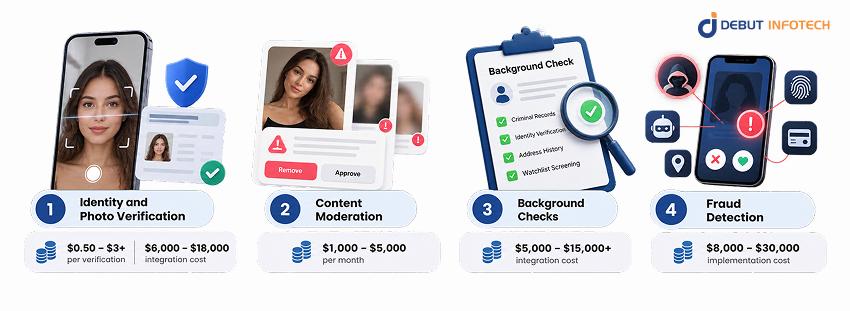
Dating applications handle personal information, photos, private conversations, location data, and sometimes identity documents. Safety therefore needs to be part of the product architecture from the beginning. Treating verification and moderation as optional features can lead to higher costs after launch.
Verification providers commonly charge per verification, with pricing depending on document checks, facial matching, country coverage, and the type of verification. For early budgeting, allow approximately 0.50–3+ per verification.
The dating app tech stack integration can add another $6,000–$18,000, depending on the workflow and provider.
Moderation can combine automated screening with human review. AI can flag suspicious images, messages, profiles, and behavior. Human moderators can then review high-risk cases and appeals.
A smaller platform may budget $1,000–$5,000 per month for moderation operations. Larger platforms can spend substantially more because content volume increases with the number of active users.
Background-check services can be added where the business model and target market justify them. API integration may cost approximately $5,000–$15,000+, while provider charges are usually separate and may be calculated per check or through an enterprise agreement.
Fraud protection can include device fingerprinting, suspicious login detection, duplicate account detection, payment risk checks, IP analysis, and monitoring. A basic implementation may cost $8,000–$30,000, depending on whether the system uses a third-party service or custom models.
Privacy and legal work should be included in the original project budget. Dating apps can process information that requires careful handling, including location, photos, profile details, communications, payment data, and identity information.
| Requirement | Estimated cost |
| GDPR/CCPA technical compliance | $10,000– $30,000+ |
| Privacy/security assessment | $5,000–$20,000 |
| Terms of Service + Privacy Policy | $2,000–$8,000 |
| Cookie/privacy documentation | $1,000–$5,000 |
| Legal/business setup | $3,000–$15,000+ |
GDPR and CCPA/CPRA compliance can require engineering work as well as legal review. When you hire mobile app developers, they may need to implement consent management, data deletion, data export, access controls, retention rules, audit logging, and privacy settings.
Business licensing costs depend on the company’s jurisdiction, corporate structure, and operating markets. Third-party libraries can also carry licensing requirements. Every commercial dependency should be reviewed before it becomes part of the production stack.
The initial development quote does not represent the complete first-year cost of running a mobile dating application. Once users begin registering and interacting, the business starts paying for infrastructure, support, moderation, maintenance, marketing, and payment processing.
Apple’s Small Business Program offers eligible developers a reduced 15% commission on qualifying paid apps and in-app purchases, subject to its eligibility rules.
Google Play’s service-fee structure varies by program and transaction type, but Google states that 99% of developers who are subject to a service fee are eligible for a fee of 15% or less through its programs.
These fees affect revenue rather than development cost, but they should be considered when planning monetization.
Hosting expenses normally rise as activity increases. More users create more profile images, messages, database requests, notifications, searches, moderation events, and media traffic.
A platform with 1 million registered accounts may not incur the same infrastructure cost as one with 1 million monthly active users. Active usage is the more useful metric for financial planning.
Customer support can begin with a small team and grow alongside the user base. Costs may include helpdesk software, support staff, trust-and-safety specialists, account recovery, refund handling, and fraud investigations.
A reasonable early operating budget is 1,000–5,000+ per month, excluding large-scale moderation.
Annual technical maintenance typically accounts for 15%–25% of the original development cost. A $100,000 dating application could therefore require roughly 15,000–25,000 per year for maintenance.
This can cover OS updates, bug fixes, security patches, API changes, database optimization, performance work, and compatibility updates.
Dating apps have an additional acquisition challenge. Users need enough active people in their location and preferred demographic for the matching experience to work well.
An early marketing budget of 5,000–30,000+ per month can cover paid acquisition, app store optimization, influencer campaigns, referral programs, content, and marketing experiments. Larger launches can require much more.
A Badoo-style application generally requires a broader feature set than a basic swipe-focused dating MVP. It can combine matching, discovery, messaging, media, verification, subscriptions, location services, and social functions.
| Dating app model | Estimated development cost | Main characteristics |
| Tinder-style | $60,000–$180,000 | Swipe, matching, chat, subscriptions |
| Badoo-style | $80,000–$300,000+ | Discovery, chat, media, verification, social features |
| Bumble-style | $90,000–$300,000+ | Matching, messaging rules, safety, verification |
A Tinder-style MVP can focus on a relatively narrow user journey. Users create profiles, discover matches, communicate, and subscribe to premium functions. That can keep the first release relatively focused.
A Badoo-style product can require broader discovery and communication options. If the application also supports video, live features, enhanced profiles, verification, and more advanced social functions, the mobile app backend and moderation requirements increase.
Bumble-style functionality can add another layer of development, as specific matching and communication rules must be enforced throughout the product. Safety features can also increase the cost through verification, reporting, moderation, and account controls.
These ranges describe comparable product scopes, not exact replicas of existing applications. Reproducing another company’s entire feature set is rarely necessary for a new dating business. The better approach is to identify the core experience the new product needs and build those functions first.
| Cost driver | Tinder-style | Badoo-style | Bumble-style |
| Basic matching | ✓ | ✓ | |
| Advanced discovery | Medium | High | Medium |
| Social features | Low–Medium | High | Medium |
| Verification | Medium | High | High |
| Safety tooling | Medium | High | Very High |
| Video/live features | Optional | More likely | Optional |
| Complex communication rules | Low | Medium | High |
| Overall complexity | Medium | High | High |
Breaking the project into phases makes the Badoo app development cost easier to estimate and manage. Each phase has a different purpose, and decisions made early can affect the amount of development required later.
| Development phase | Main activities | Estimated cost | Typical duration |
| Planning & research | Requirements, market research, technical planning | $5,000–$15,000 | 2–4 weeks |
| UI/UX design | Wireframes, user flows, prototypes, interface design | $8,000–$20,000 | 3–6 weeks |
| Development | Frontend, backend, APIs, database, integrations | $40,000–$180,000 | 3–7 months |
| QA/testing | Functional, security, performance, device testing | $8,000–$30,000 | 4–8 weeks |
| Deployment | Cloud setup, app-store submission, monitoring | $3,000–$10,000 | 1–3 weeks |
Planning and research typically cost $5,000–$15,000 and take around 2–4 weeks.
This phase covers business requirements, target-user research, competitor analysis, feature prioritization, technology selection, database planning, technical architecture, and project estimates.
For a Badoo-like matchmaking app, the team should also define matching rules, monetization options, privacy requirements, moderation workflows, and third-party integrations.
Strong planning reduces scope changes and helps the development team estimate the actual workload before coding begins.
UI/UX design can cost $8,000–$20,000 and take approximately 3–6 weeks, depending on the number of screens and design complexity. The work usually includes user flows, wireframes, clickable prototypes, visual design, design systems, icons, responsive layouts, and usability improvements.
Dating apps require careful attention to profile browsing, swiping, matching, messaging, subscriptions, reporting, and onboarding. A clear design system also makes later dating platform development faster because developers can reuse established components.
Development is normally the largest phase, with an estimated cost of $40,000–$180,000 and a timeline of 3–7 months. This covers frontend or mobile development, backend services, databases, APIs, authentication, matching logic, messaging, payments, notifications, integrations, and administrative tools. The final cost to develop an Android and iOS dating app depends on the feature scope and platform strategy.
Native iOS and Android applications generally require more development effort than a shared cross-platform codebase, especially when both platforms need separate implementations.
QA and testing can cost approximately $8,000–$30,000 and take 4–8 weeks, although testing begins earlier during development. The dating app development process covers functional testing, usability checks, device compatibility, API testing, payment flows, security testing, performance testing, notification delivery, chat reliability, and account workflows. Dating apps also need testing for blocking, reporting, profile verification, matching, and location features. Load testing becomes increasingly important when the application expects large numbers of simultaneous users.
Deployment and launch can cost around $3,000–$10,000 and take 1–3 weeks. This phase includes production cloud configuration, database setup, domain and security configuration, monitoring, analytics, crash reporting, app-store preparation, release builds, and final compliance checks. The team may also need to configure payment products, notification certificates, API credentials, backups, and deployment pipelines. After you hire dating app developers to build an app like Badoo, they must address store-review issues or technical problems before the application becomes publicly available.
A basic MVP can often launch within 3–5 months, while a moderate product may require 5–8 months. A complex application with AI, video, live features, verification, advanced moderation, and separate native applications can take 8–12 months or longer.
CTA: Launch Your Own Dating Platform
Get end-to-end development support for designing, developing, testing, and launching a dating app built around your business model.
Button: Book a free consultation
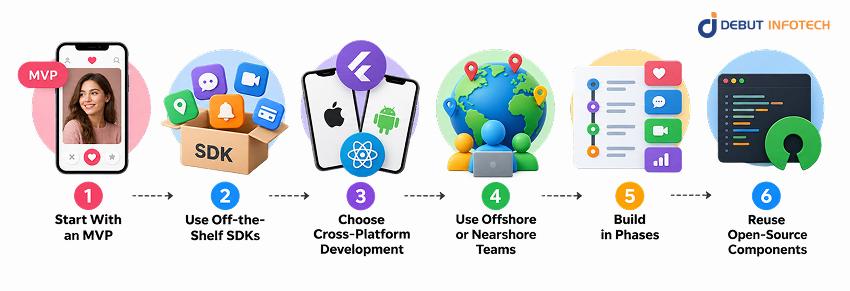
The safest way to reduce the cost to build an app like Badoo is to control the initial scope. Removing unnecessary features from the first release lowers development hours without reducing the quality of the core product.
Launch the functions that support the main dating journey:
Defer AI matching, live streaming, advanced analytics, background checks, complex gamification, and other secondary features until the product has enough users and data to justify them.
An MVP also gives the business a way to test its monetization model. If users are not engaging with the basic experience, adding more expensive features will not solve the underlying problem. A focused first release makes it easier to see what users actually value.
Building chat, video, maps, payment processing, notifications, and verification systems from scratch can add thousands of development hours. Established SDKs can reduce that workload.
The tradeoff is recurring vendor cost. For example, communication providers can charge based on monthly active users or usage. The right decision depends on projected volume and how strategically important the feature is.
Flutter or React Native can reduce duplicated work when the same product needs to support iOS and Android. A shared codebase can make an MVP cheaper to develop and maintain.
Native development can still be the better option when the application depends heavily on platform-specific functionality or requires specialized performance.
Regional development rates can create significant savings. Teams in Eastern Europe, India, Southeast Asia, and other lower-cost regions can offer lower hourly rates than many US or Western European teams.
However, rate should not be the only selection criterion. Review relevant portfolio work, architecture practices, QA processes, communication, and post-launch support.
A phased roadmap connects development spending to business results. Launch the core matching and communication experience first. Add subscriptions when engagement is sufficient to support monetization. Introduce video when users show demand for it. Add advanced AI once sufficient behavioral data is available.
This approach prevents the business from funding expensive features before there is evidence that users want them.
Open-source libraries can reduce development time for common technical functions. They may help with authentication, image processing, database access, analytics, UI components, and other routine tasks.
Every dependency should still be reviewed for security, maintenance activity, compatibility, and commercial licensing before it is used in production.
The final cost to develop a dating app like Badoo depends on the build approach, feature complexity, platform strategy, team location, infrastructure, safety tools, legal requirements, and ongoing maintenance.
Start with the core dating experience, validate demand, and add advanced features as the product gains traction. A phased approach helps control spending while leaving room for AI matching, video, verification, subscriptions, and other features as the business grows.
Building a dating app like Badoo requires more than developing profiles, swiping, and chat. The application also needs reliable backend architecture, secure payments, real-time communication, moderation, and a mobile experience that performs well as the user base grows.
Debut Infotech is a top technology company offering mobile app development services that help businesses turn dating app concepts into scalable mobile products. Our team can handle UI/UX design, cross-platform or native development, backend engineering, third-party integrations, testing, and post-launch support.
With a focus on practical product development, we can help you define an MVP, control development costs, and build a roadmap for advanced features such as AI matching, video calling, subscriptions, and verification.
Building an app like Badoo can cost around $40,000 to $150,000 for a basic to advanced version. A feature-rich platform with AI matching, video calls, location-based discovery, strong moderation, and scalable infrastructure can exceed $200,000. The final price depends mainly on features, design complexity, technology choices, integrations, and development team rates.
The cost of developing a dating app in 2027 can range from $30,000 to $200,000 or more. A basic MVP will sit toward the lower end, while apps with AI matchmaking, video features, subscriptions, advanced security, and real-time communication cost more. Development location, platform choice, integrations, and ongoing maintenance also affect the final budget.
Developing an app like Badoo usually takes around 4 to 9 months, depending on the scope. A basic MVP with profiles, matching, messaging, and search can take about 3 to 5 months to build. A larger product with video calls, AI recommendations, subscriptions, moderation, admin tools, and advanced security may require 6 to 12 months.
An app like Badoo needs user registration, profile creation, photo uploads, location-based discovery, search filters, swiping or matching, private messaging, push notifications, and reporting tools. More advanced versions can include video calls, AI-powered recommendations, subscriptions, virtual gifts, verification, geolocation, social login, content moderation, and an admin dashboard for managing users and activity.
Start by defining the target audience, core features, revenue model, and MVP scope. Then create the UX/UI design, choose the technology stack, develop the backend and mobile apps, integrate payments and communication tools, and add security controls. After testing, launch the app, monitor user behavior, fix issues, and gradually introduce advanced features based on real feedback.
A Badoo-like dating app can use technologies such as React Native or Flutter for cross-platform mobile development, Node.js or Python for backend services, and PostgreSQL or MongoDB for data storage. AWS, Google Cloud, or Azure can handle hosting and scaling. WebSockets support real-time messaging, while services such as Stripe can manage payments.
A Badoo clone app can cost between $30,000 and $150,000, depending on how closely it matches the original platform. A simple clone with profiles, matching, chat, and search costs less. Adding video calls, AI matching, subscriptions, verification, moderation, location services, and a custom UI can significantly increase development costs.
You can reduce development costs by starting with an MVP rather than building every feature up front. Use cross-platform development, third-party APIs, cloud services, and proven frameworks where practical. Keep the first release focused on matching, profiles, messaging, and payments. You can then add video, AI, advanced analytics, and other features as your user base grows.
Our Latest Insights

USA
2501 Chatham, Rd Suite R Springfield, IL 62704
+1-708-515-4004
info@debutinfotech.com
UK
7 Pound Close, Yarnton, Oxfordshire, OX51QG
+44-770-304-0079
info@debutinfotech.com
Canada
154 Eden Oak Trail, Kitchener, ON N2A 0H9
+1-708-515-4004
info@debutinfotech.com
INDIA
Sector 101-A, Plot No: I-42, IT City Rd, JLPL Industrial Area, Mohali, PB 140306
9888402396
info@debutinfotech.com