ON THIS PAGE
Progress0%






Our Global Presence :


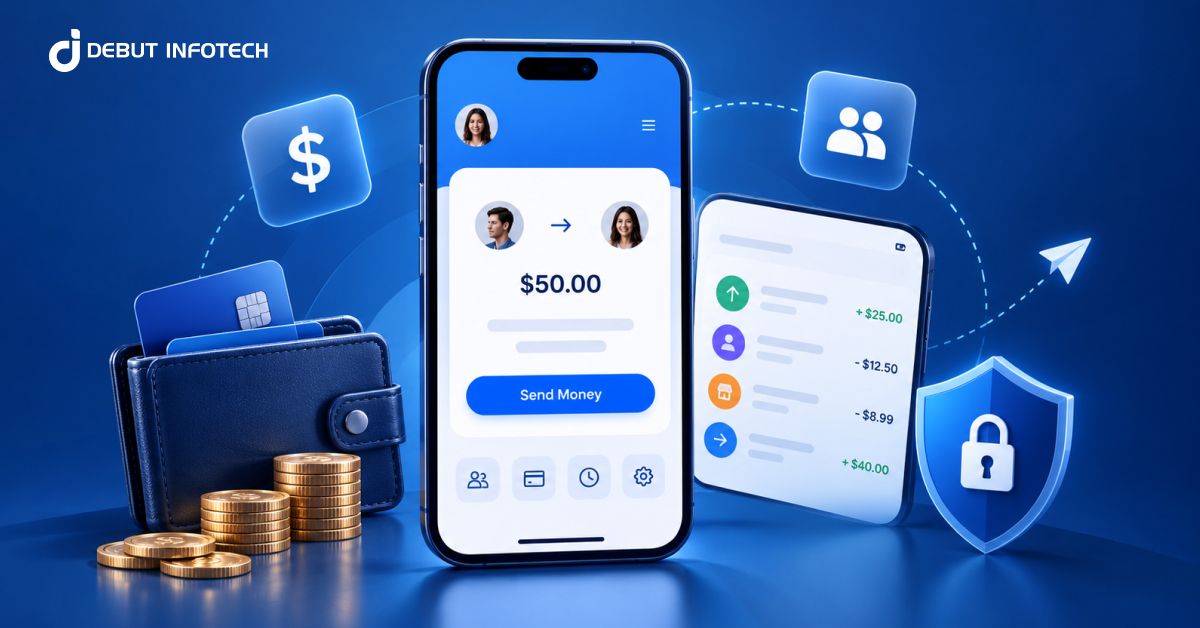


Payment app development costs depend on scope and complexity: A limited MVP can start at $15,000, while more comprehensive platforms require customized estimates based on integrations, transaction workflows, and infrastructure.
An MVP should prioritize secure payment workflows: Account registration, identity verification, money transfers, transaction tracking, authentication, and administrative controls establish the foundation for a reliable P2P payment app.
Third-party financial APIs can reduce custom development effort: Providers such as Plaid and payment processors support specific financial functions, but businesses must understand their capabilities, integration requirements, and contractual limitations.
Payment infrastructure and security significantly influence development costs: Bank transfers, instant withdrawals, ledger management, fraud monitoring, reconciliation, and applicable PCI DSS requirements add engineering and operational complexity.
Technology selection should reflect transaction requirements and scalability: Flutter, React Native, Node.js, PostgreSQL, and cloud platforms such as AWS are potential options, depending on the application's architecture and expected transaction volume.
Implementation timelines depend on external financial and compliance dependencies: Product planning, financial partnerships, UX design, development, testing, and gradual rollout must be coordinated, with provider onboarding and regulatory reviews potentially extending launch schedules.
Ongoing operating expenses must be included in the first-year budget: Payment processing, cloud hosting, identity verification, fraud monitoring, maintenance, customer support, and compliance costs should be forecast alongside initial development expenses.
Sending money via Venmo is instant, but building the network that makes such transactions possible is a long process that involves a lot of planning and investment.
The cost of building payment apps such as Venmo can vary from around $58,500 for a scalable MVP to $325,000 for an extensive platform, depending on the illustrative development scenarios. The final investment is based on the function of your product, payment system, security system, and technical complexity.
One important consideration is how much of the payment system your business intends to build versus what established financial service providers can handle. This decision will impact on development costs, regulatory duties, transaction processing and the cost of maintaining the application once it has gone live.
This guide examines Venmo like app development costs, essential features, technology choices, and realistic implementation timelines. You’ll also learn how to allocate your budget, assess development proposals, and identify opportunities to reduce expenses while building a reliable and secure payment platform.
Two payment apps can deliver almost the same experience to the end-user while having vastly different development budgets. The difference is usually in the things that occur after each transaction. An application that relies on a known provider for money transferring services will involve less custom engineering than one which is designed to control a handful of payment networks, deal with complicated transaction states, as well as offer a broad set of financial services.
The cost of Venmo-like app development can vary from $58,500 for a basic MVP to $325,000 for a more sophisticated platform. The table below illustrates the effect of development scope on budget.
A payment app’s development budget depends on the transaction features, third-party integrations, security requirements, and technical infrastructure needed for its intended users. A startup launching a focused payment solution through an established payment provider will have different requirements from a business developing a comprehensive peer-to-peer payment platform.
Debut Infotech’s basic MVP development pricing starts at $15,000 for a limited application scope. More sophisticated payment applications require additional investment, particularly when they involve multiple financial integrations, reconciliation systems, fraud detection, and complex transaction workflows.
| App complexity | Estimated cost | Project scope |
| Basic MVP | Starting at $15,000 | User registration, payment requests, basic transfers, transaction history, and one payment integration |
| Mid-Level Application | Custom estimate based on requirements | Multiple payment features, withdrawals, enhanced transaction tracking, notifications, and administrative controls |
| Advanced Platform | Custom estimate based on requirements | Broader payment integrations, advanced fraud management, business features, and scalable transaction infrastructure |
The $15,000 starting point applies to a limited MVP and should not be interpreted as the cost of reproducing Venmo’s complete payment infrastructure. It assumes substantial reliance on an existing payment provider and a tightly controlled development scope.
Mid-level and advanced projects require separate estimates based on the number of supported platforms, transaction workflows, financial integrations, security requirements, and testing commitments.
Third-party transaction fees, payment provider onboarding, regulatory approvals, external security assessments, and ongoing infrastructure expenses may also require separate budgets.
A helpful estimate will be in the form of a breakdown of engineering hours, not a final project cost. The initial investment is made in product design, application development, backend infrastructure, integrations and testing.
For instance, enabling bank-funded transfers and instant withdrawals adds extra integration and transaction handling requirements to a single transfer option.
The estimates are based on the defined software development scope and are not the overall costs of operating a financial service. The regulatory arrangements, charges by payment providers, independent security evaluation and post launch operational costs should all be allocated as separate cost items.
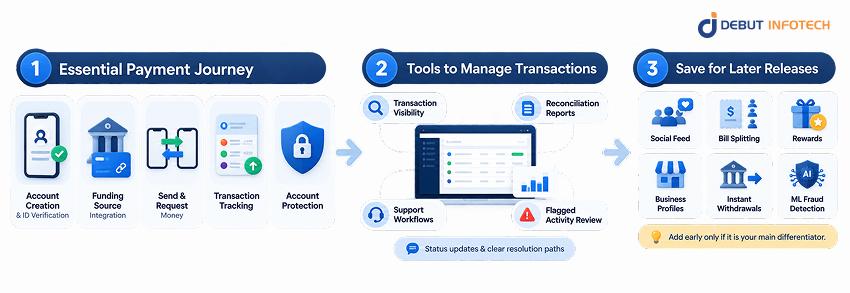
The first question your first release should address is whether you can enable customers to send money from one person to another without needless hassle, and whether your business can see every single transaction?
That means focusing on the payment experience, and the systems that drive it. For peer-to-peer payment app development, a well-defined minimum viable product (MVP) should include the functionality needed to complete transactions, manage exceptions, and support customers when something goes wrong.
Don’t overload the initial release with too many features, structure it around the activities customers are going to use.
These functions create the customer-facing building blocks of a payment application such as Venmo. But a seamless payment experience depends on what goes on behind the interface too.
Administrative functionality deserves to be taken into consideration when planning the MVP. Your team should have the ability to view transaction information, reconciliation reports, customer support workflows and flagged activity review tools.
Think of a customer who has a transfer accepted but returned by their bank. The application should be updated with the new status and should keep its records, and should give a clear resolution procedure. Even a well designed application can be hard to use if it doesn’t have these functions.
Social payments feeds, bill splitting, reward, business profiles, and instant withdrawals may be implemented if they are studied and found valuable by the customer. As the number of transactions grows and as more behavioral data becomes available, advanced machine learning payment fraud detection can also be valuable.
The exception is the functionality that forms the basis of your product’s differentiation. For instance, bill splitting might be a part of the MVP if it’s the main feature in the use case.
The goal is to launch a product that provides a full, manageable payment experience before moving on to features that add to the development and operation burden.
Not all payment options need to be engineered alike. Some are relatively easy to develop at the user interface level, others require the involvement of financial institutions, third party APIs, and transaction processing systems. These differences can substantially influence the P2P payment app development cost, particularly when businesses introduce more payment methods or take on additional operational responsibilities.
Knowing where that complexity comes from aids in estimating development effort with precision, and prevents costly changes once development is underway.
One of the biggest factors to consider in digital payment app development is the transfer of funds from one account to another. Working with an existing financial service provider can lessen the infrastructure that your team needs to build on its own. But this arrangement still needs to be technically integrated, monitored for transactions, and have clear responsibilities.
The inclusion of ACH transfers, card funding or instant withdrawals changes the processing rules and the settlement requirements. For instance, the insufficient funds or unauthorized activity of ACH transactions may result in the transaction being returned for further processing, and reconciliation logic is required.
Applications with stored balances also require more complex ledger management and controls on fund availability. These requirements go beyond the first transfer functionality and add to engineering effort.
Developing for both iOS and Android devices can impact the development resources, especially when businesses opt for different native applications. While cross-platform frameworks can help mitigate some of the duplicated interface work, there will still be platform-specific testing and payment integrations required.
The budget also is affected by integration requirements. The integration of a payment gateway can include API setup, authentication, management of payment events, and compatibility testing. Further adding financial data providers, notifications services or extra payment networks expands the systems that developers need to coordinate.
Custom social features will have their own set of requirements. Payment feeds, privacy settings and interaction controls must be backed by additional functionality in the backend, and not just an extra screen.
For financial applications, it is necessary to have protections beyond just user authentication. The development workload includes such elements as encryption, access controls, transaction monitoring, and the secure handling of sensitive information.
Specific compliance requirements are determined by the operating model, financial partners and rules applicable to a product. If the transaction is card-funded, the amount of cardholder data processed also has implications for the corresponding PCI DSS requirements.
The implementation of advanced fraud controls may require extra development effort in the form of risk scoring, behavioral monitoring and investigation workflows. Meanwhile, there is a need to test for duplicate requests, network failure, concurrent transfers and unexpected provider responses to ensure reliable transaction processing.
These factors can be considered jointly in project planning. An initial engineering estimate that excludes necessary transaction security or integration needs does not have a lot of benefit.
The technology of a payment application should be more than a responsive interface. It needs to maintain the accuracy of transactions, interact with financial service providers, and manage updates without losing vital information.
The ideal payment app development stack will vary depending on the nature of the product, the skills of the engineering team, and the amount of financial infrastructure to be built in-house.
Several technologies are used for various applications. The following is a list of items that can be used in a practical stack:
| Technology component | Recommended options | Purpose |
| Mobile development | Flutter, React Native, Swift, Kotlin | Build responsive applications for iOS and Android |
| Backend development | Node.js, Java, .NET | Manage business logic, transactions, and API communication |
| Database | PostgreSQL | Maintain structured transaction and account records |
| Background processing | RabbitMQ, Apache Kafka | Process asynchronous events and transaction updates |
| Cloud infrastructure | AWS, Microsoft Azure, Google Cloud | Host application services, databases, and monitoring systems |
| Financial integrations | Plaid, compatible payment processors | Support bank account connections and eligible money movement services |
These are examples of technologies that might be used, but not every project has to use them. A smaller application might work well with a fairly basic back end architecture, but another platform with a higher number of transactions might require more specialized services.
The backend needs to keep an accurate log of each payment as it progresses through the various processing stages. A transfer could start off as pending, be confirmed by a provider or be placed in the queue after a failed transaction.
Developers can use idempotency keys to prevent repeated requests from unintentionally creating duplicate payments. Authenticated webhooks relay updates from the provider while audit logs and reconciliation procedures can be used to determine if the internal records agree with transaction reports from the provider.
Financial integrations should also be chosen based on their functional abilities. For example, Plaid Auth can verify bank accounts, but needs a bank payment processor to transfer money.
A proper structure ensures that these roles are defined from the outset and provide a platform on which businesses can build and develop their payment capabilities.
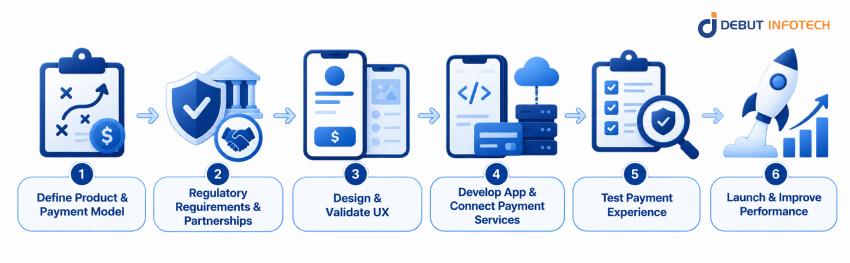
Turning a payment app concept into a working product requires coordination between software developers, financial service providers, and compliance teams. The development process should establish how transactions will work before committing resources to building the application.
Businesses planning to build an app like Venmo can follow these six stages to move from initial requirements to a market-ready product.
Identify your target customers, intended payment activities, and revenue model. Map how funds will move between users, including which organizations will process transactions and maintain the underlying financial accounts.
Engage appropriate legal and compliance specialists to determine applicable obligations. Evaluate potential banking and payment partners, confirm their supported services, and establish responsibility for transaction processing, verification, and operational oversight.
Create wireframes and interactive prototypes showing how customers will navigate the application. Test important workflows with representative users, resolve usability concerns, and finalize the requirements for the initial release before development begins.
Build the mobile interface, backend services, and supporting administrative functionality. Integrate approved financial service APIs, configure transaction workflows, and establish secure communication between the application and external providers.
Test more than successful transfers. Simulate interrupted connections, delayed confirmations, unsuccessful payments, and other exceptional conditions. Conduct security assessments, verify financial record accuracy, and resolve critical issues before release.
Begin with a controlled rollout involving a limited group of eligible users. Monitor transaction completion, service reliability, customer feedback, and operational incidents before expanding access.
Development milestones should also account for external dependencies. Banking approvals, provider onboarding, contractual reviews, and compliance assessments may take longer than the software engineering itself, making early coordination essential to a realistic launch schedule.
Launching your application marks the beginning of another financial commitment. As customers register, initiate transfers, and use different services, the business incurs expenses that weren’t necessarily covered by the initial development contract.
These ongoing expenses should be considered when estimating the cost to develop a payment app like Venmo, particularly if the business expects transaction volumes to grow significantly during its first year.
| Operating expense | What affects the cost |
| Payment processing | Transaction volume, funding methods, network charges, and provider pricing |
| Cloud hosting and monitoring | Application traffic, storage requirements, system availability, and infrastructure usage |
| Identity verification and fraud monitoring | New customer registrations, verification checks, transaction screening, and fraud investigation services |
| Maintenance and updates | Software patches, operating system updates, integration changes, and defect resolution |
| Customer support | Support staffing, transaction inquiries, payment disputes, and account recovery requests |
| Compliance and security | Required assessments, independent audits, security reviews, and ongoing regulatory obligations |
Some providers also charge monthly platform fees, impose minimum commitments, or require financial reserves. These arrangements should be reviewed carefully because reserves affect available working capital even when they aren’t direct operating expenses.
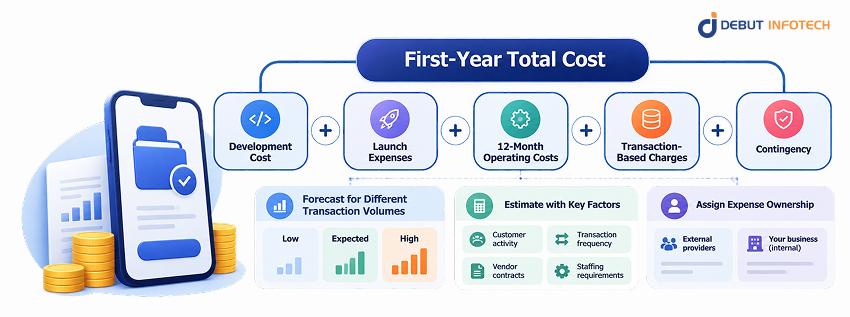
A useful financial forecast should combine the initial investment with expected operating expenses:
First-Year Total Cost = Development Cost + Launch Expenses + 12-Month Operating Costs + Transaction-Based Charges + Contingency
Instead of relying on a fixed maintenance percentage, estimate expenses using expected customer activity, transaction frequency, vendor contracts, and staffing requirements.
Prepare forecasts for low, expected, and high transaction volumes. This helps identify when increasing usage may require additional infrastructure, customer support resources, or revised provider agreements.
Assigning responsibility for each expense also makes it easier to distinguish services covered by external providers from those your business must manage internally.
A development company’s ability to deliver an attractive mobile interface doesn’t necessarily mean it can build a dependable payment application. Financial software requires a deeper understanding of transaction workflows, third-party integrations, operational risks, and long-term system maintenance.
When evaluating payment app development companies, look beyond portfolio screenshots and project quotations. Pay attention to how each team approaches the following areas:
Before signing an agreement, request a detailed scope of work outlining project deliverables, acceptance criteria, payment milestones, and procedures for managing changes. A well-defined proposal should also explain the development approach, integration requirements, and potential technical limitations. This provides a more reliable basis for comparing development partners than pricing alone.
As a custom mobile app development company, Debut Infotech helps businesses plan and develop applications tailored to their technical and operational requirements. For projects involving peer-to-peer payments, digital wallets, or third-party financial integrations, our team can discuss your proposed features, development scope, and implementation requirements to help you make informed decisions before development begins.
Developing a payment application requires more than bringing payment features together. Businesses need a reliable technical foundation that supports secure transactions, financial integrations, and future expansion. At Debut Infotech, we bring over 15 years of software engineering experience to building custom digital solutions for startups and enterprises.
Our portfolio reflects our experience handling complex financial workflows. For HDFC Life, we developed HDFC Life Insta, a digital insurance platform that simplifies policy sales through premium calculations, digital transactions, and secure document management. Our work with NDAX, a Canadian cryptocurrency exchange, further demonstrates our experience in financial technology. We helped develop its wallet and exchange ecosystem, incorporating secure transactions, multi-chain functionality, and portfolio management capabilities. The platform has supported over $12 billion in cumulative trading volume.
We apply this experience to our digital payment app development services, helping businesses evaluate payment integrations, define essential features, and plan scalable application architectures.
Whether you’re developing a peer-to-peer payment app like Venmo or expanding an existing digital payment platform, our team can help assess your requirements, establish development milestones, and prepare a project-specific cost estimate.
Licensing requirements depend on how the business handles customer funds and which jurisdictions it serves. Some applications operate through licensed financial partners, but these arrangements don’t automatically remove every regulatory obligation. In the United States, businesses should assess federal FinCEN requirements and applicable state money transmission laws with qualified legal counsel.
Venmo earns revenue through services such as business payment fees and instant transfer charges. Other peer-to-peer payment apps may adopt similar models or introduce subscription plans and premium business features. The right monetization strategy depends on customer behavior, processing expenses, competitive pricing, and whether the proposed revenue streams can support operating costs.
Yes. Third-party APIs can help businesses connect bank accounts, verify customer information, and facilitate supported transfers without developing every financial component internally. However, providers perform different functions. Plaid Auth, for instance, supports bank account connections but requires a compatible payment processor to move funds. Businesses must also assess provider eligibility, integration requirements, and contractual obligations.
A mobile wallet provides access to payment methods and, depending on its design, may support stored balances or purchases. A P2P payment app focuses on transferring money between individuals. These functions often overlap, as applications like Venmo combine wallet capabilities with person-to-person transfers. Their technical and regulatory requirements depend on the actual financial services offered.
Not every application needs a custom machine learning payment fraud detection system at launch. Appropriate authentication, transaction limits, monitoring, and investigation procedures should still be established from the beginning. Businesses can also evaluate existing fraud detection services before investing in proprietary models. More advanced AI payment app development capabilities may become worthwhile as transaction activity and risk-management needs increase.

Our Latest Insights
USA
2501 Chatham, Rd Suite R Springfield, IL 62704
+1-708-515-4004
info@debutinfotech.com
UK
7 Pound Close, Yarnton, Oxfordshire, OX51QG
+44-770-304-0079
info@debutinfotech.com
Canada
154 Eden Oak Trail, Kitchener, ON N2A 0H9
+1-708-515-4004
info@debutinfotech.com
INDIA
Sector 101-A, Plot No: I-42, IT City Rd, JLPL Industrial Area, Mohali, PB 140306
9888402396
info@debutinfotech.com