ON THIS PAGE
Progress0%






Our Global Presence :





The cost to develop an app like Tinder depends on scope and complexity: Illustrative budgets range from $60,000–$100,000 for a focused MVP to $200,000–$300,000 for an advanced platform, based on assumed development hours and a $50 hourly rate.
A focused dating app MVP should prioritize core functionality: User profiles, discovery, mutual matching, text messaging, reporting, blocking, and basic moderation help validate the product before investing in advanced features.
Technology choices influence development costs and maintenance requirements: Prebuilt clone scripts, cross-platform frameworks such as Flutter and React Native, and native iOS and Android apps involve different trade-offs in customization, code reuse, testing, and long-term ownership.
Dating app development timelines depend on feature scope and project coordination: A focused MVP may take 4–6 months, an expanded commercial release 6–9 months, and an advanced platform 9–15 months, excluding app store approval time.
User safety and moderation must be included in the initial development plan: Age-related access controls, reporting, blocking, identity verification, and moderation workflows address different risks and can affect engineering effort and operational costs.
First-year ownership costs extend beyond initial development: Cloud infrastructure, messaging, media storage, third-party services, security updates, maintenance, customer support, and content moderation should be budgeted separately according to expected usage.
Comparing development proposals requires more than evaluating price: Businesses should assess deliverables, acceptance criteria, source-code ownership, security testing, third-party dependencies, maintenance responsibilities, and commercial terms before selecting a dating app development company.
The cost to develop an app like Tinder depends on what you need to launch: your platforms, matching features, messaging system, and user-safety workflows.
For example, if a project is estimated at 2,000 hours with a blended rate of $50/hour, this would be $100,000 worth of development hours. This is a budgeting example, not a market average or project quotation, hosting and ongoing moderation and maintenance have to be budgeted separately.
For founders, the first decision is which features will help an initial community discover and connect safely. Profiles and swiping are just a portion of that range. This guide will help you understand how launch requirements, technology options, and AI capabilities impact the budget and timeframe. It also offers a scope comparison and first year cost model to assist you in evaluating estimates prior to committing to development.
For initial planning, the model below places a focused dating app MVP at $60,000–$100,000, an expanded commercial release at $120,000–$180,000, and an advanced platform at $200,000–$300,000. These are only illustrative budgets based on assumed delivery hours and a blended $50 per hour rate (not market averages or Debut Infotech quotations).
The estimates are based on one launch market, English-language support, cross-platform iOS and Android applications, shared backend, and a web-based administration panel. Development effort includes discovery, design, engineering, project management, testing and preparation for release.
| Planning scenario | Included scope | Assumed total effort | Illustrative build cost at $50/hour | Indicative delivery window |
| Focused MVP | Profiles, preference-based discovery, mutual matching, text chat, reporting, blocking, and basic moderation tools | 1,200–2,000 hours | $60,000–$100,000 | 4–6 months |
| Expanded commercial release | MVP scope plus subscriptions, verification integration, advanced filters, and deeper analytics and moderation workflows | 2,400–3,600 hours | $120,000–$180,000 | 6–9 months |
| Advanced platform | Expanded scope plus custom recommendations, richer communication, and more demanding performance and operational requirements | 4,000–6,000 hours | $200,000–$300,000 | 9–15 months |
The delivery windows are planning assumptions for a small multidisciplinary team, which is working at overlapping stages. Total hours are total team hours, not actually time elapsed. Store approval dates are excluded.
Use the scenario closest to your launch requirements, then replace the assumed hours and rate with an itemized proposal. For example, an expanded release scoped at 2,800 hours would produce this labor estimate:
2,800 hours × $50 per hour = $140,000.
Rate changes also matter. At the same scope, assuming an $75 cost per hour, would cost $210,000, not counting separately billed costs. A lower per-hour rate should be considered in conjunction with effort, deliverables and acceptance criteria.
These Tinder-like app development cost figures do not include continuous hosting, third party usage fees, moderation personnel, customer support, marketing, taxes, and post-launch enhancements. Any contingency allowance should appear separately. The advanced scenario also represents a defined new product, not a reproduction of Tinder’s global infrastructure.
Use each range as a blank template. A project quote that is usable should clearly define the scope of work, boundaries of the work excluded and assumptions that might impact the cost.
Your MVP should enable the user to go through one journey: create a profile, find suitable people, match, and start a conversation. It also requires the controls your staff will utilize for account management and problem resolution. When building a dating app MVP, it is important to have a clear understanding of this experience before implementing additional features that increase the investment without proving a correct business assumption.
The following matrix separates a practical launch scope from potential later additions.
| Feature area | Include at launch | Consider later | Why the distinction matters |
| Registration and profiles | Sign-in, age-related access controls, consent, photos, preferences, and profile editing | Social integrations and additional profile formats | Each connection introduces permissions and testing requirements |
| Discovery and matching | Basic preferences, approximate-location discovery, likes, and mutual matches | Advanced filters and personalized recommendations | Custom ranking requires additional logic, data, and evaluation |
| Communication | Text messaging between matches, notifications, and unmatching | Voice notes and video calls | Richer communication adds media handling and testing |
| User protection | Reporting, blocking, content review, and support access | More advanced detection and review automation | Reports need a response process from the first release |
| Administration | Moderation queues, account actions, staff permissions, and basic analytics | Custom dashboards and extensive automation | Staff need tools to operate the service |
| Data controls | Privacy settings, account deletion, and defined retention workflows | Additional controls informed by user feedback | Account changes must work across connected systems |
A feature list is helpful if it specifies behavior you expect. In messaging, define whether the users can send pictures and what happens to the conversations after blocking or after unmatching. For discovery, set the search radius and the location’s presence to other users. These decisions help developers estimate the same scope.
Include monetization when it supports the launch experiment. A single paid offering might be enough to demonstrate willingness to pay; multiple subscription levels and boosts add more additional purchase and entitlement processes.
In addition, for an online dating site, differentiate age validation, ID verification, and photo verification. They are all related to a different type of risk. Define the protections your product requires and assign responsibility for reviewing reports before launch.
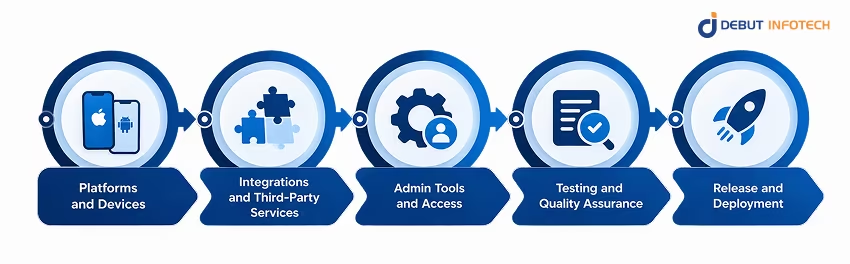
The largest budget differences often sit behind familiar features. “Messaging” could mean integrating a managed service or building a custom delivery system. “Discovery” could involve basic preference filters or personalized ranking. To estimate your Tinder-like dating app development cost, define the behavior, workload, and responsibilities behind each requirement.
With shared code, supporting iOS and Android still demands support for the respective platforms, testing on devices and preparing releases. Design and testing work for custom gestures, animations and accessibility behavior. Define supported devices and necessary interactions in the early stages or vendors can quote varying levels of compatibility and polish.
More effort is matched as the rules dictate who shows up, how profiles are ranked, and when they are recommended to change. Managed services lower the number of infrastructures your team is building, but still require integration for real-time communication. Custom messaging adds work to delivery, reconnection, synchronization and monitoring. Compare both implementation effort and provider dependencies before choosing an approach.
A verification provider’s API is only part of the implementation. If a check fails, it could need to be retaken, restricted or manually reviewed. Evidence capture, case histories, staff permissions and escalation paths could be considered examples of moderation. For each additional workflow you will include screens, backend logic, and acceptance tests to describe what the response should be, not what the feature should be called.
Registered-user counts provide limited guidance for backend estimates. More useful inputs are the concurrent conversations, discovery requests, photo uploads and retention periods. For instance, larger photo galleries impact upload handling, storage, delivery and content review. Provide developers with measurable workload assumptions to help them make capacity and performance-testing decisions
Multiple languages expand interface, notification, and testing requirements. Other markets may add further privacy, payment and distribution issues that should be assessed.
Other delivery arrangements impact dating platform development costs. Define the roles of approving designs, providing content, handling integrations, and approving finished work. If teams make late decisions or there are unclear ownerships, teams will need to go back and revisit the connected components, adding effort with no visible features.
These choices come from dealing with two decisions. A clone script provides existing code that can be customized; cross-platform and native development are the method of building the mobile applications. A prebuilt script can use either approach, so assess its foundations before comparing implementation costs.
| Approach | Potential fit | Main budget consideration |
| Prebuilt clone script | Existing functionality closely matches your launch requirements | Licensing, code assessment, customization, and dependency updates |
| Custom cross-platform app | iOS and Android share most screens and workflows | Shared implementation plus platform-specific integrations and testing |
| Separate native apps | Distinct platform experiences or demanding integrations justify separate mobile codebases | Separate interface development, specialist staffing, and coordinated maintenance |
With Tinder clone app development, the purchase price tells you little about the effort needed to launch your product. Ask for a code review and a demonstration of what you need. Examine modification rights, documentation, upgrade plan, and how the application can be maintained by another development team. When major changes are made to core workflows, buying prebuilt code loses some value.
Flutter can be used for code reuse across operating systems, while React Native can support platform-specific implementations. In both scenarios, developers must deal with platform variations.
In your proposal, identify what will be shared and what will need to be done separately. Think of native development if there are identifiable integration or experience requirements that warrant the extra effort.
Other aspects of the dating app tech stack include backend services, a database, matching algorithms, messaging, media storage, and moderation features. These components can serve either shared or separate mobile codebases.
When comparing mobile app development services, evaluate the complete architecture, ownership terms, and maintenance plan alongside the initial build estimate.
A focused MVP may take 4–6 months to build, while an expanded release could take 6–9 months. An advanced product may require 9–15 months. The precise schedule will be determined by agreed requirements, team capacity, timeline of third party services, and speed of decision making.
The dating app development process typically kicks off with discovery, which entails gathering details from the audience, launch features, integrations, and success milestones. This is followed by design and prototyping. Once key screens and workflows are approved, developers can build the mobile apps, backend, and administration tools, with testing taking place throughout.
There are some tasks which can be executed concurrently, but undecided decisions can cause delays in dependent tasks. For instance, if the matching rules change after development begins, it can impact discovery screens and logic. Delays can also occur because a verification or payment provider requires time to set up.
Think of the dating app development timeline as a set of milestones, where there are clear deliverables, review dates and dependencies. Allow time for beta feedback and release preparation, then plan store review separately. A completed build sets the stage for launch; it does not guarantee a particular approval date.
The cost to maintain a dating app like Tinder depends on how many people use it and how much support they need. Hosting is just one aspect of the budget. There are other costs involved with messaging, photo storage, bug fixes, security updates, moderation and customer support, which are all ongoing costs. Try to estimate these costs based on expected use, not an arbitrary percentage of the initial build costs.
Use a first year model that monitors the number of monthly active users, messages sent, photos uploaded, verification checks and support requests. These inputs relate activity of the products to operating needs. For instance, the more photos are uploaded, the more storage and delivery costs will be incurred, and the more reports will be submitted, the more moderator time will be needed. Evaluate the services selected using provider pricing, and document date and assumptions for each estimate.
Separate ongoing costs into three groups:
If the product is a subscription or other digital product, consider payment processing fees or charges from the app store. These are dependent on the payment arrangement you select, so be sure to verify any applicable fees prior to publishing your budget. Marketing and user acquisition should be included in the overall business plan but separately from the technical operating expense.
The result is a more useful first year ownership estimate: the initial build cost plus 12 months of technical operations and maintenance and service operations. List one-time setup charges separately from recurring charges and provide a usage scenario to help readers understand what might change in the future as the platform expands. This provides you with a more solid foundation to use when comparing launch estimates and planning the next release.
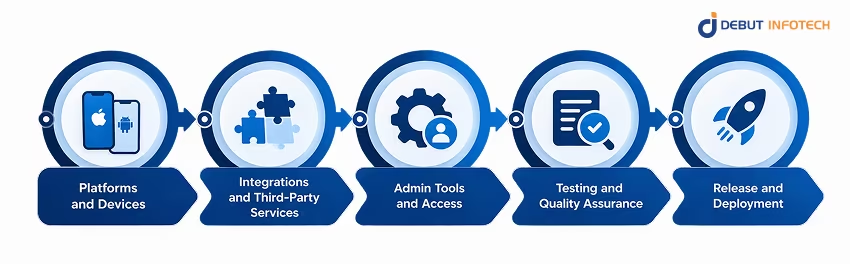
Provide shortlisted developers with the same written scope and request that they write down assumptions. This will make it easier to determine the difference in price. Before you hire dating app developers to create an application like Tinder, you should find out if each proposal includes all of the identical platforms, integrations, administration tools, testing and release obligations.
Compare these commitments:
Have vendors describe their proposed scope of launch and how it will enhance a useful discovery experience in your first community. A registration target is not a guarantee of achieving the discovery of relevant profiles and the initiation of conversations by members. The proposal should outline what you will measure during the pilot and what results will be used to determine additional investment.
Lastly, ask for evidence of similar work and discuss the team’s real impact. A good reason to evaluate is being able to show a relevant demonstration or a documented architecture decision, or a client reference, rather than an unsupported promise of fast delivery.
At Debut Infotech, we bring over 15 years of software development experience, with a portfolio of more than 300 completed projects across industries such as healthcare, fintech, and entertainment. Our technical expertise spans native iOS and Android development, cross-platform applications, AI integration, and custom software solutions.
Through our mobile app development services, we help businesses turn their ideas into functional, scalable applications while making informed decisions about development costs, technical architecture, and long-term maintenance.
Whether you’re building a basic matchmaking platform or a feature-rich dating app with AI-powered recommendations, real-time messaging, identity verification, and subscription management, our team can help identify essential features, evaluate integration requirements, and establish a practical development roadmap.
Share your project goals, target audience, preferred platforms, and budget expectations with Debut Infotech. We’ll work with you to define the development scope and prepare a tailored cost estimate covering design, engineering, testing, and post-launch support.
A dating app MVP should support the core user journey: sign-up, profile creation, discovery, mutual matching, and messaging. It also needs reporting, blocking, and basic moderation tools so users and staff can respond to problems. During dating app MVP development, prioritize features that test your product’s main assumption; add video calls or advanced recommendations when user feedback supports them.
A clone script may help if its existing features closely match your requirements and you can modify and maintain its code. Before choosing Tinder clone app development, check the license, code quality, customization limits, security update process, and data ownership terms. Custom development gives you more control over product behavior, but the cost depends on the scope you define.
Common models include subscriptions, paid boosts, and in-app purchases for added visibility or other optional features. The best fit depends on your audience and the value users receive. Decide what belongs in the free experience and what users might pay for, then include only the purchase flows needed to test that model at launch.
At minimum, plan for users to report and block others, and give staff a way to review reports and act on accounts. Age-related access controls, identity checks, and photo moderation address different risks. The right dating app development solutions should define these workflows, who handles cases, and how users can contact support.
Start with a specific audience and launch area where users can find enough relevant profiles to make discovery worthwhile. Reach potential members through community partnerships, targeted campaigns, and referral programs, then track profile completion, matches, and conversations. A concentrated early community can provide more useful product feedback than registrations spread across a broad region.
Yes. Cross-platform frameworks can share much of an app’s code across iOS and Android, though platform-specific behavior and testing still matter. Your dating app tech stack should fit the required integrations, user experience, and team’s maintenance plans. Separate native apps may make sense when platform needs differ substantially.
Our Latest Insights
USA
2501 Chatham, Rd Suite R Springfield, IL 62704
+1-708-515-4004
info@debutinfotech.com
UK
7 Pound Close, Yarnton, Oxfordshire, OX51QG
+44-770-304-0079
info@debutinfotech.com
Canada
154 Eden Oak Trail, Kitchener, ON N2A 0H9
+1-708-515-4004
info@debutinfotech.com
INDIA
Sector 101-A, Plot No: I-42, IT City Rd, JLPL Industrial Area, Mohali, PB 140306
9888402396
info@debutinfotech.com