ON THIS PAGE
Progress0%





Our Global Presence :


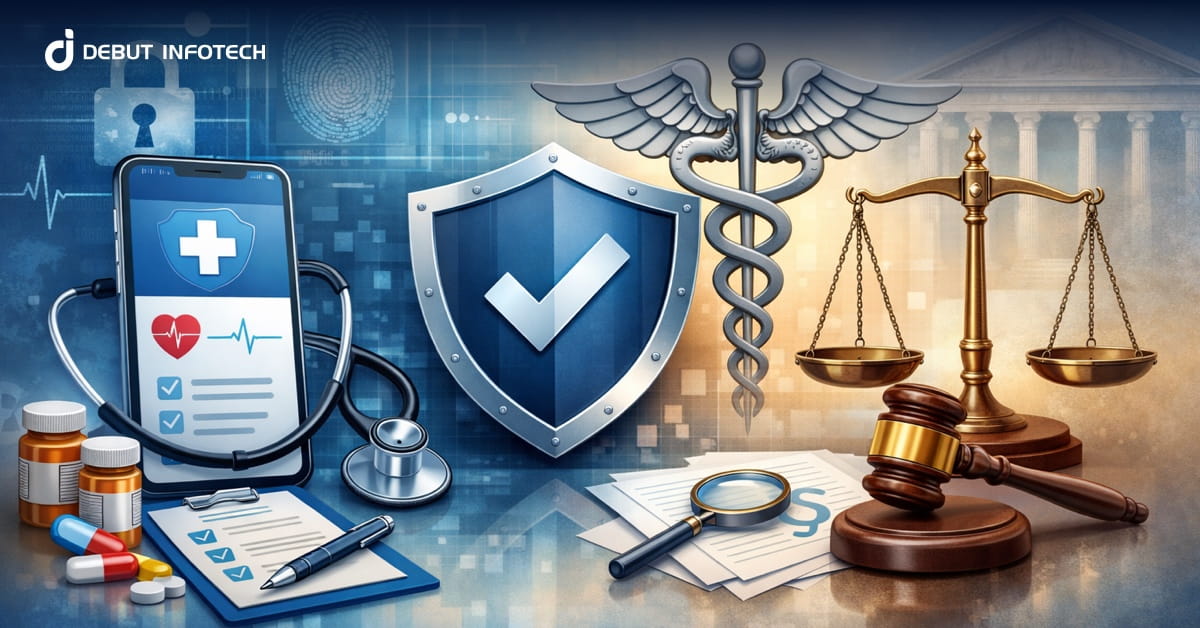


The development of healthcare apps is advancing rapidly due to improvements in mobile technology, data analytics, and digital health solutions. Mobile health apps are becoming an important aspect of modern medical delivery. They include telemedicine platforms, remote patient monitoring tools, and fitness and wellness apps. But with new ideas comes a greater duty to follow rigid rules and laws. As of 2026, app developers and organizations still need to pay close attention to legal and regulatory compliance in healthcare.
Healthcare apps handle highly sensitive patient information, including medical records, diagnostic data, and personal identifiers. If you don’t follow the rules, you could lose patient trust, get fined, have your reputation hurt, and have your data stolen. This tutorial explains what regulatory compliance means in the development of healthcare apps, why it matters, and how companies can address complex compliance requirements in 2026. It also discusses typical problems, best practices, and how technology can help ensure rules are followed without getting in the way of new ideas.
Regulatory compliance in healthcare refers to the process of adhering to laws, regulations, standards, and guidelines designed to protect patient safety, privacy, and data security. These regulations govern how healthcare data is collected, stored, processed, shared, and accessed across digital systems.
When discussing legal and regulatory compliance in healthcare, it includes both national and international frameworks such as data protection laws, healthcare-specific regulations, and cybersecurity standards. Compliance requirements vary depending on the app’s functionality, the type of data processed, and the geographic regions where the app is deployed.
For healthcare app developers, regulatory compliance extends beyond backend systems and data storage. It also applies to user interfaces, authentication methods, consent management, data sharing mechanisms, and third-party integrations. Ensuring compliance requires collaboration between legal teams, developers, security professionals, and regulatory compliance specialists.
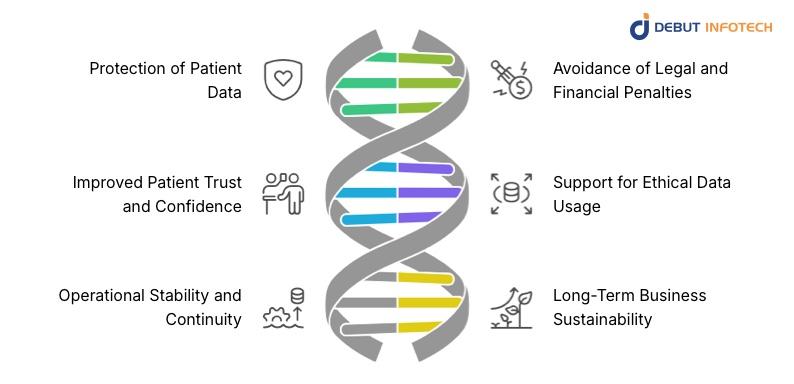
What is the importance of regulatory compliance in healthcare. Regulatory compliance plays a critical role in ensuring the safety, security, and reliability of healthcare systems. As digital health solutions continue to evolve, compliance is essential for protecting patients, organizations, and the broader healthcare ecosystem.
Also Read: The Ultimate Guide: Healthcare Mobile App Development.
A common question in healthcare organizations is who is responsible for regulatory compliance in healthcare for sharing patient data. The answer often depends on the organization’s size and structure, but responsibility is typically shared across multiple roles.
At a strategic level, senior leadership is accountable for ensuring compliance frameworks are in place. Compliance officers or regulatory compliance specialists oversee implementation, audits, and policy updates. In healthcare app development projects, product managers, developers, and security teams also play a direct role in ensuring compliance requirements are met throughout the app development process.
In many cases, organizations appoint a dedicated regulatory compliance specialist in healthcare to monitor regulatory changes, manage compliance documentation, and coordinate with development teams. This collaborative approach helps ensure compliance is integrated into both technical and operational workflows.
Healthcare app development in 2026 is influenced by a range of global and regional regulations. While specific requirements vary by location, several regulatory frameworks continue to shape compliance strategies worldwide.
Data protection laws such as HIPAA, GDPR, and other regional privacy regulations define how patient data must be handled and protected. These laws govern consent management, data minimization, breach notification, and patient rights over their data.
Healthcare-specific regulations focus on patient safety, clinical accuracy, and interoperability. Apps that support diagnosis, treatment, or clinical decision-making may be subject to additional regulatory oversight. Developers must also consider data-sharing regulations, especially when apps integrate with electronic health records or third-party systems.
Understanding these regulatory frameworks is essential for building compliant mobile healthcare apps that can scale across markets.
One of the most complex aspects of healthcare app development is regulatory compliance for sharing patient data. Data sharing is essential for interoperability, care coordination, and analytics, but it also introduces significant compliance risks.
Healthcare regulations require explicit patient consent before data can be shared, along with clear disclosure of how and why the data will be used. Secure data transmission, encryption, and access controls are mandatory to prevent unauthorized access.
In 2026, regulatory compliance in healthcare industry settings increasingly emphasizes transparency and accountability. Healthcare apps must provide audit trails, consent management tools, and mechanisms for patients to control their data. Failure to comply with these requirements can result in severe penalties and loss of user trust.
Related Read: Why mHealth App Development Matters in Modern Healthcare?
While regulatory compliance is essential, implementing it within healthcare app development presents several practical challenges. These issues often stem from regulatory complexity, operational constraints, and user experience considerations.
Regulatory compliance monitoring in healthcare is an ongoing process rather than a one-time activity. Healthcare apps must continuously monitor data access, system activity, and security events to maintain compliance.
Monitoring tools help detect anomalies, unauthorized access attempts, and potential breaches early. Automated alerts and reporting mechanisms support faster incident response and regulatory reporting when required.
In 2026, compliance monitoring is increasingly integrated into healthcare app architectures. This proactive approach reduces risks and supports continuous improvement in compliance practices.
As regulatory requirements grow more complex, many healthcare organizations are moving away from manual compliance processes. Manual workflows often rely on spreadsheets, checklists, and fragmented documentation, which increases the risk of errors and missed regulatory updates. In contrast, compliance automation provides a more reliable and scalable approach to managing regulatory obligations.
Compliance automation integrates regulatory checks directly into the healthcare app development lifecycle. Automated tools can track compliance requirements, monitor system activity, and generate audit-ready reports. This approach not only reduces administrative burden but also improves consistency across development, deployment, and maintenance phases.
In 2026, automation is increasingly viewed as a necessity rather than an optional enhancement. Healthcare organizations that adopt automated compliance frameworks are better equipped to adapt to regulatory changes without disrupting their mobile app development timeline.
One of the key advantages of automation is its ability to reduce regulatory fines and penalties. Compliance failures often occur due to delayed responses, incomplete documentation, or human oversight. Automated systems help address these issues by enforcing compliance rules in real time.
Automated compliance tools can continuously monitor access logs, data usage, and security events. When anomalies or violations are detected, alerts are triggered immediately, allowing teams to take corrective action before issues escalate. This proactive approach significantly lowers the likelihood of regulatory breaches.
Additionally, automation simplifies audit preparation. Instead of manually compiling compliance evidence, healthcare organizations can generate reports that demonstrate adherence to legal and regulatory compliance in healthcare. This level of preparedness reduces financial and legal risks during regulatory reviews.
Security and compliance go hand in hand in healthcare app development, as regulatory requirements depend on strong data protection measures. Encryption and access controls help safeguard sensitive patient data and ensure only authorized users can access it.
Security solutions also support compliance by enabling continuous monitoring and incident response. Intrusion detection systems, vulnerability scanning, and regular penetration testing help identify weaknesses before they are exploited. By embedding security into the app development process, organizations strengthen both compliance and overall system resilience.
To maintain consistent regulatory compliance, many healthcare organizations choose to hire dedicated mobile app developers with experience in healthcare standards. Dedicated teams help reduce compliance risks by applying secure data handling and regulatory best practices throughout the mobile app development process.
Ongoing compliance monitoring is essential for maintaining regulatory alignment throughout the lifecycle of a healthcare app. Regulations evolve, new threats emerge, and system usage patterns change over time. Without continuous monitoring, even compliant systems can drift out of alignment.
Regulatory compliance monitoring in healthcare involves tracking system activity, user access, data flows, and policy adherence. Automated monitoring tools help ensure that compliance controls remain effective and up to date.
In 2026, many healthcare organizations will adopt real-time monitoring dashboards that provide visibility into compliance status across applications. These tools enable faster decision-making and help teams respond quickly to potential issues, reducing both operational and regulatory risks.
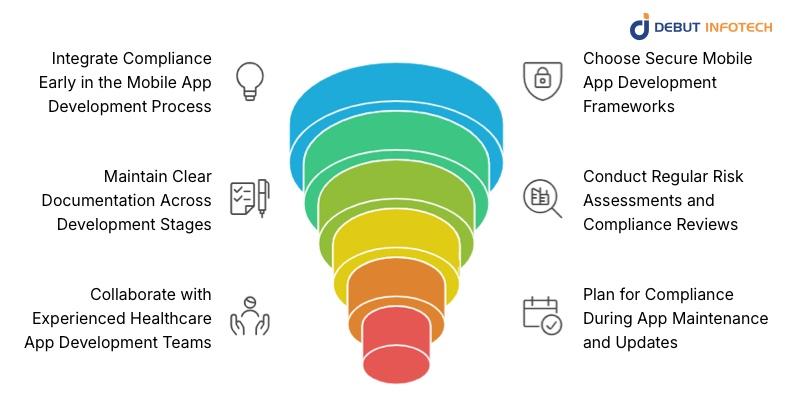
Building compliant healthcare applications requires a proactive and structured approach throughout the process and the mobile app development cost. Regulatory requirements should be considered from the earliest planning stages to ensure compliance is embedded in both the technical architecture and the user experience.
Small and mid-sized healthcare organizations often face added complexity when managing regulatory compliance due to limited resources and operational constraints. Understanding these challenges helps SMBs plan more effective compliance strategies.
To overcome these challenges, many healthcare SMBs adopt compliance automation and work with managed healthcare app development services. This approach provides access to specialized expertise while reducing operational overhead and regulatory risk.
Healthcare compliance continues to evolve alongside technological advancements and evolving regulatory expectations. In 2026, increased emphasis is placed on interoperability, data transparency, and patient control over personal information.
Artificial intelligence and automation are playing a growing role in compliance monitoring and risk management. Predictive analytics and intelligent monitoring systems help organizations anticipate compliance risks and respond proactively.
As mobile healthcare technology advances, regulatory frameworks are expected to become more standardized across regions. This shift may simplify the deployment of cross-border healthcare apps while maintaining strong data protection and patient safety standards.
Debut Infotech supports healthcare organizations in navigating complex regulatory landscapes by embedding compliance into every stage of healthcare app development. From planning and architecture design to deployment and ongoing maintenance, compliance is treated as a core requirement rather than an afterthought.
Our healthcare app development services focus on secure data handling, regulatory alignment, and scalable architecture. By combining technical expertise with an understanding of healthcare regulations, we help organizations build mobile healthcare apps that meet both operational and compliance goals.
Whether you are developing a new healthcare application or modernizing an existing system, Debut Infotech provides the guidance and technical support needed to ensure long-term legal and regulatory compliance in healthcare.
A. Regulatory compliance in healthcare app development refers to adhering to laws and standards that govern patient data protection, privacy, security, and clinical safety. These regulations ensure healthcare apps handle sensitive information responsibly and legally.
A. Legal and regulatory compliance in healthcare is important to protect patient data, avoid legal penalties, and maintain trust. Non-compliance can lead to fines, operational restrictions, and reputational damage.
A. Regulatory compliance is typically a shared responsibility involving leadership, compliance officers, legal teams, and technical staff. In healthcare app development, developers and security teams also play a critical role in meeting compliance requirements.
A. A regulatory compliance specialist in healthcare monitors regulatory changes, ensures policies align with legal requirements, and supports audits and reporting. They act as a bridge between regulatory bodies and internal teams.
A. Common challenges include evolving regulations, data security risks, manual compliance processes, and balancing usability with security controls. These challenges are especially common in small and mid-sized healthcare organizations.
A. Compliance automation reduces manual effort, improves accuracy, and supports real-time monitoring. It helps healthcare organizations detect issues early and reduces the risk of regulatory fines.
A. Security solutions such as encryption, access controls, and continuous monitoring help meet regulatory requirements for data protection. Strong security practices are a foundational part of compliant healthcare app development.

Our Latest Insights

USA

2501 Chatham, Rd Suite R Springfield, IL 62704
+1-708-515-4004
info@debutinfotech.com
UK

7 Pound Close, Yarnton, Oxfordshire, OX51QG
+44-770-304-0079
info@debutinfotech.com
Canada

154 Eden Oak Trail, Kitchener, ON N2A 0H9
+1-708-515-4004
info@debutinfotech.com
INDIA

Sector 101-A, Plot No: I-42, IT City Rd, JLPL Industrial Area, Mohali, PB 140306
9888402396
info@debutinfotech.com

9001:2015
Quality Certified

ISO 27001
Security Certified

A+ Rating
Accredited Business

Certik
Security & Audit


Copyright © 2026, Debut Infotech. All rights reserved. | Privacy Policy