ON THIS PAGE
Progress0%






Our Global Presence :





Real estate is having its “digital twist” moment with the rise of tokenized real estate marketplaces. These digital platforms offer real estate investors the opportunity to convert physical real estate assets into tokens that can be bought by clicking icons on a screen. Consequently, more investors can now own a piece of illiquid real estate assets rather than owning them outright.
So, there’s no need to wire a huge amount of money, wait for long periods before confirmation, or go through excess paperwork just because you want to own a piece of real estate. Tokenized real estate marketplaces now serve as intermediaries between investors and the market, with tokens as the currency. It’s the same income-producing property. It’s just that it is now easier to buy, hold, and trade in tiny fractions thanks to tokenized real estate marketplaces.
Property investment has now become a digital affair, and there’s so much to unlearn and relearn to function excellently in this emerging real estate tokenization marketplace. From the new regulations to the mind-blowing possibilities, this article breaks down all the things you need to know about how tokenized real estate marketplaces are shaping the future of property investment and provides some step-by-step instructions to help you tokenize real estate commodities successfully.
Tokenized real estate marketplaces are digital platforms that convert the ownership or economic rights of real estate assets into compliance-aware digital securities that investors can hold, purchase, or transfer. These online real estate marketplaces let investors buy digital tokens tied to a building (usually via an SPV/trust) by purchasing tokens tied to those tokens. For example, you might own £500 worth of a logistics facility or a slice of a multifamily asset, all from the comfort of your electronic device, anywhere in the world, without having to depend on brokers, reading through bulky docs, or any multi‑week settlement.
On a tokenized real estate marketplace, tokens are issued as compliance-aware digital securities, such as ERC-3643 or ERC-1400 tokens, to ensure that only KYC/AML‑verified investors can hold or transfer them. And on that note, the identities of investors and any other parties involved are handled by on‑chain registries (e.g., ONCHAINID), while transfer rules enforce jurisdiction, accreditation, and lock‑ups. Finally, ongoing actions and payments such ash as corporate actions like dividends and rent, can be automated using smart contracts.
The implication of this novel real estate tokenization marketplace is that it narrows the gap between traditional properties (which are usually illiquid by the way) and the broader, more modern real-world assets (RWA) movement. This is because it provides fractional access, programmable compliance, and optional regulated secondary trading. And that’s a good thing for the real estate market.
Blockchain technology is the reason it is possible to tokenize real estate properties. When it comes to real estate investments, security and safety are some of the most important concerns you need to address due to the sheer volume of the financial transactions involved in these kinds of investments. However, because blockchain technology is decentralized and secure, investors can rest assured that transactions are transparent and tamper-proof. This is one of the key realities that enable blockchain to power the marketplace.
Every token issuance, transfer, and distribution is traceable and auditable, which is exactly what regulated assets need.
In addition to transparency, traceability, and auditability, blockchain technology also supports smart contracts, which automate transaction rules. So, for instance, if an investor is approved and the window is open, a transfer settles; if not, it fails. As a result, there are fewer intermediaries between parties, shorter settlement times, and stronger audit trails in the real estate tokenization marketplace.
But tokenization is not only on‑chain. The legal wrapper (SPV/trust), property management, valuation, and custody remain off‑chain and must be tightly integrated. When the off‑chain legal truth is kept in sync with the on‑chain record, you get a market that’s transparent, efficient, and regulator‑ready. (This is precisely what Dubai’s DLD + VARA pilot aims to demonstrate.)
Related Reads: Step-By-Step Guide To Launching a Real Estate Tokenization Platform
So, what makes a real estate tokenization marketplace tick?
Below, we have highlighted key technological components and units that play major roles in making a tokenized real estate platform more efficient for property investment.
Token standards are a set of rules, protocols, and specifications, or crucial blueprints that dictate how digital tokens should behave and interact within a particular blockchain ecosystem, such as a particular tokenized real estate platform. They essentially specify how individual tokens are created, issued, and managed on the blockchain.
For example, the ERC‑3643 (T‑REX) somewhat addresses identity and transfer controls within the token; ERC‑1400 adds document anchoring and partitioned tranches. Both interoperate with ERC‑20 tooling for broad ecosystem support.
These technological components provide a secure, scalable, and audit-friendly approach to managing user and machine identities. For example, ONCHAINID/VCs attach eligibility to wallets in the form of jurisdiction, accreditation, and sanctions, so that the system checks and confirms each transfer before it is authorized for settlement. This way, the system preserves the privacy of the entire system while making sure evidence is provable
These are third parties who have been delegated the task of securing and managing the private keys for the real estate tokens. For a tokenized real estate marketplace to work, there needs to be assurances that the keys for accessing the real estate tokens can not be compromised, and that’s exactly what token custodians guarantee. For instance, qualified custodians or MPC wallets with segregation and disaster‑recovery procedures have now become a regulatory expectation in hubs like ADGM.
Fiat rails or regulated stablecoins (MiCA’s EMT/ART in the EU) streamline distributions and redemptions. They work together to ensure settlement can occur in real time on a blockchain network. This is how the blockchain network ensures that anyone can purchase the real estate unit of their choice at near-instant speed.
We’ve mentioned on multiple occasions that tokenized real estate marketplaces inject a much-needed liquidity into the illiquid real estate markets. But how does this happen?
The following are some explicit ways through which tokenized marketplaces boost liquidity.
Through tokenized marketplaces, real estate property owners can divide their property into smaller units, represented as digital tokens on a blockchain network. The implication is that it was previously illiquid because buying the entire property at once requires a large cash outlay, which can be difficult for a single person to provide.
However, by converting to tokens, it is easier for multiple people to afford the smaller units. As a result, breaking a single asset into thousands of tokens creates more price points, more participants, and higher potential turnover.
Unlike paper‑heavy traditional real estate markets, tokenized real estate marketplaces can operate non-stop for 24 hours a day, 7 days a week. They’re digital, and everything is automated. Therefore, anyone can buy or sell tokens at anytime they please.
Furthermore, secondary venues can operate extended hours within regulated parameters, thus significantly improving the time‑to‑exit from certain trade positions relative to legacy processes. In general, this 24/7 access makes it easy for traders to convert their digital tokens to cash without losing much value, and that is what better liquidity is all about.
Once again, the friction often encountered when real estate owners seek to convert their properties or assets into cash can be greatly reduced with the help of blockchain technology and smart contracts. For example, smart contracts in particular already automate some of the processes involved in converting assets to cash.
Some of these standardized processes that have been automated include standardized disclosures and KYC/AML verification checks. With this high level of automation, tokenized real estate marketplaces can reduce manual ops, cut costs, and compress settlement times—key ingredients for healthier secondary markets.
Tokenization doesn’t guarantee liquidity. Research shows RWAs often under‑trade due to a lack of market‑making, data transparency, and venue quality. The fix: list on proper ATS/MTF, appoint liquidity providers, publish regular valuations, and avoid vague “buyback” promises that can create solvency risk.
Related Reads: How Real Estate Tokenization on Blockchain Works
So, let’s assume you wanted to convert your real estate property to a token today.
How would you go about it?
We’ve been doing this for years at Debut Infotech Pvt Ltd, and we have now decided to share a summarised our approach into the most effective and consequential sets for yo u to follow:
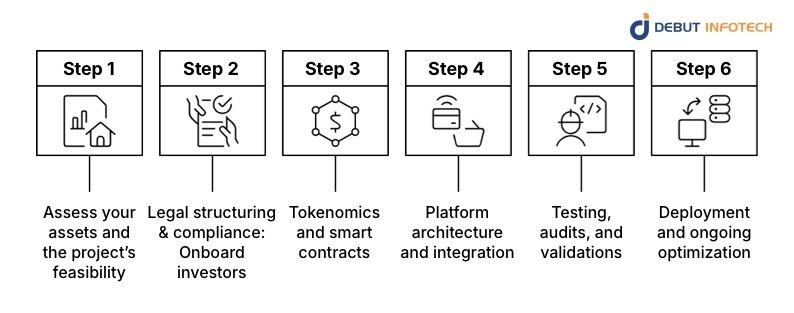
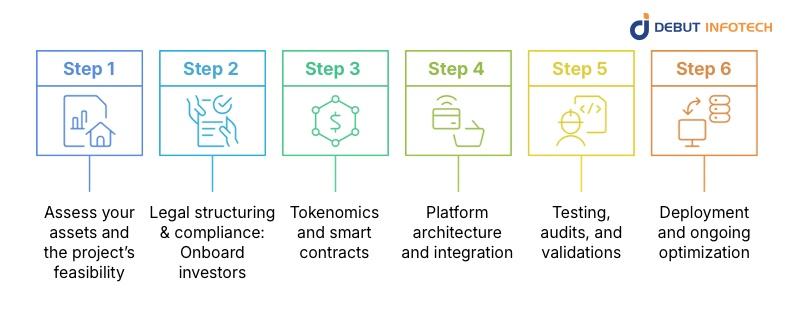
A major reason for our success at Debut Infotech Pvt Ltd over the years is that we take the time to evaluate your property portfolio, investment goals, and regulatory constraints before we take any action. A closer look at these parameters helps us to define the optimal tokenization approach while balancing all legal, financial, and technical considerations.
Once we have done all these, we choose a cash‑flowing property and form the SPV/trust. Map offering docs and investor rights to the chain via ERC‑1643 document references.
Having received clear direction, our legal and technical teams now begin collaborating to create a jurisdictional setup and establish criteria for investor eligibility. The purpose of this step is to ensure that tokens are issued only within a secure, enforceable framework. Therefore, this is the time to run KYC/AML and accreditation checks, and issue verifiable credentials so eligibility can be checked programmatically without resubmitting documents.
With the secure and enforceable framework in place, you can now start designing asset-backed token structures, defining ownership rules, and developing secure smart contracts. Doing this helps you automate ownership transfers, dividend distributions, and cap table management.
More specifically, you can deploy ERC‑3643/1400 with transfer rules (jurisdiction, lockups, per‑wallet caps).
The next step is to task engineers with actually building the online real estate marketplace platform. This is the tangible infrastructure that supports investors and all trading activities. This platform includes investor onboarding (KYC\AML), digital wallets, secondary trading modules, and issuer dashboards, ready for white label tokenization platform development.
Doing all these makes your platform ready to accept fiat or regulated stablecoins, and to hold investor assets under qualified custody/MPC with segregation and incident playbooks (per ADGM‑style expectations).
With the initial structures in place, you need to rigorously test the functionality of all platform units, including the smart contracts, while also conducting thorough compliance checks to ensure the online real estate marketplace aligns with industry regulations, investor protections, and performance standards.
Your tokenized real estate marketplace is now live and accessible to the public. At this point, you should ensure ongoing monitoring, performance tuning, regulatory updates, and platform enhancements to keep the tokenized real estate marketplace you have launched constantly evolving with the wider market demands.
Below, we have highlighted some of the most successful tokenization projects we have worked on here at Debut Infotech Pvt Ltd.
Challenge: Streamline operations across 7,000+ units, enable fractional ownership, slash paperwork.
Solution: Debut Infotech delivered a compliance‑native platform (ERC‑3643 + ERC‑20 interoperability) with on‑chain identity registries and programmable transfer rules aligned to Dubai’s evolving framework.
Results: 7,000+ units tokenized, ~90% paperwork reduction, and regulator‑aligned processes—showing how large portfolios can digitize without sacrificing control.
Challenge: Improve liquidity, enhance perceived value, and accelerate access to growth capital.
Solution: A smart‑contract‑driven issuance and distributions stack with ERC‑20‑compatible rails for exchange connectivity.
Results: +40% perceived asset value via transparent fractional access, 85% transaction automation, and improved liquidity readiness through standardized rails.
Using XRP Ledger technology (Ctrl Alt/Prypco Mint), the Dubai Land Department piloted tokenized property in 2025 with VARA support in what is now loosely called the XRP Dubai real estate tokenization project. With registry synchronization and a published projection that tokenized transactions might account for about 7% of the market by 2033, early stages focused on fractional participation. The headline is that a government register merged with a public chain under oversight, not “which chain won.” The message for company executives is clear: a feasible route to scale is public-chain openness, regulator guardrails, and registry sync.
Tokenized real estate marketplaces are taking an old‑school asset and giving it a modern upgrade—simpler access, stronger auditability, and the potential for orderly liquidity. The regulatory pieces are falling into place (Dubai, EU, UK), and the tech stack is enterprise‑ready (ERC‑3643/1400, identity wallets, professional custody). The firms that win won’t just mint tokens; they’ll orchestrate the full stack—legal, identity, custody, venues, and data—so investors and regulators can trust the rails.
If you would like to navigate all these with clarity and precision, you may need the guidance of an asset tokenization development company like Debut Infotech Pvt Ltd. Reach out to us today!
A. A platform where ownership of property is represented as compliant digital tokens you can buy, hold, transfer, and (where permitted) trade on regulated venues, with KYC/AML controls built into the token itself.
A. ERC-1400 for partitions/tranches and document anchoring; ERC-3643 (T-REX) for identity-gated, compliance-by-design transfers. Institutional platforms frequently cite both.
A. Tokenized real estate with licensing for issuance, custody, and (optionally) trade is being piloted in Dubai/UAE by DLD + VARA.
EU: Tokenized securities are still governed by the MiFID II + DLT Pilot, while stablecoins and CASPs are governed by MiCA.
UK: Secondary trading requires MTF/OTF authorization; promotions are subject to FCA regulations.
A. No. Transparent data, market-making, and venue design all contribute to liquidity. Numerous RWAs under-trade without these, according to studies. Don’t presume liquidity; instead, design for it.
A. We are an asset tokenization development company that offers tokenization-as-a-service and white label tokenization platforms, including ERC-3643/1400 issuance, KYC/identity, custody, corporate actions, and ATS/MTF connectivity. Case studies include Futurm One (+40% perceived asset value; 85% automation) and AlFahim Group (7,000+ units tokenized; ~90% savings in paperwork).

Our Latest Insights
USA
2501 Chatham, Rd Suite R Springfield, IL 62704
+1-708-515-4004
info@debutinfotech.com
UK
7 Pound Close, Yarnton, Oxfordshire, OX51QG
+44-770-304-0079
info@debutinfotech.com
Canada
154 Eden Oak Trail, Kitchener, ON N2A 0H9
+1-708-515-4004
info@debutinfotech.com
INDIA
Sector 101-A, Plot No: I-42, IT City Rd, JLPL Industrial Area, Mohali, PB 140306
9888402396
info@debutinfotech.com