ON THIS PAGE
Progress0%






Our Global Presence :


According to a Deutsche Bank Report, 2025 has been a significant year for asset tokenization, and momentum continues to build as we enter 2026, with the total market size for tokenized assets rising from a measly USD 4 billion in 2019 to a whopping USD 331 billion in November 2025. This branch of crypto was developed to increase liquidity, reduce the entry barrier to certain investments, and improve efficiency, especially for assets like diamonds.
Diamonds come in different shapes, sizes, and qualities; every stone is unique. While this adds to its allure, it also makes it a tedious investment instrument because there is no standard to follow. So, it is generally harder for investors to navigate the intricacies surrounding diamond investments.
However, thanks to the blockchain and the miracle of diamond tokenization, the once difficult-to-enter market is now more accessible than ever. In this article, we break down the myths surrounding diamond tokenization by explicitly stating its main purpose, how diamond tokenization works, its benefits, and tangible use cases that businesses like yours can capitalize on to get the most from this emerging market.
Basically, we’re saying there are countless investment opportunities for you to explore in diamond tokenization, and the key is understanding how it works and knowing where to look.
Here at Debut Infotech Pvt Ltd, we offer tokenization as a service, including tokenized diamonds. Come, let’s show you how to maximize the opportunities!
The tokenization of real world assets is a broad and emerging field, comprising different subsets, one of which is diamond tokenization. In particular, diamond tokenization is the comprehensive and systematic process of turning ownership rights to physical diamonds stored in a secure location into what you can essentially call crypto diamonds, or blockchain-based digital tokens. Effectively, anyone who has access to these ‘crypto diamonds’ can lay ownership claims to the physical diamonds or the financial gains from their investments.
There’s probably more to that oversimplification; however, that’s the crux of diamond tokenization.
Each token represents a real, verifiable diamond in secure custody. While the token is clearly not the diamond itself, it is a digital certificate of ownership, one that can be fractionalized, transferred, and traded.
Despite being one of the world’s most valuable commodities, the diamond market is illiquid, pricing is opaque, there are high accessibility barriers, and, well, authentication concerns. It is why it takes a lot of back-and-forth to sell diamonds physically.
Compared with other assets such as silver and gold, there is no “standard” for diamonds because of their uniqueness. The 4Cs determine the value of each stone: cut, clarity, color, and carat. As a result, pricing is subjective (which adds to the reason why it is so hard to sell).
So, instead of relying on paper certificates, intermediaries, and closed marketplaces, tokenized diamonds operate within programmable, verifiable blockchain systems.
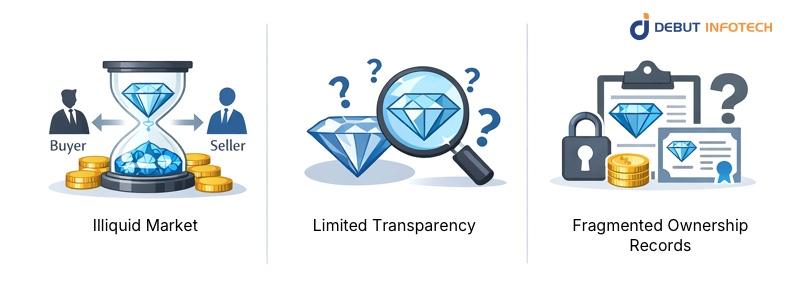
To understand the value of diamond tokenization, it helps to look at the problems baked into the traditional diamond market.
Diamonds are incredibly expensive, as you may well know.
Therefore, it means that selling or buying them is restricted to only a few high-net-worth individuals or institutions. Consequently, it takes a rather longer period of time to trade them, hence, the ‘illiquid diamond market.
In addition, the resale market is highly fragmented, as you often find one too many intermediaries between a buyer and a seller trying to facilitate the trade. Again, this links to the fact that diamonds are incredibly expensive and scarce. Therefore, the market isn’t particularly favorable to individual sellers.
Another factor contributing to this is that there are no standardized pricing guides for trading diamonds, unlike for other precious metals like gold and silver. So, you’ll often find that the market is incredibly subjective and unpredictable. Sometimes, sellers are forced to offer steep discounts just to exit trading positions, at great financial cost. These liquidity constraints are why diamonds are not considered serious investment assets, despite their perceived value.
Despite the numerous intermediaries you’ll often find in the diamond market, the price of a diamond is often determined by something known as the 4Cs: Cut, Color, Clarity, and Carat.
Pretty straightforward, right?
Wrong!
Those 4Cs are still adjudged rather subjectively in the diamond trading market. Hence, there is little to no price transparency in diamond trading. The pricing data is neither transparent nor publicly accessible. Again, the numerous intermediaries involved are part of that. As a result, buyers often have to rely on dealer quotes, appraisals, and even private negotiations, creating an information imbalance that favors insiders over retail investors.
Verifying ownership is another issue that plagues traditional diamond investments. With more than one intermediary in the mix, so many things can go wrong with ownership records when purchasing diamonds.
For example, the ownership certificate may be lost, forged, or even disputed because they change hands so often. At the same time, custody arrangements can vary widely, and tracking a stone’s origin across borders is complex and inefficient.
All of these challenges, taken together, slow down transactions and fuel skepticism toward diamond investments.
Read this blog: Tokenization vs Traditional Asset Management: Key Differences
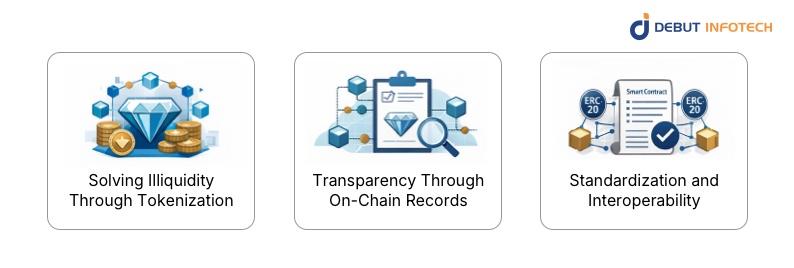
Diamond asset tokenization directly addresses the structural weaknesses of the traditional market by introducing blockchain-native solutions.
Crypto diamonds can be traded anywhere, expanding the market, so liquidity is no longer dependent solely on local dealers and private buyers. These diamonds can be traded on digital marketplaces and tokenization platforms, allowing buyers and sellers to trade without physically moving the underlying asset.
Another way tokenization solves the liquidity problem is by fractionalizing these assets, which significantly reduces the entry barrier for investors. With tokenization, even small investors can gain exposure to diamond investments.
Just as tokenize real estate commodities have unlocked liquidity in property markets, tokenized diamonds make it easier to enter and exit positions efficiently.
By nature, tokenized diamonds are represented on the blockchain. As such, they benefit from the immutable nature of blockchain technology, and that means that we can now keep an unchangeable record of the certification details, train of ownership records, provenance data, custody information, and basically any other vital chain of records that would usually be lost in transition in the traditional diamond trading market.
Everything is now stored on the blockchain, and we now have transparency because all that data is verifiable on-chain. As such, buyers can independently confirm authenticity and ownership without relying on third parties.
Traditional diamond trading used to be arbitrary, with intermediaries, buyers, and sellers dictating the terms of their trades as they saw fit. However, that is no longer the case with tokenized diamonds.
On a diamond tokenization app, sellers can now create an ERC-20 token with clear terms of trade and an exchange agreement. And all these can be standardized and enforced with smart contracts. By extension, standardizing these processes also leads to interoperability, as the same operational standards can now be duplicated across multiple trades and use cases. This ensures compatibility across wallets, marketplaces, and DeFi protocols.
A diamond token is only as trustworthy as the system backing it. Reputable tokenization platforms rely on:
Taking these measures ensures that each token remains fully backed and redeemable. It will then reassure investors that digital ownership corresponds to real-world value.
This custody-first approach is also a core principle around successful tokenization companies operating in the precious metals and commodities space.
A diamond tokenization app typically acts as the user interface between investors and the underlying blockchain infrastructure. Through these platforms, users can:
Professional asset tokenization development companies are behind the scenes of these platforms, powering them using smart contracts, custody integrations, and compliance modules. Depending on your needs, you could choose a white label tokenization platform (a pre-built, customizable solution) or opt for a fully custom solution for greater flexibility and absolute control over the intellectual property. Some of these platforms include Tiamonds (LCX), Spydra, Icecap Diamonds, and Zoniqx.
Tokenization drastically changes the game for people seeking to invest in diamonds. You don’t have to buy just one single high-value stone because you have the option to diversify across several diamonds through fractional ownership. You can rebalance your portfolios with ease and adjust your exposure based on the market.
Tokenized diamonds can also be used as collateral for loans and margin facilities, incorporated into structured products, including diversified commodity baskets, or combined with other tokenized assets, such as gold and real estate. This flexibility earns diamonds a seat alongside other digitally native investment instruments.
Diamond tokenization function at the intersection of commodities, digital assets, and financial regulation. Platforms must manage:
Navigating all these regulatory bottlenecks is why many projects rely on a Tokenization as a Service provider or hire a dedicated development team with experience in regulated asset markets.
Setting yourself apart from fleeting projects requires being compliance-first. It is not optional for sustainable platforms.
While trading and investment are the most obvious use cases, diamond tokenization enables a lot more. You could explore
Diamonds as collateral in traditional finance is not a sight you see very often. This is because the whole process is cumbersome, from valuation to custody, and even having to resell it if a buyer defaults. Tokenization has made this so much easier because these tokens are secured in verified custody and can be pledged as collateral through smart contracts. If a borrower defaults, the token’s control can automatically transfer to the lender without physical intervention or lengthy legal proceedings.
Yes, smart contracts again. The ownership transfer conditions for your tokenized diamonds can be defined in advance using smart contracts. For instance, tokens can be programmed to transfer to designated beneficiaries upon the occurrence of certain events, such as a verified death record.
Tokenized diamonds can be held fractionally, so you can control exactly how much of your portfolio is allocated to diamonds. You can also rebalance it over time and combine it with other tokenized assets, such as real estate.
Institutions can also gain diamond exposure without dealing with the complex operational burden, including vault logistics, manual reconciliation, or custody agreements. At best, it is a data-driven process.
With tokenized diamonds, investors from different regions can access the same assets without moving the diamonds themselves; they remain in secure custody. Settlements occur on-chain, and compliance checks can be automated within the platform. You don’t have to worry about shipping costs or customs clearance.
Read this blog: Diverse Tokenization Use Cases Across Industries
Diamond tokenization follows the same foundational logic as the tokenization of other real-world assets, but with unique advantages arising from structural and market factors.
Compared to real estate, diamonds are easier to store and transport, as they can be kept in secure vaults and transported across borders. In contrast, real estate is immobile, jurisdiction-dependent, and legally complex.
In relation to gold and silver tokenization, there are many similarities, as the same principles of fractional ownership, transparent custody verification, and integration with financial ecosystems underlie them. However, gold and silver are fungible assets, meaning one unit is interchangeable with another of the same purity, but diamonds are inherently non-fungible. As a result, diamonds require more sophisticated tokenization frameworks and valuation mechanisms. In return, diamonds offer significantly higher value density, enabling substantial wealth to be stored and transferred in a compact form.
In comparison to art tokenization, diamonds are graded using globally recognized standards and can obtain standardized certification. Art, on the other hand, relies heavily on subjective valuation and provenance disputes. So, diamonds have simpler verification processes, meaning there is less ambiguity in ownership and quality assessment.
Tokenized diamonds function as a compelling bridge between commodities and digital finance, combining the scarcity and tangibility of physical assets with the programmability and liquidity offered by blockchain technology.
While smart contracts are a crucial part of building diamond tokenization platforms, they are much more than that. You need to consult experts in
For this reason, many projects partner with an asset tokenization development company or explore tokenization platforms that already support commodity-backed assets.
Diamond tokenization is still early, but the direction is clear. As institutional interest in real-world asset growth and infrastructure matures, tokenized diamonds are likely to become a standard part of diversified digital portfolios. Its benefits, including increased liquidity, greater transparency, and accessibility, will reshape how diamonds are valued and traded globally—the once opaque, closed market is becoming open and borderless.
Diamond asset tokenization transforms an exclusive, illiquid market into a modern, accessible one. By tying each token to certified stones in secure vaults, blockchain platforms solve the classic diamond market’s problems of liquidity, transparency, and standardization. Investors gain the benefits of owning real gem-backed assets without the usual headaches.
A. Diamond tokenization is a form of real-world asset tokenization that makes diamonds more accessible by leveraging blockchain technology. It involves issuing digital tokens on a blockchain that represent ownership of a physical diamond held in secure custody. Ownership of these tokens allows you to trade them globally.
A. Tokenizing diamonds solves problems inherent to physical diamonds due to their uniqueness: liquidity, transparency, and standardization challenges. Because diamonds typically don’t have a universal standard, valuation is subjective to the point of unfairness, leading to liquidity and trust issues. However, tokenization introduces standardization and fractionality, making it easier to hold and trade this asset.
A. Yes, but as with any other investment, returns on these assets depend on factors such as diamond quality, platform credibility, and, of course, market conditions. Tokenized diamonds offer an opportunity to diversify your portfolio, have low correlation with the stock market, and have inflation-hedging potential. They are viable alternatives to traditional investments.
A. Yes, several diamond tokenization platforms, like Tiamonds, offer redemption options that allow token holders to exchange their digital tokens for the underlying physical diamond. The process is usually in line with the platform’s policies, which may include verification requirements and minimum thresholds. Upon redemption, the physical diamond is released from the secure vault storage and delivered to the owner.
A. While the underlying technology is similar, diamonds require more detailed certification and valuation models. However, tokenization provides the same benefits as gold and silver tokenization, including liquidity, transparency, and global access.

Our Latest Insights


USA

2501 Chatham, Rd Suite R Springfield, IL 62704
+1-708-515-4004
info@debutinfotech.com
UK

7 Pound Close, Yarnton, Oxfordshire, OX51QG
+44-770-304-0079
info@debutinfotech.com
Canada

154 Eden Oak Trail, Kitchener, ON N2A 0H9
+1-708-515-4004
info@debutinfotech.com
INDIA

Sector 101-A, Plot No: I-42, IT City Rd, JLPL Industrial Area, Mohali, PB 140306
9888402396
info@debutinfotech.com

9001:2015
Quality Certified

ISO 27001
Security Certified

A+ Rating
Accredited Business

Certik
Security & Audit


Copyright © 2026, Debut Infotech. All rights reserved. | Privacy Policy