ON THIS PAGE
Progress0%





Our Global Presence :


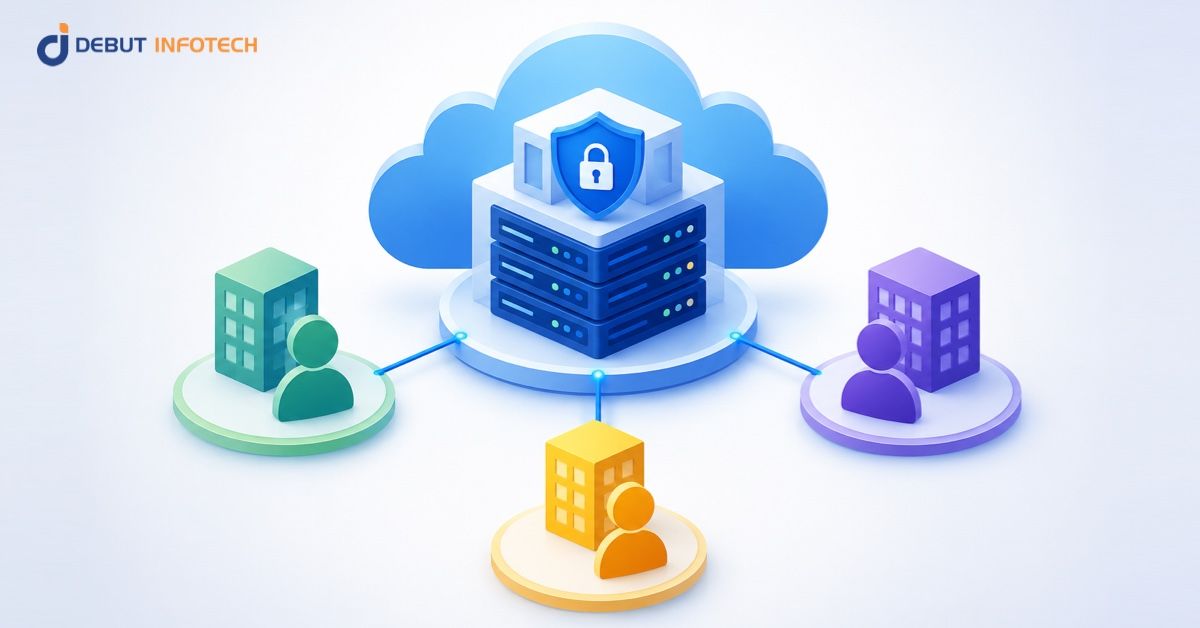


Multi-tenant architecture has become the backbone of modern SaaS platforms, allowing providers to serve multiple customers through a single, shared application environment while maintaining strict data separation.
SaaS multi-tenancy model drives efficiency at scale, with SaaS platforms reporting up to 30–40% lower operational costs when using multi-tenant systems compared to traditional single-tenant setups. It also supports centralized updates, faster deployment cycles, and consistent user experiences across tenants.
SaaS adoption continues to accelerate, with over 80% of organizations now using at least one SaaS application in their operations. At a broader level, the SaaS market is also expanding rapidly, with global spending projected to reach around $1 trillion by 2027, reflecting strong demand for scalable cloud delivery models like multi-tenant architecture.
Understanding multi-tenant architecture means looking beyond definitions into how it works, its structural variations, benefits, challenges, and the best practices that make it reliable at scale.
Multi-tenant architecture is a SaaS design model in which one application instance serves multiple customers (tenants) on shared infrastructure. The codebase, compute resources, and sometimes databases are shared, while each tenant’s data is logically isolated.
Access controls, tenant identifiers, and configuration layers ensure separation. This approach reduces duplication, supports centralized updates, and allows providers to manage many users through a single, unified system.
A multi-tenant architecture uses a shared application and infrastructure to serve multiple customers, while a single-tenant architecture assigns a dedicated environment to each customer.
In single-tenancy, every tenant has its own database, compute resources, and deployment, which increases isolation but also raises costs and maintenance effort. Multi-tenancy reduces duplication by pooling resources, making scaling and updates easier.
However, it requires strong data isolation, access control, and performance management to ensure tenants do not affect one another within the shared system.
| Aspect | Single–Tenant Architecture | Multi–Tenant Architecture |
| Data Isolation | Each tenant has a fully separate database and environment, ensuring strict physical isolation and minimal risk of data overlap. | Tenants share infrastructure, but data is logically isolated using tenant IDs, schemas, or separate databases depending on the model. |
| Customization | High level of customization since each tenant runs a dedicated instance that can be modified independently. | Customization is configuration-based, allowing tenant-specific settings without changing the shared core application. |
| Scalability | Scaling requires adding resources per tenant, which can slow expansion and increase operational effort. | Scales efficiently by expanding shared infrastructure, supporting large numbers of tenants without duplicating environments. |
| Security | Strong isolation reduces exposure risks, making it suitable for highly sensitive workloads. | Requires advanced security controls to ensure proper isolation, but can meet high standards when designed correctly. |
| Cost | Higher costs due to separate infrastructure, maintenance, and resource allocation for each tenant. | Lower costs through shared resources, reducing infrastructure and operational expenses across tenants. |
| Performance | Performance is consistent since resources are dedicated to a single tenant without interference. | Performance depends on resource management; proper allocation prevents issues such as noisy-neighbor effects. |
| Maintenance | Updates and patches must be applied separately for each tenant environment, increasing workload. | Centralized maintenance allows updates to be deployed once and applied across all tenants simultaneously. |
| Resource Allocation | Resources are fixed per tenant, leading to underutilization or inefficiency. | Resources are dynamically shared and allocated, improving utilization and adapting to changing demand. |
Multi-tenant architecture is not a single fixed model. It comes in different structural variations, each offering a different balance between cost efficiency, scalability, customization, and data isolation depending on business and technical requirements.
This model uses a single application and a shared database for all tenants. Data is logically separated by tenant identifiers within tables. It is the most resource-efficient approach, enabling easy scaling and simplified maintenance, but it requires strict access controls and validation rules to prevent data exposure across tenants.
In this setup, all tenants use the same application instance, but each tenant has a dedicated database. This improves data isolation and simplifies backup or recovery processes. It balances cost and control, making it suitable for businesses handling sensitive information while still benefiting from shared application management.
Each tenant operates within its own application instance and database, managed under a broader SaaS framework. This model delivers maximum isolation, customization, and support for compliance. It is often used for enterprise clients with strict requirements, though it increases infrastructure costs and operational complexity compared to other multi-tenant approaches.
A multi-tenant system processes user requests through a shared application layer that identifies each tenant using authentication tokens or tenant IDs. Once identified, the system applies tenant-specific configurations, permissions, and data access rules.
Isolation is enforced at the database, schema, or row level, while resource management ensures fair usage, stable performance, and consistent service delivery across all tenants.
Multi-tenant architecture offers clear operational and financial advantages for SaaS providers. These benefits go beyond cost reduction, supporting scalability, efficiency, and flexibility while maintaining strong control over shared infrastructure and tenant experiences.
Multi-tenant architecture reduces infrastructure and operational expenses by allowing multiple tenants to share the same resources, including servers, storage, and application layers. This eliminates the need for separate environments per customer, lowering hosting, licensing, and maintenance costs while improving overall resource utilization and enabling providers to offer competitive pricing.
Multi-tenant systems are built to scale efficiently as user demand increases. Providers can expand shared infrastructure instead of duplicating environments for each tenant. This approach supports rapid growth, handles fluctuating workloads, and ensures consistent performance, making it suitable for SaaS platforms expecting high user volumes and evolving business requirements.
With a shared application environment, updates, patches, and feature releases are applied once and instantly available to all tenants. This reduces maintenance overhead, minimizes downtime, and ensures consistent version control. It also simplifies monitoring and troubleshooting, allowing teams to manage the system more efficiently without handling multiple deployments.
Resource sharing allows better utilization of computing power, storage, and network capacity. Instead of idle resources sitting unused in separate environments, multi-tenant systems distribute workloads dynamically. This improves performance efficiency, reduces waste, and ensures that available capacity is used effectively across all tenants within the platform.
Despite shared infrastructure, multi-tenant platforms can offer tenant-specific configurations such as user roles, workflows, and interface settings. This flexibility allows businesses to tailor the application to their needs without requiring separate deployments. Configuration layers and modular design ensure customization without affecting other tenants on the same system.
Multi-tenant systems enforce strict data isolation through techniques like encryption, role-based access control, and tenant-aware queries. These measures ensure that each tenant’s data remains secure and inaccessible to others. When properly implemented, this model meets security standards while maintaining the efficiency advantages of shared infrastructure.
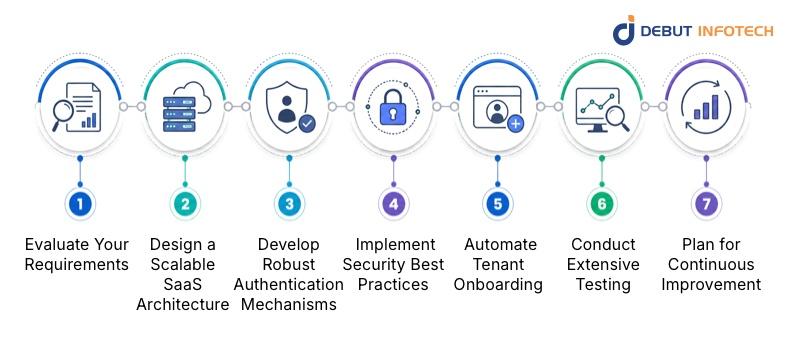
Implementing multi-tenant architecture requires a structured approach that aligns technical multi-tenant application design with business goals. Each stage plays a role in ensuring scalability, security, and performance across tenants while reducing long-term operational risks.
Start by defining business goals, tenant expectations, compliance needs, and projected growth. Identify whether tenants require strict data isolation, customization, or shared resources. This step guides architecture selection and prevents costly redesigns later, ensuring the system aligns with performance, security, and scalability requirements from the outset.
Choose an architecture model that supports long-term growth without frequent restructuring. Focus on modular components, flexible data storage strategies, and efficient resource allocation.
Planning for scaling early helps avoid bottlenecks, supports increasing tenant numbers, and ensures the scalable SaaS architecture system remains stable as workloads expand over time.
Implement strong authentication systems that accurately identify tenants and users within the platform. Use secure identity protocols, token-based authentication, and tenant-aware access controls. This ensures every request is correctly mapped, prevents unauthorized access, and forms the foundation for maintaining data separation and system integrity.
Apply encryption for data at rest and in transit, enforce role-based access control, and secure APIs against vulnerabilities. Regularly audit and update security measures to address emerging threats. Strong security practices protect tenant data, maintain trust, and ensure compliance with industry regulations and data protection standards.
Streamline the process of adding new tenants by automating provisioning, configuration, and resource allocation. Automation reduces manual errors, speeds up deployment, and ensures consistency across tenants. It also enables faster scaling, allowing businesses to onboard customers efficiently without increasing operational complexity.
Test the system across multiple scenarios, including high traffic loads, concurrent tenant access, and failure conditions. Validate data isolation, performance stability, and security controls. Thorough testing ensures the architecture performs reliably under real-world conditions and helps identify issues before they impact users.
Monitor system performance, tenant usage, SaaS architecture patterns, and emerging requirements to guide ongoing improvements. Regular updates, optimizations, and feature enhancements help maintain efficiency and reliability. Continuous refinement ensures the platform adapts to changing demands while delivering consistent performance and a stable user experience.
While multi-tenancy offers efficiency and scalability, it introduces technical and operational challenges that require careful planning. Addressing these challenges in shared vs isolated tenancy architecture is critical to maintaining security, performance, and reliability across a shared environment.
Improper data isolation or weak access controls can expose sensitive tenant information. Even minor flaws in query logic or configuration can lead to data leakage. Strong validation, encryption, and continuous monitoring are required to maintain strict separation and protect against unauthorized access across shared environments in multi-tenant data architecture.
Since tenants share the same infrastructure, a failure in core components can affect all users simultaneously. Downtime in databases, servers, or network layers can disrupt service across the platform. High availability design, redundancy, and failover mechanisms are necessary to reduce the impact of such outages.
Managing multi-tenant systems demands expertise in distributed systems, cloud infrastructure, and security practices. Teams must understand SaaS tenant isolation, performance tuning, and scaling strategies. This increases the need for skilled personnel and structured processes to ensure the platform operates efficiently and securely at scale.
When one tenant consumes excessive resources, it can degrade performance for others sharing the same infrastructure. This issue, known as the noisy neighbor effect, requires careful resource allocation, monitoring, and throttling mechanisms to maintain fairness and consistent performance across all tenants within the system.
Multi-tenant systems require complex access control models to ensure that users interact only with their own data. Application logic must account for tenant-specific rules, permissions, and configurations. This increases enterprise software development and maintenance complexity, making it essential to design clear, scalable authorization frameworks from the beginning.
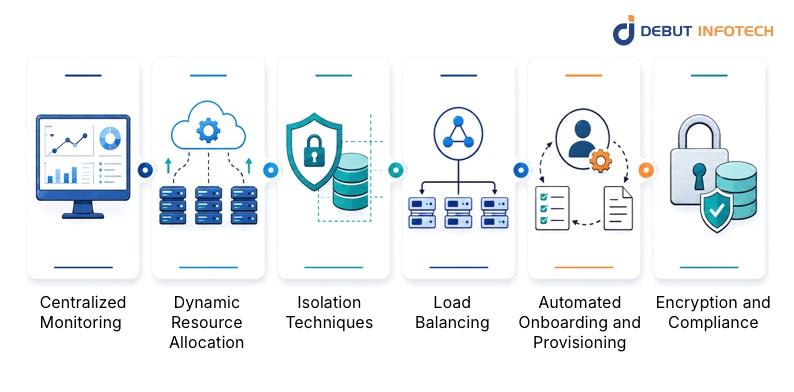
Enterprise SaaS platforms rely on proven practices to maintain performance, security, and scalability in multi-tenant environments. These practices help manage shared resources effectively while ensuring consistent service quality and strong data protection for every tenant.
Use centralized monitoring tools to track system health, tenant activity, and performance metrics in real time. This approach helps detect anomalies, identify bottlenecks, and respond quickly to incidents. It also provides visibility into tenant usage patterns, supporting informed decisions on scaling, optimization, and long-term capacity planning.
Implement systems that automatically adjust compute, storage, and network resources in response to real-time demand. Dynamic allocation ensures that tenants receive consistent performance during peak usage while avoiding resource waste during low activity. This improves efficiency and reduces the risk of performance degradation caused by uneven workload distribution.
When you hire SaaS developers, ensure they use appropriate isolation mechanisms, such as row-level security, schema separation, or dedicated databases. This depends on tenant requirements. Strong isolation ensures data protection and compliance while maintaining system efficiency. Selecting the right level of separation helps balance cost, performance, and security across different types of tenants.
Distribute incoming traffic across multiple servers to prevent overload on any single resource. Load balancing improves system availability, enhances response times, and supports fault tolerance. It ensures that tenant requests are handled efficiently, even during high demand, maintaining consistent performance across the platform.
Automate tenant setup processes, including account creation, configuration, and resource assignment. This reduces manual intervention, speeds up deployment, and ensures consistency across tenants. Automated onboarding also minimizes errors and allows the platform to scale efficiently as new customers are added without increasing operational burden.
SaaS development companies should protect tenant data using encryption for both storage and transmission. Ensure compliance with relevant industry standards and regulations by implementing secure data handling practices. Regular audits and updates help maintain compliance, strengthen security posture, and build trust with tenants who rely on the platform for sensitive operations.
Multi-tenant SaaS architecture continues to evolve alongside advances in cloud computing and distributed systems. New approaches are improving performance, automation, and scalability, helping SaaS platforms handle growing demand while maintaining efficiency and strong tenant isolation.
AI-driven systems are being used to analyze tenant behavior, predict demand, and allocate resources more efficiently. These tools can automatically adjust workloads, detect anomalies, and optimize performance without manual intervention in AI SaaS platforms. This improves system stability, reduces operational costs, and enables more responsive scaling based on real-time usage patterns across tenants.
Modern SaaS platforms are adopting microservices and serverless models to improve flexibility and scalability. Breaking applications into smaller services enables independent deployment and scaling, while serverless computing removes the overhead of infrastructure management. This approach supports faster development cycles, efficient resource usage, and better handling of varying tenant workloads.
Edge computing brings data processing closer to end users, reducing latency and improving application responsiveness in SaaS product engineering. For multi-tenant SaaS platforms with global users, this approach enhances performance by minimizing data travel distance. It also supports real-time processing needs while maintaining centralized control over tenant data and system operations.
Multi-tenant architecture remains a core foundation for scalable SaaS platforms, balancing shared infrastructure with strong data isolation. It supports cost efficiency, streamlined updates, and flexible scaling while demanding careful design around security and performance.
Businesses that implement multi-tenant architecture with clear planning and best practices are better positioned to deliver reliable, high-performing applications as user demand continues to grow.
Partnering with Debut Infotech gives you a practical path to building and optimizing multi-tenant architecture. As a top SaaS development company, we offer expertise in scalable design, secure deployment, and performance tuning. This helps you launch faster while keeping your platform efficient, reliable, and ready to handle growing tenant demands without unnecessary complexity.
A. SaaS architecture is the architecture that enables software to run in the cloud and serve users over the internet. Multi-tenant architecture is at the core of many SaaS apps, enabling multiple customers to share a single system while keeping their data separate and secure.
A. Multi-tenant architecture reduces infrastructure costs because multiple customers share the same resources. It simplifies updates because changes roll out to everyone at once. It also improves scalability and onboarding speed, letting businesses add new users quickly without rebuilding or duplicating systems for each customer.
A. Multi-tenant architecture usually costs less to run over time because resources are shared across tenants. There’s less duplication of infrastructure and maintenance work. Upfront development can be more complex, though, since engineers need to build strong isolation and resource management from the start.
A. Scaling in a multi-tenant architecture relies on adding more compute power as demand grows, rather than duplicating entire systems. Applications are built to scale horizontally, with load balancers and distributed services handling traffic. This setup keeps performance stable even as more tenants and workloads are added.
A. Common tools for multi-tenant architecture include cloud platforms such as AWS, Azure, and Google Cloud, as well as container tools such as Docker and Kubernetes. Developers also use tenant-aware databases, API gateways, and monitoring tools to manage performance, security, and resource usage across different customers.
A. Data isolation in multi-tenant systems is handled by separating customer data at different levels: database per tenant, schema per tenant, or row-level tagging. Access controls enforce boundaries, and encryption adds another layer of protection. Good design ensures one tenant can’t see or affect another, even under shared infrastructure pressure.
A. Enterprises design scalable multi-tenant systems by building stateless services, using load balancers, and separating compute from storage. They rely on horizontal scaling, caching, and queue-based processing to handle spikes. Tenant-aware architecture, efficient resource allocation, and monitoring tools keep performance steady as more customers and data pile up.

Our Latest Insights
USA

2501 Chatham, Rd Suite R Springfield, IL 62704
+1-708-515-4004
info@debutinfotech.com
UK

7 Pound Close, Yarnton, Oxfordshire, OX51QG
+44-770-304-0079
info@debutinfotech.com
Canada

154 Eden Oak Trail, Kitchener, ON N2A 0H9
+1-708-515-4004
info@debutinfotech.com
INDIA

Sector 101-A, Plot No: I-42, IT City Rd, JLPL Industrial Area, Mohali, PB 140306
9888402396
info@debutinfotech.com

9001:2015
Quality Certified

ISO 27001
Security Certified

A+ Rating
Accredited Business

Certik
Security & Audit


Copyright © 2026, Debut Infotech. All rights reserved. | Privacy Policy