ON THIS PAGE
Progress0%




Our Global Presence :


The Software-as-a-Service (SaaS) ecosystem is the leading digital transformation framework as of 2026. Organizations are rapidly migrating to higher rungs of scalable cloud applications, whether small or large, to deliver a better user experience to their customers and generate additional revenue streams for their businesses.
Successful SaaS products are built on a solid technical foundation- and that starts with the selection of the best SaaS framework. However, here is where the problem arises: today, there are endless frameworks and a multitude of options to choose from when creating a digital product. Each framework offers its own set of features, performance, and scalability.
In this guide, we will provide you with everything you need to know in a simplified manner, from insights on understanding SaaS frameworks to the best SaaS framework for 2026, and to building high-performing digital products.
A SaaS framework is a structured collection of tools, libraries, and best practices by which developers develop, deploy, and operate SaaS applications efficiently. Unlike traditional software frameworks, SaaS frameworks are specifically designed to support:
In simple terms, a SaaS system helps facilitate development without compromising scalability, security, or your product’s readiness for real-world use.
Related Read: What is Saas Development – A Complete Guide For 2026
The inappropriateness of a SaaS framework results in poor product performance and scalability, along with higher development costs. On the contrary, the best SaaS framework results in a shorter development cycle and product success.
It is essential to review the key features of a framework before discussing the top SaaS application development frameworks.
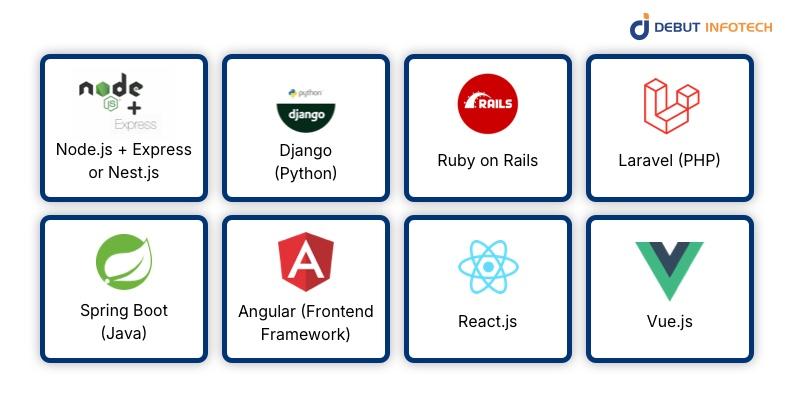
We will explore the best frameworks shaping the SaaS industry in 2026.
Node.js continues to remain one of the most popular choices to be used for creating scalable SaaS products.
Node.js is commonly included in a current technology stack of web development and is a frontrunner among startups and businesses alike.
Django is a Python framework that is of a high level and is characterized by its simplicity and swift development.
Django is a software that is widely employed by companies using custom software development services because it is reliable and fast.
Ruby on Rails (RoR) is known for its developer-friendly approach and convention-over-configuration philosophy.
It is also among the most effective rapid web application development software in the market today.
Laravel remains the leading presence in the PHP ecosystem and one of the most powerful engines to create SaaS applications.
SaaS development companies prefer Laravel because it is flexible and cost-efficient.
Spring Boot is a powerful platform that can be used in enterprise-level SaaS software.
The framework is widely applied in Enterprise software development projects.
Angular is a high-performance software development platform for dynamic SaaS user interfaces.
React continues to dominate frontend development in 2026.
React can be used with Node.js to build full-stack SaaS applications.
Vue.js is becoming popular because of its simplicity and flexibility.
| Framework | Language | Best For | Scalability | Learning Curve |
| Node.js | JavaScript | Real-time apps | High | Moderate |
| Django | Python | Data-driven platforms | High | Easy |
| Ruby on Rails | Ruby | MVPs & startups | Medium | Easy |
| Laravel | PHP | Business apps | Medium | Easy |
| Spring Boot | Java | Enterprise solutions | Very High | Hard |
| React | JS | UI development | High | Moderate |
| Angular | TS | Enterprise frontend | High | Hard |
| Vue | JS | Lightweight apps | Medium | Easy |
The selection of the best framework for SaaS applications is based on several factors:
1. Project Requirements: Determine whether your SaaS needs real-time capabilities, AI, or intense data processing.
2. Budget Considerations: Some frameworks consume more development resources, which affects the overall cost of SaaS development.
3. Scalability Requirements: When you anticipate fast growth, select frameworks such as Node.js or Spring Boot.
4. Speed of Development: Use Django or Ruby on Rails when you want to launch fast.
5. Team Expertise: This decision should be related to the technical capabilities of your team or your capability to recruit SaaS developers.
Even the most ideal structure cannot be successful without an appropriate team. By using a dedicated software development team, it is guaranteed that:
As you develop your SaaS product, it is important to monitor performance.
Key SaaS Metrics include:
Such measures allow you to gauge the product’s success and optimize growth policies.
A well-structured tech stack for web development is crucial for building scalable SaaS products.
With the right tools, performance, scalability and reliability are guaranteed.
The SaaS marketplace is changing dynamically. The following are some of the trends that are influencing framework selection:
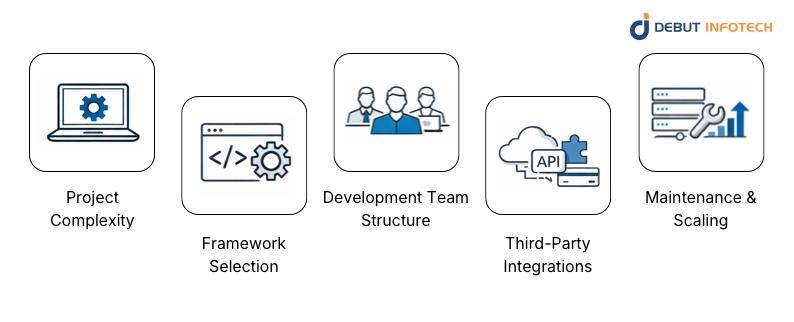
When planning your product, it is necessary to understand the saas development cost. The overall investment varies based on factors such as the chosen framework, feature complexity, and team setup.
1. Project Complexity
2. Framework Selection: Certain frameworks will take longer and require more development skills, which are more expensive. For example:
3. Development Team Structure: The choice between using a specialized software development team and a freelance team has a huge influence on the cost and quality.
4. Third-Party Integrations: There are APIs, payment gateways, and analytics tools that are added to the total costs.
5. Maintenance & Scaling: The cost of post-launch costs (hosting, updates, scaling) is usually 15-25% of the initial development cost.
Choosing the right saas development company is as good as choosing the framework. You can consider the following lists to see what to look for:
Collaborating with a qualified saas development company would mitigate risks and make the development process smoother.
The recruitment strategy you choose can significantly impact your product’s success. An in-house team should handle long-term projects, as it gives you complete control. However, it is also more expensive to develop and maintain.
Freelancers, on the other hand, are more flexible and also more cost-effective. However, they might not be able to handle long-term projects or be consistent in their work. A dedicated software development team is the best option for price, expertise, and scalability. This is why it is the most sought-after option for most businesses.
After all, when businesses need to scale quickly, they usually opt to hire SaaS developers contracted by a particular agency to ensure an efficient, reliable deployment process.
Awareness of the applications of frameworks in real life can help you make better decisions.
1. Slack (Node.js): Slack is built upon Node.js to provide real-time messaging and scalability.
2. Instagram (Django): Django serves as the backend of Instagram, and it is efficient in processing huge amounts of data.
3. Shopify (Ruby on Rails): Shopify uses Rails as a high-performance development and scaling framework.
4. Netflix (Spring Boot & Microservices): Netflix implements high-performance streaming services based on Java frameworks.
Selecting the right tech stack for web development is critical for building scalable SaaS platforms.
| Layer | Technologies | Purpose |
| Frontend | React.js, Angular, Vue.js | Build interactive and responsive user interfaces |
| Backend | Node.js, Django, Spring Boot | Handle business logic and server-side operations |
| Database | PostgreSQL, MongoDB | Store and manage application data |
| Cloud & DevOps | AWS, Azure, Google Cloud, Docker, Kubernetes | Enable deployment, scaling, and infrastructure management |
Note: Selecting the right tech stack for web development is critical for building scalable SaaS platforms. Combining these tools ensures efficient development and long-term scalability.
Security is a top priority for any SaaS product. Here are some key security practices:
By selecting a framework that has inherent security, there are lower risks.
Modern rapid web application development tools are changing the way SaaS products are developed by allowing them to prototype more quickly, minimizing development time, reducing costs, and enhancing teamwork. Low-code platforms, ready-to-use SaaS templates, and API-first development solutions enable faster development, particularly useful when startups need to have an MVP ready as quickly and efficiently as possible.
Scalability is essential as your product starts to pick up. The following are strategies that will be needed during scaling:
Scalability is especially effective with frameworks such as Node.js and Spring Boot.
Innovation and automation are the new guiding forces of the SaaS frameworks.
Key Predictions:
Businesses investing in modern frameworks today will be better positioned for future growth.
Choosing the best SaaS framework in 2026 comes down to aligning technology with your business goals. Whether it’s Node.js for scalability, Django for speed, or Spring Boot for enterprise performance, the right choice—along with a solid web development tech stack—ensures strong performance, security, and scalability from the start.
Beyond tech, execution is key. Working with a dedicated software development team or experienced SaaS development companies helps ensure efficient development and smooth scaling. By managing SaaS development cost and tracking essential SaaS Metrics, you can build a product that performs well today and adapts to future growth.
A. There is no one-size-fits-all answer when choosing the best SaaS framework in 2026. Popular options like Node.js, Django, and Spring Boot stand out, but the right choice depends on your project requirements, scalability needs, and team expertise.
A. Django and Ruby on Rails are excellent choices for startups because they enable rapid development and faster time-to-market. These frameworks include built-in features that reduce development effort, making them ideal for quickly launching MVPs.
A. The SaaS development cost typically ranges from $15,000 to over $120,000, depending on the complexity, features, and development approach. Factors such as team structure, integrations, and scalability requirements can significantly influence the final cost.
A. Hiring SaaS developers through a reliable development company is often the best option for scalability and long-term success. It provides access to experienced professionals, structured workflows, and faster project delivery compared to managing freelancers individually.
A. Tracking SaaS Metrics is essential for understanding product performance and user behavior. Metrics such as MRR, churn rate, and customer lifetime value help businesses make data-driven decisions and refine growth strategies.
A. A strong web development tech stack typically includes React for the frontend, Node.js or Django for the backend, and cloud platforms like AWS for deployment. This combination ensures scalability, performance, and flexibility for modern SaaS applications.
A. SaaS development companies offer end-to-end services, including planning, development, deployment, and maintenance. They help businesses reduce risks, accelerate time-to-market, and build scalable SaaS solutions with the right expertise.

Our Latest Insights
USA

2501 Chatham, Rd Suite R Springfield, IL 62704
+1-708-515-4004
info@debutinfotech.com
UK

7 Pound Close, Yarnton, Oxfordshire, OX51QG
+44-770-304-0079
info@debutinfotech.com
Canada

154 Eden Oak Trail, Kitchener, ON N2A 0H9
+1-708-515-4004
info@debutinfotech.com
INDIA

Sector 101-A, Plot No: I-42, IT City Rd, JLPL Industrial Area, Mohali, PB 140306
9888402396
info@debutinfotech.com

9001:2015
Quality Certified

ISO 27001
Security Certified

A+ Rating
Accredited Business

Certik
Security & Audit


Copyright © 2026, Debut Infotech. All rights reserved. | Privacy Policy