ON THIS PAGE
Progress0%






Our Global Presence :





Your MVP can be released quickly, and still fail, if the architecture is too fragile, too complex or too rigid. Unfortunately, this is something many startups find out too late when customers begin to arrive, the product becomes increasingly difficult to change, bugs creep back, and even minor changes are dangerous.
That’s why MVP architecture is important.
It means building a product that’s simple to get to market, and that can grow into something more complex when users come. Rather than immediately diving into microservices and top-level infrastructure, most startups need a simpler approach: a simple, modular system, defined API boundaries, a scalable database, basic security, easy deployment, and product monitoring.
In this article we will break down the MVP architecture choices that allow startups to avoid rebuilding, improve their technical debt and build for growth. By the end of this guide you will understand what to build, what to postpone and how to build an MVP that can handle growth without over-complexity.
Related Read: A Complete Guide For MVP Development: Helping You Save Resources
A scalable MVP architecture isn’t about building a product to serve millions of users when you don’t even know if it’s wanted. That often results in wasted time and money, and unnecessary complexity.
Rather, scalability at the MVP level means creating a product that can expand. It means you can extend the product, correct any issues, optimize its performance, and adapt to customer requests without having to start over.
A good MVP should benefit both the business and the development process. It should support faster product updates, clear ownership of different parts of the codebase, manageable infrastructure costs, basic security, easier debugging, and enough flexibility to move into a larger system later when the product proves itself.
From experience, many MVPs run into problems for one of two reasons. Some are built too quickly with no structure, making them fragile and difficult to maintain. Others are overengineered too early, with complex tools and systems the business does not yet need. A better way to think about it is to make the MVP a learning tool. It must be easy to build to test the idea, but resilient to accommodate the demands of real users, feedback and growth.
A very common pitfall for startups is the desire to build for a huge scale before they know if anyone wants the product in the first place. It might sound like a good idea to build a larger, more complicated setup in order to “future-proof” the MVP, but more often than not, this is the opposite.
At the MVP level, the product must be quick to develop, test, and iterate, and robust enough for initial customers. It doesn’t require sophisticated cloud architecture, complex deployment processes, or a microservice architecture right away. When these things are introduced too soon, they can slow the development team, increase cost, introduce complexity, and increase the difficulty of debugging.
The real goal is not to build the largest possible system at the beginning. The goal is to build a flexible foundation that can change as you learn from users. Early users and investors are typically more interested in how the product works, if it solves a need, if it’s fast, and if it can be improved. They won’t be evaluating the product on the complexity of the back end.
It is better to design for change rather than design for a huge scale. This means building an architecture that allows for clean code, clear roles, secure access, performance and easy upgrades, without prematurely introducing complexity.
You should begin planning for heavier scaling when you see signs, such as:
So, in other words, do not build enterprise-grade architecture for a product that is not ready for an enterprise. Design an MVP that is minimal, robust and flexible. This is the one way to ensure your startup can ship a product early, learn fast from your users, and scale when the time comes.
One of the biggest architecture questions startups face is whether to build with a monolith, a modular monolith, or microservices. The truth is, many MVPs shouldn’t use microservices in the beginning.
A modular monolith is a better option for many early stage products. This makes development easier, deployment less complicated, and lets your team move quickly, but also introduces boundaries within the codebase. This is important because your MVP will likely evolve many times once customers begin to provide feedback.
Microservices are great, but they’re also expensive. You will need advanced DevOps, monitoring, testing, service-to-service communication, and a mature team to work with a distributed system. If you don’t have these, microservices can actually make you less productive.
A good rule of thumb is this: start simple, but structure the product in a way that does not trap you later. That is the practical foundation of successful MVP to production scaling.
| Architecture | Best For | Main Advantage | Main Risk |
| Simple monolith | Very early MVPs and prototypes | Fast to build and easy to deploy | Can become messy if the codebase is not well organized |
| Modular monolith | Most scalable MVPs | Clear internal boundaries and easier future migration | Requires discipline in code structure and module separation |
| Microservices | Mature products with multiple teams or complex domains | Independent scaling and deployment | High DevOps, testing, monitoring, and communication complexity |
| Serverless | Event-driven MVPs or lean teams | Fast deployment and usage-based cost | Vendor lock-in, cold starts, and harder debugging |
| Low-code/no-code backend | Idea validation and quick prototypes | Very fast to launch | Limited control, flexibility, and long-term scalability |
This is why Martin Fowler’s “Monolith First” argument is still relevant for startups. Before splitting a product into multiple services, the team needs to understand the product boundaries, user flows, and business logic clearly. If those boundaries are unclear, microservices may simply spread confusion across many services instead of solving the problem.
The best approach is not to avoid microservices forever. It is to do it when there is a need, such as increasing traffic, team ownership, complex business or performance issues in a part of the product.
For most MVPs, it is better to start with a well-organized modular monolith, maintain a clean architecture, and design the product in a way that key modules can be extracted later when the product has been proven in the market.
Also Read: MVP vs Prototype vs POC: How to Choose the Right Product Strategy in 2026
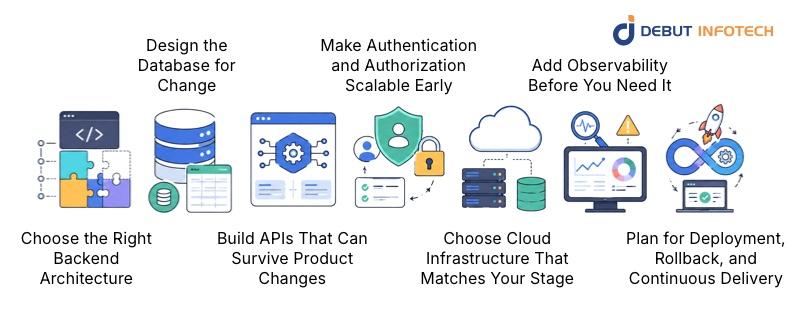
The key to scalable MVPs is not to create the most sophisticated system possible. It’s about making the right initial decisions to ensure your product can scale without getting slow, costly, or hard to manage.
The best architecture decisions are usually practical. Your MVP must be lean and fast to build, but also flexible enough to accommodate new users, features, connections and business demands. This is why MVP tech stack selection matters. The choices you make early can either make future scaling easier or create technical debt that slows the product down.
Your backend is the engine of your MVP. If it is too complex, each new feature will be more difficult to develop, test and maintain. Microservices are generally not the right place to start for most startups. A better option is often a modular monolith.
A modular monolith keeps the product in one deployable system, but separates the code into clear sections such as authentication, users, payments, notifications, admin, analytics, and integrations. This gives your team the speed of a simple architecture while still creating enough structure for future growth.
The main goal is to avoid mixing everything together. The product logic shouldn’t be mixed with routes or controllers, or tangled up with third-party services. If you isolate product logic, then it’s easier to refactor, test and scale the MVP in the future.
Your database should be sufficient for the current product, but it also needs to be adaptable to what users will need in the future. Many MVPs become difficult to scale because the database was designed only for the first version of the product.
For many SaaS MVPs, PostgreSQL is a strong default because it supports structured data, relationships, transactions, indexing, and reporting. It’s a good choice for products that handle users, payments, subscriptions, access control, orders, or logs.
NoSQL can also be the best choice for a product that uses flexible, document-based, or scaled data. However, it should be chosen because it solves a real product problem, not because it sounds more modern.
A scalable database strategy should consider the structure of data, how to separate user or tenant data, which fields should be indexed, and how to manage database changes in the future. This is not about designing a database that’s “perfect” for the MVP product, but rather not making things worse in the future.
Your product’s APIs are the links between the front end, back end, mobile, third-party services, and future systems. When these connections are unclear, it’s easy to get lost in complexity.
Most MVPs need to have APIs that are simple, consistent, and documented. The team should know how the API should name endpoints, how it should return errors, how authentication should work, whether it should use REST or GraphQL.
The best APIs are typically not the most complex. They are the APIs that can be understood without a lot of explanation. When the API structure is clear, your product is easier to maintain, easier to grow and easier to integrate with other systems in the future.
Security should never be treated as something to add after the MVP becomes successful. If your product handles user accounts, payments, private records, business data, or admin controls, access management needs to be planned from the beginning.
Authentication confirms who the user is. Authorization controls what that user is allowed to do. Both are important if your MVP will support different user roles, admin privileges, team accounts, organisation-level access, or tenant-based access for B2B SaaS products.
This becomes even more important for products in finance, healthcare, education, legal services, or any industry that handles sensitive information. Even at MVP stage, users expect their data to be protected. Poor access control can quickly turn a promising product into a serious security risk.
A scalable MVP doesn’t necessarily require a complex cloud infrastructure. Often, managed services are better in this case because they can help your team get launched quickly without having to worry about infrastructure issues.
During the initial phase, the infrastructure should help you deploy, monitor and enhance the product without draining your budget. Managed hosting, managed databases, object storage, CDNs, background workers and queues can help you get a solid MVP without building everything from scratch.
The key is to have the right infrastructure at the right time. You may need Kubernetes, sophisticated cloud networking, or even your own infrastructure in the future, but those are not always required in an MVP. Instead, it’s more important to have development, staging, and production environments, secure environment variables, and a system your team can replicate.
You cannot improve what you cannot see. Many MVP teams only add monitoring after users start reporting problems. By that point, the team is often guessing instead of diagnosing.
Observability means your team can understand what is happening inside the product. At MVP stage, this can be as simple as application logs, error tracking, uptime monitoring, performance monitoring, and alerts for serious failures.
For instance, a marketplace MVP may not necessarily need microservices, but it does need to understand why checkout failed, if the payment callback is working, if an endpoint is slow, and where people are abandoning onboarding.
Observability is a low-cost way to increase the scalability of an MVP because it helps the team identify issues in the system, troubleshoot bugs quickly, and make better product decisions with real data.
Having a scalable MVP is not just about the architecture. It is also about how safely the team can change it.
If every release feels risky, growth slows down. Developers become cautious, fixes take longer, and product experiments become harder to run. That is why deployment planning matters from the beginning.
Your MVP needs an efficient deployment process. This could involve a simple CI/CD process, tests for critical user flows, safe database migration strategies, feature flags where appropriate, environment variables securely handled and a rollback strategy if needed.
You don’t necessarily need a massive DevOps team. But you do need a process that enables your team to make changes safely without worrying every change will break the product.
An MVP architecture that is right for your product can be the difference between rapid growth and technical debt. It’s not just about getting to market quickly; it’s about designing a foundation that enables real users, future functionality, secure data management and sustainable business growth.
At Debut Infotech, a top software development company, we work with startups and businesses to build MVPs that are simple to build and robust enough for long-term growth. From backend architecture, database, API design, cloud computing, DevOps, security and performance, we collaborate with clients to align technical choices with business goals.
We have helped companies bring new concepts to market in the form of scalable digital products, replace legacy systems with modern solutions, and develop custom-built software that is flexible enough to evolve as markets and needs shift. Rather than aim for perfection up front, we design meaningful, scalable architecture that helps avoid rebuilds and enhance product adaptability.
Whether you are developing a SaaS business model, mobile application or enterprise software platform, Debut Infotech offers the technical planning and development services to create a scalable MVP.
A. Designing an MVP starts with one simple question: what problem are we trying to solve, and who needs this solution most?
Once that is clear, the next step is to choose only the features that are needed to test the idea with real users. An MVP should not try to do everything. It should be simple, usable, and focused on proving whether people actually want the product.
A good MVP usually includes the core feature, a clear user journey, basic design, reliable performance, and a way to collect feedback. After launch, the team can study how users interact with it, what they like, where they struggle, and what needs to improve.
The goal is not to build a perfect product immediately. The goal is to build a useful first version, learn from real users, and make smarter decisions before investing more time and money.
A. The best tool depends on what you are trying to build. For simple app MVPs, Bubble and Glide are good no-code options. For websites or landing pages, Webflow and Framer make it easier to design, publish, and test ideas quickly.
For design and prototyping, Figma is still one of the most reliable choices. Uizard is helpful when you want to turn rough ideas into quick visual concepts. AI tools like Bolt.new and Lovable can also speed up early builds.
These tools are great for testing an idea fast. But if your MVP needs custom features, strong security, integrations, or room to scale, it is better to work with an experienced development team.
A. The architecture choices you make for an MVP can either make scaling easier or create problems later. At the beginning, it may feel tempting to focus only on launching quickly. But if the product starts gaining users, weak architecture can make it harder to add features, improve performance, or fix issues without disrupting the whole system.
Good MVP architecture gives your product room to grow. A clean backend structure, well-planned database, secure APIs, and flexible cloud setup can help your team respond to user demand without rebuilding everything from scratch.
Poor decisions, on the other hand, often lead to technical debt. The product may become slow, costly to maintain, and difficult to change.
So, architecture decisions matter because they help you balance speed today with scalability tomorrow.

Our Latest Insights
USA
2501 Chatham, Rd Suite R Springfield, IL 62704
+1-708-515-4004
info@debutinfotech.com
UK
7 Pound Close, Yarnton, Oxfordshire, OX51QG
+44-770-304-0079
info@debutinfotech.com
Canada
154 Eden Oak Trail, Kitchener, ON N2A 0H9
+1-708-515-4004
info@debutinfotech.com
INDIA
Sector 101-A, Plot No: I-42, IT City Rd, JLPL Industrial Area, Mohali, PB 140306
9888402396
info@debutinfotech.com