ON THIS PAGE
Progress0%






Our Global Presence :






All companies that create a web application must understand they are also creating a hacking target. These are becoming more numerous, complex and costly. The web app security can be enhanced by considering security first, at the design stage, before development starts. This is a big risk that needs to be handled. We at Debut Infotech are dedicated to developing web apps that operate well and are resistant to tampering, ensuring data integrity and withstanding the scrutiny of regulators and enemies.
This article highlights the necessity of including web app security architecture in the development discussion from the start. It discusses the key elements of security architecture, threats, defensive measures and stresses the importance of best practices to avoid attacks. It’s important to keep these rules in mind if you’re embarking on a new career path or if you’re reviewing your existing role. Not following them could have big effects.
It’s important to understand the financial impact of data breaches, with IBM’s 2025 research showing the average cost globally at $4.44 million and $10.22 million in the U.S. Ransomware attacks cost $5.08 million and supply chain intrusions cost an average of $4.91 million. The average time to detect and contain a breach is 241 days.
Organizations that build security in from the development stage can save these costs. The Equifax hack was a failure to patch a known vulnerability and cost over $1.7 billion in losses. Architectural designs include compensatory mechanisms to prevent such breaches.
These figures give the context. Instead of being a line item to cut when funds are limited, secure app development practices should be considered an absolute need.
Web application security architecture is the set of system structuring decisions that, in combination, ensure that the application can protect itself against, identify and recover from security attacks. It’s not a single feature or tool. It’s a collection of concepts and patterns and controls that are baked into every layer of the application. It involves how data is kept, how users authenticate, how APIs communicate, how failures are logged.
These design principles underpin a secure architecture:
These principles provide direction for real decisions in application security, touching areas such as authentication protocols, session management, encryption key storage, and error detail exposure. Applications that are resistant to typical threats are the result of deliberate and methodical decision-making, not of impromptu solutions.
A common myth in software delivery is that security is a step, something you do after the build, during testing, before release.
To manage vulnerabilities effectively it is important to embed security into the software development process from the outset. When security reviews are done after development, they often lead to expensive architectural changes, as engineers under duress tend to cut corners.
On the other hand, applications are created with secure software architecture in mind, including security requirements along with functional ones, using threat modeling during the design phase. This leads to integrated security controls in the application design, based on the frameworks such as the OWASP Application Security Verification Standard (ASVS), and adopting the DevSecOps concept, making sure that security is integrated throughout the software delivery pipeline.
For teams that engage in custom software development, taking on this approach early is the one single greatest leverage security decision they can make.
When discussing different types of web application vulnerabilities, the OWASP Top 10 gets more references than any other source. Understanding these threat types is the first step toward designing an architecture that addresses them.
| # | Vulnerability Category | What It Means |
|---|---|---|
| 1 | Broken Access Control | Users can access data or functions they shouldn’t be allowed to. |
| 2 | Cryptographic Failures | Sensitive data is transmitted or stored without proper encryption. |
| 3 | Injection (SQL, XSS, etc.) | Untrusted data is sent to an interpreter, causing unintended commands to execute. |
| 4 | Insecure Design | Architectural and logic flaws that create attack surfaces even when code is technically correct. |
| 5 | Security Misconfiguration | Default settings, unnecessary features, or missing patches leave systems exposed. |
| 6 | Vulnerable and Outdated Components | Third-party libraries or frameworks with known CVEs are used without patching. |
| 7 | Identification & Authentication Failures | Weak credential management allows attackers to compromise accounts. |
| 8 | Software & Data Integrity Failures | Unverified updates or tampered code introduce malicious logic. |
| 9 | Security Logging & Monitoring Failures | Insufficient logging delays detection of active breaches. |
| 10 | Server-Side Request Forgery (SSRF) | Server features are exploited to access internal systems or sensitive data. |
A well-built application security framework addresses every one of these categories systematically, not reactively.
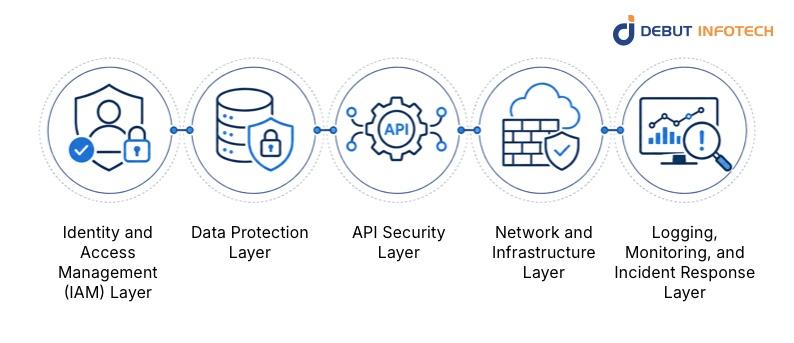
Ask any senior security architect to draw you a secure web application and they will speak of several overlapping layers of protection. This is what the layers look like in practice.
Authentication answers the question : who are you ? Authorization answers: what you are allowed to do? The answer to both must be correct, consistent and at every access point, not just upon login.
Enterprise apps have a centralised identification and Access Management (IAM) system that includes federated identification and single sign-on (SSO) protocols like OAuth 2.0 and OpenID Connect. Multifactor authentication (MFA) is essential for apps dealing with sensitive data.
Roles and attributes are used to control access using Role-Based Access Control (RBAC) or Attribute-Based Access Control (ABAC) and are periodically reviewed to limit privilege escalation.
A good security design starts with the assumption that data is protected by default, e.g. by requiring encryption of sensitive data in motion and at rest. TLS 1.2 or above, encryption keys are maintained separately and rotated regularly.
The concepts of privacy-by-design are based on the reduction of data, collecting only what is required, and tokenizing or masking sensitive elements. Parameterized queries avoid sql injection . Explicit data retention standards avoid old data becoming a liability .
APIs are the backbone of today’s applications and each endpoint is a potential security risk. APIs are increasingly used to deploy applications. In a 2025 F5 poll, 68% of enterprises use APIs and 58% said API sprawl is a key security concern.
An API architecture that is secure would have authentication for each endpoint, rate restriction, tight input validation, output encoding to prevent content injection, and correct versioning techniques to deprecate old endpoints.
Controls are the first line of security at the network level . A Web Application Firewall ( WAF ) filters malicious HTTP/S traffic to block threats such as SQL injection and cross site scripting . In addition, Content Delivery Network (CDN) settings safeguard against DDoS attacks.
Zero-trust architecture requires verification of every request, regardless of assumptions of internal confidence. It also uses microsegmentation to further segregate network segments, so if an attacker breaks into one segment, they can’t travel laterally and compromise numerous components.
Security Logging and Monitoring Failures is number nine on the OWASP Top 10 list because they help to identify ongoing attacks. Without adequate logging and an incident response plan, companies cannot respond effectively to attacks.
An effective monitoring framework logs critical events (such as authentication requests, access to sensitive data, and so on). Real-time alerts allow timely detection of anomalies and minimise the window of opportunity for the attacker.
Enterprise web security design doesn’t develop in a vacuum. Established frameworks give structured controls and benchmarks to assist firms in establishing security programs that are complete, quantifiable and defensible to auditors and regulators.
| Framework / Standard | Scope | Best For |
| OWASP ASVS | Technical application security requirements | Development teams building web applications |
| NIST Cybersecurity Framework (CSF) | Organizational security governance | Enterprise security program design |
| ISO/IEC 27034 | Application security management process | Integrating security across the SDLC |
| PCI DSS | Payment card data security | Applications handling cardholder data |
| HIPAA | Health data security and privacy | Healthcare and health-tech applications |
| SOC 2 | Trust service criteria for service organizations | SaaS products and cloud service providers |
| CIS Controls | Prioritized, actionable security controls | Organizations building baseline security programs |
Enterprise applications can benefit from a combination of frameworks such as OWASP ASVS for technical controls and NIST CSF for governance, as well as industry specific standards such as PCI DSS or HIPAA for compliance. This will decrease redundancy and make it easier to get ready for audits. Development teams must partner with web development service providers who use these standards in a methodical way, not as a tick box exercise.
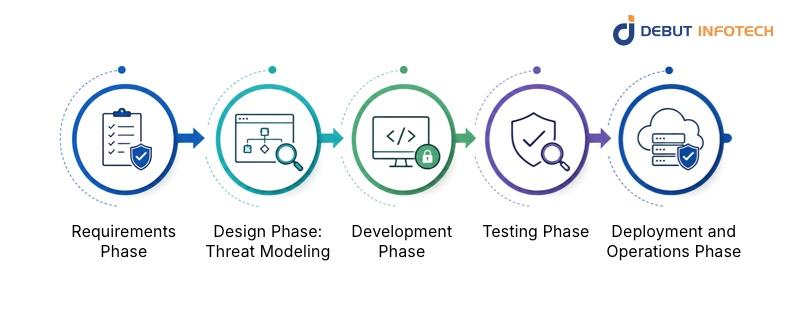
Security is best when it’s built into every stage of the software development lifecycle (SDLC), not bolted on at some point.
Security requirements are developed along with functional requirements. This includes data classification (what data will be processed in the application?), regulatory compliance (which laws need to be complied with?), threats (who may attack this application and how?) and access control (who is allowed to access what and when?).
Threat modeling is the process of identifying attack vectors prior to coding. This can be done in a variety of ways, such as using STRIDE and OWASP Threat Modeling. These processes help the design team to identify trust boundaries, misuse cases and risky data flows, defining targeted security controls.
It is the phase where important decisions are made on authentication, data encryption, API security, and infrastructure segmentation. Security during design is far cheaper than post-development, and this phase is critical to making such decisions.
Secure coding guidelines for validating inputs, encoding outputs, error handling, cryptography and dependency management. Automated tools for CI/CD to identify vulnerable code. Secret scanning prevents API keys and passwords being stored in version control.
SCA scans third-party dependencies for vulnerabilities, alerting teams to known CVEs in libraries before to production. These secure app development practices are not optional add-ons for teams working on rapid web application development tools — they are the baseline for any development workflow that takes security seriously.
Security testing in a mature development organization goes beyond functional testing. It includes:
When you combine these methods, you get the most complete covering. Everything can’t be captured by just one testing approach.
Security in production demands constant attention during the Deployment and Operations phase. Processes for patch management make sure that security holes in program parts and infrastructure are fixed quickly. Runtime application self-protection (RASP) technology provides in-application monitoring of active assaults. Security configuration management is how we make sure hardened settings don’t drift towards insecure defaults over time.
Security reviews, penetration tests and vulnerability scans should not only be done once at launch and forgotten, but also scheduled on a set cycle.
Authentication and authorization are one of the biggest architectural decisions that any web application will make. Recent incident response data shows that identification flaws exist in about 90% of security investigations and identity-driven events account for 65% of first access occurrences. We estimate modern phishing-resistant MFA techniques can stop more than 99% of identity-based attacks.
For enterprise applications, the architectural requirements are:
Authentication:
Authorization:
The distinction between authentication and authorization errors matters architecturally. Broken authentication allows attackers to become someone they shouldn’t be. Broken authorization allows authenticated users to do things they shouldn’t be able to. Both must be addressed, and both require architectural solutions, not just code fixes.
Beyond the architectural layers described above, there are a set of specific controls that effective web app vulnerability prevention relies on.
Data entering the application, including form fields and API parameters, must be validated for expected format, length, and type. Allowlist validation is more effective than blocklist validation. Output encoding is essential to prevent cross-site scripting (XSS) attacks by ensuring that browser-rendered data isn’t interpreted as executable code.
Error messages presented to end users should be generic and uninformative. Detailed error messages, stack traces, and system information provide attackers with a roadmap to your application’s internals. Verbose logging happens server-side, in secure log storage, where it’s available to your security team but not to an external attacker.
In October 2024, over 287 malicious packages were identified on the NPM platform alone, many impersonating popular libraries. Third-party component security is a supply chain risk that must be managed systematically. SCA tools track all application dependencies against vulnerability databases and alert teams to new CVEs. A Software Bill of Materials (SBOM) documents every component in the application, enabling rapid response when a new vulnerability is disclosed.
HTTP security headers are a low-cost, high-impact control that many applications still don’t implement fully. Content Security Policy (CSP) limits the sources from which the browser can load scripts, preventing many classes of XSS attack. HTTP Strict Transport Security (HSTS) enforces HTTPS connections. X-Frame-Options prevents clickjacking. These headers are part of the standard configuration for any well-secured web application.
The tech stack for web development has direct security implications. Framework choice, language selection, infrastructure platform, and third-party service integrations all create security considerations that must be addressed during the architecture phase.
| Layer | Security Considerations |
| Frontend Framework | XSS protections, CSP compatibility, dependency security |
| Backend Framework | Input validation features, ORM security, built-in auth libraries |
| Database | Parameterized query support, encryption at rest, and access controls |
| API Gateway | Rate limiting, authentication enforcement, and traffic inspection |
| Cloud Infrastructure | IAM policies, network segmentation, logging configuration |
| Container/Orchestration | Image scanning, runtime protection, secrets management |
| CI/CD Pipeline | SAST/DAST integration, secret scanning, and access controls on deployments |
Experienced web development companies recognize that architectural technology decisions impact security. Poor input validation or a lack of parameterized queries can lead to costly security issues. For organizations developing progressive web applications (PWAs), partnering with a knowledgeable PWA development company is crucial for addressing security concerns related to service workers, cache poisoning, and offline data storage.
One of the most common business objections to security investment is cost. Understanding web application development cost in relation to security helps reframe this conversation.
The cost of building security into an application from the start — threat modeling, secure design review, integration of security testing tools into the CI/CD pipeline, developer security training — typically adds 10–15% to a project’s development budget. The cost of remediating a significant vulnerability discovered post-deployment is commonly estimated at 15–30 times the cost of fixing it during design. The cost of a breach, as the IBM data shows, averages $4.44 million globally.
When you frame the security investment against these comparisons, the calculus is not difficult.
| Security Investment Stage | Relative Cost |
| Design-phase security review | 1x |
| Code-phase remediation | 6x |
| Testing-phase remediation | 15x |
| Post-deployment patch | 30x |
| Post-breach remediation | 100x+ |
The earlier security is addressed, the cheaper it is to address. This is not a principle unique to security — it is the same principle that makes catching a bug in design review cheaper than catching it in production. Security follows the same economic logic.
Organizations working with web development companies or looking to hire web developers should ask explicitly about how security is integrated into the development process, what testing tools are used, and what security standards the team builds to. The answers reveal far more about the true security of the resulting application than any post-build audit.
Zero trust is an architectural philosophy that mandates no user, device, or network segment is inherently trusted, necessitating verification for every request based on identity, context, and policy. In web applications, this approach involves per-request authentication, continuous user behavior validation, microsegmentation of application components, and real-time risk assessment.
Its rapid adoption in enterprises reflects the need to address modern infrastructure realities, as traditional trust models fail amidst diverse cloud environments and user devices. For development teams utilizing modern architectures like microservices and cloud-native applications, integrating zero trust principles from the outset is essential.
For business owners and technical decision-makers evaluating their development process, here is a consolidated reference of the controls and practices that make up a mature security posture.
| Category | Key Controls |
| Identity & Access | MFA, RBAC/ABAC, SSO, session management, least privilege |
| Data Protection | Encryption in transit and at rest, tokenization, and data minimization |
| API Security | Per-endpoint auth, rate limiting, input validation, output encoding |
| Application Layer | Input validation, secure error handling, parameterized queries, security headers |
| Infrastructure | WAF, network segmentation, zero trust, DDoS protection |
| Dependencies | SCA tools, SBOM, regular patching, dependency audits |
| Testing | SAST, DAST, penetration testing, security code review |
| Monitoring | SIEM integration, anomaly detection, and incident response plan |
| Compliance | OWASP ASVS, NIST CSF, industry-specific standards (PCI DSS, HIPAA) |
Web app security architecture is fundamental to the overall integrity of an application. With global breaches costing an average of $4.44 million and attackers remaining undetected for about 241 days, integrating security from the earliest design phase is essential. The most resilient applications emerge not from extensive audits before launch, but from architectures that inherently resist attacks.
Debut Infotech champions this architecture-first security approach, encompassing threat modeling, security-integrated CI/CD pipelines, web development services and post-deployment monitoring, underscoring that the foundation of a successful application is its security-oriented design. For applications needing to withstand pressures from various stakeholders, prioritizing architecture is crucial for sustained performance and user trust.
A. Securing a web application involves a layered architecture approach that includes strong authentication methods like MFA and OAuth 2.0, role-based access controls, data encryption, user input validation, a Web Application Firewall, and security testing throughout development.
A. The OWASP Top 10 outlines critical web application risks, including broken access control, cryptographic failures, injection attacks, insecure design, security misconfiguration, vulnerable third-party components, authentication failures, software integrity failures, insufficient logging and monitoring, and server-side request forgery (SSRF).
A. A mature security testing program integrates multiple tool categories, including Static Application Security Testing (SAST) for source code analysis, Dynamic Application Security Testing (DAST) for testing running applications, Software Composition Analysis (SCA) for tracking dependency vulnerabilities, and Web Application Firewalls (WAFs) for runtime protection.
A. Building security into an application during development adds 10–15% to the budget, which is much lower than the 15–30 times higher cost of fixing vulnerabilities after deployment and the average data breach cost of $4.44 million globally. Ongoing security expenses include testing, monitoring tools, and developer training.
A. Key practices for secure applications include: threat modeling in design, adopting a security-integrated SDLC (DevSecOps), enforcing secure coding standards, regular code reviews, strong authentication, validating inputs, encrypting sensitive data, patching dependencies, deploying a WAF, enabling security logging, and aligning with frameworks like OWASP ASVS and NIST CSF.
A. A secure web application architecture includes multiple layers of controls: identity and access management (MFA, RBAC), data protection (encryption, tokenization), API security (authentication, input validation), network security (WAF, DDoS protection), and monitoring (SIEM, anomaly detection).
A. Enterprises safeguard web applications through architectural design, process controls, and technologies such as WAFs, MFA, SSO, API gateways, SIEM, and automated vulnerability scanning. Key process controls include threat modeling, penetration testing, incident response, developer training, and vendor risk management.

Our Latest Insights
USA
2501 Chatham, Rd Suite R Springfield, IL 62704
+1-708-515-4004
info@debutinfotech.com
UK
7 Pound Close, Yarnton, Oxfordshire, OX51QG
+44-770-304-0079
info@debutinfotech.com
Canada
154 Eden Oak Trail, Kitchener, ON N2A 0H9
+1-708-515-4004
info@debutinfotech.com
INDIA
Sector 101-A, Plot No: I-42, IT City Rd, JLPL Industrial Area, Mohali, PB 140306
9888402396
info@debutinfotech.com