ON THIS PAGE
Progress0%


Our Global Presence :



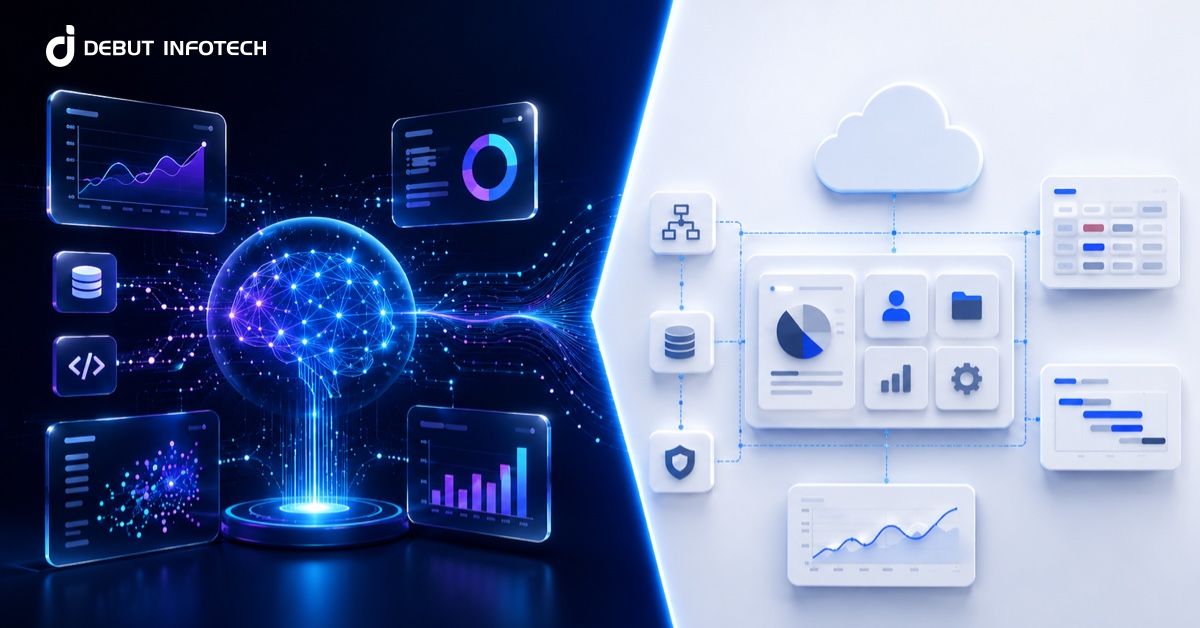


Imagine your sales team is using a traditional CRM. Each day, the team must update customer data, compose follow-up emails, monitor deal status and proactively check which deals may be in trouble. The system keeps the data, but it’s still up to your team to think and take action.
Now imagine using an AI SaaS solution. An AI-native CRM can transcribe and summarize sales calls, detect when deals are at risk, recommend the next action to take, generate follow-up emails, and even automate workflows. Rather than just managing tasks, the software helps manage decision-making and speed up processes.
This is the difference between traditional SaaS and AI SaaS.
Traditional SaaS transformed the way organisations use software through cloud computing. AI-native SaaS is doing more than that by transforming software. It’s no longer about reports, forms or manual data entry. It is about intelligent systems that can analyze context, automate repetitive work, personalize experiences, and support smarter business decisions.
But this does not mean all firms should replace their current SaaS systems. It is about making the right decision based on workflow complexity, data quality, compliance needs, cost, security and readiness to embrace AI-driven processes.
In this article, we will discuss AI SaaS vs traditional SaaS in practical terms, so you can see how they differ, the advantages and disadvantages, how they can be used, and the factors to consider before you decide which model is best for your company.
Traditional SaaS is cloud-based software that companies access via a web browser or mobile application. Rather than having to install software on each computer or host it on company servers, businesses pay for the software to be hosted online for a monthly or annual subscription fee.
This approach has been a game-changer for many organisations. It makes software easier to access, easier to update, and usually more affordable than building and maintaining everything internally.
A traditional SaaS product is typically:
Common examples include CRM systems, HR platforms, accounting tools, project management software, email marketing platforms, and helpdesk solutions.
Traditional SaaS is best known for its stability. Companies can rely on what is offered: established processes, price, and updates, as well as a stable user interface. Traditional SaaS continues to be a great fit for teams that require organization, control and consistency.
But the downside is that the majority of traditional SaaS systems are still largely manual. This means that users must update records, transfer tasks from one system to another, and review reports and initiate actions. This can be a challenge for teams that are dealing with a lot of data, complex customer interactions, or multiple systems.
That is why businesses are now weighing up traditional SaaS with AI SaaS platforms. Traditional SaaS helps businesses manage their work, while AI SaaS is built to help automate, predict, recommend and accelerate work.
AI-native SaaS is software that uses artificial intelligence as the foundation for how the product works. It’s not just SaaS with some added AI functionality. Rather, AI is built into the product, and influences how the software processes data, how it helps the user understand data, how it automates processes, and how it learns to improve processes over time.
In other words, traditional SaaS typically helps us manage tasks. AI-native SaaS helps people manage, understand and advance work more intelligently.
For instance, an AI-native SaaS solution might let the user ask questions in natural language, create summaries, anticipate customer actions, suggest actions, or automate repetitive tasks across multiple enterprise systems. This means that the software becomes more than just a tool, it’s an embedded intelligent assistant built into daily operations.
AI-native SaaS solutions are designed to do more than organize data or processes. They leverage artificial intelligence to learn user preferences, automate tasks, process business data, and help make decisions quickly. This makes the software more flexible, predictive and valuable to your business.
AI-native SaaS software is typically built to:
This is also why companies looking for custom software development are no longer just interested in simple cloud-based apps. They want software that can spot trends, decrease the need for manual work, and help them make decisions more quickly. They want software that does more than store information.
Traditional SaaS and AI-native SaaS might seem alike at first because they are both cloud applications. But how they help people is where the difference lies.
With traditional SaaS, teams typically get an organised way to manage their work, store information, track performance and collaborate. AI-native SaaS goes beyond just managing work. It leverages artificial intelligence to make sense of what is going on, recommend the next steps, and even automate some of the work.
Here is a simple comparison:
| Comparison Area | Traditional SaaS | AI-Native SaaS |
| Core function | Helps users manage and complete tasks | Helps users automate, predict, recommend, and complete tasks |
| User experience | Built around forms, dashboards, menus, and reports | Built around conversations, smart prompts, predictions, and guided workflows |
| Automation | Usually follows fixed rules set by the user | Uses AI to respond to context, patterns, and business data |
| Data use | Shows reports and analytics after data is collected | Turns data into real-time insights, alerts, and decision support |
| Pricing model | Often charged per user or per seat | May include subscriptions, usage-based pricing, outcome-based pricing, or a mix of models |
| Customization | Offers settings, integrations, and workflow rules | Supports adaptive workflows, AI agents, model tuning, and personalized recommendations |
| Productivity impact | Makes work easier to access, organize, and share | Reduces manual effort and helps teams make faster, better-informed decisions |
| Risk profile | More familiar, stable, and predictable | Requires stronger controls for privacy, security, accuracy, compliance, and AI governance |
| Best fit | Stable and repeatable business processes | Complex, data-heavy, repetitive, or fast-changing workflows |
The key point is this: traditional SaaS supports the user, while AI-native SaaS can actively support the work itself. For instance, traditional customer support software might help agents view tickets, determine case assignments, and track response times. An AI-native system may help to automatically summarize customer questions, recommend responses, identify urgency, automatically route tickets and notify managers if customer service drops.
This is why the debate between traditional SaaS vs AI platforms is important. Businesses are no longer only asking, “Which tool helps us get our work done?” They are also asking, “Which tool can help us automate processes, guide our decision-making and add value to our business?”
But AI-native SaaS is not the right choice for all businesses. If you have simple processes and data, or tight security and compliance constraints, traditional SaaS may be a simpler and cheaper option.
The best decision depends on your process, data quality, budget, security and compliance requirements, and your team’s readiness to work with AI to make business decisions.
AI-native SaaS is getting attention because companies are looking for more than “intelligent software.” They want software to eliminate complexity, automate time consuming processes, and help them make decisions faster.
For , traditional SaaS has helped businesses transition from spreadsheets and desktop software to cloud-based systems. That was a major step forward. But a lot of teams still have to switch multiple systems, enter data multiple times, wait for someone to update the system, and struggle to turn reports into action.
This is where AI-powered SaaS products are changing expectations.
Rather than storing data or presenting dashboards, AI-powered SaaS can help teams interpret data, make suggestions and automate their work.
For instance, a customer support tool can identify critical cases, extract customer issues, provide suggested responses, and assign cases to the appropriate team. A sales platform can detect deals at risk, generate follow-up emails and notify sales reps about which leads are most likely to close deals.
This transformation is driven by business needs, such as:
The move to agentic AI is already playing out in the enterprise. According to McKinsey, 88% of companies surveyed are already using AI for at least one business function, but only one-third have begun scaling AI across their businesses. The report also noted that 23% of participants are scaling agentic AI in one or more business functions, while 39% are experimenting with AI agents.
The takeaway here is that AI-native SaaS is becoming important because of AI.
They want tools that can help improve productivity, decision making, customer experience and business performance.
One of the best ways to distinguish between traditional SaaS and AI SaaS is how they are priced.
Traditional SaaS pricing is typically straightforward: you pay for user licenses, seats, storage, add-ons or a subscription level. That makes budgeting easier because finance teams can estimate monthly or annual software spend based on team size.
For example, Salesforce Sales Cloud lists plans from $25 to $350 per user per month, while HubSpot Sales Hub lists paid tiers from $15 to $150 per seat per month. These are familiar seat-based models where the cost rises mainly as more people use the platform
AI-native pricing works differently. Rather than accessing the software, some companies in the AI SaaS market charge you for what it does. That could mean AI credits, agent actions, automated conversations, outcomes, API calls, or token usage.
McKinsey notes that as AI+SaaS products begin to perform work rather than simply support work, pricing is moving toward consumption-based and work-unit models. It also warns that buyers want clearer cost predictability because AI usage can be difficult to forecast across multiple vendors.
| Vendor / Product | Pricing Model | Publicly Listed Figure | What This Shows Buyers |
| Salesforce Sales Cloud | Seat-based traditional SaaS | Starter Suite: $25/user/month; Pro Suite: $100/user/month; Enterprise: $175/user/month; Unlimited: $350/user/month | Traditional SaaS pricing is predictable because cost scales mainly by number of users and plan tier. |
| HubSpot Sales Hub | Seat-based SaaS with AI features | Free: $0/month; Starter: $15/seat/month; Professional: $100/seat/month; Enterprise: $150/seat/month | Buyers can estimate cost quickly by multiplying seats by the chosen plan. |
| Zendesk Suite + Copilot | Hybrid seat + AI assistant pricing | Suite + Copilot Professional: $155/agent/month; Suite + Copilot Enterprise: $209/agent/month; Copilot add-on: $50/agent/month | Some vendors package AI into higher-priced bundles or sell it as an add-on to existing SaaS seats. |
| Microsoft Copilot Studio | Credit-based AI agent pricing | $200/month for 25,000 Copilot Credits; also offers pay-as-you-go billing | AI agent pricing can be based on credits consumed when agents complete actions or responses. |
| Salesforce Agentforce | Consumption, conversation, and user-based options | Flex Credits: $500 per 100k credits; Conversations: $2 per conversation; flat access: $125/user/month | AI SaaS pricing may offer multiple buying models, making comparison more complex than traditional subscriptions. |
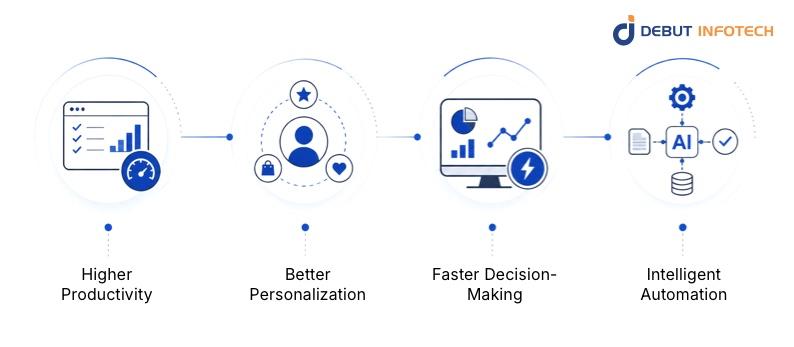
AI-native SaaS is more than just the occasional “smart” feature in software. It allows teams to cut down on tedious tasks, speed up response times, personalize interactions, and gain insights from existing data.
1. Higher Productivity
AI-native SaaS platforms can automate routine tasks that can slow down teams, such as data entry, call summaries, tagging tickets, routing workflows and generating reports.
For instance, rather than a sales executive taking notes after each call with a customer, an AI system can automatically record the call, note key points, and update the CRM. This frees up time for employees to do more meaningful tasks such as addressing customer issues, enhancing customer experience, and closing sales.
2. Better Personalization
AI-native systems can learn to personalise the experience for every individual user or customer according to their actions, interests, previous engagement and current context.
For example, a customer success platform can suggest the best onboarding steps to take for a new customer, while a marketing system can recommend content based on the user’s viewing and click history. Making the experience more personalized, relevant, helpful and timely rather than generic.
3. Faster Decision-Making
AI-native SaaS can help to detect patterns, opportunities, and threats more quickly. Traditional SaaS solutions often provide dashboards and reports, but users still need to interpret the data to make decisions.
For instance, it can spot a customer that is at risk of churning, it can highlight a project that is running behind schedule, or it can detect a high irregularity spending before it becomes a problem. This helps leaders act earlier and make decisions with more confidence.
4. Intelligent Automation
Simple automation is based on rules like “if A is this, then do B”. AI-native SaaS takes this a step further by considering context to suggest what to do next.
For instance, rather than all helpdesk tickets being processed the same way, an AI-native helpdesk can compare the customer’s history, urgency, problem type and tone of voice, then prioritise the ticket to the right support team. This type of intelligent automation is emerging as a key part of the tech stack for web development, particularly for companies developing smarter SaaS products.
AI-native SaaS can help software be more efficient, intelligent, and automated. But as with all powerful tools, it does have its risks, which businesses should be aware of before using it.
The real question is not only “Can this AI tool save time?”
It is also “Can we trust its output, protect our data, and stay in control of important decisions?”
1. Inaccurate or Hallucinated Outputs
One of the biggest risks of AI-native SaaS is that the system may produce answers that sound confident but are incorrect.
For example, an AI tool may:
In some low-risk applications, this might only lead to a minor error. But in critical areas like finance, health, law, recruiting, or customer service, flawed AI results can impact business operations and human lives.
2. Prompt Injection Attacks
Prompt injection is another serious concern. This occurs when someone seeks to undermine the AI system by providing it with hidden or malicious instructions.
For example, an attacker may try to make the system:
OWASP identifies prompt injection and insecure output handling as major risks in large language model applications because they can lead to data exposure, poor decisions, and wider security problems.
3. Poor Explainability
Another risk is that AI systems don’t always provide transparent explanations for their decisions.
With traditional SaaS, for instance, a user can see how an action was taken if it was based on a rule, setting, or workflow. With AI-native SaaS, the reasoning may be harder to understand.
This can create problems when teams need to answer questions like:
For high-risk or regulated industries, explainability is not just helpful. It is essential.
Developing an AI SaaS product is not as simple as automating tasks or including a chat bot within a cloud-based software platform. It needs product strategy, scalable and secure architecture, data governance, user experience design, and understanding of how software is used by businesses to enhance their operational and business performance.
As a top SaaS development company, Debut Infotech assists startups, enterprises and emerging businesses with turning existing software into smart, AI-enabled platforms. We assist businesses in every step of the process with product discovery, MVP development, AI-powered capabilities, cloud development, API integration, workflow automation, security, performance, and scaling after launch.
Our approach is to create solutions that help business goals, not just technology that looks impressive. Whether it’s to increase productivity and automate tasks, support quick decision-making and enhance customer experiences, Debut Infotech turns SaaS concepts into real business outcomes.
Whether you’re looking to transform an existing product or create a next-generation AI-powered SaaS product, Debut Infotech delivers the technical expertise, product thinking, and delivery capabilities to help you scale.
A. AI SaaS is cloud-based software that uses artificial intelligence to automate tasks, analyze data, personalize experiences, and suggest smarter actions.
In simple terms, it helps software move from just storing information to actively supporting better business decisions.
A. Enterprises move to AI-native SaaS by making AI part of the product’s core workflows, not just an added feature.
They usually start with AI-assisted tools like chatbots, summaries, and recommendations, then move toward automated workflows and AI agents that handle multi-step tasks with human oversight.
To succeed, enterprises need clean data, secure integrations, strong governance, and scalable architecture.
A. AI-native SaaS platforms help businesses work faster, reduce manual tasks, and make smarter decisions. Because AI is built into the core of the platform, the software can analyze data, spot patterns, recommend actions, and personalize user experiences in real time.
This helps teams speed up workflows, improve productivity, predict risks earlier, and scale operations more easily. In simple terms, AI-native SaaS does more than manage work; it helps improve how work gets done.
Our Latest Insights
USA
2501 Chatham, Rd Suite R Springfield, IL 62704
+1-708-515-4004
info@debutinfotech.com
UK
7 Pound Close, Yarnton, Oxfordshire, OX51QG
+44-770-304-0079
info@debutinfotech.com
Canada
154 Eden Oak Trail, Kitchener, ON N2A 0H9
+1-708-515-4004
info@debutinfotech.com
INDIA
Sector 101-A, Plot No: I-42, IT City Rd, JLPL Industrial Area, Mohali, PB 140306
9888402396
info@debutinfotech.com