ON THIS PAGE
Progress0%






Our Global Presence :



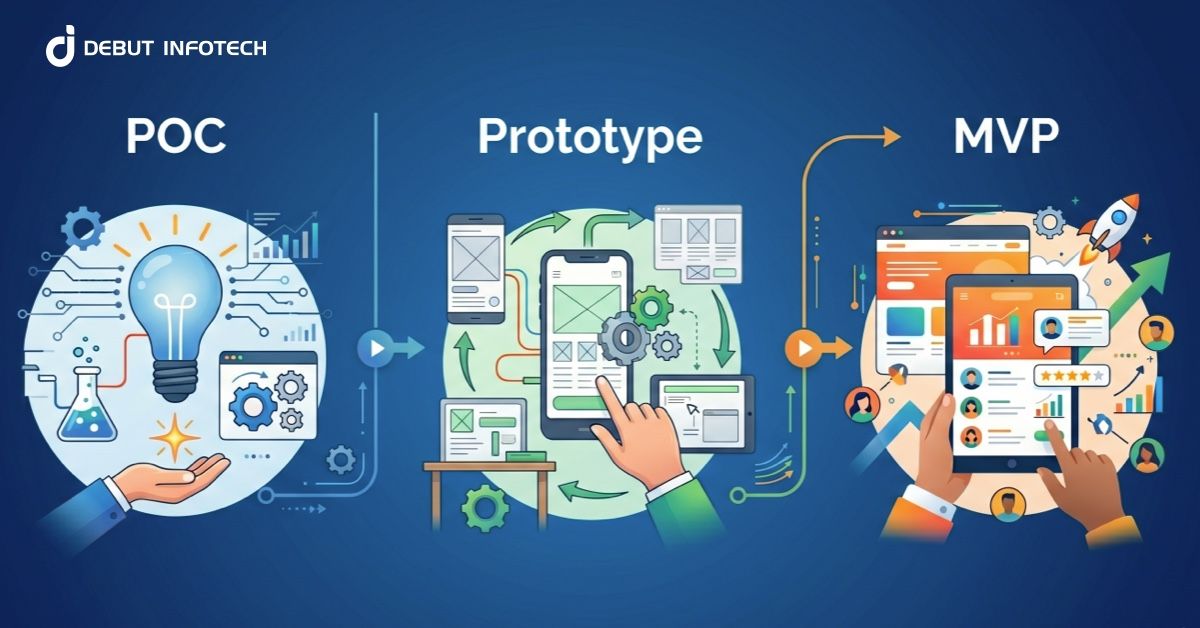


If you are comparing MVP vs Prototype vs POC, then you are asking the right question. Most startups fail to spend time and money, not because the idea is poor, but because they create the wrong version of the product initially.
A Proof of Concept (POC) is needed by some businesses to determine whether the technology is actually feasible. Others require a Prototype to demonstrate the look and feel of the product to solve a user problem. Launching an MVP (Minimum Viable Product) is better suited to many startups to see if real demand exists with actual customers.
Being aware of the difference will save months of development time, reduce extra costs that could be avoided, and guide you to making smarter product decisions from the first day.
In this guide, you’ll learn:
This breakdown will enable you to take a step and stay confident regardless of whether you are a founder, product manager, or a team of startups. Let’s get into it!
A Proof of Concept (PoC) is a small, focused test used to answer one practical question early: can this idea actually work before we invest more time and money into it?
This is what a PoC is all about. It is not intended to be smooth and client-ready or loaded with features.
In simple terms, a PoC helps a team test the riskiest assumption behind an idea. Sometimes that risk is technical. For example, can an AI model classify support tickets with sufficient accuracy to be useful? Is it possible to integrate a payment system with an existing platform? Can a new product handle live data securely and fast enough to meet user expectations? A PoC gives you evidence before you move into full design or development.
That is why a PoC is very important in software projects. Teams tend to get enthusiastic about the product concept, yet the smarter thing to do is to prove the point that the most difficult part is feasible. That early validation can prevent expensive detours later.
A good Proof of Concept (PoC) usually works like this:
To illustrate, suppose a startup wishes to develop a SaaS application summarizing legal documents using AI. The team may also have a PoC prior to the design of dashboards or the construction of subscriptions to determine whether the summarization model is capable of providing useful, reliable outputs on actual documents. When the responses are poor, the team will learn early. If the results are strong, they can move forward with far more confidence.
That matters because product and project risk is real. In its 2024 global study on project success, PMI discovered that only 47.8% of projects were deemed successful and 12% were deemed failures under its value-based definition of success. Although that report is not necessarily about software, it is a lesson that validating early puts a team in a better position to not waste effort.
A PoC is typically not a comprehensive product roadmap, but a single experiment. The team selects the issue that has the highest probability of breaking the project and tests it initially.
That might involve:
The outcome is not “we launched.” The outcome is “we now know whether this concept deserves the next level of investment.”
Related Read: How to Choose the Right Tech Stack for a Web Development Project?
A PoC works best when the team stays disciplined. One of the biggest mistakes is turning it into a mini product build. That usually slows learning and increases cost.
A stronger approach is to:
That last point is important. A PoC is useful even in situations when the response is no, as it will assist a team in not developing the wrong thing on a large scale.
The main reason to use a PoC is simple: it reduces risk before risk becomes expensive.
It can help you:
Therefore, when someone inquires about what a PoC actually does, the best response is as follows: it assists you in testing the feasibility prior to commitment. And in software, that can be the difference between a more intelligent launch, and an extremely expensive error.
Also Read: Rapid Web Development Tools: Build Faster, Better, and Smarter
A prototype is an early form of a digital product created to demonstrate how the end product will appear, feel and operate before the actual development starts. It assists in converting an idea that exists in the abstract into something tangible that can be experienced by users, investors, designers and developers.
Consider it to be a safe and economical method of testing your product before investing more.
In contrast to a Proof of Concept (PoC) which is employed to check whether a technical concept can be made to work, a prototype is aimed at usability, design flow, and customer experience. It responds to questions like:
In the case of startups and expanding businesses, prototypes can help minimize expensive errors since the issues are detected prior to the start of coding.
The majority of prototypes start with low-fidelity wireframes or sketches. These simple layouts assist in mapping screens, buttons, menus, and user journeys. As soon as the concept is better understood, groups develop interactive prototypes with applications such as Figma or Adobe XD.
Users are then allowed to scroll through the product as though it is real.
As an example, when creating a SaaS platform, a prototype can enable a person to create an account, navigate to services, and navigate to checkout pages, even though the back-end system is not yet implemented.
This phase provides useful feedback when there is an increase in development costs.
Digital products are increasingly competitive, and prototyping has become a more significant factor. According to a recent market report, the market size of prototyping software in the world was estimated to be $1.48 billion dollars in the year 2025, which is highly demanded by startups and software teams desiring to have faster and smarter product validation.
The fact that growth is positive indicates one thing: more companies are turning to prototypes as a way of minimizing risk and enhancing the success of the launch.
The most effective prototypes are user-driven, focused, and simple. Begin by testing only the features of utmost importance. Avoid trying to replicate the entire product too early. Get the prototype in front of actual users and see where they go wrong and make improvements fast.
The feedback of various perspectives (customers, internal teams, and technical stakeholders) is also prudent to receive.
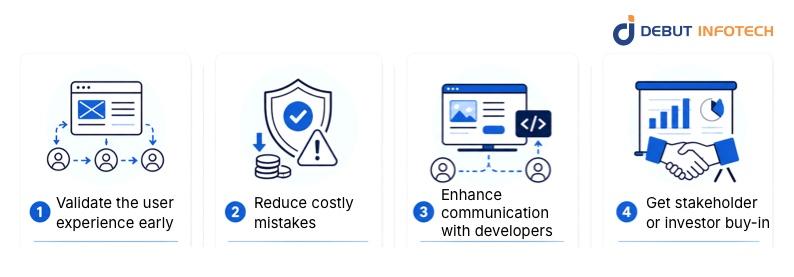
One of the cleverest ways to minimize uncertainty prior to the full development of the product is the use of a prototype. You can test concepts early and get actual feedback and make the product better before you devote bigger budgets to it.
Some of the primary reasons why businesses use a prototype are as follows:
A prototype will allow you to visualize how easily users can use the product, comprehend features, and perform the most important tasks. This will enable you to resolve confusion prior to development.
It is usually costly and time-consuming to modify designs once the coding is completed. A prototype assists in identifying the problems at the beginning when modifications are simpler and less costly.
Developers simply find it easier to grasp your vision when they can look at screens, workflows and interactions rather than having to read about it.
A prototype provides the investors, partners or internal decision-makers with something physical to look at. This often creates more confidence than presenting only an idea.
Related Read: A Complete Guide For MVP Development: Helping You Save Resources
The first usable version of a product that provides one distinct value to real users is a Minimum Viable Product (MVP). It is not some sloppy sketch, or a stripped-down product that is produced thoughtlessly. A good MVP is intentionally focused. It assists a business in testing the desire of people in the solution before investing time and money in constructing everything simultaneously.
In a nutshell, an MVP will enable you to learn before you scale. Rather than releasing with all features on the wishlist, you release with the most essential feature. In this manner, you will be able to expose the product to actual users and observe their reaction, and evolve it on the basis of evidence, not assumptions. This is what makes MVPs so useful to early-stage product validation.
There are common characteristics of a strong MVP. To begin with, it addresses a single primary issue effectively rather than attempting to accomplish too much. Second, it contains only the necessary functions required by the users to accomplish the primary task. Third, it is practical enough to be employed by ordinary people in a real-life environment. Lastly, it is designed to gather feedback, thus enabling the team to learn what works, what baffles users, and what to improve upon next.
The most significant objective of using MVP is to minimize risk. It provides founders and product teams with a quicker, more feasible means to assess demand prior to investing significantly. It also makes teams prioritise more, as they get to see which features are really valued by the users rather than speculating.
That is important since one of the most frequent causes of product failure is overbuilding prematurely. CB Insights discovered that 35% of startups failures were associated with lack of need in the market, and this demonstrates how risky it is to develop before verifying actual demand.
So, an MVP is not just a development shortcut. It is an intelligent method of learning and justifying demand, and better decisions on products with less waste.
A Proof of Concept (PoC), Prototype, and Minimum Viable Product (MVP) are often mentioned together, but they represent different stages of the product development journey. Knowing which one to apply at what time may assist businesses to save budgets, minimize risk, and make decisions more quickly and efficiently.
In simple terms, a Prototype and a PoC tend to belong to the pre-product stage. They are created before launching anything publicly and often require lower investment. An MVP, in turn, is the initial actual product that is launched to the users. It consists of core features, real functionality, and gives you the opportunity to test whether the market wants your solution.
To most founders understanding the distinction between these three approaches could be the difference between constructing wisely and constructing blindly.
| Factor | PoC | Prototype | MVP |
| Primary Goal | Prove technical feasibility | Demonstrate business concept and experience | Validate demand and product-market fit |
| Development Time | Days to weeks | Weeks | Months |
| Main Audience | Developers, internal teams | Stakeholders, investors, focus groups | Early adopters, customers, investors |
| Use Case | Test technical possibilities | Show flows, UI/UX, and gather feedback | Launch usable product and collect analytics |
| Risk Reduced | Technical risk | Usability and concept risk | Higher |
| Investment Level | Low | Medium | Yes |
| Revenue Potential | No | No | Full product scaling |
| Next Step | Prototype or MVP | MVP development |
What is a PoC?
A PoC checks whether your idea can technically work. It is best for products involving complex or uncertain technology.
Use a PoC when:
What is a Prototype?
A Prototype is a graphic or interactive model that demonstrates how the product will appear and operate. It can be applied in feedback, testing flows and in presentations to investors.
Use a Prototype when:
What is an MVP?
An MVP is a functional product with essential features only. It is released to actual users to check demand, gather information, and enhance through updates.
Use an MVP when:
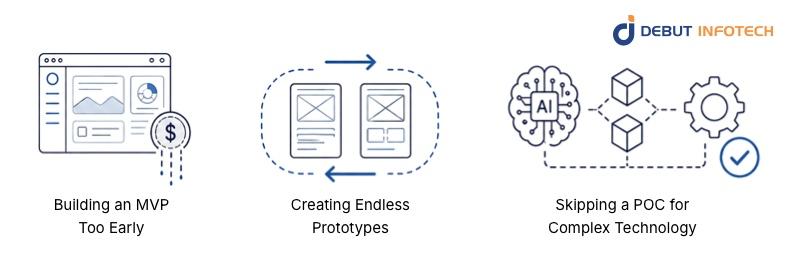
Bad coding, bad marketing, and lack of effort are not the largest causes of startups spending more than they should. It is making the wrong decision on the development stage of the product at the wrong time.
Most founders also jump into building at a high pace because they desire some momentum, but a fast pace without validation is often costly in the long-term.
Building an MVP Too Early
The idea of an MVP sounds reasonable, and unless you have already tested the desire of people to receive the solution, it might be an expensive guess. Most startups invest thousands of dollars in creating features, dashboards, and user flows, without ensuring actual demand. In some instances, founders spend between $30,000 and $100,000 on a product that no one had requested. Strong startup product development stages begin with learning first, then building only what matters.
Creating Endless Prototypes
Prototypes can be used to test ideas and enhance user experience. The problem starts when teams stay in prototype mode for too long. They continuously re-design screens, modify colors and refine layouts, yet they never put them to the test to see whether they would ever pay or change to existing solutions. Good designs are not enough to generate traction.
Skipping a POC for Complex Technology
When your product relies on AI, blockchain, automation, or other advanced integrations, it may be dangerous to skip a Proof of Concept. A POC is used to ensure that technology functions prior to large-scale investment. In its absence, startups can find themselves with severe technical constraints after several months of development, causing delays, reworking, and squandered budgets.
The smartest founders do not just ask what to build. They inquire about the first things to be tested.
When evaluating PoC vs Prototype vs MVP, each of the options is designed to resolve one essential question: Is this idea worth investing in? Which direction to take will depend on what you must first prove to be the case-technology, usability, or the real market need.
A PoC (Proof of Concept) is the right option when you need to check whether the underlying technology can actually work. A Prototype can assist you in visualizing the product, getting user feedback, and perfecting the experience before full development starts. An MVP is the best option when you are prepared to introduce a working product with the necessary functions and get to know the honest customer behavior.
Most business ventures waste time and finances because they start in the wrong place. Some build an MVP too early. Technical validation does not always go hand in hand with complex ideas. Such errors may slow down growth and lead to unnecessary expenses.
At Debut Infotech, we assist the businesses to avoid those risks by steering them into the most intelligent approach of product validation. We evaluate your objectives, schedule, budget, target audience, and technical scale to advise on the appropriate next step which could be PoC, Prototype or MVP.
From startup ideas to business-level products, we integrate strategy, design, and development capabilities to enable you to launch on time, spend wisely, and build confidently. When the first decision matters most, we are here to help you make the right one.
A. A Proof of Concept (PoC) is used to test whether an idea is technically possible. It focuses on one key question: Can we build this? A PoC is usually created for internal use and helps teams reduce technical risk before full development begins.
An MVP (Minimum Viable Product) is a basic working version of the product released to real users. It focuses on a different question: Do people want this? An MVP helps validate demand, collect feedback, and gain early traction in the market.
In simple terms, a PoC tests feasibility, while an MVP tests real customer interest.
A. Moving from a prototype to production is a major step for enterprises. At the prototype stage, the focus is usually on testing ideas and proving the product works. Once production begins, priorities shift to quality, consistency, cost control, and reliability.
To make this move successfully, businesses often refine the design so it can be manufactured efficiently at scale. They also secure dependable suppliers, carry out detailed testing, and introduce quality control processes to maintain standards.
At the same time, teams review operations, timelines, and costs to ensure they are ready for larger demand. The goal is to turn an early working model into a reliable product that can be delivered consistently and profitably.
A. The cost of PoC vs Prototype vs MVP depends on your goals and product complexity, but each stage usually has a different budget level.
A Proof of Concept (PoC) is usually the cheapest and fastest option. It often costs $5,000 to $25,000 and can be completed in under two weeks. It is used to test technical feasibility.
A Prototype is mid-range in cost because it focuses on design and user experience. It typically costs $2,000 to $30,000+ and takes two to eight weeks.
An MVP (Minimum Viable Product) is usually the most expensive because it is a real working product for users. Costs often range from $15,000 to $250,000+ and development may take six to sixteen weeks.
In simple terms, a PoC tests the tech, a Prototype tests the concept, and an MVP tests the market.

Our Latest Insights
USA
2501 Chatham, Rd Suite R Springfield, IL 62704
+1-708-515-4004
info@debutinfotech.com
UK
7 Pound Close, Yarnton, Oxfordshire, OX51QG
+44-770-304-0079
info@debutinfotech.com
Canada
154 Eden Oak Trail, Kitchener, ON N2A 0H9
+1-708-515-4004
info@debutinfotech.com
INDIA
Sector 101-A, Plot No: I-42, IT City Rd, JLPL Industrial Area, Mohali, PB 140306
9888402396
info@debutinfotech.com