ON THIS PAGE
Progress0%






Our Global Presence :


Organizations constantly test new ideas, but the stakes are high. According to the Standish Group’s CHAOS report, 69% of software projects either fail outright or miss their strategic targets. Furthermore, Harvard Business School research suggests that 75% of venture-backed initiatives fail commercially. A Proof of Concept (POC) addresses this by validating feasibility before these resources are committed.
A proof of concept addresses this challenge by testing whether an idea can work before major investment begins. It allows teams to examine feasibility, validate assumptions, and identify technical or operational barriers in a controlled environment.
Businesses across software development, pharmaceuticals, manufacturing, and emerging technology rely on this approach to make informed decisions. This guide explains what a proof of concept is, when to use it, what it includes, its benefits, the steps to create one, and how it differs from prototypes, pilots, and MVPs.
A proof of concept (POC) is a structured experiment used to determine whether a proposed idea, technology, or solution can work in a practical environment. It focuses on feasibility rather than full development.
Teams use a POC to test core assumptions, confirm that the underlying approach functions as expected, and identify technical or operational challenges. The results help decision-makers determine whether the concept should proceed to prototyping, product development, or further research.
Organizations use a proof of concept during the early stages of innovation to determine whether a new product idea or concept can function as intended. The POC tests the technical feasibility of the idea before full design or engineering begins. By evaluating the concept in a controlled environment, teams can identify limitations, validate assumptions, and confirm whether the product concept is worth moving forward with development.
Companies often create a proof of concept to demonstrate the viability of an initiative when presenting it to executives, investors, or strategic partners. A working demonstration provides tangible evidence that the solution addresses a real problem. This validation helps stakeholders evaluate potential value, understand the opportunity, and determine whether the project aligns with business priorities and market demand before approving larger investments.
A blockchain proof of concept becomes useful when organizations plan to introduce new technologies or advanced features into existing systems. Examples include blockchain integration, artificial intelligence, blockchain solutions, or complex automation tools.
Running a POC allows technical teams to assess system compatibility, performance, and scalability, and to identify integration challenges early. This ensures that the proposed technology can operate effectively within the organization’s infrastructure.
Businesses also rely on proof of concept projects when evaluating improvements to internal processes or operational models. The POC helps determine whether the proposed approach delivers measurable benefits such as efficiency gains, reduced costs, or improved performance.
Demonstrating validated results through a controlled experiment strengthens credibility. It helps organizations attract investors or partners who prefer data-driven evidence before committing funding.
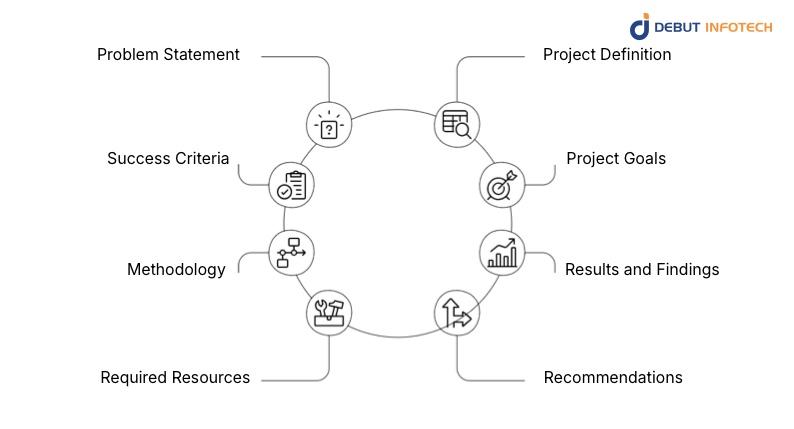
The problem statement explains the specific challenge or gap the enterprise blockchain project intends to address. It defines the context of the issue, outlines its impact on users or business operations, and clarifies why solving it matters. A well-defined problem statement ensures the proof of concept focuses on testing a clearly identified need.
The project definition outlines the proposed solution and explains how the proof of concept will test it. It describes the idea being evaluated, the environment where testing will occur, and the boundaries of the experiment. This section clarifies what the POC will attempt to demonstrate and what it will not cover.
Success criteria establish measurable indicators that determine whether the concept works as expected. These metrics may include technical performance, usability benchmarks, response time, or operational improvements. Clear success criteria guide the testing process and provide an objective way to evaluate whether the proof of concept achieved its intended outcome.
Project goals describe the outcomes that the proof of concept aims to achieve during testing. They connect the original problem with the expected solution and help guide the experiment. Clear goals keep the team focused on validating feasibility rather than expanding the project scope beyond the initial concept.
The methodology explains the procedures and testing approach used during the proof of concept. It outlines how the experiment will be conducted, the tools or technologies involved, and the methods used to collect and evaluate data. A defined methodology ensures the testing process remains structured and repeatable.
This section records the outcomes observed during testing. It presents performance data, observations, and technical insights gathered throughout the experiment. Documenting the results clearly helps stakeholders understand whether the concept performed as expected and provides evidence needed to support decisions about future development.
Required resources identify the people, tools, technologies, and financial inputs necessary to execute the proof of concept in blockchain. This section outlines what the project team needs to conduct testing effectively. Defining resources early helps ensure the experiment remains realistic and achievable within the organization’s capabilities.
The recommendations section summarizes the conclusions drawn from the proof-of-concept results. It outlines the suggested next steps based on the evidence collected during testing. The team may recommend continuing development, refining the concept, or reconsidering the approach depending on whether the experiment met its success criteria.
A proof of concept allows organizations to gather early feedback from users, technical teams, or stakeholders before significant development begins. This feedback highlights usability issues, unmet expectations, and feature gaps. The insights gained help teams refine the concept, improve planning accuracy, and align development priorities with real user needs.
Testing a concept early helps teams identify technical limitations and operational constraints before entering full-scale development. Once feasibility is confirmed, the development process becomes more focused and efficient. Clear validation at the POC stage reduces uncertainty, allowing teams to move through design, prototyping, and production phases faster and with greater confidence.
A successful proof of concept provides a technical and strategic foundation for future development. The experiment reveals how systems interact, how components perform, and what architecture works best. These insights guide the next stages of product design, helping teams build on validated knowledge rather than relying solely on theoretical assumptions.
Investors often prefer projects that demonstrate practical feasibility rather than theoretical potential. A proof of concept provides tangible evidence that the idea has been tested and evaluated under controlled conditions. This validation strengthens investment proposals, improves credibility, and helps organizations communicate the potential value and viability of their concept.
A proof of concept helps organizations detect technical or operational challenges before committing large budgets to development. Identifying limitations early prevents expensive redesigns and failed implementations. By testing assumptions at a small scale, teams can address risks proactively and avoid investing resources in ideas that may not perform as expected.
The primary purpose of a proof of concept is to determine whether an idea can function in a real-world environment. Through controlled testing and measurable evaluation, teams confirm whether the concept delivers the expected results. This validation provides clarity about technical viability and helps organizations decide whether to proceed with further development.
Demonstrating a working concept strengthens confidence among executives, partners, and project sponsors. Stakeholders can review tangible results rather than theoretical proposals. Organizations that validate ideas early also position themselves ahead of competitors who are still exploring possibilities, giving them a stronger foundation for innovation and faster progress toward implementation.
Proof-of-concept results provide reliable data that leaders can use to guide strategic decisions. The findings reveal whether the concept meets technical expectations, aligns with business objectives, and delivers measurable value. With clear evidence available, organizations can confidently determine whether to continue development, modify the idea, or pursue alternative approaches.
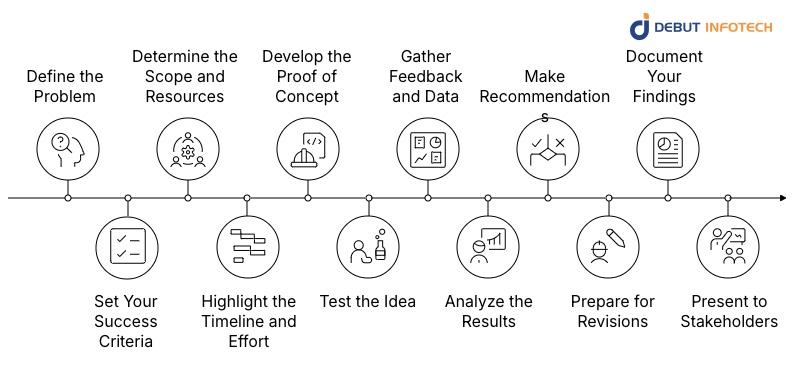
Start by clearly identifying the problem the proof of concept intends to address. This involves understanding the operational challenge, the gap in current solutions, or the opportunity the new concept seeks to explore. A precise problem definition ensures the experiment remains focused, measurable, and aligned with the broader goals of the project or organization.
Expert Insight: “Avoid ‘Solution-First’ thinking. Don’t start with ‘We need an AI chatbot.’ Start with ‘Our support team spends 40 hours a week answering the same five questions.’ The POC should prove you can automate those five specific answers, not just ‘build a bot.’”
Establish measurable benchmarks that will determine whether the concept works as intended. These criteria may include technical performance levels, operational efficiency improvements, or user acceptance indicators. Clear success metrics enable the project team and stakeholders to objectively evaluate results and determine whether the concept meets the expectations set at the start.
Expert Insight: “Define your ‘Kill Metrics.’ Success criteria are great, but you also need to know when to stop. If the latency exceeds 2 seconds or the API integration fails three times in a row, be prepared to pivot or abandon the concept early to save costs.”
Define the boundaries of the proof of concept by outlining what will be tested and what will remain outside the experiment. At the same time, identify the resources required, including personnel, tools, technology, and budget. A clear scope prevents unnecessary complexity and ensures the project remains manageable during testing. If you run into challenges, you can consult with reputable blockchain consultants for guidance.
Expert Insight: “Keep your ‘Strike Team’ lean. A POC usually only needs a Lead Architect and one Senior Developer. Adding too many stakeholders at this stage creates ‘design-by-committee’ and slows down the experimental nature of the project.”
Create a realistic timeline that outlines the key phases of the proof of concept, including preparation, testing, and evaluation. This timeline should estimate the effort required from team members and specify milestones for reviewing progress. A structured schedule helps maintain project momentum and ensures the experiment remains within the intended timeframe.
Expert Insight: “If a POC takes longer than 4 weeks, your scope is likely too broad. A POC is a sprint, not a marathon. If you can’t prove feasibility in a month, you are likely building a Prototype, not a Proof of Concept.”
At this stage, the project team creates the experimental model or limited implementation needed to test the idea. This may involve building a small software module, configuring a technical environment, or designing a simplified version of the proposed solution. The objective is to construct a controlled setup capable of demonstrating feasibility.
Expert Insight: “Don’t worry about the ‘Paint.’ Use a ‘Headless’ approach where possible. If you’re testing a new database logic, you don’t need a UI. Testing the logic via a command line is faster and keeps the focus on technical feasibility.”
Conduct controlled testing to determine whether the concept performs according to expectations. During this stage, the team observes how the system operates, measures performance metrics, and evaluates whether the proposed solution addresses the defined problem. Testing should remain structured so that results can be compared directly with the established success criteria.
Expert Insight: “Test for ‘Edge Cases,’ not just the ‘Happy Path.’ It’s easy to make a concept work under perfect conditions. A true POC tests how the technology handles bad data or network interruptions.”
Collect both quantitative data and qualitative feedback during the testing process. Performance measurements, user reactions, and technical observations provide valuable insight into how the concept behaves under practical conditions. Gathering comprehensive data ensures that the evaluation phase is supported by evidence rather than assumptions.
Expert Insight: “Focus on the ‘Why’ behind the data. If a blockchain transaction takes 30 seconds, the data tells you it’s slow, but the feedback from the developer tells you it’s because of a specific node configuration error. That insight is more valuable than the number itself.”
After testing is complete, the team reviews the collected data to determine whether the concept met the defined success criteria. This analysis involves examining performance metrics, identifying strengths and weaknesses, and assessing the reliability of the approach. Careful evaluation helps determine whether the concept can progress to the next development stage.
Expert Insight: “Be brutally honest. A ‘Failed’ POC is actually a success if it prevents you from spending $200k on a product that would have never worked. Treat every technical limitation discovered as a win for the company’s budget.”
Based on the analysis, the project team develops recommendations regarding the future of the concept. These recommendations may include proceeding with development, refining specific components, or reconsidering the approach entirely. Clear guidance helps stakeholders understand the practical implications of the proof of concept results.
Expert Insight: “Recommendations should be binary: Go, No-Go, or Pivot. Avoid ‘Maybe.’ If the feasibility is shaky, recommend a second, smaller POC to address the specific point of failure rather than a full project greenlight.”
Proof of concept testing often reveals areas that require adjustments or improvements. The team should identify these areas and outline possible revisions that could strengthen the concept. Preparing for refinement ensures that lessons learned during testing are directly incorporated into the proposed solution before further development begins.
Expert Insight: “Document the ‘Technical Debt.’ During a POC, you likely took shortcuts to save time. Make sure you list exactly which parts of the code were ‘quick and dirty’ so they aren’t accidentally used as the foundation for the final product.”
Comprehensive documentation is essential for communicating the results of the proof of concept. This documentation should include the objectives, methodology, testing procedures, collected data, and final analysis. Clear records allow stakeholders to review the experiment, understand the outcomes, and reference the findings during future project planning.
Expert Insight: “Create a ‘Feasibility Scorecard.’ Stakeholders often don’t have time to read a 20-page technical report. A one-page executive summary with a Red/Yellow/Green status for each success criteria is your most powerful communication tool.”
The final step involves presenting the proof of concept results to decision-makers, investors, or project sponsors. This presentation summarizes the objectives, testing process, findings, and recommendations. A well-structured presentation ensures stakeholders clearly understand the feasibility of the concept and can make informed decisions about moving forward.
Expert Insight: “Show, Don’t Just Tell. Even if the POC is just a back-end script, find a way to visualize the data output. Showing a ‘Before’ and ‘After’ comparison of processing speeds or cost-savings is what gets budgets approved.”
In software development, a proof of concept often involves building a small functional component to test whether a particular technology, framework, or system architecture can support the intended application. Blockchain app development companies may evaluate performance, integration with existing systems, or the reliability of algorithms before committing to full product development or large-scale implementation.
Product development teams use proof of concept experiments to determine whether a design idea can perform its intended function. This may involve creating a simplified version of a device, material, or mechanical structure to test feasibility. The results help engineers confirm the concept’s practicality before investing in detailed design, prototyping, and manufacturing processes.
In pharmaceutical research, a proof of concept evaluates whether a drug candidate demonstrates the intended biological effect during early testing stages. Researchers conduct laboratory or preclinical studies to confirm that the compound interacts with the targeted biological mechanism. Positive results help justify further blockchain proof of concept market research, clinical trials, and regulatory development stages.
Comparison Table
| Stage | Scope | User Involvement | Goal | Investment | Iteration |
| Proof of Concept (POC) | Narrow and experimental. Focuses only on validating whether a concept or technology can work in practice. | Minimal or none. Usually tested internally by engineers or researchers. | Confirm feasibility and determine whether the idea is technically possible. | Low investment because the experiment is small and controlled. | Limited iteration since the goal is validation, not product refinement. |
| Prototype | Broader than a POC. Demonstrates the design, workflow, and functionality of a product concept. | Moderate involvement from internal testers or selected users. | Evaluate usability, design decisions, and technical implementation before development. | Moderate investment in design tools, engineering effort, and testing. | Iterative. Multiple versions are often created to improve functionality and user experience. |
| Pilot | Real-world deployment in a limited environment or selected user group. | High involvement from actual users operating in real conditions. | Test operational performance and gather real-world usage insights before full rollout. | Higher investment due to infrastructure, monitoring, and operational resources. | Moderate iteration based on real user feedback and operational findings. |
| Minimum Viable Product (MVP) | A functional product with the core features required to solve a user problem. | High involvement from real customers and market users. | Launch early, validate market demand, and begin generating real user data. | Higher investment than earlier stages because it is a market-ready release. | Continuous iteration based on user feedback, analytics, and product performance. |
A proof of concept focuses on validating whether a proposed idea, technology, or method can work under controlled conditions. It tests feasibility rather than product design or usability. Teams use a POC to confirm that the underlying technical approach solves the intended problem. The outcome determines whether the concept deserves further development, prototyping, or refinement before larger investments are made.
A prototype is a working model that demonstrates how a product will look, function, and operate. Unlike a POC, it focuses on design, usability, and feature interaction. Prototypes allow teams to test workflows, user experience, and interface decisions. Through repeated iterations, developers refine the design and functionality before transitioning into full product development and production.
A pilot project introduces a nearly complete solution to a small group of real users within a controlled environment. The goal is to evaluate how the system performs under real operating conditions. Organizations use pilot programs to identify operational challenges, measure performance outcomes, and collect user feedback before expanding the solution to a wider audience or full-scale deployment.
A minimum viable product is the simplest functional version of a product released to real users. It includes only the core features required to solve the main problem. The objective is to validate market demand, gather customer feedback, and guide product improvement. Teams refine the MVP continuously as new insights emerge from real-world usage.
A proof of concept helps organizations determine whether an idea, technology, or product approach can work before committing major resources. By validating feasibility early, teams reduce risk, improve planning accuracy, and build stronger confidence among stakeholders. From defining the problem to presenting results, a structured proof of concept creates a clear path toward informed development decisions and successful project execution.
Companies looking to implement a reliable proof of concept often work with experienced technology partners. Debut Infotech, a global blockchain business development, supports businesses in validating new ideas through structured POC development, technical testing, and strategic guidance, helping organizations move from concept validation to scalable digital solutions with confidence.
A. A Proof of concept checks whether an idea can technically work. It answers the simple question: Can this be built? A POV, or Proof of Value, goes a step further. It tests whether the solution delivers real benefits for users or a business before large-scale development begins.
A. A Proof of concept is sometimes called a feasibility test or feasibility study. Some teams also refer to it as a concept validation stage. The aim stays the same: build a small version of the idea to confirm the technology works before investing time and money in full product development.
A. A Proof of concept usually takes anywhere from a couple of weeks to a few months. The timeline depends on the complexity of the idea, the technologies involved, and the amount of testing required. Simple digital products move faster, while advanced systems require deeper technical validation.
A. The cost of a Proof of concept varies widely. A small software validation project might cost a few thousand dollars. At the same time, complex platforms involving AI, blockchain, or IoT can reach tens of thousands. Pricing mainly depends on scope, development hours, testing needs, and technical expertise required.
A. Once the Proof of concept proves the idea works, the project moves into deeper development stages. Teams usually build a prototype or minimum viable product next. That stage focuses on refining features, testing with real users, and preparing the solution for full-scale product development and launch.

Our Latest Insights
USA

2501 Chatham, Rd Suite R Springfield, IL 62704
+1-708-515-4004
info@debutinfotech.com
UK

7 Pound Close, Yarnton, Oxfordshire, OX51QG
+44-770-304-0079
info@debutinfotech.com
Canada

154 Eden Oak Trail, Kitchener, ON N2A 0H9
+1-708-515-4004
info@debutinfotech.com
INDIA

Sector 101-A, Plot No: I-42, IT City Rd, JLPL Industrial Area, Mohali, PB 140306
9888402396
info@debutinfotech.com

9001:2015
Quality Certified

ISO 27001
Security Certified

A+ Rating
Accredited Business

Certik
Security & Audit


Copyright © 2026, Debut Infotech. All rights reserved. | Privacy Policy