ON THIS PAGE
Progress0%






Our Global Presence :



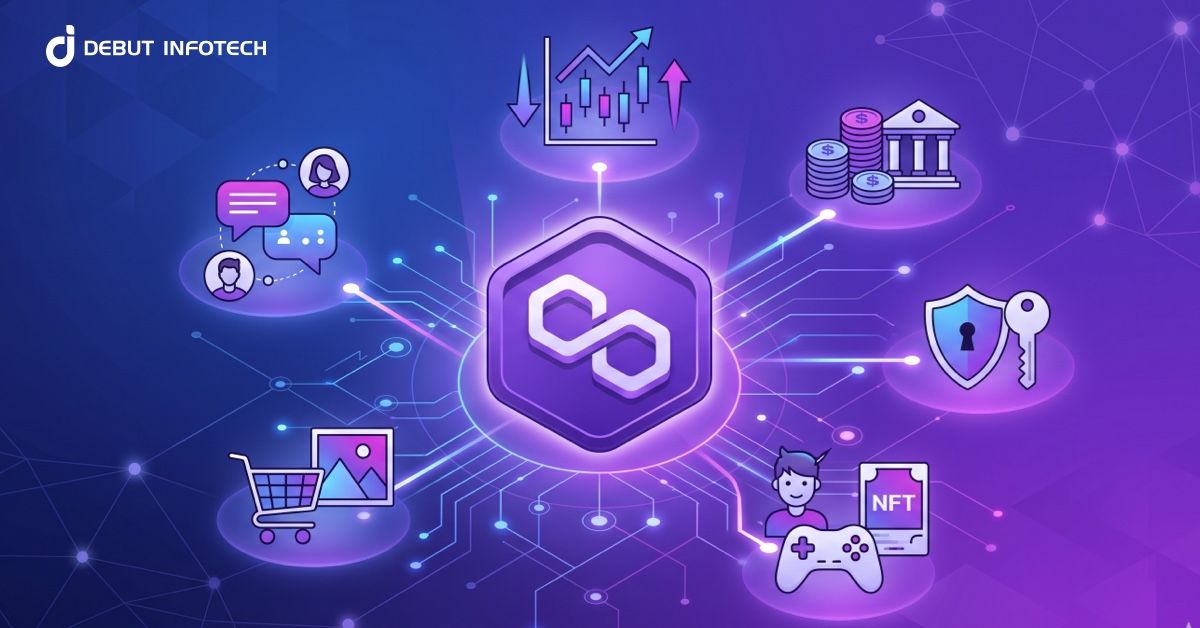


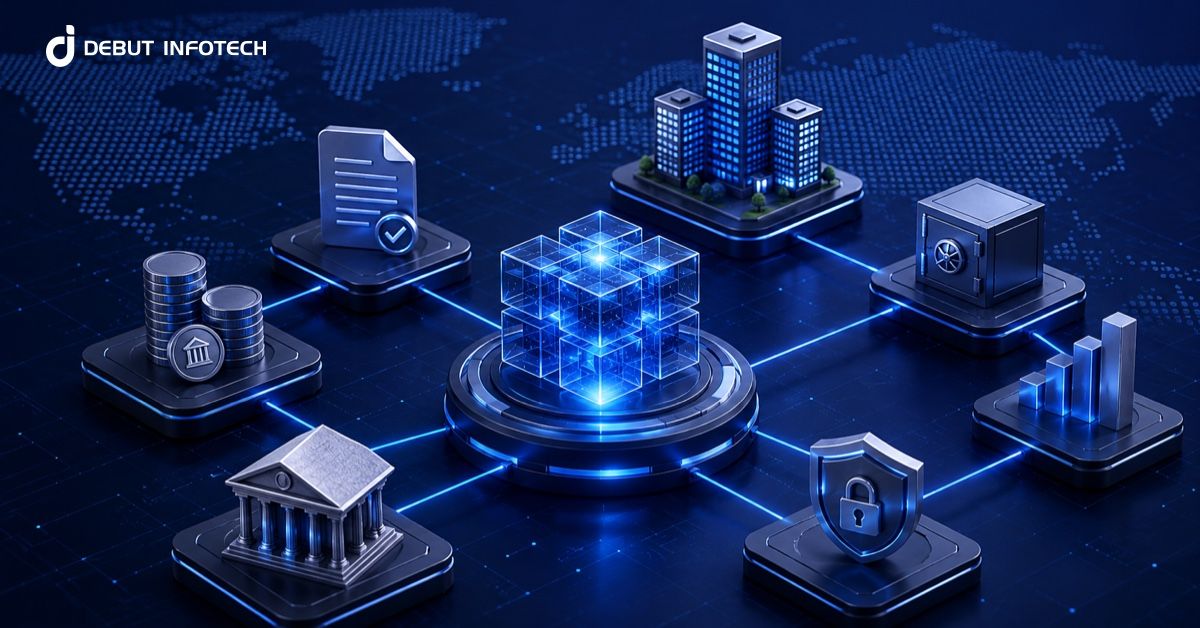
Building Dapps on Polygon has become a strategic choice for developers aiming to combine Ethereum’s security with improved scalability and cost efficiency. As a Layer 2 solution for the Ethereum blockchain, Polygon enables faster transaction processing and significantly lower fees, which directly impacts user adoption and application performance.
The network has seen rapid ecosystem growth, with over 45,000 deployed dApps supporting use cases across DeFi, gaming, and NFTs. In addition, Polygon recorded 1.23 million daily active addresses in early 2025, highlighting strong and consistent user engagement.
This article explains how Polygon works, its architecture, scaling techniques, and how it compares with Ethereum, helping you decide when and why to build dApps on Polygon for efficiency and scale.
Polygon has grown into a practical environment for building decentralized applications that need speed, affordability, and flexibility without moving away from the Ethereum blockchain ecosystem. It functions as a multi-layer scaling framework that extends Ethereum’s capabilities while preserving compatibility with its tooling and smart contracts.
Developers can deploy applications faster, reduce congestion-related delays, and handle higher transaction volumes efficiently. This makes Polygon a reliable choice for teams aiming to build scalable, production-ready dApps with consistent performance.
Polygon enables developers to build dApps using familiar tools such as Solidity, MetaMask, and Ethereum-based frameworks. The process involves deploying smart contracts on Polygon-compatible chains, where transactions are processed off the Ethereum mainnet before being finalized or anchored back to it.
Developers test, deploy, and interact with contracts using standard workflows, while Polygon’s infrastructure handles scaling. This approach ensures faster execution, lower costs, and a smoother development experience without requiring major changes to existing codebases.
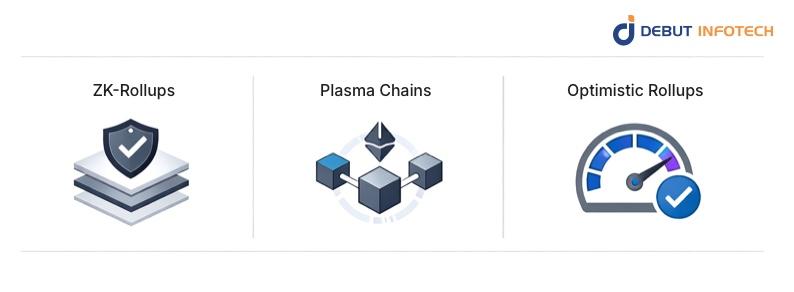
Polygon applies multiple scaling approaches to improve transaction speed and reduce costs without compromising security:
Zero-Knowledge Rollups bundle multiple transactions into a single cryptographic proof that is submitted to the Ethereum blockchain. This reduces on-chain data load while maintaining strong security guarantees. They enable high throughput and faster confirmations, making them suitable for applications that demand efficiency, privacy, and accuracy without compromising on validation integrity.
Plasma chains function as secondary chains that process transactions independently before periodically committing results to Ethereum. This approach reduces congestion on the main network while supporting high transaction volumes. They are particularly effective for use cases like gaming and micropayments, where frequent interactions require speed without continuously relying on the base layer.
Optimistic Rollups process transactions by assuming validity unless challenged within a specific time window. This reduces computational overhead and increases throughput. They strike a balance between scalability and decentralization, making them suitable for applications that require consistent performance, lower fees, and a reasonable level of security backed by Ethereum’s dispute resolution mechanism.
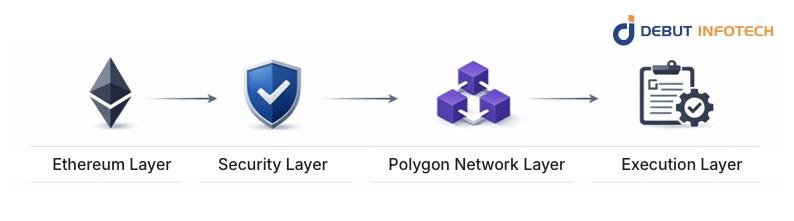
Polygon’s architecture is structured into multiple layers that work together to deliver scalability, security, and efficient execution
The Ethereum layer acts as the foundation for security and final settlement. Polygon periodically submits transaction data to the Ethereum network, ensuring that activities on its network are anchored to a trusted base. This connection strengthens reliability, as any disputes or inconsistencies can be resolved using Ethereum’s robust consensus and validation mechanisms.
The security layer provides shared validator services that projects can opt into, rather than maintaining their own infrastructure. It helps streamline operations while ensuring consistent validation standards. By relying on a common pool of validators, developers can reduce complexity and focus more on application logic rather than managing network security components.
This layer is responsible for block production, consensus, and overall network coordination within Polygon. When you build Dapp on Polygon, it ensures that transactions are processed efficiently across nodes. By handling these core operations independently from Ethereum, the network layer improves performance while maintaining synchronization with the broader ecosystem when required.
The execution layer manages smart contract execution and state transitions within the network. It operates in a way that mirrors Ethereum’s execution environment, ensuring compatibility with existing tools and contracts. Developers can deploy and run applications without significant modifications, while benefiting from faster processing and reduced transaction costs.
Polygon offers a range of features designed to improve performance, reduce costs, and simplify development.
Polygon is designed to handle a significantly higher number of transactions per second compared to the Ethereum blockchain mainnet.
By offloading execution to secondary layers, it reduces congestion and latency. This allows dApps to scale efficiently, even during peak usage, while maintaining consistent performance and avoiding the bottlenecks typically associated with single-layer blockchain systems.
Polygon maintains full compatibility with Ethereum’s development environment, including Solidity, EVM standards, and widely used tools. This allows developers to migrate or replicate existing applications without rewriting core logic.
It reduces development time and cost, while ensuring that teams can continue using familiar workflows, libraries, and infrastructure already established within the Ethereum ecosystem.
Polygon supports seamless interaction between different blockchain networks, enabling cross-chain communication and asset transfers. This interoperability expands the scope of dApp functionality, allowing developers to integrate multiple ecosystems into a single application.
It also enhances liquidity movement and data exchange, which are critical for building advanced decentralized finance and multi-chain blockchain platforms.
Polygon’s modular framework allows developers to choose from various scaling solutions, such as rollups, sidechains, or standalone chains, based on application requirements. This flexibility ensures that infrastructure can be tailored to specific use cases.
Developers are not restricted to a single approach, enabling optimized performance, cost efficiency, and better control over network design and architecture.
DApp on Polygon network enhances user experience by delivering faster transaction confirmations and significantly lower fees. This removes common friction points associated with blockchain interactions, such as delays and high costs.
As a result, users can interact with dApps more smoothly, thereby improving engagement, retention, and overall satisfaction, especially in applications that require frequent transactions.
Polygon strengthens its security by combining its own validation mechanisms with periodic anchoring to the Ethereum blockchain. This layered approach ensures that transactions benefit from Ethereum’s established security while being processed efficiently on Polygon.
It provides developers with a reliable environment to build applications that require both scalability and strong protection against network vulnerabilities.
Choosing between Polygon and Ethereum requires evaluating performance, dapp development cost, and scalability needs. While both share a common foundation, their differences influence development strategy, user experience, and long-term application growth.
Here’s a quick comparison table:
| Criteria | Polygon | Ethereum |
| Foundation | Layer 2 scaling framework built on top of the Ethereum blockchain | Layer 1 base blockchain with native smart contract execution |
| Scalability | High throughput via rollups and sidechains | Limited throughput due to on-chain processing |
| Programming Languages | Solidity, EVM-compatible, easy migration | Solidity, mature ecosystem and tooling |
| Market Cap | Growing ecosystem with increasing adoption ($960 – $978 million, as of early April 2026) | Larger, more established market dominance ($248 billion, as of early April 2026) |
| Transaction Fees | Low and predictable fees (often <$0.01) | High and variable gas fees (can exceed $1–$6+) |
| Transaction Finality | Fast confirmations with Ethereum anchoring | Strong, secure finality but slower confirmations |
| Total DApps | 45,000+ deployed dApps | 3,000 dApps (approximate ecosystem count) |
Polygon blockchain operates as a Layer 2 scaling framework built on top of the Ethereum blockchain, extending its capabilities. It processes transactions off-chain and periodically anchors them to Ethereum, allowing developers to build scalable applications while still relying on Ethereum’s base infrastructure for trust and final settlement.
In contrast, Ethereum serves as a Layer 1 blockchain and the foundational network for decentralized applications. It provides native smart contract execution, decentralized validation, and strong security guarantees. All transactions occur directly on-chain, which ensures transparency and immutability but also introduces scalability and cost limitations during high network demand.
Polygon significantly improves scalability by handling transactions on secondary layers such as sidechains and rollups. This reduces congestion on the main network and enables higher throughput. Applications built on Polygon can support large user bases and frequent interactions without experiencing delays or rising transaction costs during peak usage periods.
On the other hand, Ethereum processes transactions directly on its mainnet, which limits scalability due to network capacity constraints. During periods of high demand, transaction speeds slow down, and fees increase. While upgrades aim to improve scalability, the base layer still faces challenges in supporting high-volume applications efficiently.
Polygon supports Solidity and is fully compatible with the Ethereum Virtual Machine (EVM). This allows developers to reuse existing code, tools, and libraries without major changes. It simplifies the development process and enables teams to transition applications seamlessly while maintaining consistency in development workflows and smart contract logic.
Alternatively, Ethereum also relies on Solidity as its primary programming language for smart contract development. It has a mature ecosystem with extensive documentation, tools, and community support. Developers benefit from a well-established environment, though deploying and testing contracts directly on the mainnet can be more resource-intensive.
Polygon has experienced steady growth as a scaling solution within the Ethereum ecosystem. Its native token supports network operations and governance. While its market capitalization is smaller compared to Ethereum, it reflects increasing adoption driven by demand for scalable infrastructure and cost-efficient decentralized application deployment.
By contrast, Ethereum holds one of the largest market capitalizations in the blockchain space, reflecting its widespread adoption and foundational role in decentralized technologies. Its strong market position attracts developers, investors, and enterprises, reinforcing its dominance as the primary platform for smart contracts and decentralized application development.
Polygon offers significantly lower transaction fees due to its off-chain processing and efficient scaling mechanisms. This makes it suitable for applications with frequent transactions, such as gaming or micro-payments. Lower fees improve accessibility and encourage user participation without the financial burden often associated with mainnet transactions.
Conversely, Ethereum’s transaction fees are typically higher, especially during network congestion. Gas costs fluctuate based on demand, which can make simple interactions expensive. While this reflects strong network activity, it can limit usability for applications that require frequent or low-value transactions, thereby affecting user experience and adoption rates.
Polygon achieves fast transaction confirmations through its own consensus mechanisms, with periodic finality anchored to the Ethereum blockchain. This approach balances speed and security, allowing applications to operate efficiently while still benefiting from Ethereum’s trusted validation layer for final settlement assurance.
On the flip side, Ethereum provides strong deterministic finality through its consensus protocol, ensuring that confirmed transactions are secure and irreversible. While this enhances trust and reliability, the process can take longer than Layer 2 solutions, particularly during periods of high activity when network congestion delays confirmation times.
Polygon has seen rapid growth in the number of decentralized applications, driven by its scalability and low-cost environment. Many developers are migrating or launching directly on Polygon to avoid Ethereum’s limitations, resulting in a diverse and expanding ecosystem across DeFi, gaming, NFTs, and enterprise solutions.
In contrast, the Ethereum blockchain hosts the largest number of dApps in the blockchain ecosystem, supported by its long-standing presence and developer community. It remains the primary hub for innovation, with a wide range of applications across industries. However, scalability and cost challenges have encouraged some projects to explore alternative or complementary platforms.
While Polygon offers clear advantages in scalability and cost, it also presents certain limitations.
Polygon depends on Ethereum for final settlement and security assurances. While this strengthens trust, it also introduces reliance on Ethereum’s performance and network conditions. Any congestion or upgrades to Ethereum can indirectly affect Polygon’s operations, potentially influencing transaction finality timelines and overall system responsiveness in certain scenarios.
Polygon continues to evolve with new scaling solutions and infrastructure improvements. This ongoing development means some features may not yet be fully optimized or widely adopted. Developers might encounter occasional inconsistencies, limited tooling support, or documentation gaps, especially when working with newer components or experimental scaling technologies.
Polygon operates in a competitive landscape alongside other Layer 2 solutions and alternative blockchains offering similar scalability benefits. Platforms like other rollup-based networks continue to attract developers, which can impact adoption rates. This competition pushes innovation but also requires Polygon to consistently improve performance and developer support.
Matic Plasma chains, while efficient, can introduce complexity in asset withdrawals and dispute handling. Users may experience delays when moving funds back to Ethereum due to exit mechanisms. This can affect user experience, particularly for applications that require frequent cross-chain transfers or immediate liquidity access across networks.
Polygon supports a wide range of real-world applications due to its scalability and low transaction costs.
DApp on Polygon supports fast and low-cost payment solutions, making it suitable for peer-to-peer transfers, remittances, and merchant payments. Transactions are processed quickly and at minimal fees, improving accessibility for everyday users. Businesses can integrate payment systems into their dApps without worrying about high transaction costs, enabling smoother financial interactions across local and global markets.
Decentralized lending platforms on Polygon benefit from reduced transaction fees and faster execution speeds. Users can borrow, lend, and earn interest without delays caused by network congestion. This efficiency supports high-frequency financial operations while maintaining transparency through smart contracts. Developers can build scalable DeFi applications that remain accessible to a broader user base.
Blockchain-based games require frequent transactions for in-game assets, rewards, and interactions. Polygon provides the necessary scalability to handle these operations without performance issues. Players can buy, sell, or trade assets seamlessly. At the same time, developers can design immersive gaming experiences without worrying about high fees or slow confirmations affecting gameplay.
Polygon enables cost-efficient minting and trading of NFTs, making it accessible for creators and collectors. Lower fees reduce barriers to entry, allowing more users to participate in digital asset ownership. Marketplaces can scale easily while maintaining smooth user experiences, supporting activities such as auctions, transfers, and collections without delays or high costs.
Supply chain applications on Polygon allow businesses to track goods in real time with transparency and accuracy. Each transaction or update is recorded securely, improving traceability across production and distribution stages. The network’s efficiency enables large volumes of data to be processed quickly, making it suitable for industries that rely on reliable logistics and verification systems.
Dapps on Polygon offer a practical path for building scalable, cost-efficient, and user-friendly decentralized applications without leaving the Ethereum ecosystem. With flexible architecture, multiple scaling techniques, and strong compatibility, Polygon addresses key performance challenges developers face. It supports faster transactions, lower fees, and broader accessibility, making it a suitable choice for modern dApp development across industries.
If you’re looking to build high-performance Dapps on Polygon, Debut Infotech brings the expertise needed to deliver. As a trusted DApp development company, we focus on secure architecture, efficient smart contracts, and scalable solutions tailored for long-term success.
A. Developers keep leaning toward Polygon because it fixes Ethereum’s biggest headache—high gas fees. Transactions are cheaper and faster, which makes testing and scaling less painful. It still connects to Ethereum, so you get that ecosystem too. You’re not starting from scratch, and that matters when deadlines are tight.
A. There’s no fixed price, but Polygon keeps things lighter on the budget compared to Ethereum. A simple Dapp might cost a few thousand dollars, while complex builds can run much higher. Lower transaction fees also reduce long-term costs, especially when your app starts getting real user activity.
A. Polygon inherits security from Ethereum, which already has a strong track record. That said, the real risk usually comes from smart contract bugs, not the network itself. If the code is solid and audited properly, you’re in a good place. Skip that step, and problems can show up quickly.
A. Ethereum Dapps run directly on the main chain, which means higher fees and slower transactions during busy periods. Polygon Dapps sit on a Layer 2 network, so they’re faster and cheaper. You still get Ethereum compatibility, but without the usual congestion issues that frustrate developers and users alike.
A. It depends on how complex the project is. A basic Dapp can take a few weeks, while something more advanced might stretch into a few months. Polygon doesn’t slow you down—it actually speeds things up thanks to lower costs and smoother testing during development cycles.

Our Latest Insights
USA
2501 Chatham, Rd Suite R Springfield, IL 62704
+1-708-515-4004
info@debutinfotech.com
UK
7 Pound Close, Yarnton, Oxfordshire, OX51QG
+44-770-304-0079
info@debutinfotech.com
Canada
154 Eden Oak Trail, Kitchener, ON N2A 0H9
+1-708-515-4004
info@debutinfotech.com
INDIA
Sector 101-A, Plot No: I-42, IT City Rd, JLPL Industrial Area, Mohali, PB 140306
9888402396
info@debutinfotech.com