ON THIS PAGE
Progress0%






Our Global Presence :





One of the most significant shifts in the way that organizations deal with data, transactions, and trust is blockchain architecture enterprise systems. If you’re new to distributed ledger technology, or looking at it for a particular business problem, a useful first step is to grasp how blockchain is designed from the ground up. Debut Infotech works with businesses of all sizes to build blockchain systems that go beyond demos and theory to real-world performance. In this text, we have provided all the information you need about blockchain architecture, and the impact it can have on your business.
Blockchain is a complex dance of cryptography, networking, consensus, and data structures. The choices you make for your blockchain architecture in the early days of your project will impact the performance, security, and scalability of your system as it matures. In this article, we explore various layers, elements and factors, which are valuable for both CTOs and CEOs.
The blockchain network architecture is defined by its architecture, that is, how the information is structured, stored, verified, and distributed in a decentralized network. In a classic database, the data is owned by an access provider, whereas in blockchain, data is stored on numerous nodes, each one with a copy of the ledger.
It allows for new characteristics that traditional database systems cannot offer, such as decentralization, immutability, transparency, and trustless verification. Blockchain characteristics make it suited for the banking sector, medical and supply chain businesses, and legal services that demand data integrity.
It is helpful to have an understanding of the key components of blockchain, which are present in almost all blockchain systems, to discuss the design of blockchain systems. They are all necessary components and together form the whole.
| Component | Role | Example |
| Node | Participant in the network that stores and validates data | Validator node, full node, light node |
| Block | Container of ordered, validated transactions | Bitcoin block, Ethereum block |
| Chain | Sequence of cryptographically linked blocks | Immutable ledger history |
| Cryptographic Hash | Unique fingerprint of block data | SHA-256, Keccak-256 |
| Consensus Mechanism | Rules by which nodes agree on a valid state | PoW, PoS, PBFT, Raft |
| Smart Contract | Self-executing code triggered by conditions | ERC-20 token, DeFi protocol |
| Mempool | Queue of pending, unconfirmed transactions | Bitcoin mempool |
| Wallet / Address | Interface for signing and submitting transactions | Public-private key pair |
There are three types of nodes: full nodes, lite nodes, and validator/miner nodes. Enterprise blockchain architecture is usually permissioned, i.e., only authorized parties can participate in and validate transactions.
A block is a record with a set of transactions, metadata, and a nonce. The hash points to the previous block. This gives the order and verification of the ledger.
This enables us to securely implement a blockchain without a trusted authority. We require two cryptographic primitives: hash functions, which take some input and return a fixed-length string. This function cannot be reversed.
The consensus mechanism enables all nodes in a blockchain network to reach agreement on the ledger’s current state. This is one of the most significant enterprise design considerations a team will make for a blockchain architecture, as it directly affects throughput, energy consumption, and security.
Smart contracts are programs that run on blockchains and are automatically executed when certain pre-specified conditions are met. The architecture of smart contracts describes how business logic is written, delivered, and triggered on-chain. In enterprise use cases, smart contracts can be used for payment on delivery confirmation, compliance checks, or multi-party approval orchestration.
There are multiple layers to the blockchain technology, each of which does a different job. Enterprise architects need to understand the blockchain layers to make informed decisions at each layer of the system.
| Layer | Name | Function |
| Layer 0 | Network / Infrastructure | Physical hardware, internet connectivity, peer-to-peer protocols |
| Layer 1 | Data Layer | Block structure, hashing, transaction records, Merkle trees |
| Layer 2 | Network Layer | P2P communication, node discovery, data propagation |
| Layer 3 | Consensus Layer | Agreement protocols (PoW, PoS, PBFT) |
| Layer 4 | Application Layer | Smart contracts, DApps, APIs, user interfaces |
| Layer 5 | Governance Layer | Voting, upgrades, protocol rules, permissions |
Not all blockchain networks are created equal. Choosing the proper kind of blockchain network is one of the most essential decisions in developing blockchain infrastructure. There are four main network types for different use cases.
| Type | Access | Validators | Speed | Best For |
| Public | Open to anyone | Any node | Slower | Cryptocurrency, public DeFi, open DAOs |
| Private | Restricted to one org | Central admin | Fast | Internal record-keeping, audit trails |
| Consortium | Restricted to a known group | Pre-selected members | Fast | Industry groups, B2B workflows |
| Hybrid | Mixed public/private layers | Configurable | Varies | Regulated industries with selective transparency |
Bitcoin and Ethereum are public and open blockchains. Open to anyone, the ledger can be viewed, transacted upon, and validated. The price you pay is speed. Public chains are fast, secure, and decentralized, but slow, with only a few transactions per second. They are ideal for applications that would benefit from total anonymity and censorship resistance.
A private blockchain is controlled by a single organization, and access is restricted. Only approved nodes may validate. These systems provide high throughput and low latency at the cost of decentralization, which is one of the key sources of value for the blockchain. They are good for internal audit trails or document versioning where speed and control are more important than open involvement.
Consortium Blockchains are operated by a pre-selected set of entities, usually in banking, insurance, and supply chain consortia. The network is not owned by anyone. But it’s not public either.
Hybrid blockchains combine public and private components. They enable enterprises to keep sensitive data on a private chain while also linking proofs or summaries to a public chain for openness and auditability. This is an architectural pattern we are seeing more and more in regulated areas such as healthcare, where patient data must remain private while compliance records must be publicly verifiable.
When creating an enterprise blockchain architecture, architects can choose from several architectural patterns, depending on the business problem at hand. Knowing these patterns will help you make technology choices aligned with business objectives.
Note that blockchain is not the only form of distributed ledger architecture. A distributed ledger is a consensus of duplicated, shared, and synchronized data dispersed geographically over various sites, countries, or institutions. The data structure used by blockchain is peculiar to that technology although other distributed ledgers may be better suited to different applications.
Hashgraph achieves consensus very fast using gossip protocol and virtual voting. These approaches address some of the problems of blockchain scalability architecture of traditional linear chain architecture.
Scalability is one of the most discussed difficulties in the architecture of blockchain systems. Public blockchains face constraints on the number of transactions they can handle per second – Bitcoin is capable of processing approximately 7 transactions per second (TPS), and Ethereum (after the Merge) can process approximately 15-30 TPS. Enterprise applications often demand thousands of TPS. This constraint is addressed by several architectural approaches.
| Solution | Approach | Trade-off | Example |
| Layer 2 Rollups | Bundle transactions off-chain, settle on-chain | Added complexity | Optimism, Arbitrum |
| State Channels | Direct off-chain channels between parties | Limited to participants | Lightning Network |
| Sharding | Split the network into parallel processing groups | Cross-shard communication | Ethereum 2.0 |
| Sidechains | Separate chains with bridges to the main chain | Sidechain security risk | Polygon, Gnosis Chain |
| Private/Consortium Chain | Fewer nodes, faster consensus | Less decentralized | Hyperledger Fabric |
| DAG Architecture | Parallel transaction graph instead of a linear chain | Different trust model | IOTA, Hedera |
Choosing a platform is a critical design decision for blockchain. Different blockchain platforms have different programming approaches, governance, performance and ecosystem. Below is a comparison of the most popular enterprise platforms.
| Platform | Type | Consensus | Smart Contracts | Best For |
| Hyperledger Fabric | Permissioned | Raft / PBFT | Chaincode (Go, Java, JS) | B2B workflows, supply chain, finance |
| Ethereum | Public / Private (via Besu) | PoS (Gasper) | Solidity | DeFi, tokenization, open ecosystems |
| Corda | Permissioned | Notary-based | Kotlin / Java | Financial services, legal contracts |
| Quorum (ConsenSys) | Permissioned Ethereum | IBFT / Raft | Solidity | Banking, private enterprise |
| Hedera Hashgraph | Public (governed) | Hashgraph | Solidity / Hedera SDK | High-throughput enterprise apps |
| Stellar | Public | Stellar Consensus Protocol | Soroban (Rust) | Cross-border payments, CBDCs |
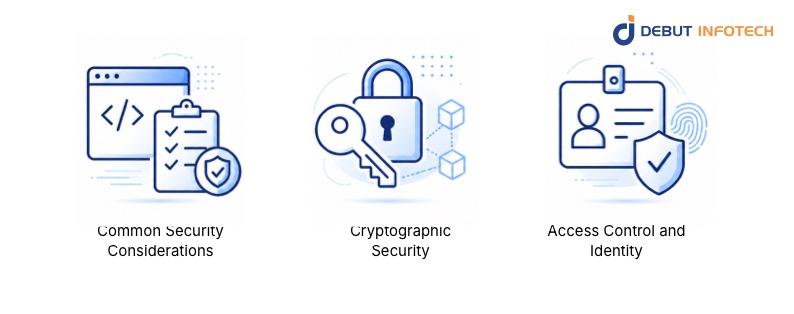
Because of its cryptographic foundations, blockchain is safer from some attacks than traditional databases. However, it is not immune. You need to be aware of the security model of the architecture you choose.
The most prevalent vulnerability to proof-of-work systems is the 51% assault. An attacker with more than 50% of the network’s hashing power might alter the recent history of the transactions. In enterprise permissioned systems, this is not a significant concern as the validators can be trusted. Smart contract vulnerabilities are another type of vulnerability – poor code can be used to steal funds or alter state, as with several recent DeFi hacks. Smart contract architecture is characterized by verification, auditing, and coding practices.
ECC is used for key pairs, and hash functions like SHA-256 or Keccak-256 are used to secure blockchain systems. They are believed to be unbreakable with today’s technology. But quantum computing is on the rise. The enterprise blockchain architecture should begin to incorporate post-quantum cryptography standards as they are finalized by bodies like NIST.
Access control is a top priority for permissioned systems. Role-based access control (RBAC) determines who can initiate transactions, access the ledger, and participate in consensus. Participants are given digital identities by certificate authorities (CAs). This is done in Hyperledger Fabric by an MSP (Membership Service Provider) design.
Selecting the right platform is simply one step in establishing a successful enterprise blockchain system, which can run in production. These are the design elements that always make the difference between successful deployments and stalled pilots.
One of the most realistic challenges for enterprise blockchain development is integrating blockchain with legacy systems.
There are also middleware layers, such as Hyperledger Cacti, and libraries like web3.js and ethers.js that allow development teams to write blockchain integrations in languages they are comfortable with. The goal is to integrate blockchain-as-a-service into the rest of the enterprise architecture, not to make every system speak blockchain natively.
One of the most frequently asked questions from organizations before starting a blockchain project is: What will this cost? The blockchain development cost depends greatly on the complexity, the platform, the location of the team, and the amount of integration work needed.
| Factor | Low End | Mid Range | High End |
| Proof of Concept | $15,000 – $30,000 | – | – |
| MVP (Single Use Case) | $40,000 – $80,000 | $80,000 – $150,000 | – |
| Full Enterprise System | – | $150,000 – $400,000 | $400,000 – $1M+ |
| Smart Contract Audit | $5,000 – $15,000 | $15,000 – $50,000 | $50,000+ |
| Ongoing Maintenance (annual) | $20,000 – $50,000 | $50,000 – $150,000 | $150,000+ |
The choice to hire blockchain developers in-house or to use the help of a specialized development firm has a huge impact on cost and timeline. It takes 6-12 months to recruit and onboard an in-house team from scratch before you can start productive development. Working with a company that already has seasoned blockchain developers, architects, and QA engineers shortens time-to-delivery and provides access to cross-platform expertise that would be difficult to cultivate in-house.
Blockchain architecture is a modular system in which every design choice affects performance, security, scalability, and cost. Success is about matching components such as consensus, storage, platforms, and smart contracts to your business needs. Many companies struggle to treat blockchain as anything more than a simple database replacement, but those that view it as a purpose-built system for shared trust and multi-party collaboration can unlock real value.
Debut Infotech is a one-stop shop for this journey from architecture design and platform choice to full-scale development and post-launch support, so your blockchain solution can scale from day one.
A. The four main types are public, private, consortium, and hybrid. Public chains are open but slow; private chains are fast but centralized. Consortium blockchains governed by a known group are the most practical model for B2B use cases. Hybrid chains mix both for selective transparency.
A. Core components include permissioned nodes with certificate-based identity, a consensus mechanism suited to known validators (e.g., PBFT or Raft), a smart contract layer for business logic, off-chain storage for large datasets, and API layers that connect the blockchain to existing systems.
A. Most enterprise teams solve scalability by using a permissioned network with fewer trusted validators, which delivers far higher throughput than public chains. Where public-chain properties are needed, Layer 2 rollups, state channels, or sharding handle volume off-chain before settling on-chain.
A. Costs range from $15,000 for a basic proof-of-concept to $1M+ for a full multi-organization system. The main cost drivers are smart contract complexity, legacy system integration, the number of participating organizations, and security audits. Most mid-market enterprise projects fall between $80,000 and $400,000 for initial development.
A. Blockchain’s cryptographic block-chaining makes retroactive tampering computationally infeasible in well-maintained systems. The real risks lie elsewhere: smart contract vulnerabilities, mismanaged private keys, and misconfigured access controls.
A. The most proven enterprise use cases are supply chain provenance, trade finance, healthcare data sharing, decentralized identity (KYC/AML), and asset tokenization. Each demands different architecture patterns and platforms, what works for a supply chain consortium will not necessarily suit a cross-border payment system.
A. Before committing to a platform or writing any smart contract code. The costliest mistakes, wrong network type, unscalable data structures, and misaligned consensus, happen in early design. An architecture review upfront is far cheaper than a redesign mid-project, and it helps confirm whether blockchain is even the right tool for the problem.

Our Latest Insights
USA

2501 Chatham, Rd Suite R Springfield, IL 62704
+1-708-515-4004
info@debutinfotech.com
UK

7 Pound Close, Yarnton, Oxfordshire, OX51QG
+44-770-304-0079
info@debutinfotech.com
Canada

154 Eden Oak Trail, Kitchener, ON N2A 0H9
+1-708-515-4004
info@debutinfotech.com
INDIA

Sector 101-A, Plot No: I-42, IT City Rd, JLPL Industrial Area, Mohali, PB 140306
9888402396
info@debutinfotech.com

9001:2015
Quality Certified

ISO 27001
Security Certified

A+ Rating
Accredited Business

Certik
Security & Audit


Copyright © 2026, Debut Infotech. All rights reserved. | Privacy Policy