ON THIS PAGE
Progress0%






Our Global Presence :



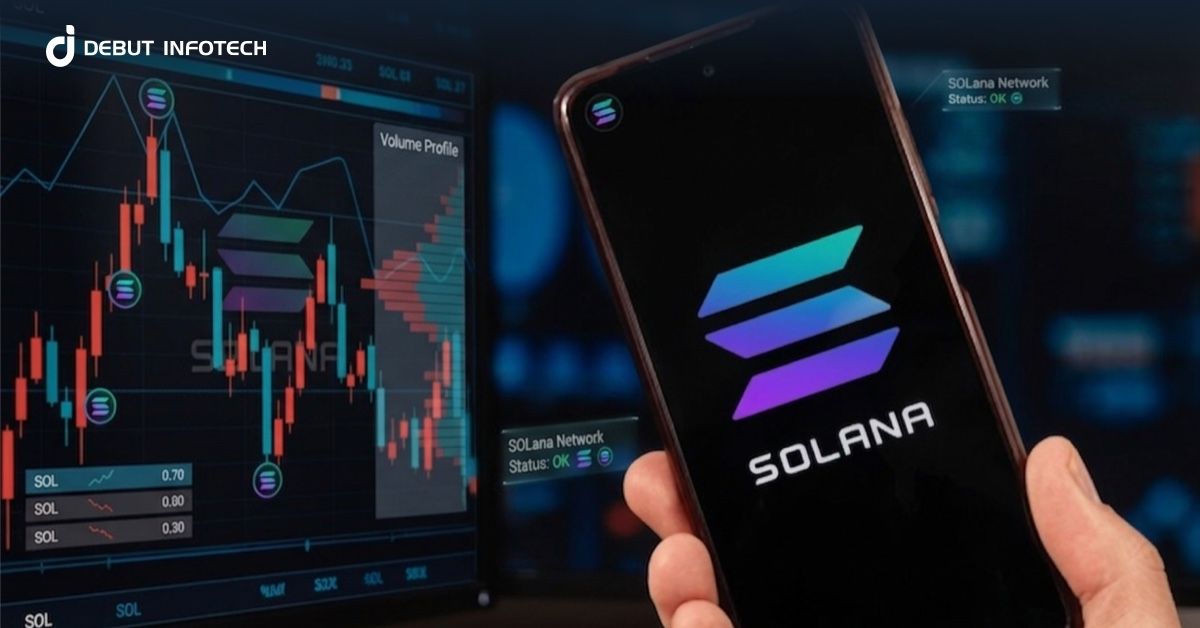


Wondering what Solana is and why you continue to hear it in crypto discussions?
Fundamentally, Solana (SOL) is a high-speed blockchain. It supports decentralized applications (dApps) and can process crypto transactions within a few seconds without the exorbitant charges that may be charged on other networks. The only difference is that it has got a unique system that integrates Proof of History (PoH) with Proof of Stake (PoS) which enables it to handle thousands of transactions in a short period of time.
Solana has established itself as a competitive substitute to the older blockchains in an environment where speed, cost, and scalability are important factors.
In an attempt to explain what Solana is, the most straightforward way to look at it is that it is a blockchain designed to make crypto more practical, faster, and cheaper.
Early blockchains proved that decentralized systems work but they also revealed major limitations. With the addition of more users, networks became slower, fees were raised, and scalability was a major issue.
Solana was designed to address these very issues. Anatoly Yakovenko, an engineer with extensive knowledge of distributed systems, launched it in 2020. His idea was to create a blockchain that would be able to serve the real-world needs without compromising performance.
Solana is fundamentally a high-performance blockchain network that runs using its native token, SOL.
However, more than the token, what really defines Solana is the ability to run the network effectively under load.
Solana is unique due to three major strengths:
Speed
The processing of transactions is extremely fast, sometimes in seconds, even when there is high demand.
Low Costs
The fees are also kept very low thereby making it feasible to use daily in case of frequent transactions.
Scalability
The network is configured to expand without slowing down, to allow large-scale applications and users.
These benefits are essential to practical purposes.
An example of this is in services such as solana wallets which are based on speed and low prices in order to provide a user with a smooth experience. In the absence of this performance, sending or receiving crypto would be slow and expensive- which would reduce adoption.
To see why Solana constantly has high performance benchmarks, it is important to look past the superficial answers to this question and see what engineering choices underlie it.
Solana was not created as a small improvement on the existing blockchains. Instead, it introduces a fundamentally different approach to time, transaction ordering, and execution efficiency, three areas that have historically limited blockchain scalability.
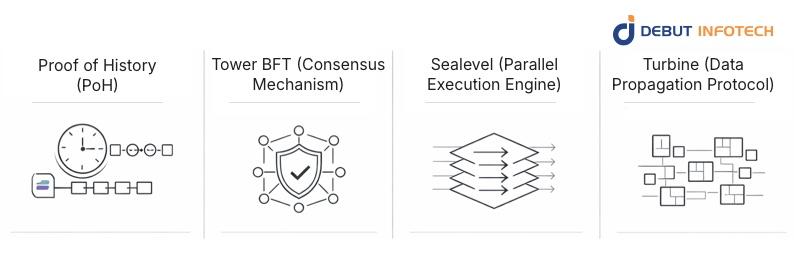
The architecture of Solana is a combination of several innovations that addresses a particular bottleneck in previous blockchain systems.
Proof of History (PoH)
This is the most significant innovation of Solana. It is a cryptographic clock, generating a verifiable order of timestamps that demonstrates that events have happened, without validators needing to agree on time in real time.
Tower BFT (Consensus Mechanism)
Tower BFT is constructed upon PoH and enables the validators to achieve agreement more quickly with the help of this timeline that is established initially. This minimizes network overhead and enhances performance of the network.
Sealevel (Parallel Execution Engine)
In comparison to conventional blockchains where transactions are exchanged sequentially, Solana executes several smart contracts at the same time. This is one of the causes of its great throughput since it is being parallelized.
Turbine (Data Propagation Protocol)
Turbine is used to optimize the sharing of data throughout the network; it is done by fragmenting the data into smaller segments and sharing them effectively just like the way the current content delivery systems work.
From a technical and architectural standpoint, the lack of a reliable internal clock.
In the majority of blockchains, the validators need to maintain constant communication to decide on the sequence of transactions. This coordination adds latency and is more inefficient with the scale of the network.
Solana removes this dependency.
By timestamping transactions before validation, PoH establishes a trusted order of events in advance. Validators can then focus on verifying transactions rather than negotiating their sequence.
This change drastically lowers congestion and allows the network to continue functioning at a high level of performance even at heavy load.
These design choices are not theoretical, they directly impact how applications perform in production environments.
From the perspective of teams working in enterprise blockchain development, scalability is not optional. Systems must handle thousands of interactions in real time without delays or unpredictable costs.
Solana’s architecture is specifically aligned with these requirements. It delivers:
This is especially appropriate in DeFi, games, and large-scale internet apps where performance is of high importance.
Most traditional blockchains operate like a system where every participant must constantly check and agree on the exact order of events before moving forward.
Solana changes this model entirely.
It provides an inbuilt and verifiable timeline, which enables the network to handle transactions in parallel and at scale, so that it does not slow down as the demand grows.
That architectural shift is what positions Solana not just as a faster blockchain, but as a purpose-built system for high-performance, real-world applications.
Among the most important factors that keep Solana in the limelight is its capability to ensure high performance without sacrificing ease of use and price. Its characteristics are not merely on paper, it has direct implications on how the developers build it and how the users feel about the network.
1. High-Speed Transactions
Solana is optimized for speed. The network is capable of supporting tens of thousands of transactions per second, which is one of the fastest blockchains in the current market.
Expertly, such throughput is a basic requirement in applications such as trading platforms, gaming and real-time financial systems, where the delay can affect the users and results.
2. Extremely Low Transaction Fees
Cost efficiency is another major advantage. On Solana, the average transaction fee is a fraction of a cent.
To the ordinary users, this translates to smooth dealings without having to worry about increased charges. To developers operating a solana contract, it offers a stable and low-cost platform to run and scale applications.
3. Built-In Scalability (No Layer 2 Required)
Contrary to most blockchains, which provide more scaling layers, Solana is built to scale directly on the base layer.
This simplifies the system and minimizes friction, enabling applications to perform more effectively with increase in network demand. It also eases development and enhances maintainability.
4. Energy Efficiency
The consensus mechanism of Solana is far more efficient in terms of energy consumption as compared to the traditional Proof of Work mechanisms.
It ensures a more sustainable blockchain model, which is gaining importance in the eyes of enterprises, regulators, and users who are conscious of the environment by lowering the computational intensity.
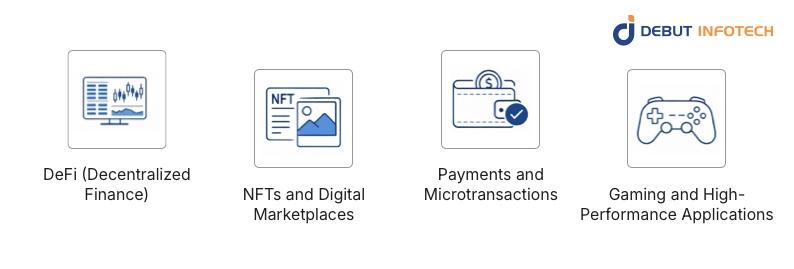
To fully comprehend the relevance of Solana, it would be effective to go beyond the theory and explore its real-world performance. The difference is not only in the speed claims that Solana makes, but the fact that Solana is capable of supporting live applications with real user demand, which is one of the benchmarks experts use to determine the viability of a blockchain.
DeFi (Decentralized Finance)
Solana has turned out to be a powerful backbone of decentralized finance platforms that need both speed and accuracy.
A notable example is Serum, which introduced an order-book model typically seen in traditional finance.
From an expert perspective, this is significant. Order-book systems demand high throughput and low latency, and Solana’s architecture makes this possible without excessive transaction costs. This positions it as a viable infrastructure for more advanced financial applications, not just basic token swaps.
NFTs and Digital Marketplaces
The NFT ecosystem provides one of the clearest stress tests for any blockchain. Platforms such as Magic Eden have proven how high user activity impacts Solana.
During peak NFT cycles, a great number of users switched to Solana, as the fees were less, and the confirmation time was shorter. Ethereum was frequently clogged up and regularly incurred expensive gas fees, but Solana allowed users to mint, purchase and trade NFTs in large amounts with much lower prices.
This practical user behavior change points to an important lesson that adoption is directly dependent on performance and affordability.
Payments and Microtransactions
In practical terms, Solana has low fees, so it is quite appropriate when it comes to payments and microtransactions, especially in applications where cost sensitivity is essential.
For businesses and developers, this directly affects blockchain development cost, because decreased transaction costs and efficient processing lower the overhead of developing and scaling blockchain-based systems. This is particularly applicable in emerging markets and high volume applications where minimal charges can become an obstacle.
Gaming and High-Performance Applications
Games based on the blockchain need infrastructure capable of supporting real-time transactions, real-time transfer of assets, and high numbers of users at the same time. Solana is designed to accommodate these requirements.
Solana allows developers to create scalable and responsive gaming ecosystems that do not have latency issues, unlike slower networks, which may ruin the gaming experience. This makes it especially appealing to those projects that seek to provide similar experience to the traditional online games, but with blockchain-based ownership.
When trying to position Solana within the blockchain ecosystem, one should compare it to the two most developed networks Ethereum and Bitcoin. Both of them were constructed with a dissimilar objective, and it has a direct impact on their functionality as they are used in reality.
| Feature | Solana | Ethereum | Bitcoin |
| Speed | Very high (thousands of TPS) | Moderate | Low |
| Fees | Very low (fractions of a cent) | High (can spike during congestion) | Medium |
| Consensus | Proof of History + Proof of Stake | Proof of StakeProof of Work | Proof of Work |
| Primary Use Case | dApps, DeFi, NFTs, gaming | Smart contracts, dApps | Store of value (“digital gold”) |
In terms of performance, Solana is evidently faster and less expensive. That is one of the key reasons why developers and businesses are starting to consider Solana blockchain development services, particularly where real time processing and low transaction costs are essential.
Ethereum however, is the most well-established smart contract platform, which has a well-established ecosystem and robust developer base. But its exorbitant costs may be a liability to the average user.
Bitcoin does not work the same way. It is designed more for security and decentralization, instead of speed, which explains why it is generally used as a long-term store of value instead of an application platform.
In evaluating any blockchain, one should be able to go beyond its outward narrative and the articulation, scrutinize its actual performance, its developer activity, and its sustainability. Solana excels in a number of areas of interest to users and industry experts.
1. High Speed with Low Costs
The fact that the Solana network can maintain a high transaction throughput without increasing fees is one of the most technically important benefits.
Contrary to most older blockchains where the system becomes clogged when faced with high demand, the architecture of Solana is designed to handle a large number of transactions effectively. Practically, this is the translation of almost instant confirmations and low transaction costs which are essential in applications such as payments, trading and gaming.
2. Rapidly Expanding Ecosystem
Solana does not only grow speculatively, but it is also backed by active usage in numerous areas, such as decentralized finance (DeFi), NFTs, and Web3 gaming.
In terms of industry, long-term ecosystem growth indicates a good signal of relevance. The increasing number of projects launching on Solana reflects growing confidence from developers, startups, and venture-backed teams who require scalable infrastructure.
3. Strong Developer Adoption
The success of a blockchain in the long-term is directly connected to its developer community. Solana remains appealing to developers because of its performance-focused architecture and the possibility to run complicated and high-load applications.
This persistent developer participation leads to constant advancements in tools, infrastructure and end-user experience, all of which is necessary to stay competitive in a highly dynamic blockchain ecosystem.
Although Solana has a strong performance, it should be evaluated using a real-life, balanced perspective, particularly when you are going to build on it or invest in it.
Network Reliability Concerns
Among the most talked about issues are network outages that Solana has experienced in the past.
It has been experienced that the Solana network has been temporarily offline, thus disrupting transactions and services.
To most users, this can be a hassle. To businesses and developers, though, reliability is paramount, and even brief downtimes may bring up questions of long-term dependability.
Centralization Debate
Centralization is another critical point that is frequently raised by experts.
The solana platform has fewer validators in comparison to Ethereum. This may raise concerns that the network is not as decentralized as it claims to be and that it is not resilient to pressure, or even orchestrated attacks.
Decentralization is not only a technicality of blockchain but it is a fundamental element of security, trust and censorship resistance.
Ecosystem Maturity
The ecosystem created by Solana is developing, and it is not final.
Although the number of promising projects is substantial, other tools, infrastructure, and developer frameworks are not as mature as those that exist in older blockchain ecosystems. This may influence the stability, experience of developers and adoption in the long term.
Related Read: A Comprehensive Guide to Blockchain Use Cases in Every Sector
Looking ahead, the future of Solana will be heavily reliant on the success or failure of its further development and adaptation to the needs of the real world.
One major area of focus is ongoing scaling improvements. Although Solana is already a fast network, the network is actively striving to improve stability and performance so that it can support even larger amounts of transactions without a hitch. In long-term credibility, regular uptime will have equal amounts of importance as raw speed.
At the same time, institutional interest is starting to grow. With the increasing adoption of blockchain by more enterprises, the need to have high-quality infrastructures and robust Solana support systems is critical. This covers enhanced developer resources, enhanced security measures, and stronger ecosystem support, all of which is an indicator of maturity to serious investors and organizations.
Competition is another major driver that determines the future of Solana. The Layer 2 solutions created by Ethereum are quickly making it more scalable and cheaper, which is why Solana is no longer the competitor to Ethereum on its own, but rather to a whole ecosystem of scaling technologies.
Expertly, Solana will be successful in the long term, as far as it balances performance, reliability and ecosystem growth. Should it be able to reinforce those aspects without losing its speed edge, it can be a significant participant in the next stage of blockchain innovation.
Solana is created to address one of the largest issues of blockchain scalability. Its mix of Proof of History and Proof of Stake provides high speed, minimal charges, and high practicality with real-world applications (DeFi and NFTs).
Its expanding ecosystem demonstrates that it is adopted in reality, yet it is necessary to remain balanced. The history of network outages and a current concern of decentralization points to the fact that Solana is still developing.
For anyone exploring blockchain, Solana is worth considering but only with a clear understanding of both its potential and its risks.
Curious to go deeper? It is high time to get a glimpse of the Solana ecosystem and learn to use actual applications and experience how this technology is transforming the future of blockchain.
A. Solana is a quick, open-source blockchain that is designed to support cost-effective and secure transactions.
It has the capability to handle thousands of transactions in a single second at a relatively low cost of less than $0.01
It is due to its special blend of Proof of Stake (PoS) and Proof of History (PoH) that it has this speed.
As a result, Solana powers decentralized apps (dApps), NFTs, and smart contracts efficiently at scale.
A. Solana (SOL) is widely regarded as a high-risk and high-reward investment.
It is unique in its rapid transactions and extremely low charges (as low as $0.01), as well as increasing popularity in DeFi and NFTs. This provides it with great growth prospects.
However, there are risks to consider. Solana has had some problems with network reliability, and similarly to any cryptocurrency, it is very volatile. There is also the regulatory uncertainty which creates another layer of risk.
In short, Solana offers promising upside, but it’s best approached cautiously as part of a diversified portfolio.

Our Latest Insights
USA
2501 Chatham, Rd Suite R Springfield, IL 62704
+1-708-515-4004
info@debutinfotech.com
UK
7 Pound Close, Yarnton, Oxfordshire, OX51QG
+44-770-304-0079
info@debutinfotech.com
Canada
154 Eden Oak Trail, Kitchener, ON N2A 0H9
+1-708-515-4004
info@debutinfotech.com
INDIA
Sector 101-A, Plot No: I-42, IT City Rd, JLPL Industrial Area, Mohali, PB 140306
9888402396
info@debutinfotech.com