ON THIS PAGE
Progress0%






Our Global Presence :






Blockchain AI Integration lets an autonomous agent act on its own and still be trusted, because the blockchain supplies the identity and settlement the AI cannot. That pairing is what makes real economic autonomy possible.
A crypto wallet is what makes an agent economic. It gives the agent an identity and, just as important, the ability to earn and spend on its own without a person approving each move.
A blockchain AI agent is really six layers stacked together: reasoning, identity, wallet, execution, data and oracles, and governance. Most of the security comes from keeping them separate.
Safe wallets never lean on a single private key. They combine account abstraction, scoped session keys, on-chain spending policies, and MPC or TEE custody, so even a hijacked agent stays boxed inside tight limits.
With AI-powered smart contracts, the agent does the thinking off-chain and the contract does the settling on-chain. That split keeps a probabilistic model away from irreversible money movement.
The enterprises that get the most out of this start small, with one high-value workflow, and build the guardrails before handing over any autonomy.
Blockchain and artificial intelligence spent most of the past decade solving different problems. Blockchain became the technology of record for ownership and settlement, a way to make a transaction final without a trusted middleman in the middle of it. AI, meanwhile, grew fluent in language and prediction, none of which it could prove or pay for. The two rarely needed each other. That changed in 2026, and autonomous agents are the reason.
Once an AI system can pursue goals on its own, it hits a hard limit: to do anything with real stakes, it has to hold value and prove who it is, all while settling payments no human signed off on. A blockchain is where those capabilities already exist. This guide covers how Blockchain AI Integration works in practice, what sits inside the architecture of a blockchain AI agent, why such agents need crypto wallets, and how an enterprise can deploy one without handing an autonomous system unchecked access to the treasury.
None of this is theoretical anymore. In January 2026, the ERC-8004 identity standard went live on Ethereum mainnet and signed up more than 24,000 agents inside a few weeks. Coinbase’s x402 protocol, a payment rail built for machines rather than people, has already moved tens of millions of dollars in value between agents. What looked like a demo two years ago now behaves like an economic participant, and the blockchain is quietly becoming the environment it runs in.
Blockchain AI Integration means wiring artificial intelligence and blockchain together so each covers what the other lacks. On its own, an AI system is intelligent and increasingly autonomous, yet it has no way to prove ownership or establish a verifiable identity. A blockchain is the reverse. It excels at proof, ownership, and identity, but holds no intelligence of its own. Put the two in one system and the result is software that can decide and act independently, while still leaving a trustworthy record of what it did and settling the outcome in the open.
The value flows both ways, though not evenly. AI cleans up the blockchain itself: it spots fraud in on-chain activity, tunes gas and routing, and helps write and audit contract code. It also turns raw ledger data into something a business can actually read. The reverse direction is arguably the bigger story right now. A blockchain hands an autonomous agent the one thing AI has always lacked, which is a way to be trusted. The agent picks up a tamper-proof identity and an audit trail no one can quietly rewrite. It can pay and be paid machine to machine, at any hour, on a settlement layer with no bank in the loop. AI-powered blockchain solutions sit at that meeting point, and autonomous agents are where both sides converge.
That two-way street is easy to underestimate. Many enterprises still file it under features to add later, when the real work belongs at the design stage. Before an agent is ever allowed to transact, someone has to draw a clear line between the parts of the system meant to think and the parts meant to be trusted, then decide exactly where control passes between them. Done well, that boundary lets the system scale without drama. Get it wrong, though, and the same setup leaves a probabilistic model holding unlimited spending authority, which is less an asset than a liability waiting to surface.
A chatbot answers questions. An autonomous agent completes objectives, which usually means taking actions that cost money and carry consequences. Booking compute, paying an API, purchasing data, rebalancing a portfolio, settling an invoice: each of these requires the agent to move value and prove authorization. Traditional payment infrastructure was built for humans holding cards and clearing through banks, and it fits an autonomous machine badly. Card networks assume a person, checkout flows assume a browser, and settlement assumes business hours.
Blockchain removes those assumptions. Stablecoins give an agent money that is programmable and available every second of the day. On-chain identity gives it a persistent, verifiable name. Smart contracts give it a counterparty that executes exactly as written. Three developments in particular pushed agents on-chain during 2025 and 2026. Coinbase introduced x402, which revives the dormant HTTP 402 status code so an agent can pay for a resource in stablecoins directly at the moment of the request, with no account and no stored card. Google launched the Agent Payments Protocol and extended it with an on-chain payment path built alongside Coinbase, the Ethereum Foundation, and MetaMask. And the Ethereum community shipped ERC-8004, an on-chain registry that lets agents be discovered, verified, and trusted across organizations without a central intermediary. Together these turned the integration of autonomous agents into blockchain from a research idea into working infrastructure.
Numbers make the shift concrete. ERC-8004, the on-chain identity standard for agents, went live on Ethereum mainnet in January 2026 and passed 24,000 registered agents within its first weeks. Account abstraction, the smart-account standard that makes safe agent wallets possible, now underpins tens of millions of accounts.
Agent frameworks have scaled in parallel: ElizaOS reports more than 50,000 agents in operation, collectively managing over $20 billion in value across chains. And x402, the stablecoin payment rail for machines, has cleared tens of millions of dollars in cumulative volume since launch.
Each figure points the same way. The infrastructure for autonomous on-chain agents is no longer a roadmap. It is deployed, adopted, and growing, which is why enterprises are moving from watching the space to building in it.
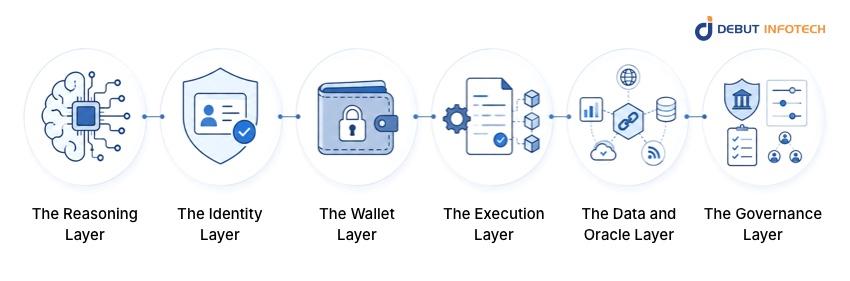
A production blockchain AI agent is best understood as a stack of layers, each with a distinct job. Treating it as one monolithic system is the fastest route to an insecure one. Six layers matter.
At the top sits the agent’s brain: one or more large language models wrapped in a framework that handles memory, planning, and tool use. Frameworks such as ElizaOS, Virtuals Protocol, and Coinbase AgentKit provide this runtime. ElizaOS alone reports tens of thousands of live agents managing billions of dollars in value across chains. The reasoning layer decides what to do. It does not touch funds directly, and that separation is deliberate.
An agent that transacts needs to prove who it is and what it is allowed to do. ERC-8004 and similar standards give an agent a registered on-chain identity, a reputation history, and verifiable credentials. This lets one agent trust another it has never met, which is the precondition for an open agent economy rather than a set of walled gardens.
The wallet holds the agent’s assets and signs its transactions. Crucially, a well-designed agent wallet is not a raw private key. It is a programmable account with built-in limits, which the security section below covers in depth.
This is where decisions become on-chain actions. Action toolkits and SDKs translate the agent’s intent into concrete smart contract calls, token transfers, and swaps. The execution layer is deterministic by design, so that a probabilistic decision upstream still resolves into a predictable, auditable transaction.
Agents reason over information, and blockchains cannot see beyond their own state. Oracles bridge that gap, feeding market prices, real-world events, and off-chain data into the system. The more advanced pattern verifies AI outputs themselves: several independent nodes run the same model on the same input, compare results, and economically penalize outliers, which brings a measure of trust to inference that would otherwise be a black box. Networks such as Chainlink and Pyth are building this verifiable data and computation layer.
Underneath everything sits policy. Spending limits, approval thresholds, allowlisted contracts, and human sign-off for high-value actions all live here. This layer decides what the autonomy is actually permitted to do, and it is the difference between a useful agent and an expensive incident.
The layers become clearer in motion. Consider an agent assigned a concrete objective: buy a specific market-data feed, use it to rebalance a portfolio, and stay under a $500 daily limit. The reasoning layer breaks the goal into steps and decides it first needs the data. The identity layer presents the agent’s ERC-8004 credential, so the data provider knows the counterparty is legitimate.
The governance layer has already issued a session key scoped to one day, a single set of contracts, and that $500 ceiling. When the agent requests the feed, the provider answers with an x402 payment demand, and the agent pays a few cents in stablecoins inline, with no account and no checkout. Data in hand, the reasoning layer computes new positions, and the execution layer turns that decision into deterministic smart contract calls that the wallet signs within its limits. Every step lands on-chain as an auditable record. Had a prompt injection tried to redirect the agent toward draining funds to an attacker, the session key’s allowlist and spending cap would have rejected the transaction before it ever settled. That single loop, reason, authenticate, pay, act, and record, sits under nearly every blockchain AI agent, whatever the use case.
A wallet is not an accessory for an autonomous agent. It is the thing that makes the agent economic. Without one, an agent can reason about a payment but cannot make it, can recommend a purchase but cannot complete it, and can offer a service but cannot get paid. The wallet supplies three capabilities at once.
First, it provides identity. The wallet address is the agent’s account, its signature, and, increasingly, its reputation anchor through standards like ERC-8004.
Second, it provides the ability to receive value. An agent that performs work, whether answering queries, executing trades, or supplying data, can be paid directly to its wallet with no invoicing and no delay.
Third, it provides the ability to spend. Machine-to-machine commerce depends on agents paying other agents and services for compute, data, and APIs, and protocols like x402 make those micropayments happen inline, thousands of times, without human involvement. Money becomes something software can send and receive natively, which is precisely what full autonomy requires. Strip the wallet away and the agent reverts to a smart assistant that still needs a person to move every dollar.
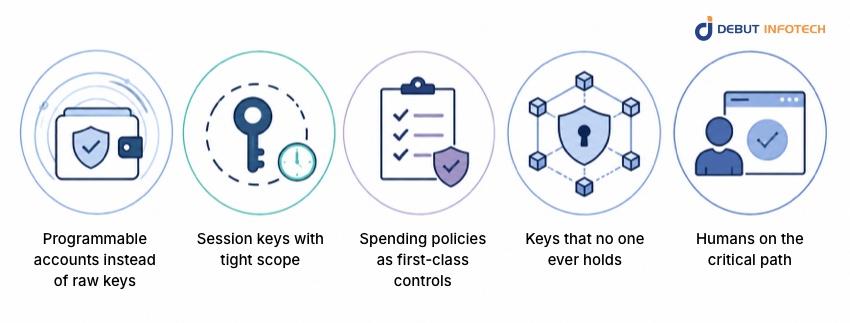
This is the question that decides whether an enterprise deployment survives contact with reality. An autonomous agent is non-deterministic and, by 2026, a documented target: the OWASP security community has tracked a sharp year-over-year rise in prompt injection, an attack that hijacks an agent’s instructions with no malware and no stolen credentials.
Pair that exposure with a naive wallet and the result is catastrophic, because a standard externally owned account holds one private key with unlimited spending authority. The industry has converged on a layered answer that assumes the agent will eventually be tricked and limits the blast radius when it is.
Account abstraction, standardized in ERC-4337 and extended by EIP-7702 in 2025, replaces the raw key with a smart account. A smart account runs custom validation logic on every transaction, which means the rules live in code that the agent cannot override. This single change turns a wallet from an all-or-nothing key into a policy engine.
Rather than trusting an agent with full account control, operators issue session keys: temporary, narrowly scoped permissions. A session key might be valid for one hour, limited to a single contract, and capped at a small maximum value. The agent signs within those bounds, and the smart account enforces them on-chain. Even if an attacker captures the session key, the damage is confined to what the key was allowed to do.
On top of session keys sit explicit policies: daily transfer limits, allowlisted recipients and protocols, and permitted operating windows. Wallet infrastructure now treats these as native features rather than application-level afterthoughts, so the constraints hold even if the calling application is compromised.
The master key still needs protection, and two approaches dominate. Multi-Party Computation splits a key into shares that never come together in one place. Trusted Execution Environments generate and use keys inside sealed hardware enclaves, so the raw key is never exposed to the application, the vendor, or the operator. Providers such as Turnkey, Privy, Crossmint, and Coinbase’s developer platform build agent wallets on these foundations, and the master key retains the power to revoke any session key instantly.
For high-value or irreversible actions, the strongest systems keep a person in the loop. An agent can prepare a large transfer, but a human approves it. Combined with continuous monitoring of agent behavior, this keeps autonomy productive without making it reckless. The governing principle is simple: grant the least authority the task requires, and make every grant revocable.
The phrase AI-powered smart contracts describes a partnership, not a merger. A smart contract is deterministic and immutable, which is exactly why it can be trusted to settle value. An AI model is probabilistic and adaptive, which is exactly why it should never hold irreversible settlement logic on its own. The productive pattern keeps them distinct. The AI reasons, decides, and prepares an action off-chain. The smart contract validates and executes that action on-chain, deterministically. Responsibility stays where each system is strong.
Within that boundary, AI transforms how contracts get built and run. Models now generate contract scaffolding, flag vulnerabilities, and accelerate audits, which shortens development and reduces the class of bugs that has drained value across the industry. During operation, agents read live chain state, evaluate conditions, and trigger the right contract calls at the right moment, which is the essence of smart contract automation. A treasury agent can monitor yields and rebalance positions. A payments agent can release funds when an oracle confirms delivery. A compliance agent can screen a counterparty and block a transfer that fails policy. Each of these turns a static contract into a component of a living, automated workflow, while the contract itself remains a predictable executor rather than a guessing machine.
Enterprise automation has always hit the same wall: the moment a workflow needs to move money or cross a trust boundary between organizations, a human has to step in. Blockchain AI Integration removes that wall by giving autonomous systems a trusted way to transact and an immutable record of what they did. Several categories show clear, near-term value.
Autonomous payments and procurement lead the list. An agent can source a service, negotiate terms, pay in stablecoins through a protocol like x402, and log the entire exchange on-chain for audit, all without a purchase order routed through three inboxes. In financial operations, treasury and yield agents manage liquidity continuously rather than in quarterly reviews, moving funds within strict policy limits. In supply chains, agents combine real-time reasoning with on-chain provenance, verifying that goods match records and releasing payment automatically on confirmed delivery. In compliance and audit, every agent action already carries a tamper-proof trail, which turns reporting from a reconstruction exercise into a query. And in the emerging agent economy, autonomous services buy and sell from one another directly, creating machine-native markets for data, compute, and specialized tasks.
The common thread is trust plus autonomy. AI supplies the autonomy, letting systems act without waiting on a person. Blockchain supplies the trust, letting other parties rely on those actions without a central authority vouching for them. Automation that once stopped at the payment or the organizational boundary now runs straight through it.
The theory holds up because it already runs in production across several domains. AI agents in blockchain have moved well past speculation, and a handful of categories show where the value concentrates first.
Autonomous DeFi and treasury management. Agents watch yields, liquidity, and risk across protocols and rebalance positions continuously within policy limits, doing in real time what a treasury team does on a quarterly cycle. Machine-to-machine commerce. Agents buy and sell services from one another, paying for compute, storage, data, and specialized tasks through inline stablecoin micropayments, which builds markets that no human could operate at the required speed. Supply chain and provenance. Agents pair real-time reasoning with on-chain records, confirming that shipments match documentation and releasing payment automatically once an oracle verifies delivery. Tokenized and real-world assets. Agents manage the lifecycle of tokenized assets, from issuance conditions to compliance checks to automated distributions, with every action recorded immutably. Decentralized data and compute marketplaces. Agents source and pay for exactly the resources a task needs, when it needs them, instead of committing to fixed contracts. DAO and protocol operations. Agents execute governance-approved actions, manage community treasuries under strict mandates, and handle routine operational work that would otherwise stall waiting on manual signatures.
Across all of them the pattern repeats. The agent handles judgment and speed, the blockchain handles trust and settlement, and the combination automates work that used to require a person precisely where money or trust changed hands.
The gap between an impressive demo and a production system is almost entirely a matter of sequence. Teams that lead with autonomy and add controls later tend to fail. Teams that design the guardrails first tend to ship. A practical path runs in seven steps.
None of these steps is exotic, and that is the point. Building secure autonomous agents on blockchain is less about novel cryptography and more about disciplined engineering, applied in the right order.
The technology is real, but so are its limits, and a balanced view names them. The clash between probabilistic AI and deterministic settlement never fully disappears, which is why the off-chain reasoning and on-chain execution split matters so much. Security remains the dominant risk, since agents introduce a new attack surface that classic application security was not designed to catch, and prompt injection turns a helpful agent into a hostile one without breaking anything technically. Regulation is unsettled, with open questions about who is liable for an agent’s transaction and how anti-money-laundering rules apply to machine-to-machine payments. Oracle trust is a live concern, because an agent acting on manipulated data will act confidently and wrongly. And the standards, though maturing fast, are young. Gartner expects a large share of agentic AI projects to be canceled before they mature, and weak foundations are usually the reason. None of this argues against building. It argues for building carefully, with the guardrails first.
Delivering an autonomous agent that touches real value asks a rare combination: deep blockchain engineering on one side and applied AI on the other, joined by a security-first mindset.
Debut Infotech works at that intersection. The blockchain practice has engineered production systems since 2015, spanning smart contract development, DeFi development, tokenization, and exchange infrastructure, with formal security auditing built into delivery rather than bolted on at the end. The AI practice builds and integrates LLM-based systems, workflow automation, and AI agent development using current frontier models.
Brought together, that range covers the full stack this guide describes. Debut designs agent wallets with policy guardrails and MPC or TEE custody, connects agents to smart contracts and oracles for reliable on-chain execution, and audits both the contract layer and the agent logic against modern threats.
For organizations exploring Blockchain AI integration, the work also draws on broader custom blockchain development solutions, web3 development, and AI integration capabilities, so the agent, the contracts, and the surrounding systems are engineered as one coherent whole rather than stitched together from disconnected pilots.
It is the combination of AI, which can reason and act, with blockchain, which can prove and settle. AI gives software autonomy and intelligence, blockchain gives it identity, payments, and a trustworthy record, and together they let an autonomous agent transact on its own while still being verifiable.
Because a wallet is what lets an agent participate in an economy. It serves as the agent’s identity, the account that receives payment for work, and the means to pay other services for data, compute, and APIs. Without a wallet, an agent can decide on a transaction but never complete one.
They can be, when built correctly. Security comes from programmable accounts, tightly scoped session keys, on-chain spending policies, and key custody through MPC or trusted execution environments, backed by audits and human approval for high-value actions. A naive agent wallet with a single unlimited key is not secure, which is why the architecture matters more than the model.
An AI agent is the decision-maker: it reasons, plans, and chooses actions, and it runs off-chain. An AI-powered smart contract is the executor: it runs fixed, deterministic logic on-chain and settles the action the agent decided on. The agent can be adaptive and creative, while the contract stays predictable and auditable. Keeping the two separate is what makes the system both flexible and safe.
Networks with low transaction costs, fast finality, and mature account-abstraction and stablecoin support tend to fit best, which is why much early agent activity settled on Ethereum Layer 2 networks and other high-throughput chains. The right choice depends on the workflow, the cost tolerance, and where the relevant liquidity and tooling already live.
Begin with a single bounded workflow that has clear economics, design the wallet limits and guardrails before the agent logic, wire in verifiable data, audit everything, and keep humans on the critical path. Prove the controls in a contained pilot, then widen scope once the evidence supports it.

Our Latest Insights
USA
2501 Chatham, Rd Suite R Springfield, IL 62704
+1-708-515-4004
info@debutinfotech.com
UK
7 Pound Close, Yarnton, Oxfordshire, OX51QG
+44-770-304-0079
info@debutinfotech.com
Canada
154 Eden Oak Trail, Kitchener, ON N2A 0H9
+1-708-515-4004
info@debutinfotech.com
INDIA
Sector 101-A, Plot No: I-42, IT City Rd, JLPL Industrial Area, Mohali, PB 140306
9888402396
info@debutinfotech.com