ON THIS PAGE
Progress0%






Our Global Presence :






Blockchain in healthcare improves trusted data exchange: Permissioned networks can create tamper-evident records, strengthen interoperability, and support secure collaboration across providers, payers, laboratories, pharmacies, and other organizations.
Off-chain storage is critical for healthcare data: Sensitive EHR, genomic, imaging, and IoMT data should generally remain in secure systems, while blockchain records hashes, references, permissions, timestamps, and audit events.
High-value use cases involve multiple independent participants: Pharmaceutical traceability, claims reconciliation, clinical trials, provider credentialing, consent management, and healthcare identity are particularly relevant where shared verification is needed.
Platform selection depends on the workflow, not transaction speed alone: Hyperledger Fabric suits many permissioned healthcare networks, while Ethereum-based networks, Corda, and Besu can fit specific supply-chain, insurance, privacy, and smart-contract requirements.
Healthcare blockchain implementation requires integration and compliance planning: EHR/HIS connectivity, HL7 FHIR, identity management, data residency, HIPAA, GDPR, DSCSA, and FDA 21 CFR Part 11 requirements can significantly influence architecture, cost, and deployment complexity.
Costs and timelines vary substantially by implementation scope: The blog estimates $30,000–$100,000 for a proof of concept, $100,000–$300,000 for a limited pilot, and $300,000–$750,000 for a production application, with larger consortium networks requiring substantially more investment.
A phased pilot reduces implementation risk: Organizations should define measurable business outcomes, validate the use case and architecture with a limited participant group, assess ROI, and scale only after integration, security, compliance, and operational requirements are proven.
Healthcare organizations generate and exchange enormous amounts of sensitive information across hospitals, laboratories, pharmacies, insurers, medical devices, and research institutions.
Yet this information often remains fragmented across systems, making it difficult to verify, share, and reconcile efficiently. Data breaches, inconsistent records, and limited visibility across pharmaceutical supply chains add to these challenges.
Blockchain in healthcare industry provides a way to create trusted, tamper-evident records across multiple organizations without requiring them to rely entirely on separate databases.
It can support secure data exchange, patient consent management, pharmaceutical traceability, claims processing, and clinical research while working alongside existing healthcare infrastructure.
In this complete guide to blockchain in healthcare industry, we will explain how blockchain works, its key benefits and use cases, real-world applications, infrastructure requirements, and leading blockchain platforms.
It also examines the technology’s challenges, regulatory considerations, implementation process, costs of blockchain healthcare solutions, future potential, and what businesses should look for when choosing a healthcare blockchain development company.
The blockchain in healthcare market is growing. Fortune Business Insights reveals that the global blockchain in healthcare market is estimated at $3.24 billion in 2026, up from $2.49 billion in 2025. The market is projected to reach $18.94 billion by 2034, growing at a 24.72% CAGR during the forecast period.
North America held the largest share of the global blockchain in healthcare market in 2025, accounting for 40.96% of total market revenue. The regional market was valued at approximately $1.02 billion that year. Strong digital health infrastructure, high healthcare IT spending, and growing demand for secure data exchange are supporting adoption across healthcare providers, payers, pharmaceutical companies, and life sciences organizations.
Security concerns are another important driver behind blockchain adoption. The U.S. Department of Health and Human Services maintains a public database of healthcare breaches affecting 500 or more individuals, with hacking and unauthorized access continuing to account for a substantial share of reported incidents.
As healthcare organizations exchange more digital information, the need for stronger data integrity, access controls, and auditable records continues to influence technology investment.
Pharmaceutical traceability is creating another practical demand for shared digital infrastructure. Under the Drug Supply Chain Security Act, the FDA is continuing the transition toward enhanced electronic and interoperable tracing of certain prescription drugs.
The agency has also issued waivers and exemptions extending into 2026 for eligible trading partners. These requirements can encourage pharmaceutical organizations and trading partners to explore technologies that provide reliable product histories and verification records.
This push for trusted data exchange extends beyond pharmaceutical supply chains. Healthcare organizations increasingly need to move information between EHRs, laboratories, pharmacies, insurers, medical devices, and digital health applications. HL7 FHIR provides a standardized framework for electronic healthcare information exchange, giving blockchain implementations a foundation for connecting distributed records with existing healthcare systems.
Together, these market forces are moving blockchain toward practical healthcare applications. Adoption of blockchain in healthcare industry is increasingly centered on secure data exchange, pharmaceutical traceability, patient consent, claims reconciliation, provider credentials, and trustworthy data flows for AI and connected medical devices.
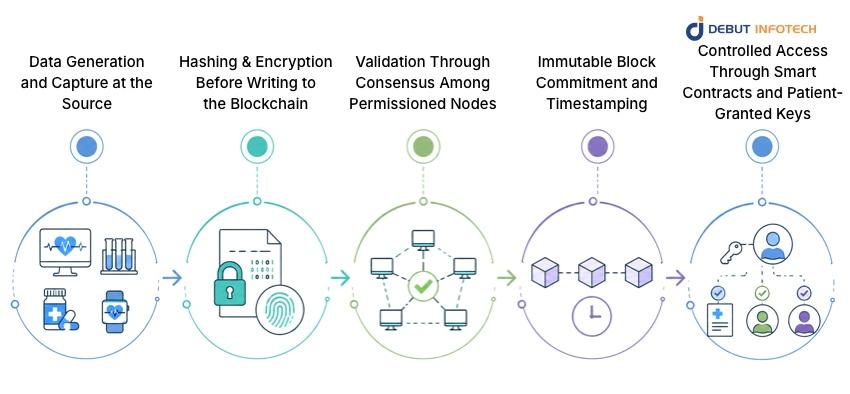
Blockchain in healthcare works by recording verified transactions across authorized network participants while keeping sensitive medical data in secure off-chain systems.
Data is captured, hashed, validated by permissioned nodes, timestamped on the ledger, and accessed through defined permissions and smart contracts that control how information is shared.
Blockchain-based healthcare systems begin with data generated by existing healthcare applications and devices. A clinician may update an EHR, a laboratory may produce a test result, a pharmacy may record a prescription transaction, or an IoMT device may capture patient readings.
The relevant event is then sent from the source system to the blockchain application for processing. The blockchain does not need to replace the system that originally generated the data.
Before information is recorded or referenced on the blockchain, the system applies appropriate security measures. Sensitive healthcare information is typically encrypted and stored outside the blockchain, while a cryptographic hash can be generated from the original record.
The hash acts as a digital fingerprint. If the underlying record changes, its hash changes as well. The system can later compare hashes to verify whether the referenced information remains unchanged.
After a transaction is submitted, participating blockchain nodes validate it according to the network’s predefined rules. Healthcare networks commonly use permissioned nodes because participants such as hospitals, insurers, laboratories, and pharmaceutical companies are known and authorized.
The nodes reach agreement through the network’s consensus mechanism before accepting the transaction. This prevents one participant from unilaterally changing the shared record and ensures that only valid transactions are added to the healthcare ledger.
Once the network validates a transaction, it is grouped with other approved transactions into a block and added to the blockchain. Each block is cryptographically connected to the previous block, creating a continuous record of activity.
The transaction is also timestamped, establishing when the event was recorded. If someone attempts to alter a previously committed record, the cryptographic relationship can reveal the change, creating a reliable and traceable history of blockchain activity.
After data has been recorded, blockchain healthcare applications use identity controls, permissions, and smart contracts to determine who can access specific information or perform certain transactions.
For example, a patient can authorize a specialist to access selected records, while a researcher may receive permission to use a defined dataset. Smart contracts enforce these predefined rules automatically.
When permissions change or are revoked, the system records the corresponding event and updates access accordingly.
Blockchain in medical industry can improve healthcare by strengthening data integrity, enabling trusted information exchange, giving patients greater control over consent, improving pharmaceutical traceability, reducing administrative inefficiencies, and creating auditable transaction records.
These blockchain in healthcare benefits are particularly valuable when multiple independent organizations need to verify and exchange the same information.
| Benefit | How Blockchain Delivers It | Healthcare Impact |
| Data security | Creates tamper-evident records | Protects data integrity |
| Interoperability | Provides a shared verification layer | Easier data exchange |
| Patient data control | Records consent and permissions | Greater patient control |
| Supply chain transparency | Tracks product transactions | Better traceability |
| Reduced fraud | Creates auditable transaction histories | Fewer billing discrepancies |
| Clinical trial integrity | Records research events | More reliable trial data |
| Lower reconciliation costs | Provides shared transaction records | Less administrative work |
Blockchain creates a tamper-evident record of healthcare transactions and data activity. Each approved record is cryptographically linked to previous records, making unauthorized changes easier to detect. This can strengthen the integrity of patient records, laboratory results, claims, and other sensitive information.
Healthcare organizations also gain a reliable audit trail that shows when information was recorded or accessed, helping improve accountability and trust between participating organizations.
Blockchain can help healthcare organizations exchange trusted information across different systems without requiring every participant to maintain an identical database.
A shared ledger can coordinate records, permissions, and transaction history between hospitals, laboratories, insurers, pharmacies, and other providers.
When combined with standards such as HL7 FHIR, blockchain can reduce information silos, minimize duplicate data reconciliation, and make cross-organizational data exchange more consistent and efficient.
Blockchain in healthcare industry can give patients greater control over how their healthcare information is accessed and shared. Smart contracts can record consent decisions and enforce predefined access permissions between patients, providers, researchers, and other authorized parties.
Patients can have greater visibility into who accesses their information and when. This creates a more transparent consent process while supporting patient-centered data sharing across different healthcare organizations and research environments.
Blockchain in medical industry can create a shared and traceable record of pharmaceutical products as they move between manufacturers, distributors, pharmacies, and healthcare providers.
Authorized participants can verify product information and review transaction histories without relying on disconnected records. This improves supply chain visibility, makes suspicious transactions easier to identify, and strengthens efforts to detect counterfeit or compromised products.
It can also support pharmaceutical organizations as they implement enhanced drug traceability requirements.
Blockchain can simplify administrative processes by giving payers, providers, and other participants access to a consistent transaction history. Smart contracts can automate predefined checks for eligibility, claims, payments, and other routine processes. This reduces repetitive verification and manual reconciliation.
A shared and auditable record can also make unusual transactions easier to investigate, helping healthcare organizations identify duplicate claims, inconsistent information, and other activities associated with fraud or payment errors.
Blockchain can improve clinical trial management by creating a reliable record of consent, data submissions, research activities, and other important events. Researchers and sponsors can use this record to verify when information was generated and track changes throughout a study.
Automated smart contracts can also support predefined trial workflows and permission rules. This can improve data integrity, simplify auditing, and reduce the administrative effort involved in coordinating information across multiple research sites and participants.
Payers and healthcare providers often maintain separate records for services, claims, payments, adjustments, and eligibility. Reconciling these records can require significant manual effort.
Blockchain can provide participating organizations with a shared transaction history, reducing the need to compare separate databases repeatedly.
Smart contracts can automate agreed validation and payment rules, helping shorten processing cycles. Over time, this can reduce administrative costs, minimize disputes, and allow staff to spend less time resolving routine data inconsistencies.
Blockchain in healthcare industry can support medical workflows that involve multiple organizations, shared records, and the need for verifiable transactions.
These blockchain healthcare use cases now extend across clinical data, pharmaceutical supply chains, insurance, research, identity, and connected devices.
| Use Case | How Blockchain Helps | Primary Benefit |
| EHR management | Records hashes, permissions, and access events | Data integrity |
| Pharmaceutical supply chain | Tracks product transactions | Traceability |
| Clinical trials | Records consent and research events | Data integrity |
| Claims processing | Creates shared transaction history | Faster reconciliation |
| Provider credentialing | Verifies credentials | Faster verification |
| Remote monitoring | Records data provenance | Trusted IoMT data |
| Genomic data marketplaces | Manages consent and access | Controlled data sharing |
| Healthcare identity | Coordinates verified identities | Interoperability |
Blockchain can improve the integrity, traceability, and controlled sharing of electronic health records across healthcare organizations.
Instead of storing complete medical files on-chain, organizations can keep clinical data in existing EHR databases while recording hashes, access events, timestamps, and consent information on the blockchain.
Blockchain for electronic health records creates a verifiable history without forcing providers to replace their existing systems.
Authorized participants can verify whether a record has been altered and track relevant access activity.
The approach can support better coordination between hospitals, specialists, laboratories, and other providers while maintaining established data-storage practices.
Blockchain can provide pharmaceutical companies and supply-chain participants with a shared record of product movement from manufacturing through distribution and dispensing.
Each transaction can be recorded and linked to relevant product identifiers, creating a traceable history that authorized participants can verify. This can make suspicious transactions, duplicate records, and potentially counterfeit products easier to identify.
Clinical trials involve researchers, sponsors, healthcare providers, laboratories, and participants, all of whom generate or handle important information.
Blockchain can create a tamper-evident record of consent events, data submissions, protocol-related activities, and other research transactions. This can strengthen data provenance and make it easier to demonstrate when information was created or modified.
Smart contracts can also support predefined consent rules and access permissions. Researchers can maintain detailed records without placing complete clinical datasets on-chain.
Sensitive trial information can remain in controlled storage while blockchain provides an independent audit layer around important events.
Healthcare claims often move between providers, insurers, clearinghouses, and other organizations, creating opportunities for delays, duplicate processing, and reconciliation disputes.
Blockchain can provide a shared transaction history that records claim submissions, verification events, approvals, adjustments, and payments.
Smart contracts can automate predefined rules for eligibility checks and claim validation where appropriate. This can reduce repetitive verification and make disputed transactions easier to trace.
Blockchain will not eliminate complex claims requiring clinical or human review. Its value comes from creating a consistent, auditable transaction record that reduces unnecessary administrative work between participating organizations.
Healthcare organizations routinely verify professional licenses, certifications, training records, and other provider credentials before allowing clinicians to practice or access specific systems.
Blockchain can provide a shared, tamper-evident record of verified credentials that authorized organizations can access when needed.
When a licensing authority or approved institution issues a credential, the event can be recorded and linked to the provider’s digital identity.
Participating hospitals and healthcare networks can then verify the credential without repeatedly contacting the issuing organization. This can reduce administrative work, speed up onboarding, and make expired or revoked credentials easier to identify.
Remote patient monitoring systems and Internet of Medical Things devices generate continuous streams of information from wearables, sensors, and connected medical equipment.
Blockchain can provide a verifiable record of important data events, including the device or system that generated the information and when it was recorded. This can strengthen data provenance for clinicians, researchers, and other authorized users.
However, storing every sensor reading directly on-chain would create unnecessary performance and storage demands.
A more practical architecture keeps detailed device data off-chain while recording selected hashes, timestamps, permissions, and audit events on the blockchain.
Genomic information can support drug discovery, disease research, and personalized treatment, but sharing this data raises significant privacy concerns.
Blockchain can help manage consent, access permissions, data-use conditions, and transaction histories around genomic datasets. Patients could authorize specific research activities while maintaining greater visibility into how their information is accessed.
Researchers could verify that data was obtained under defined permissions without receiving unrelated personal information.
The underlying genomic files should remain in secure storage rather than being placed directly on a blockchain. This architecture supports controlled data sharing while reducing unnecessary exposure of highly sensitive information.
Blockchain can support healthcare identity systems by creating a trusted way to coordinate patient, provider, and insurance identities across participating organizations.
A shared identity layer can help address problems caused by duplicate patient records, inconsistent identifiers, and fragmented insurance information.
Authorized organizations can verify identity-related information without maintaining identical databases. Blockchain can also record consent and access events associated with identity credentials.
The technology does not replace existing identity and authentication systems. Instead, it can provide a shared verification layer that connects hospitals, insurers, laboratories, pharmacies, and other participants while improving traceability and reducing duplicate administrative work.
Several healthcare organizations and technology companies have moved beyond blockchain experiments to test practical applications in data integrity, pharmaceutical traceability, research, and secure information exchange. These real-world applications of blockchain in healthcare explained with examples show how different blockchain models work in real healthcare environments.
MediLedger, developed by Chronicled, is one of the clearest examples of blockchain being applied to a specific healthcare supply-chain problem.
The network supports pharmaceutical product verification by allowing authorized trading partners to verify product information and transactions. Its architecture provides a shared verification layer without requiring every participant to expose its internal systems.
The example of blockchain healthcare innovation demonstrates how blockchain can support pharmaceutical traceability, trading-partner coordination, and DSCSA-related supply-chain processes.
Estonia has used Guardtime’s KSI blockchain technology to strengthen the integrity and auditability of its national healthcare records.
Rather than storing complete medical records on a blockchain, the infrastructure uses blockchain-based techniques to provide evidence that records have not been improperly altered. This approach allows Estonia to retain its existing health information infrastructure while adding an independent integrity layer.
It demonstrates how blockchain can complement national healthcare systems without replacing their underlying databases.
IBM has explored blockchain applications for healthcare data exchange and clinical research, including projects examining how distributed ledgers can support clinical trial processes.
Blockchain can record important research events, consent information, and data provenance while keeping sensitive datasets in controlled storage. These initiatives demonstrate a practical approach to blockchain in clinical research.
Rather than replacing clinical trial management systems, blockchain can provide an additional layer for verification, auditability, and controlled collaboration between participants.
Akiri developed a healthcare network infrastructure designed to support secure and controlled exchange of health information between organizations. Its approach uses a permissioned network model to establish trusted relationships between participants and manage policies around data movement.
The platform is designed to connect healthcare organizations without requiring them to expose their internal systems directly.
Akiri illustrates how distributed network infrastructure can address healthcare data exchange while maintaining organizational control over sensitive information.
Embleema has developed a patient-centered health data platform focused on bringing together clinical, genomic, wearable, and patient-reported information for research.
Its model emphasizes patient consent and controlled data sharing, allowing individuals to participate in research while maintaining greater visibility into how their information is used.
Blockchain has been explored within this type of architecture to support consent and data provenance. The example demonstrates how distributed technologies can support more transparent, patient-centered research data ecosystems.
Healthcare blockchain infrastructure combines the blockchain network with storage, identity, smart contracts, and integration components. Each layer of blockchain healthcare infrastructure has a specific role in keeping the system secure, interoperable, scalable, and manageable.
This healthcare blockchain guide section explains how these layers work together to support secure, scalable, and interoperable healthcare applications.
The network type determines who can participate, validate transactions, and access blockchain data.
Private networks are controlled by one organization, while consortium networks are jointly governed by several trusted healthcare participants.
Public blockchains allow broader participation but introduce greater privacy and governance concerns.
For most healthcare applications, private or permissioned consortium networks are more suitable because they provide controlled membership, defined governance, and stronger access management.
| Network Type | Who Controls It? | Access | Best Healthcare Use Cases | Key Advantage | Main Limitation |
| Private | One healthcare organization | Restricted | Internal records, credentialing, internal audit trails | High control and privacy | Limited participation |
| Permissioned | Approved organization or governing body | Authorized participants only | EHR sharing, claims, clinical research | Strong identity and access control | Requires governance |
| Consortium | Multiple participating organizations | Approved members | Pharma supply chains, payer-provider networks, health information exchange | Shared ownership and trust | Governance can be complex |
| Public | Decentralized network | Generally open | Public verification, selected research or tokenization applications | High transparency and broad accessibility | Greater privacy and compliance challenges |
For most enterprise healthcare projects, a permissioned consortium network is the strongest option when multiple independent organizations need to collaborate. It provides controlled participation while preserving the shared-ledger benefits that make blockchain useful for healthcare workflows.
Nodes are the computers or servers that maintain and validate the blockchain network.
In a healthcare consortium, different organizations can operate their own nodes. Hospitals, insurers, laboratories, pharmaceutical companies, and approved regulators may each have defined responsibilities.
The infrastructure should specify which participants validate transactions, which can access particular data, and how nodes communicate. This distributed architecture prevents one organization from having complete control over the shared ledger.
The smart contract layer contains the programmable rules that automate healthcare transactions and permissions.
Smart contracts can define how claims are validated, how pharmaceutical products are verified, or when a patient’s data can be accessed. They run according to predefined conditions and record the resulting transactions on the network.
The infrastructure should include secure development, testing, auditing, deployment, and upgrade processes because errors in smart contract logic can affect multiple participating organizations.
Healthcare blockchain infrastructure should separate the blockchain ledger from large and sensitive clinical datasets. EHR files, medical images, genomic information, and IoMT data can remain in secure databases or cloud storage.
The blockchain can store hashes, references, timestamps, and relevant transaction information. This architecture reduces blockchain storage requirements while allowing organizations to verify data integrity.
It also makes it easier to manage retention, correction, deletion, and data-residency requirements.
Identity infrastructure determines who can join the network, submit transactions, and access healthcare information.
Each participating organization and authorized user needs a verifiable digital identity with appropriate permissions.
The system should integrate authentication, role-based access control, credential management, encryption keys, and revocation mechanisms.
Strong identity infrastructure prevents unauthorized users from accessing sensitive records and allows the blockchain to maintain an auditable record of actions performed by authenticated participants.
The integration layer connects the blockchain infrastructure to existing healthcare applications.
APIs, FHIR interfaces, middleware, and event-driven services can connect EHRs, HIS platforms, laboratory systems, pharmacy applications, claims systems, and medical devices to the network. This layer translates information between existing systems and blockchain applications without requiring organizations to replace their core infrastructure.
It also handles data synchronization, authentication, error management, and transaction routing between connected healthcare systems.
Hyperledger Fabric is generally the strongest choice for permissioned healthcare networks because it provides controlled participation, identity management, and enterprise-focused architecture.
However, Ethereum-based consortium networks, Corda, and Besu can be better suited to specific supply-chain, insurance, or transaction workflows depending on privacy, interoperability, and governance requirements.
The right choice depends on governance, privacy requirements, interoperability, transaction volume, smart contract needs, regulatory exposure, and the number of participating organizations.
| Platform | Permissioning | Throughput/Performance | Compliance fit | Smart contracts | Best healthcare fit |
| Hyperledger Fabric | Strong | High for permissioned enterprise workloads | Strong | Yes | EHR networks, health information exchange, payer-provider networks |
| Ethereum-based consortium | Configurable | Strong with appropriate architecture | Depends on implementation | Strong | Pharma supply chain, shared ecosystems, tokenized data workflows |
| Corda | Strong | Designed for business transactions | Strong enterprise fit | Yes | Financial/insurance workflows and bilateral healthcare transactions |
| Quorum/Besu-based networks | Strong | Strong for enterprise deployments | Depends on architecture | Strong | Ethereum-compatible private networks and consortium applications |
A Hyperledger Fabric is particularly suitable when healthcare organizations need a permissioned network with strong identity and membership controls. Its architecture supports known participants and configurable consensus mechanisms.
Academic benchmarking has demonstrated high throughput in certain Fabric configurations, although real-world performance depends heavily on network design and workload.
Fabric is therefore a strong candidate for permissioned EHR networks, health information exchanges, provider credentialing, and payer-provider infrastructure where participants are known, and governance is tightly controlled.
Ethereum-compatible infrastructure becomes attractive when organizations need mature smart-contract capabilities, interoperability with the broader Ethereum ecosystem, or future support for tokenized assets and data-related applications.
For pharmaceutical supply chains, an Ethereum-compatible consortium can work well when multiple independent companies need a shared programmable transaction layer.
The network should still be permissioned where healthcare data and regulatory requirements demand controlled participation.
Corda is designed around business transactions between identifiable parties rather than a traditional broadcast-everything blockchain model. This can make it relevant to healthcare insurance, financing, credentialing, and other workflows where only specific parties need to see particular transactions.
Ethereum-compatible enterprise networks such as Quorum-based or Besu-based deployments can provide permissioned environments while retaining Ethereum smart-contract compatibility.
They can be useful where development teams want access to Ethereum tooling without placing sensitive healthcare transactions on a public network.
For permissioned EHR and health information exchange, Hyperledger Fabric is usually the strongest starting point because of its membership controls, enterprise architecture, and suitability for consortium governance.
For pharmaceutical supply chain networks, an Ethereum-based permissioned consortium can be attractive when smart contracts, ecosystem interoperability, and shared transaction workflows are central requirements.
For insurance and bilateral business transactions, Corda can be considered where privacy between counterparties is a primary architectural requirement.
The final decision should come after a proof of concept. Blockchain healthcare platform selection based only on transaction-per-second figures is inadequate for healthcare. Identity, privacy, integration, governance, auditability, and operational support matter just as much.
Businesses should evaluate whether blockchain fits the intended use case, assess regulatory exposure, understand EHR integration requirements, review internal technical capabilities, calculate the expected ROI, establish data governance rules, and decide between in-house development and an external partner.
These factors determine whether blockchain will solve a genuine business problem or add unnecessary complexity.
This healthcare blockchain guide section outlines the key factors businesses should assess before committing to implementation.
Before implementing blockchain, businesses should first determine whether the problem genuinely requires distributed infrastructure. Blockchain is most useful when multiple independent parties need to share, verify, or update information without relying entirely on one central authority.
Suitable examples include: pharmaceutical traceability, payer-provider claims reconciliation, clinical trial records, and cross-organizational consent management.
If one organization controls the entire workflow and a conventional database can handle the requirements, blockchain may add unnecessary complexity.
Key questions to assess include:
Healthcare blockchain projects can involve sensitive patient information, pharmaceutical records, insurance data, or clinical research information. Businesses should identify every regulation that applies before development begins.
Depending on the market and use case, this may include HIPAA, GDPR, DSCSA, FDA 21 CFR Part 11, and data-residency requirements. The architecture should determine what information can be stored on-chain and what must remain off-chain.
Businesses should assess:
Legal and compliance teams should be involved during architecture planning rather than reviewing the system after development.
Blockchain rarely operates independently in a healthcare environment. It must connect with existing EHRs, hospital information systems, laboratory platforms, pharmacy systems, claims applications, identity providers, and other enterprise software.
Businesses should map these systems before development and identify available APIs, FHIR interfaces, data formats, authentication methods, and integration limitations. Patient identity matching also requires attention because the same individual may be represented differently across healthcare systems.
Assess the following before development:
Integration can become one of the largest project costs, so it belongs in the initial technical assessment and budget.
A blockchain network introduces technical responsibilities that may not exist in a conventional healthcare application.
Businesses need capabilities covering distributed systems, smart contracts, cryptography, identity management, node administration, cybersecurity, APIs, and healthcare interoperability. They should determine whether internal teams can operate and secure the infrastructure after launch.
If important skills are missing, an experienced development partner can fill the gap. Evaluate internal capabilities across:
Outsourcing development does not remove the organization’s responsibility for its data, security, and compliance obligations.
Blockchain implementation costs extend beyond application development. Businesses may need to fund EHR integration, node infrastructure, cloud services, cybersecurity, smart contract audits, compliance assessments, testing, support, and network administration.
Before approving the project, calculate the expected financial and operational return. Potential benefits include lower reconciliation costs, faster claims processing, reduced manual verification, improved traceability, and lower fraud exposure.
Build the ROI model around measurable factors such as:
A pilot can validate these assumptions before full-scale deployment.
Healthcare blockchain projects need clear rules for how data is created, accessed, shared, corrected, retained, and removed. Businesses should define which organization controls each dataset and what permissions patients, clinicians, researchers, insurers, and other participants receive.
Consent rules should cover granting, modifying, and revoking access. Sensitive health information should generally remain in secure off-chain systems, while blockchain records appropriate hashes, references, permissions, or audit events.
The governance model should define:
These policies should be established before smart contracts are developed because the contracts will enforce them.
Businesses should decide whether to build the blockchain healthcare solution internally, work with an external development company, or use a hybrid approach.
An internal team provides greater control but requires expertise in blockchain, healthcare integration, security, compliance, and infrastructure operations.
An external partner can provide specialized knowledge and development capacity, but the organization should evaluate its technical experience and ownership terms carefully.
When assessing a development partner, review:
A phased engagement can reduce risk by starting with discovery and a proof of concept.
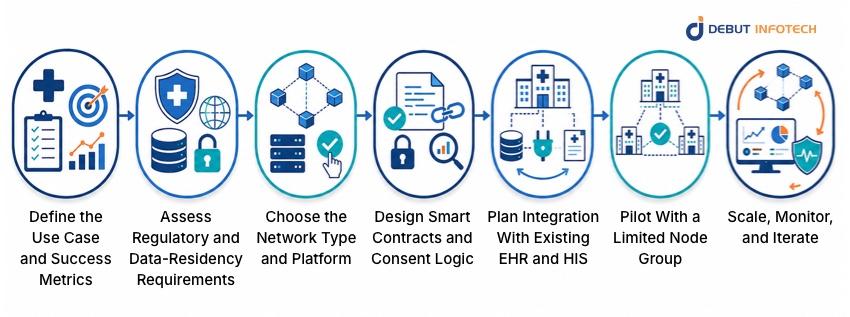
A structured blockchain healthcare implementation process helps healthcare organizations move from an initial blockchain concept to a controlled production environment.
Each stage of blockchain implementation in healthcare should validate the business case, technical architecture, compliance requirements, and operational readiness before the next stage begins.
Start by identifying one specific healthcare problem that blockchain can address. Avoid beginning with a platform or technology choice. Define the existing workflow, organizations involved, information exchanged, and problems caused by fragmented or inconsistent records. Then establish measurable targets.
A pharmaceutical network might aim to reduce product verification time, while a claims platform could target faster reconciliation. Document baseline performance before development starts.
Define metrics such as:
Clear metrics make it easier to determine whether blockchain provides measurable business value.
Once the use case is defined, identify the legal and regulatory requirements governing the project.
Determine whether the system will process protected health information, personal data, pharmaceutical transaction records, clinical research data, or electronic records subject to FDA requirements.
Assess where information can be stored and whether participating organizations operate across different jurisdictions. Decide which information belongs off-chain and which transaction evidence can safely be recorded on-chain.
The assessment should cover:
These requirements should shape the architecture before development begins.
Choose the network architecture according to the participants and governance requirements.
A private blockchain may suit a single healthcare organization, while a consortium network is generally more appropriate when hospitals, payers, pharmaceutical companies, laboratories, or regulators need to participate.
Next, evaluate platforms such as Hyperledger Fabric, Ethereum-based permissioned networks, Corda, or Besu.
Compare platforms based on:
Do not select a blockchain healthcare platform based only on transaction-per-second claims. Healthcare requires a broader technical and compliance assessment.
Translate approved business rules into smart contracts and access policies. Define who can initiate transactions, what conditions must be satisfied, which information each participant can access, and how permissions change over time.
Consent workflows should account for granting, modifying, and revoking patient permissions. Smart contracts should also support exceptions because healthcare processes rarely follow one path in every situation.
The design should define:
Keep contract logic simple and auditable. Conduct security testing and independent review before connecting smart contracts to production data.
Design the integration layer before connecting the blockchain to production healthcare systems. Identify every EHR, HIS, laboratory, pharmacy, claims, medical imaging, identity, and analytics platform involved in the workflow.
Determine how each system exchanges information and whether FHIR APIs, web services, event streams, or other interfaces are available. Map data fields, patient identifiers, authentication methods, and transaction events between systems.
The integration plan should cover:
The blockchain should complement existing infrastructure rather than force organizations to replace functioning systems.
Do not begin with a large production network involving dozens of organizations. Start with a controlled pilot involving a small number of participants that represent the intended ecosystem.
A pharmaceutical pilot could connect one manufacturer, a distributor, and selected pharmacies. A claims pilot could involve a small group of providers and one payer. The pilot should test both the technology and the business workflow.
Measure:
Compare the results against the baseline metrics established during discovery. Resolve major issues before expanding the network.
After the pilot demonstrates technical and business viability, expand the network gradually.
Add participants in stages and monitor transaction performance, node health, integration reliability, access events, security alerts, and user activity.
Conduct regular smart contract reviews and security assessments as the system evolves. Governance should also mature as more organizations join.
Establish processes for:
Continue comparing performance against the original success criteria. If the system fails to deliver measurable improvements, adjust the workflow or architecture before scaling further.
The main challenges of blockchain in healthcare include scalability, integration with legacy EHR systems, regulatory differences, implementation costs, privacy concerns, and limited industry-wide adoption. These blockchain in healthcare challenges can increase development complexity and slow deployment.
Healthcare organizations can reduce the risks by choosing focused use cases, using off-chain storage, and planning interoperability and compliance from the beginning.
| Challenge | Why It Matters | Practical Approach |
| Scalability | Healthcare generates large data volumes | Keep large datasets off-chain |
| Legacy integration | Existing EHRs use different systems | Use APIs and FHIR |
| Regulatory uncertainty | Requirements differ across jurisdictions | Conduct compliance assessment early |
| Implementation costs | Integration can be expensive | Start with a focused pilot |
| Privacy and immutability | Health data may need correction or deletion | Use off-chain storage |
| Limited standardization | Participants may use different systems | Establish common standards and governance |
Healthcare systems generate large volumes of information from EHRs, medical devices, laboratories, pharmacies, claims platforms, and imaging systems.
Recording every transaction directly on a blockchain can create storage and performance bottlenecks. The problem becomes more pronounced when multiple organizations share the network and transaction volumes increase.
Organizations should assess:
A practical architecture usually keeps large clinical datasets off-chain and records only hashes, references, permissions, and important transaction events on the blockchain.
Blockchain does not remove the interoperability problems already present in healthcare. Hospitals and providers may use different EHR platforms, data structures, patient identifiers, APIs, and terminology systems.
Connecting a blockchain network to these environments can therefore require substantial integration work.
Organizations should evaluate their existing infrastructure before development and identify where information needs to move between systems.
Key considerations include:
Without a strong integration strategy, the blockchain can become another isolated system instead of solving existing data fragmentation.
Healthcare blockchain projects can cross multiple regulatory boundaries, particularly when hospitals, insurers, pharmaceutical companies, or research organizations operate across countries.
Privacy, data residency, consent, retention, electronic records, and pharmaceutical traceability requirements can differ between jurisdictions.
A blockchain architecture that satisfies one market may require changes before it can operate elsewhere.
Businesses should evaluate:
Regulatory requirements should influence the architecture from the beginning. Retrofitting compliance controls after deployment can increase cost and create avoidable technical limitations.
Blockchain development costs extend beyond building the ledger or smart contracts.
Healthcare organizations may need to integrate several existing systems, establish secure node infrastructure, implement identity management, conduct security testing, and meet regulatory requirements.
These activities can make blockchain projects considerably more expensive than conventional application development.
Major cost areas include:
Businesses should therefore calculate the expected return before committing to production deployment. A narrowly defined pilot can help establish whether the projected savings justify the investment.
Blockchain’s immutability creates a difficult issue for healthcare because medical information may need to be corrected, restricted, or deleted.
Privacy regulations can also give individuals specific rights over their personal information. Storing identifiable medical records directly on an immutable ledger can therefore create compliance and privacy concerns.
A safer architecture generally separates sensitive data from blockchain records:
This approach preserves blockchain’s auditability without treating immutable storage as a substitute for healthcare data governance.
Blockchain creates value only when relevant organizations participate in the network. A hospital may implement a blockchain-based data-sharing system, but its benefits remain limited if partner hospitals, payers, laboratories, or insurers continue using incompatible infrastructure.
Reaching agreement across independent organizations can be difficult because participants may have different technical capabilities, budgets, policies, and commercial interests.
Organizations need agreement on:
Standards such as HL7 FHIR can improve interoperability, but successful blockchain adoption also requires organizational cooperation and a governance model that participants are willing to follow.
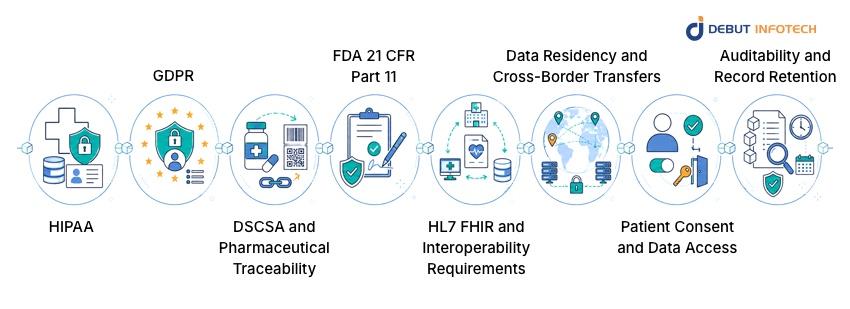
HIPAA applies when enterprise blockchain solutions for healthcare providers handle protected health information (PHI) for covered entities and business associates.
Organizations should implement appropriate administrative, physical, and technical safeguards, including access controls, authentication, encryption, and audit mechanisms.
Because blockchain records are difficult to alter or remove, sensitive PHI should generally remain off-chain, with hashes or references used to verify integrity.
GDPR creates particular challenges for blockchain because individuals can have rights to access, rectify, and erase their personal data. Storing identifiable health information directly on an immutable ledger can therefore create compliance conflicts.
Organizations serving EU data subjects should minimize on-chain personal information and design off-chain storage, identity controls, consent management, and deletion workflows around applicable GDPR requirements.
The Drug Supply Chain Security Act (DSCSA) requires trading partners to support enhanced electronic tracing of certain prescription drugs through the U.S. pharmaceutical supply chain.
Blockchain can provide a shared record of product transactions and verification events, but the network must align with FDA requirements and industry interoperability standards.
Organizations should validate product identifiers, transaction records, participant permissions, and data exchange processes before deployment.
FDA 21 CFR Part 11 establishes requirements for electronic records and electronic signatures used in FDA-regulated activities.
Blockchain applications supporting clinical trials, pharmaceutical manufacturing, or regulated research may therefore need controls for validation, authorized access, audit trails, record integrity, and electronic signatures.
Businesses should document system controls and validate relevant blockchain components before relying on them for regulated records.
HL7 FHIR is not a blockchain regulation, but it is an important interoperability standard for healthcare systems.
Blockchain applications should support FHIR-based data exchange where appropriate so they can connect with EHRs and other healthcare platforms.
Using recognized standards reduces integration friction and helps prevent blockchain networks from becoming isolated data environments that cannot communicate with existing healthcare infrastructure.
Healthcare organizations operating across jurisdictions must determine where patient information can be stored, processed, and transferred.
A distributed network can complicate this because multiple nodes may hold or process transaction information in different locations.
Before deployment, businesses should map data flows, identify applicable residency rules, restrict node locations where necessary, and ensure cross-border transfers have appropriate legal and technical safeguards.
Blockchain healthcare systems should establish clear rules for obtaining, recording, modifying, and revoking patient consent.
Smart contracts can automate access decisions, but they should reflect applicable privacy and healthcare requirements rather than treating blockchain transactions as permanent authorization.
Businesses should define who can access each data category, under what conditions, for how long, and how revoked permissions affect subsequent access.
Healthcare organizations need reliable records showing who accessed, created, changed, or transmitted information and when those activities occurred.
Blockchain can strengthen auditability by creating tamper-evident transaction histories, but it does not automatically satisfy every record-retention requirement.
Businesses should determine which events need to be recorded, how long records must remain available, and how blockchain records connect with formal compliance and archival systems.
Blockchain implementation in healthcare typically costs $30,000–$100,000 for a proof of concept, $100,000–$300,000 for a limited pilot, $300,000–$750,000 for a production application, and $750,000–$1.5 million+ for an enterprise consortium network.
The final cost depends mainly on EHR integration, compliance requirements, smart contract complexity, number of network participants, infrastructure, security testing, and ongoing maintenance.
| Implementation scope | Estimated cost | Typical timeline |
| Proof of concept (PoC) | $30,000–$100,000 | 2–4 months |
| Limited healthcare pilot | $100,000–$300,000 | 3–6 months |
| Production-ready application | $300,000–$750,000 | 6–12 months |
| Enterprise blockchain network | $750,000–$1.5M+ | 12–24+ months |
| Large multi-organization healthcare ecosystem | $1.5M–$3M+ | 18–36+ months |
The biggest cost drivers are usually EHR/HIS integration, regulatory compliance, security architecture, smart contract development, identity management, and network infrastructure.
A blockchain application that connects two systems and serves a limited number of users can stay near the lower end. A consortium connecting hospitals, insurers, pharmaceutical companies, laboratories, and regulators can quickly move into the seven-figure range.
For budgeting purposes, businesses can break the cost into these areas:
These figures are planning ranges rather than fixed market prices. Healthcare blockchain projects vary widely because the integration and compliance workload can be larger than the blockchain development itself.
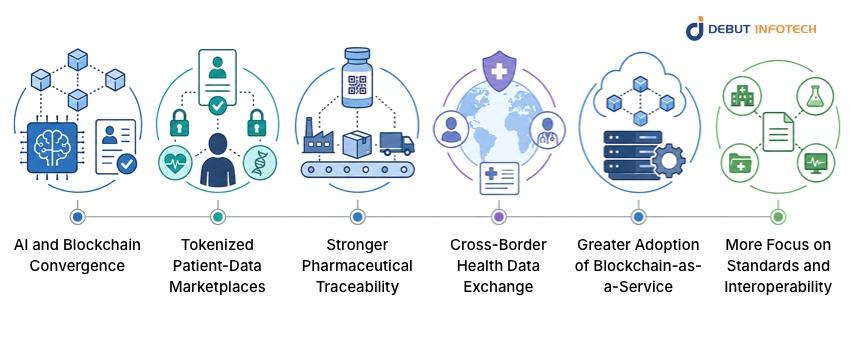
The future of blockchain in healthcare will likely focus on AI data provenance, patient-controlled research data, pharmaceutical traceability, cross-border health information exchange, managed blockchain infrastructure, and stronger interoperability standards.
Adoption will depend on practical integration with existing healthcare systems rather than blockchain operating as a separate technology layer.
AI systems increasingly depend on large healthcare datasets, making data provenance and integrity more important.
Blockchain can record where datasets originated, when information was added, and whether referenced records were modified. This could support clinical AI, medical research, and precision medicine by providing stronger evidence around data history.
Potential applications include:
A blockchain will complement AI infrastructure rather than replace data platforms or machine learning systems.
Blockchain could support consent-based models where patients have greater visibility into how their health information is shared for research.
Tokenization may allow permissions or data-use rights to be represented digitally, creating new models for controlled participation in research ecosystems.
Future systems could support:
These marketplaces will require strict privacy and governance controls because health and genomic data cannot be treated like ordinary digital assets.
Pharmaceutical traceability is likely to remain one of blockchain’s more practical healthcare applications.
As organizations continue adapting to enhanced DSCSA requirements, shared digital infrastructure can help manufacturers, distributors, pharmacies, and other trading partners verify products and maintain transaction histories.
Blockchain could support:
Continued DSCSA implementation through 2026 may encourage pharmaceutical organizations to invest further in interoperable digital traceability systems.
Cross-border healthcare creates challenges around identity, consent, data provenance, and access permissions.
Blockchain could provide a shared trust layer between healthcare organizations operating under different systems. Instead of creating one global medical database, networks could use blockchain to coordinate permissions and verify data exchanged between trusted participants.
Potential applications include:
Success will depend on harmonizing technical standards with privacy, residency, and healthcare regulations across participating jurisdictions.
Healthcare organizations may increasingly use managed blockchain infrastructure instead of operating every node and network component internally.
Blockchain-as-a-Service can reduce infrastructure and operational complexity while allowing organizations to focus on applications, integrations, and workflows.
This model can provide:
Managed infrastructure may make blockchain more accessible to healthcare organizations that lack specialized distributed-ledger engineering teams while reducing the operational burden of running consortium networks.
The future of healthcare blockchain solutions will depend heavily on interoperability standards.
Organizations are unlikely to adopt isolated blockchain networks that cannot communicate with existing healthcare infrastructure.
HL7 FHIR and other standards can provide the foundation for exchanging structured healthcare information, while blockchain can add provenance, consent, identity, and audit capabilities.
Future architectures will increasingly combine:
This standards-driven approach can make blockchain more practical for large healthcare ecosystems and reduce the risk of creating another disconnected technology layer.
Choose a healthcare blockchain development company based on its experience with healthcare compliance, EHR integration, blockchain platforms, security, smart contracts, and post-launch support.
The company providing healthcare software development services should also offer transparent pricing and a phased development approach. Proven healthcare projects are more valuable than generic blockchain experience because healthcare integration and compliance add significant complexity.
Look for a development partner that understands healthcare regulations and can demonstrate experience with frameworks such as HIPAA and, where relevant, HITRUST-aligned security practices.
The company should understand privacy requirements before writing the first smart contract.
Ask for evidence of successful integration with EHR, HIS, laboratory, pharmacy, claims, or other healthcare systems.
A blockchain developer that has never worked with healthcare integration may underestimate the complexity involved.
Avoid choosing a partner that recommends its preferred blockchain healthcare platform for every project.
The company should be able to compare Fabric, Ethereum-based networks, Corda, Besu, and other suitable architectures against the actual requirements.
Production blockchain networks require continuous monitoring. Smart contracts may need updates. Nodes require maintenance. Security vulnerabilities can emerge. Regulatory requirements can change.
Choose a partner that can provide long-term support, security assessments, performance monitoring, and technical audits.
A reliable development partner should be able to break the project into discovery, architecture, proof of concept, pilot, production, and maintenance phases.
Avoid committing to a large production build before the core use case has been validated.
A structured pilot provides evidence about technical feasibility, integration complexity, user adoption, and ROI before the organization commits to full-scale deployment.
Debut Infotech helps healthcare organizations turn blockchain concepts into secure, scalable solutions built around real business needs.
As a leading provider of blockchain development services, we bring expertise in permissioned networks, smart contracts, EHR integration, data security, and healthcare compliance.
Whether you need a proof of concept, production application, or enterprise blockchain network, our team can manage the project from architecture and development through deployment and ongoing support.
Blockchain in healthcare industry can strengthen data integrity, improve interoperability, support pharmaceutical traceability, streamline claims, and give patients greater control over consent.
This healthcare blockchain guide provided a practical foundation for evaluating use cases, infrastructure, compliance requirements, implementation costs, and the right development approach.
Organizations should start with a focused use case, validate the business case through a pilot, and scale only when the technology delivers measurable value.
Hospitals can use blockchain to secure patient records, share data across providers, verify medical credentials, track pharmaceuticals, manage consent, and simplify insurance claims. It can also create a tamper-resistant audit trail, making it easier to see who accessed or changed specific information without relying on one central database.
Healthcare blockchain software typically costs between $30,000 and $300,000+, depending on its complexity. A basic application may cost $30,000–$80,000, while enterprise platforms with EHR integration, smart contracts, advanced security, and multiple users can exceed $200,000. Development location, features, compliance requirements, and ongoing maintenance also affect the final cost.
No. Blockchain is not HIPAA-compliant by default. Healthcare organizations must design the system around HIPAA requirements for privacy, security, access control, and patient data handling.
Storing identifiable health information directly on a blockchain can create problems because blockchain records are difficult to modify or delete. Off-chain storage is often a better approach.
A typical healthcare blockchain implementation can take 3 to 12 months, depending on the project’s scope.
A simple proof of concept may take a few weeks or months. In contrast, a production-ready platform with EHR integration, security testing, compliance reviews, smart contracts, and multiple stakeholders can take six months or longer.
Yes. Blockchain can work with existing EHR systems such as Epic or Cerner through APIs, integration layers, and interoperability standards.
In most cases, the blockchain does not replace the EHR. Instead, it can provide a secure way to verify, share, or track data while the EHR remains the primary clinical record system.

Our Latest Insights
USA
2501 Chatham, Rd Suite R Springfield, IL 62704
+1-708-515-4004
info@debutinfotech.com
UK
7 Pound Close, Yarnton, Oxfordshire, OX51QG
+44-770-304-0079
info@debutinfotech.com
Canada
154 Eden Oak Trail, Kitchener, ON N2A 0H9
+1-708-515-4004
info@debutinfotech.com
INDIA
Sector 101-A, Plot No: I-42, IT City Rd, JLPL Industrial Area, Mohali, PB 140306
9888402396
info@debutinfotech.com