ON THIS PAGE
Progress0%






Our Global Presence :





Blockchain creates a trusted, shared data infrastructure that helps insurers, reinsurers, brokers, and regulators reduce reconciliation, improve transparency, and automate workflows through distributed ledgers and smart contracts.
The strongest business value comes from claims automation, fraud prevention, and compliance, where immutable records, permissioned networks, and real-time data sharing reduce operational costs and improve processing efficiency.
Enterprise insurers generally benefit more from private or consortium blockchains than public networks because they provide stronger governance, data privacy, regulatory compliance, and integration with legacy insurance systems.
Successful implementation requires a phased strategy, starting with high-impact use cases such as claims processing, KYC/AML, reinsurance, or parametric insurance before scaling across the insurance value chain.
Project costs vary significantly by scope and complexity, with PoCs and MVPs requiring lower investment, while enterprise platforms demand higher budgets for integrations, security, smart contract audits, and long-term maintenance.
Blockchain delivers the highest ROI when combined with technologies such as AI, IoT, blockchain oracles, and smart contracts, enabling faster underwriting, event-driven claims, fraud detection, and data-driven insurance operations.
Implementation success depends on balancing innovation with governance, including regulatory compliance, legacy system integration, scalability planning, cybersecurity, stakeholder alignment, and selecting the right blockchain platform and development partner.
Insurance companies are under growing pressure to modernize how they issue policies, process claims, detect fraud, and share data with partners. Customers expect faster service, regulators demand stronger compliance, and insurers must manage increasing operational costs while improving trust.
Blockchain has emerged as a practical technology that addresses many of these challenges by creating a shared, tamper-resistant record of transactions that authorized participants can access securely.
Unlike traditional databases that operate in isolation, blockchain enables insurers, reinsurers, brokers, regulators, and policyholders to work from the same trusted source of information. This improves collaboration, reduces administrative overhead, and creates opportunities to automate policy management and claims processing through smart contracts.
As insurers continue their digital transformation initiatives, blockchain is becoming an important part of modern insurance infrastructure.
This guide explains how blockchain works, why insurers are adopting it, where it delivers the greatest business value, and the challenges organizations should consider before implementation. You’ll also explore real-world applications, emerging trends, estimated development costs, and practical steps for deploying blockchain solutions across the insurance value chain.
Before exploring blockchain insurance applications, it’s important to understand how blockchain works. Its underlying architecture explains why insurers increasingly view it as a reliable foundation for secure data sharing and process automation.
Blockchain is a distributed digital ledger that records transactions across multiple computers instead of storing them in a single centralized database. Every authorized participant maintains a synchronized copy of the ledger, ensuring that all parties work from the same verified information. Once new records are validated and added, they become part of a permanent transaction history that is extremely difficult to alter.
Unlike traditional databases controlled by one organization, blockchain establishes a shared source of truth among insurers, reinsurers, brokers, healthcare providers, regulators, and policyholders.
Rather than exchanging multiple versions of the same documents, participants reference one synchronized ledger. This reduces reconciliation work, minimizes administrative overhead, and improves confidence in shared records.
Three technical characteristics make blockchain particularly valuable for insurance.
Blockchain technology in insurance also relies on cryptographic techniques to secure transactions. Every record receives a unique cryptographic hash that links it to the previous block.
Even a minor change produces a completely different hash, making unauthorized alterations immediately detectable. This built-in integrity check is one reason insurers are exploring blockchain for fraud prevention and audit trails.
Not every blockchain operates the same way. Organizations choose different network models depending on governance, privacy requirements, regulatory obligations, and business objectives.
| Blockchain Type | Description | Insurance Suitability |
| Public | Anyone can participate and validate transactions | Limited, mainly for decentralized insurance protocols |
| Private | Controlled by one organization with restricted access. | Suitable for internal insurer operations and enterprise workflows. |
| Consortium | Governed by multiple trusted organizations. | Ideal for insurers, reinsurers, brokers, and regulators sharing data. |
| Hybrid | Combines private governance with selected public capabilities. | Useful when insurers need privacy while enabling limited public verification. |
Most insurance companies favor private or consortium blockchains because customer information, policy details, and claims data contain sensitive information protected by strict regulatory requirements.
Permissioned networks allow organizations to define who can read, write, or validate transactions while preserving blockchain’s transparency, security, and auditability. This balance makes permissioned blockchain architectures the preferred choice for enterprise insurance deployments.
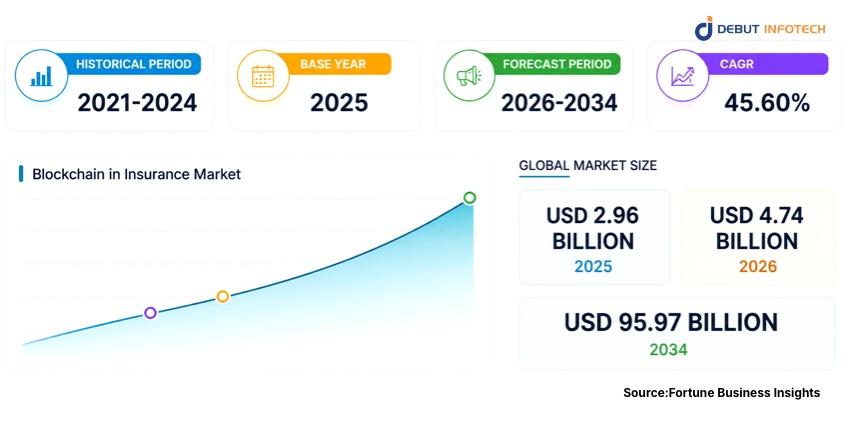
Insurers, reinsurers, and technology providers are investing in enterprise solutions that improve efficiency, reduce fraud, and modernize legacy operations.
Market growth reflects this momentum. According to Fortune Business Insights, the global blockchain in insurance market was valued at USD 2.96 billion in 2025 and is expected to reach USD 95.97 billion by 2034, representing a 45.6% compound annual growth rate (CAGR).
North America currently leads adoption, supported by mature insurance markets and early investment in enterprise blockchain platforms.
Another major driver is insurance fraud. The Coalition Against Insurance Fraud estimates that insurance fraud costs more than USD 300 billion annually across all lines of insurance in the United States. These losses increase premiums, slow claims processing, and place additional pressure on insurers to improve fraud detection and verification.
Digital transformation, such as AI and automation, is also changing claims operations. According to Capgemini’s World Property and Casualty Insurance Report, 67% of insurance executives identify faster claims processing and improved operational efficiency as key priorities for technology investment.
Blockchain is increasingly being evaluated alongside AI and automation to streamline these processes and reduce manual intervention.
Competition from InsurTech companies is also accelerating adoption. Digital-first insurers have raised customer expectations by offering faster onboarding, automated claims processing, and real-time policy management.
Established insurers are responding by investing in blockchain, artificial intelligence, cloud infrastructure, and automation to modernize operations while maintaining regulatory compliance and improving customer experience.
Insurance depends on trust, accurate records, and collaboration between multiple organizations. However, many insurers still rely on fragmented systems that slow operations and increase administrative costs.
Despite significant investments in digital transformation, many insurers continue to operate on legacy systems built decades ago. Policy administration, underwriting, claims processing, compliance, and reinsurance often run on separate platforms that do not communicate efficiently.
As a result, employees spend considerable time reconciling records, validating information, and correcting inconsistencies instead of focusing on higher-value work.
Although many insurers have digitized customer-facing services, paper documents and manual approvals remain common behind the scenes.
Policy applications, endorsements, medical reports, inspection documents, and claims evidence frequently move through multiple departments before a decision is made. Every handoff introduces delays and increases the likelihood of human error.
Blockchain technology for insurance companies replaces disconnected document exchanges with a shared ledger that authorized participants can access in real time.
Instead of maintaining separate copies of records, insurers, brokers, and other stakeholders reference the same verified data, reducing duplicate work and accelerating decision-making.
Fraud remains one of the industry’s most expensive challenges.
False claims, exaggerated damages, identity fraud, duplicate submissions, and forged documentation cost insurers billions every year.
Detecting these activities often requires comparing information across multiple systems and external databases, which is both time-consuming and resource-intensive.
Blockchain strengthens fraud prevention by creating an immutable audit trail for every transaction.
Policy creation, premium payments, claim submissions, approvals, and supporting documents are permanently recorded. Since authorized participants share the same history, altering records without detection becomes exceptionally difficult, making fraudulent activity easier to identify during investigations.
Insurance rarely involves a single organization. Brokers, reinsurers, healthcare providers, repair shops, adjusters, regulators, and customers all contribute information throughout a policy’s lifecycle. When each participant maintains its own database, inconsistencies quickly emerge.
Blockchain establishes a shared source of truth that all authorized parties can trust. Rather than exchanging multiple versions of the same information through emails or file transfers, stakeholders access synchronized records, reducing reconciliation efforts and improving data accuracy.
Claims handling is one of the most visible indicators of customer satisfaction. Yet traditional claims often require extensive verification before payment.
Adjusters review documents, validate coverage, request additional evidence, coordinate with third parties, and obtain internal approvals. This process can take days or even weeks for relatively straightforward claims.
Blockchain streamlines these workflows by combining shared records with smart contracts.
Once predefined conditions are verified, claims can move automatically to the next stage without repeated manual intervention. The result is faster settlements, lower administrative costs, and a better customer experience.
Policyholders frequently struggle to understand the status of their claims, while insurers and reinsurers spend considerable effort reconciling transaction histories.
Limited visibility creates unnecessary disputes and weakens trust between participants.
A permissioned blockchain gives every authorized stakeholder access to the same transaction history.
Each update is timestamped, verifiable, and visible according to predefined permissions. This transparency reduces misunderstandings, simplifies audits, and provides regulators with reliable records when reviewing compliance.
Blockchain does more than digitize existing processes. It restructures how information is created, verified, shared, and stored across the insurance ecosystem.
By combining distributed ledgers, cryptographic security, consensus mechanisms, and automation through smart contracts, insurers can reduce operational friction while improving transparency, security, and collaboration across the entire value chain.
Table: Insurance Challenges vs. Blockchain Solutions
| Industry Challenge | How Blockchain Helps | Business Outcome |
| Paper-based workflows | Shared digital ledger and automated records | Faster processing and lower administrative costs |
| Insurance fraud | Immutable transaction history and transparent audit trails | Improved fraud detection and prevention |
| Data silos | Shared data across authorized participants | Better collaboration and fewer inconsistencies |
| Slow claims | Smart contracts and automated verification | Faster claim settlements |
| Limited transparency | Real-time visibility into transactions | Greater trust among stakeholders |
| Compliance complexity | Tamper-resistant audit records | Easier reporting and regulatory audits |
Blockchain delivers measurable business value beyond stronger security. It helps insurers simplify operations, reduce costs, improve customer trust, and strengthen collaboration across the insurance ecosystem.
Blockchain improves nearly every stage of the insurance lifecycle, from customer onboarding and underwriting to claims processing and regulatory reporting.
By combining shared data, automation, and secure recordkeeping, insurers can improve operational efficiency while delivering better customer experiences.
Insurance operations involve numerous repetitive tasks, including policy verification, premium validation, claims assessment, and payment processing. Many of these activities still require manual reviews, slowing service delivery and increasing administrative costs.
Blockchain automates routine workflows through smart contracts. Once predefined conditions are met, actions such as policy activation, claims approval, or payment authorization can occur automatically without repeated human intervention. This shortens processing times, reduces manual errors, and allows insurers to handle larger claim volumes more efficiently.
Blockchain creates a shared, synchronized record that authorized participants can access in real time.
Insurers, brokers, reinsurers, regulators, and policyholders all work from the same verified information, reducing inconsistencies and improving collaboration.
This transparency makes it easier to track policy updates, monitor claim progress, and verify transaction histories. It also simplifies audits by providing a permanent, tamper-resistant record of every approved transaction.
Blockchain helps insurers develop affordable products for customers who have traditionally been underserved.
Lower administrative costs and digital-first processes make it easier to offer microinsurance and parametric insurance without relying on complex manual workflows.
Combined with digital identity verification and mobile platforms, blockchain enables faster customer onboarding and expands access to insurance services for individuals and small businesses.
Insurers operate under strict regulatory requirements that demand accurate recordkeeping, data protection, and transparent reporting.
Blockchain simplifies compliance by maintaining a secure, timestamped audit trail that regulators and authorized stakeholders can verify when required.
Permissioned blockchain networks also provide controlled access to sensitive information, allowing insurers to balance transparency with customer privacy while reducing the effort required for audits and compliance reporting.
Disagreements often occur when insurers, brokers, and policyholders rely on different versions of policy documents or claim records. Blockchain minimizes these issues by ensuring authorized participants access the same verified information throughout the policy lifecycle.
Smart contracts also apply policy rules consistently, reducing ambiguity during claims processing and helping resolve straightforward cases more quickly.
Insurance companies manage highly sensitive personal and financial information that requires strong protection.
Blockchain secures records using cryptographic techniques while distributing data across participating nodes instead of relying on a single centralized database.
Permissioned access controls ensure only authorized users can view or update information, improving data integrity and reducing the risk of unauthorized modifications.
Although every participant benefits from blockchain, the advantages differ depending on their role within the blockchain insurance ecosystem.
| Stakeholder | Primary Benefits |
| Insurers | Faster claims processing, lower operating costs, improved fraud detection, streamlined compliance |
| Reinsurers | Shared policy data, quicker settlements, reduced reconciliation, better risk visibility |
| Brokers | Faster policy issuance, improved access to customer information, better collaboration with insurers |
| Policyholders | Faster claims, greater transparency, fewer disputes, secure access to policy information |
Insurers benefit from greater operational efficiency and automation, while reinsurers gain improved visibility into shared policies and claims.
Brokers spend less time reconciling information, and policyholders receive faster, more transparent services with fewer disputes.
Together, these improvements strengthen collaboration across the insurance value chain while reducing administrative costs and improving customer trust.
Blockchain supports multiple insurance models. Some organizations use it to improve existing operations, while others build entirely decentralized platforms that remove traditional insurers from certain parts of the value chain.
Most enterprise insurers view blockchain as infrastructure rather than a replacement for their business model.
The insurer continues to underwrite policies, assess risk, manage customer relationships, and ensure regulatory compliance. Blockchain simply modernizes how information is recorded, shared, and verified.
Instead of replacing existing insurance operations, blockchain integrates with policy administration systems, claims platforms, customer portals, and compliance tools.
The result is faster information sharing, stronger auditability, and reduced operational friction without changing the insurer’s core responsibilities.
This approach aligns with how large insurance companies typically adopt emerging technologies.
Rather than rebuilding their entire technology stack, they introduce blockchain where it delivers measurable business value, such as claims automation, fraud detection, policy management, and reinsurance coordination. This incremental strategy lowers implementation risk while producing faster returns on investment.
Decentralized insurance takes a different approach. Instead of relying on a single insurance company, coverage is provided through blockchain-based protocols governed by smart contracts and community-managed liquidity pools. Members contribute funds collectively, and eligible claims are paid from the shared pool according to predefined rules.
Some decentralized insurance platforms focus on protecting cryptocurrency users against smart contract failures, exchange hacks, validator slashing, or protocol exploits. Others are expanding into broader forms of coverage using decentralized governance models.
Although decentralized insurance introduces new opportunities, it also creates additional challenges.
Regulatory requirements remain uncertain in many jurisdictions, capital reserves may differ from traditional insurers, and customers often have limited legal protections if disputes arise.
As a result, decentralized insurance currently complements rather than replaces conventional insurance markets.
For most established insurers, blockchain works best as an enterprise technology that strengthens existing operations while maintaining regulatory oversight.
Permissioned blockchain networks provide better control over customer data, compliance processes, and governance than fully decentralized alternatives.
Decentralized insurance, however, demonstrates how blockchain can enable entirely new business models.
As regulations mature and interoperability improves, traditional insurers and decentralized protocols may increasingly coexist, each serving different customer segments and risk profiles.
Comparison Table: Centralized vs. Decentralized Insurance
| Feature | Traditional Insurance | Blockchain-Enabled Insurance | Decentralized Insurance |
| Governance | Single insurance company | Single insurer using blockchain | Community or protocol governance |
| Policy Management | Manual or digital | Automated with blockchain support | Smart contracts |
| Claims Processing | Mostly manual | Partially or fully automated | Smart contract execution |
| Transparency | Limited | High among authorized participants | High on-chain visibility |
| Regulation | Fully regulated | Fully regulated | Varies by jurisdiction |
| Customer Control | Limited | Moderate | Higher user participation |
| Primary Risk | Operational inefficiency | Technology integration | Regulatory uncertainty and smart contract risk |
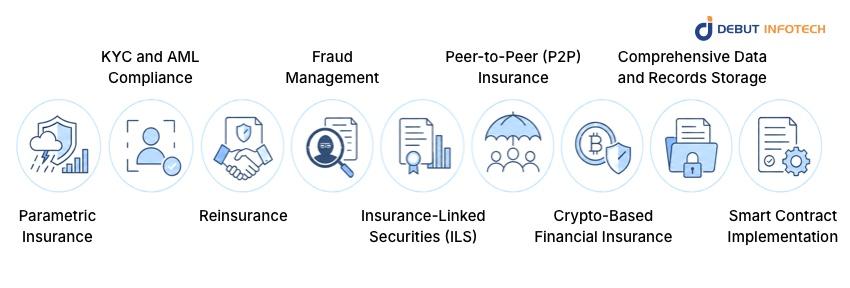
Blockchain supports far more than digital recordkeeping. If you’re still asking: What are the use cases of blockchain in insurance?
Blockchain is used in insurance to automate claims, strengthen fraud detection, simplify KYC and compliance, improve reinsurance, support parametric and P2P insurance, and secure records.
Here is more detailed information on blockchain applications in insurance.
Parametric insurance pays claims when predefined events occur instead of requiring a traditional loss assessment.
Rather than sending adjusters to verify damage, payouts are triggered automatically once trusted data confirms that agreed conditions have been met. Common examples include extreme weather, earthquakes, floods, crop failures, and flight delays.
Blockchain makes parametric insurance more efficient by combining smart contracts with trusted external data sources.
When an oracle confirms that a triggering event has occurred, the smart contract automatically verifies the policy terms and initiates payment. This significantly reduces claim processing times while lowering administrative costs.
The business value extends beyond speed. Faster payouts improve customer satisfaction and provide immediate financial support after disruptive events.
For insurers, automation reduces operational expenses and allows claims teams to focus on complex cases that require human investigation rather than straightforward, rule-based claims.
Customer verification is essential for preventing identity fraud, financial crime, and regulatory violations.
However, traditional Know Your Customer (KYC) and Anti-Money Laundering (AML) processes often require customers to submit the same documents repeatedly to different insurers or financial institutions.
Blockchain enables authorized organizations to access verified identity credentials stored within a permissioned network.
Instead of repeating the entire insurance verification process for every new policy, insurers can reference previously validated information while maintaining appropriate privacy controls.
This shared approach reduces onboarding times, improves customer experience, and lowers compliance costs.
It also helps insurers identify suspicious activities more quickly by maintaining a consistent, tamper-resistant record of identity verification events across participating organizations.
Reinsurance involves multiple organizations sharing risks through complex contractual arrangements.
Policy details, premium payments, claims information, and settlement records frequently move between insurers and reinsurers, creating significant administrative overhead.
Blockchain provides both parties with access to the same transaction history. Every policy update, premium adjustment, and claim settlement is recorded on a shared ledger, reducing reconciliation work and minimizing disagreements caused by inconsistent records.
Smart contracts can further automate portions of the reinsurance process.
Once contractual conditions are satisfied, premium transfers, loss-sharing calculations, or settlement payments can be executed automatically according to predefined rules. This shortens settlement cycles while improving financial transparency across participating organizations.
Fraud detection is among the top blockchain use cases in insurance industry.
Fraudulent claims often involve altered documents, duplicate submissions, identity theft, or coordinated schemes spanning multiple organizations.
Traditional systems make these activities difficult to detect because relevant information is scattered across separate databases.
Blockchain creates a permanent audit trail that records every transaction throughout a policy’s lifecycle. Policy issuance, premium payments, endorsements, claims submissions, supporting documentation, and settlement decisions are linked together in chronological order.
Because authorized participants reference the same verified records, inconsistencies become easier to identify. Investigators can trace transaction histories without relying on fragmented documentation from multiple systems.
Combined with artificial intelligence and analytics, blockchain helps insurers identify suspicious claim patterns earlier, reducing financial losses and strengthening overall fraud prevention strategies.
Insurance-linked securities allow insurers to transfer specific risks to capital market investors instead of retaining the entire exposure themselves.
Catastrophe bonds are among the most common examples, providing financial protection against events such as hurricanes, earthquakes, and other natural disasters.
Blockchain improves this market by increasing transparency throughout the investment lifecycle.
Investors gain access to verified transaction records, while issuers benefit from more efficient reporting and reduced administrative complexity.
Tokenization introduces additional opportunities by representing insurance-linked securities as digital assets on blockchain networks. This can simplify ownership transfers, improve liquidity, and enable faster settlement processes, although regulatory frameworks continue to evolve in many jurisdictions.
Peer-to-peer insurance enables groups of individuals or businesses with similar risk profiles to pool resources and share losses collectively.
Rather than relying entirely on a traditional insurer, participants contribute premiums to a shared fund that pays eligible claims according to predefined rules.
Blockchain improves this model by providing transparent fund management and automated claim execution. Members can verify contributions, payouts, and reserve balances without depending solely on a centralized administrator.
Greater transparency helps strengthen trust within the insurance pool because every approved transaction is recorded on an immutable ledger.
While many P2P insurance models still operate alongside regulated insurers, blockchain makes these collaborative approaches more practical and scalable than traditional community-based insurance schemes.
The growth of digital assets has created demand for insurance products designed specifically for blockchain ecosystems.
Cryptocurrency exchanges, decentralized finance (DeFi) protocols, digital wallets, custodians, and institutional investors require protection against operational failures and cyber-related risks.
Blockchain-based insurance platforms offer coverage for events such as smart contract vulnerabilities, exchange breaches, validator slashing, and digital asset theft.
Since these products operate within blockchain environments, claims verification and policy execution can often be automated using on-chain data.
Although crypto insurance remains a specialized market, demand is increasing alongside institutional adoption of digital assets.
As regulatory clarity improves, insurers are expected to introduce more sophisticated products that bridge traditional insurance with blockchain-based financial services.
Insurance generates large volumes of information throughout a policy’s lifecycle.
Applications, underwriting assessments, policy endorsements, payment histories, inspection reports, medical documentation, and claims records all require secure storage and controlled access.
Blockchain provides a shared, tamper-resistant record that improves data integrity across multiple organizations. Rather than maintaining disconnected databases that require constant reconciliation, authorized participants work from synchronized information while preserving detailed audit trails.
In practice, insurers typically store large files such as images, videos, and medical records in secure off-chain storage while recording cryptographic references on the blockchain. This hybrid approach balances scalability, security, and cost while preserving the integrity of critical insurance records.
Smart contracts automate many business processes that traditionally depend on manual approvals.
Instead of reviewing straightforward transactions individually, insurers can define business rules that execute automatically once agreed conditions have been satisfied.
Examples include activating coverage after premium payment, renewing policies, processing simple claims, calculating deductibles, issuing notifications, or distributing payments among multiple stakeholders.
Automation reduces administrative effort while improving consistency across routine operations.
It is important to distinguish the business value of smart contracts from their underlying technical execution. Here, smart contracts serve as practical tools that simplify insurance operations and improve customer service. The next section on smart contracts explains how they function technically, including how claims are triggered, verified, and paid automatically through blockchain networks.
Table: Blockchain Use Cases Across the Insurance Value Chain
| Use Case | Primary Challenge | Blockchain Benefit | Business Outcome |
| Parametric insurance | Slow claims verification | Automated event-triggered payouts | Faster settlements |
| KYC/AML | Repeated customer verification | Shared identity records | Lower compliance costs |
| Reinsurance | Complex reconciliation | Shared transaction history | Faster settlements |
| Fraud management | False and duplicate claims | Immutable audit trail | Reduced fraud losses |
| Insurance-linked securities | Administrative complexity | Transparent asset management | Improved efficiency |
| Peer-to-peer insurance | Limited transparency | Shared ledger and automation | Greater participant trust |
| Crypto-based insurance | Digital asset risk | On-chain verification | Specialized protection for blockchain assets |
| Data and records storage | Fragmented information | Secure, synchronized records | Better collaboration |
| Smart contracts | Manual workflows | Automated policy execution | Lower operating costs and faster service |
Smart contracts can automate insurance processes, but they cannot access real-world information on their own. This is where blockchain oracles become essential, connecting on-chain applications with trusted external data sources.
A blockchain oracle is a service that retrieves verified information from external systems and delivers it to a blockchain network.
While blockchains are designed to protect data already stored on-chain, they cannot independently determine whether a flight was delayed, rainfall exceeded a certain level, or a shipment arrived at its destination.
Oracles bridge this gap by supplying trusted off-chain data to smart contracts.
In insurance, these data feeds can originate from weather agencies, aviation databases, IoT sensors, healthcare systems, financial institutions, government registries, or logistics platforms.
Once the oracle verifies and transmits the required information, the blockchain can use it to execute predefined business rules automatically.
Many insurance products rely on events that occur outside the blockchain.
Crop insurance depends on rainfall measurements, travel insurance may require airline status updates, marine insurance tracks vessel movements, and vehicle insurance can incorporate telematics data.
Without reliable access to this information, blockchain-based insurance would still require manual verification, limiting many of its automation benefits.
Oracles eliminate much of this manual effort by delivering trusted event data directly to smart contracts. This allows insurers to automate routine decisions while ensuring claims are processed using objective, verifiable information rather than manual reporting alone.
Enabling Parametric Insurance and Claims Automation. Parametric insurance demonstrates the value of oracles particularly well.
Imagine a farmer purchases drought insurance that guarantees a payout if rainfall falls below an agreed threshold during the growing season.
Instead of submitting a traditional claim, a weather oracle continuously monitors rainfall data from an approved meteorological source.
If rainfall drops below the agreed level, the oracle sends that information to the blockchain. The smart contract immediately verifies that the policy is active, confirms the trigger conditions have been met, and authorizes payment automatically.
The farmer receives compensation without waiting for inspections, paperwork, or lengthy claim reviews.
Similar workflows apply to flight delay insurance, cargo protection, flood insurance, and certain health-related products where objective external data determines eligibility.
By removing unnecessary manual verification, insurers reduce administrative costs while delivering significantly faster service.
While oracles enable automation, they also introduce a critical dependency.
If an oracle provides inaccurate, incomplete, or manipulated data, the smart contract may execute the wrong decision.
For this reason, insurers often use multiple trusted data providers, validation mechanisms, and decentralized oracle networks to improve reliability and reduce the risk of a single point of failure.
Smart contracts transform insurance by replacing repetitive administrative work with automated, rule-based execution. They help insurers process policies and claims more efficiently while reducing delays and human error.
A smart contract is a self-executing program stored on a blockchain that automatically performs predefined actions when specific conditions are met.
Unlike traditional software that often depends on manual approvals, smart contracts execute contractual rules consistently once the required inputs are verified.
In insurance, these contracts can automate activities such as policy issuance, premium collection, coverage activation, claims assessment, and payout authorization.
Every action is recorded on the blockchain, creating a transparent and auditable transaction history.
Although implementation differs across insurers, most blockchain-based claims follow a similar workflow.
Step 1: Policy Creation
A customer purchases an insurance policy. Coverage terms, eligibility requirements, claim conditions, and payout rules are encoded into a smart contract. The policy is then recorded on the blockchain, where authorized participants can verify its status.
Step 2: Premium Verification
The smart contract confirms that premium payments have been received and that the policy remains active.
If payments lapse, predefined rules can suspend coverage automatically until payment obligations are satisfied.
Step 3: Event Detection
An insured event occurs. Rather than depending solely on manual reporting, trusted oracles collect relevant information from approved external sources such as weather agencies, airline systems, IoT devices, healthcare providers, or logistics platforms.
Step 4: Automatic Validation
The smart contract compares incoming data with the policy’s predefined conditions.
It verifies whether coverage applies, checks policy limits, confirms deductibles, and determines whether all contractual requirements have been satisfied.
Step 5: Claims Approval and Payment
If every condition is met, the smart contract automatically authorizes the claim and initiates payment according to the agreed policy terms.
Every action is permanently recorded, creating a transparent audit trail for insurers, regulators, and policyholders.
Automation significantly reduces administrative overhead. Claims handlers no longer need to manually review every straightforward case, allowing experienced staff to focus on complex investigations, fraud detection, and exceptional circumstances that require professional judgment.
Processing times also improve considerably. Claims that once required days or weeks can often be completed within minutes after trusted data confirms that contractual conditions have been satisfied.
Faster settlements improve customer satisfaction while reducing operational expenses.
Consistency is another important advantage. Every claim is evaluated using the same predefined business rules, reducing variation between individual reviewers. This improves fairness, strengthens compliance, and makes insurance operations more predictable across large customer portfolios.
Smart contracts are not suitable for every insurance scenario. Complex liability disputes, medical negligence cases, commercial litigation, and subjective damage assessments often require human expertise.
Smart contracts work best when contractual conditions are clear, measurable, and supported by reliable external data.
For most insurers, the greatest value comes from combining automated workflows with professional oversight.
Routine transactions can be processed automatically, while experienced claims specialists continue to manage cases involving legal interpretation, fraud investigations, or exceptional circumstances.
Table: Traditional Claims Processing vs. Smart Contract Automation
| Claims Stage | Traditional Process | Smart Contract Process |
| Policy verification | Manual review | Automatic verification |
| Premium validation | Administrative checks | Real-time confirmation |
| Event confirmation | Claims adjuster investigation | Oracle-provided data |
| Coverage assessment | Manual evaluation | Rule-based validation |
| Claim approval | Internal approvals | Automated execution (where applicable) |
| Payment | Manual processing | Automatic payout initiation |
Blockchain in Insurance offers significant advantages, but successful implementation requires insurers to address several technical, operational, and regulatory challenges.
Adopting blockchain involves more than deploying new software. Organizations must ensure the technology integrates with existing systems, complies with regulations, and performs reliably at enterprise scale.
While blockchain itself provides strong data integrity, smart contracts and supporting applications can still contain vulnerabilities.
Coding errors or weak security controls may lead to operational disruptions or incorrect transactions.
Regular code reviews, smart contract audits, penetration testing, and secure development practices help reduce these risks before deployment.
Blockchain can only verify information stored on the ledger.
Insurance applications often depend on external data from weather agencies, healthcare providers, IoT devices, or logistics systems. If this information is inaccurate, automated decisions may also be incorrect.
Insurers reduce this risk by using multiple trusted data providers and decentralized oracle networks that validate information before it reaches smart contracts.
Regulatory treatment of blockchain and smart contracts continues to evolve across many jurisdictions.
Before implementation, insurers should evaluate legal requirements related to data privacy, consumer protection, and digital contracts while working closely with compliance teams and regulators to minimize legal risk.
Most insurers rely on long-established policy administration, claims, and customer management systems.
Integrating blockchain with this infrastructure can be complex and expensive. APIs, middleware, and phased deployment strategies help organizations modernize operations without replacing existing systems all at once.
Large insurers may process thousands of transactions during peak claim periods.
Blockchain platforms must handle these workloads without sacrificing speed or increasing operational costs.
Permissioned networks, efficient consensus mechanisms, and Layer 2 scaling solutions help improve performance while supporting future growth.
Table: Common Blockchain Implementation Challenges
| Challenge | Business Impact | Recommended Mitigation |
| Software vulnerabilities | Security risks and operational disruption | Secure development, audits, penetration testing |
| Unreliable off-chain data | Incorrect automated decisions | Trusted data providers and decentralized oracles |
| Legal uncertainty | Compliance and regulatory risk | Early legal review and governance planning |
| Legacy system integration | Complex implementation | APIs, middleware, and phased deployment |
| Scalability | Performance bottlenecks during peak demand | Permissioned networks and Layer 2 scaling |
These challenges are manageable with careful planning, strong governance, secure development practices, and the right implementation partner.
Insurers that address them early are better positioned to deploy blockchain solutions that are scalable, secure, and compliant with evolving regulatory requirements.
Blockchain is already being used to solve practical insurance challenges.
The following examples demonstrate how insurers and technology providers are applying the technology to improve transparency, automate processes, and develop new insurance products.
Insurwave, developed by EY, Guardtime, and industry partners, uses a permissioned blockchain to modernize marine insurance.
The platform enables insurers, brokers, ship owners, and other participants to share trusted voyage, policy, and asset information through a single ledger.
This reduces manual reconciliation, improves visibility across maritime operations, and streamlines policy administration.
Insurwave demonstrates how blockchain can simplify complex commercial insurance ecosystems involving multiple independent organizations.
ClaimShare helps insurers combat fraud by securely sharing fraud-related intelligence across a permissioned blockchain network.
Participating insurers can compare verified claim indicators without exposing confidential customer information. This shared visibility improves the identification of duplicate or suspicious claims while reducing investigation time and administrative effort.
The platform illustrates how blockchain enables industry-wide collaboration against fraud while maintaining privacy and regulatory compliance.
The Lemonade Foundation has explored blockchain-enabled parametric insurance to support communities affected by climate-related events.
Instead of relying on lengthy claims assessments, smart contracts trigger financial assistance when trusted external data confirms predefined conditions have been met.
This approach speeds up payouts, lowers administrative costs, and improves access to insurance in underserved regions where conventional claims processing may be difficult or slow.
Etherisc, working with Chainlink, demonstrates how decentralized insurance combines smart contracts with trusted oracle data.
Chainlink supplies verified external information that allows Etherisc’s blockchain-based policies to execute automatically when agreed conditions are satisfied.
This reduces manual processing, improves transparency, and supports insurance products for digital assets and decentralized finance.
The collaboration highlights how blockchain can automate insurance while maintaining reliable decision-making.
Although these organizations operate in different markets, they use blockchain to solve similar challenges: improving transparency, reducing manual administration, strengthening trust, and automating routine processes.
These real-world blockchain insurance projects show that blockchain delivers the greatest value when applied to specific business problems rather than attempting to replace every insurance system at once.
Table: Real-World Blockchain Insurance Examples
| Organization | Primary Use Case | Blockchain Benefit | Business Outcome |
| Insurwave | Marine insurance | Shared policy and voyage records | Improved collaboration and operational efficiency |
| ClaimShare | Fraud detection | Secure information sharing | Earlier fraud identification |
| Lemonade Foundation | Parametric insurance | Automated payouts | Faster disaster assistance |
| Etherisc + Chainlink | Digital asset insurance | Smart contracts with oracle data | Automated claims processing |
Blockchain adoption in insurance is entering a new phase. Instead of focusing solely on digitizing existing processes, insurers are combining blockchain with other technologies to build more intelligent, connected, and scalable insurance solutions.
Artificial intelligence and blockchain increasingly work together to improve underwriting and claims management.
Blockchain provides trusted, tamper-resistant data, while AI analyzes that information to assess risk, prioritize claims, and identify potential fraud.
Together, they reduce manual reviews, improve decision consistency, and help insurers process straightforward claims faster while directing complex cases to experienced adjusters.
Insurers are exploring the tokenization of insurance-linked securities, including catastrophe bonds, as digital representations of real-world assets.
Tokenization improves transparency, simplifies ownership transfers, and can accelerate settlement processes while reducing administrative work.
As regulatory frameworks mature, blockchain is expected to make insurance-related investments more efficient and accessible for institutional participants.
Decentralized insurance continues to evolve beyond cryptocurrency-related risks into areas such as travel, agriculture, and business interruption coverage.
These platforms use smart contracts to automate policy management and claims while relying on decentralized governance models.
Although regulatory uncertainty remains, innovations from decentralized insurance are influencing how enterprise insurers approach automation and transparent policy administration.
Insurance organizations increasingly operate across multiple blockchain platforms and enterprise systems.
Cross-chain interoperability allows these networks to exchange verified information securely without requiring every participant to use the same technology.
This capability is particularly valuable for reinsurance, where insurers, brokers, and reinsurers must collaborate efficiently while maintaining separate infrastructure and governance models.
Connected devices are enabling embedded and micro-parametric insurance products that respond automatically to real-world events.
Sensors in vehicles, buildings, factories, and wearable devices provide trusted data that smart contracts use to trigger policy actions. This reduces manual verification, accelerates claims processing, and enables insurers to offer more personalized and responsive insurance products.
These trends point toward a more connected insurance ecosystem where blockchain serves as the trusted foundation for secure data sharing.
In addition, AI, IoT, tokenization, and interoperability expand what insurers can automate and optimize.
Organizations that invest in flexible, scalable architectures today will be better positioned to adopt these innovations as they mature.
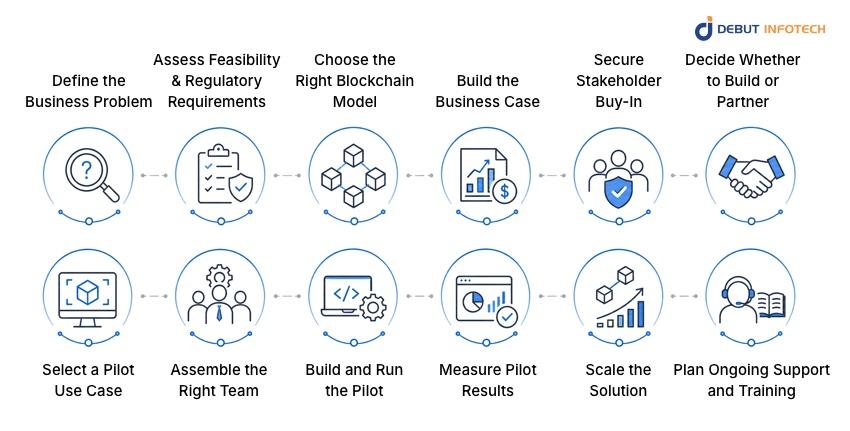
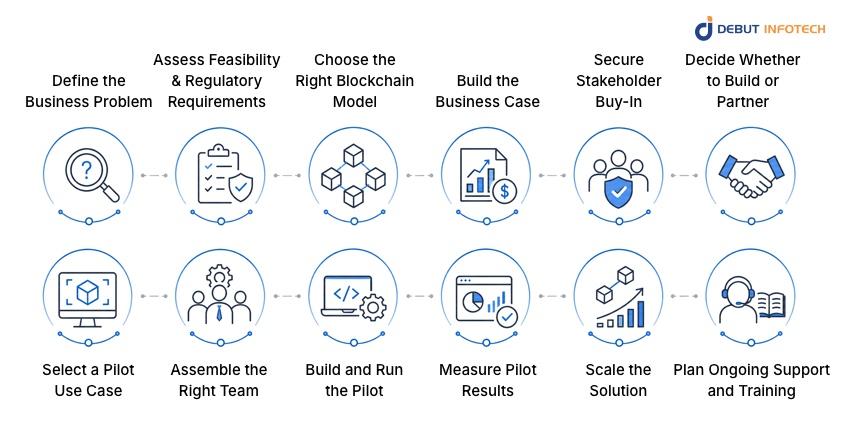
Successful blockchain initiatives begin with a clear business objective rather than a technology decision.
A structured implementation approach helps insurers reduce risk, control costs, and achieve measurable business outcomes.
Every blockchain project should begin by identifying a specific operational challenge.
Organizations should determine whether they want to reduce fraud, accelerate claims processing, improve regulatory reporting, streamline reinsurance, or modernize policy administration.
Clearly defining the problem ensures that blockchain is solving a genuine business need rather than being adopted for its own sake.
Not every insurance process benefits from blockchain.
Decision-makers should evaluate technical feasibility, expected return on investment, regulatory obligations, privacy requirements, and integration complexity before committing to development.
Early involvement from legal, compliance, and technology teams helps identify potential obstacles before implementation begins.
Selecting the appropriate blockchain architecture is one of the most important implementation decisions.
The choice should reflect the organization’s security requirements, governance model, performance expectations, and regulatory obligations rather than the popularity of a particular platform.
Most insurers prefer permissioned blockchain networks because they provide greater control over participant access, data privacy, and transaction validation.
Platforms such as Hyperledger Fabric, R3 Corda, and Quorum are widely used for enterprise applications because they support private transactions, configurable governance, and high throughput.
Public blockchain networks may be appropriate for certain decentralized insurance products or tokenized assets, but they are generally less suitable for handling confidential policyholder information.
Before development begins, insurers should establish a clear business case supported by measurable objectives.
Decision-makers need to understand not only the implementation cost but also the operational and financial benefits the project is expected to deliver.
Common success metrics include:
Quantifying these outcomes helps secure executive approval and provides benchmarks for measuring success after deployment.
A well-defined business case also helps prioritize investments when multiple digital transformation initiatives compete for the same budget.
Blockchain initiatives rarely succeed without cross-functional support.
Insurance operations involve multiple departments, including underwriting, claims, finance, compliance, legal, cybersecurity, customer service, and information technology.
External stakeholders such as brokers, reinsurers, regulators, and strategic partners may also participate.
Each group should understand how blockchain will affect existing workflows, responsibilities, and performance expectations.
Early communication reduces resistance to change and encourages collaboration throughout the implementation process.
Executive sponsorship is equally important. Leadership commitment helps secure funding, remove organizational barriers, and ensure the project remains aligned with broader business objectives.
Insurers must determine whether to develop blockchain capabilities internally or collaborate with an experienced blockchain development company.
Building an in-house solution provides greater architectural control but requires specialized expertise in blockchain engineering, smart contracts, cybersecurity, enterprise blockchain integration for insurance, and cloud infrastructure.
Collaborating with an experienced blockchain insurance technology partner can significantly reduce implementation risk.
External specialists bring proven frameworks, technical expertise, and practical experience from previous enterprise blockchain projects, allowing insurers to accelerate development while avoiding common implementation pitfalls.
The decision should consider available technical resources, project complexity, implementation timelines, long-term maintenance requirements, and budget constraints.
Rather than transforming the entire organization at once, insurers should begin with a narrowly defined pilot project.
A focused implementation allows teams to validate technical assumptions, measure business outcomes, and identify operational improvements before expanding to larger deployments.
Suitable pilot projects include:
These blockchain insurance use cases offer measurable results while limiting implementation complexity.
Blockchain projects require expertise that extends beyond software development.
Successful implementations typically involve a multidisciplinary team with technical, operational, and regulatory knowledge.
A typical project team may include:
Bringing these specialists together early improves communication and reduces costly redesigns later in the project lifecycle.
During development, teams should focus on delivering a minimum viable product (MVP) that addresses the selected business problem while maintaining security, reliability, and regulatory compliance.
Testing should include:
Once testing is complete, the pilot should be deployed within a controlled production environment where performance can be monitored under real operating conditions.
Feedback collected during this phase helps refine workflows before broader implementation.
Measuring outcomes is essential for determining whether blockchain delivers the expected business value.
Success should be evaluated using predefined key performance indicators (KPIs) established during the business case stage.
Common metrics include:
Quantitative results provide evidence for future investment decisions and help identify areas requiring additional optimization before wider deployment.
After a successful pilot, insurers can gradually expand blockchain adoption across additional products, departments, and business partners.
A phased rollout minimizes operational disruption while allowing teams to apply lessons learned from earlier deployments.
Scaling often includes integrating blockchain with customer portals, policy administration systems, underwriting platforms, claims management software, analytics tools, and external partner networks.
Each expansion should maintain consistent governance, security standards, and interoperability requirements.
Organizations should also prepare for increased transaction volumes, additional users, and more complex workflows by reviewing infrastructure capacity and performance regularly.
Blockchain implementation in insurance does not end after deployment. Continuous monitoring, maintenance, software updates, smart contract reviews, and security assessments are necessary to ensure long-term performance and resilience.
Employees also require ongoing training as workflows evolve. Claims teams, underwriters, compliance officers, customer service representatives, and IT staff should understand how blockchain affects their daily responsibilities and how to use the new systems effectively.
Establishing a long-term governance framework helps insurers manage upgrades, onboard new participants, monitor regulatory changes, and maintain consistent operational standards.
Organizations that invest in continuous improvement are more likely to realize the full value of their blockchain initiatives.
Table: Blockchain Implementation Roadmap
| Phase | Primary Objective | Expected Outcome |
| Define the business problem | Identify operational priorities | Clear implementation goals |
| Assess feasibility and regulations | Validate technical and legal readiness | Reduced project risk |
| Choose the right blockchain model | Select appropriate architecture | Better scalability and governance |
| Build the business case | Justify investment | Executive approval and measurable KPIs |
| Secure stakeholder buy-in | Align internal and external participants | Stronger organizational support |
| Decide build vs. Partner | Select delivery approach | Faster and more efficient implementation |
| Select a pilot use case | Minimize deployment risk | Controlled proof of value |
| Assemble the right team | Build multidisciplinary expertise | Higher implementation quality |
| Build and run the pilot | Validate technology | Real-world performance insights |
| Measure pilot results | Evaluate business outcomes | Data-driven scaling decisions |
| Scale the solution | Expand deployment | Enterprise-wide adoption |
| Plan ongoing support | Maintain long-term performance | Sustainable blockchain operations |
A proof of concept (PoC) or minimum viable product (MVP) designed to validate a specific insurance use case generally costs between USD 40,000 and USD 100,000. These projects typically focus on a single function, such as claims automation, fraud detection, or policy management, and include limited integrations.
For more advanced solutions that support multiple workflows, smart contracts, user portals, analytics, and enterprise integrations, development costs usually range from USD 100,000 to USD 350,000.
Large-scale enterprise platforms involving multiple insurers, reinsurers, regulators, cloud infrastructure, security audits, and legacy system integration can exceed USD 500,000, particularly when they support several business lines or operate across multiple jurisdictions.
Blockchain insurance development costs vary significantly depending on the project’s complexity, integration requirements, security needs, and regulatory obligations.
Several factors influence the overall budget:
Projects with extensive integrations, strict regulatory requirements, and sophisticated automation generally require higher investment than standalone pilot solutions.
The following estimates represent typical development ranges for enterprise blockchain insurance solutions.
Actual costs vary depending on business requirements, technology choices, and implementation complexity.
| Solution Type | Estimated Development Cost |
| Proof of Concept (PoC) | USD 20,000–50,000 |
| Minimum Viable Product (MVP) | USD 40,000–100,000 |
| Claims Automation Platform | USD 80,000–180,000 |
| Fraud Detection Solution | USD 100,000–200,000 |
| Parametric Insurance Platform | USD 120,000–250,000 |
| Reinsurance Management Platform | USD 150,000–300,000 |
| Enterprise Blockchain Insurance Platform | USD 300,000–700,000+ |
Initial development represents only part of the total investment.
Organizations should also budget for ongoing expenses such as infrastructure, blockchain insurance platform maintenance, smart contract audits, cybersecurity monitoring, technical support, employee training, software updates, and regulatory compliance. These costs help maintain system performance and security after launch.
Although blockchain requires a substantial upfront investment, the long-term financial benefits often justify the cost.
Organizations typically realize value through lower administrative expenses, faster claims processing, reduced fraud losses, improved compliance efficiency, and stronger collaboration with reinsurers and business partners.
For insurers processing thousands of policies and claims every month, even modest improvements in operational efficiency can generate significant savings over time.
Evaluating ROI should therefore consider both direct financial returns and broader business outcomes such as customer satisfaction, transparency, and reduced operational risk.
Building enterprise blockchain solutions requires expertise across software engineering, cybersecurity, cloud infrastructure, smart contracts, and insurance operations.
Partnering with an experienced blockchain app development company can help insurers reduce implementation risk and accelerate deployment.
Enterprise blockchain projects require knowledge that extends well beyond conventional software development. Teams must understand distributed ledger architecture, consensus mechanisms, cryptographic security, smart contract development, API integration, cloud infrastructure, and enterprise system interoperability.
An experienced blockchain development company brings this specialized expertise together under one team. Instead of building these capabilities internally, insurers can access professionals who have already delivered enterprise blockchain solutions across multiple industries.
Developing blockchain insurance applications from scratch often involves a steep learning curve. Experienced development partners accelerate implementation by using proven development frameworks, reusable components, established security practices, and structured delivery methodologies.
This allows insurers to launch pilot projects sooner, validate business outcomes more quickly, and begin realizing operational benefits without lengthy development delays.
Implementation costs can increase rapidly when project requirements change, or technical challenges emerge unexpectedly. Blockchain specialists reduce this risk by selecting appropriate technologies, defining realistic project scopes, and identifying potential issues during the planning stage.
Their experience also minimizes expensive redesigns and shortens development cycles, helping insurers achieve predictable budgets and better resource utilization.
Security and compliance are fundamental to every insurance platform. Blockchain development companies understand enterprise security requirements, smart contract auditing, identity management, encryption standards, and regulatory considerations that influence solution design.
They also follow established development and testing practices that reduce vulnerabilities before deployment. Combined with ongoing security assessments and governance planning, this lowers operational and regulatory risk throughout the platform’s lifecycle.
Enterprise blockchain platforms require continuous maintenance after deployment. Software updates, infrastructure optimization, smart contract enhancements, performance monitoring, security reviews, and technical support all contribute to long-term success.
A trusted development partner provides ongoing support that helps insurers adapt to changing business requirements, regulatory updates, and evolving cybersecurity threats while maintaining reliable platform performance.
Not every software company has the experience required to build enterprise blockchain insurance solutions. When evaluating potential partners, insurers should consider:
Debut Infotech helps insurers and InsurTech companies build secure, scalable blockchain solutions tailored to modern insurance needs.
With expertise in smart contracts, claims automation, fraud detection, reinsurance platforms, and enterprise blockchain integration, the company helps businesses streamline operations and improve transparency.
Debut Infotech provides end-to-end support, from blockchain consulting for insurance and proof-of-concept development to deployment and ongoing maintenance.
By combining insurance domain understanding with blockchain expertise, the company helps organizations reduce implementation risks and build reliable digital insurance platforms.
Blockchain is reshaping insurance by improving transparency, automating claims, strengthening fraud prevention, and enabling secure collaboration across the insurance ecosystem.
While implementation requires careful planning, regulatory alignment, and integration with existing systems, the long-term benefits can outweigh the initial investment.
As AI, IoT, smart contracts, and tokenization continue to evolve, insurers that adopt blockchain strategically will be better equipped to improve operational efficiency, enhance customer experiences, and remain competitive in an increasingly digital insurance market.
Blockchain is changing insurance by automating claims, reducing fraud, improving data accuracy, and making policy records easier to verify. It also helps insurers share trusted information across multiple parties without relying on endless paperwork. The result is faster claims, lower operating costs, and a smoother experience for both insurers and customers.
Blockchain gives insurers a secure, shared record of policies, claims, and customer data that cannot be changed without approval. This cuts fraud, reduces administrative work, improves compliance, and speeds up decision-making. It also makes collaboration between insurers, reinsurers, and brokers far more efficient than traditional systems.
Blockchain stores insurance records on a decentralized ledger where every approved participant sees the same verified information. Smart contracts automatically execute actions, such as approving payouts when predefined conditions are met. This reduces manual reviews, prevents duplicate claims, and keeps every transaction transparent and traceable.
Blockchain-based insurance solutions include smart contract claims processing, fraud detection systems, policy management platforms, parametric insurance, reinsurance networks, identity verification, and secure customer data sharing. These solutions automate routine processes, improve transparency, reduce disputes, and help insurers deliver faster, more reliable services.
Yes. Blockchain cuts costs by automating repetitive tasks, reducing paperwork, preventing fraudulent claims, and minimizing manual verification. It also lowers reconciliation expenses between insurers, brokers, and reinsurers. While implementation requires upfront investment, many insurers achieve long-term savings through greater operational efficiency and fewer errors.
Blockchain improves trust because policy records and claim histories cannot be secretly altered once recorded. Customers can verify transactions, track claim progress, and know decisions are based on transparent data. This reduces disputes, increases accountability, and gives policyholders more confidence throughout the insurance process.
Yes. Blockchain speeds up claims by automating verification through smart contracts and giving insurers instant access to trusted records. Once claim conditions are verified, payments can be triggered automatically without lengthy manual reviews. This shortens settlement times from weeks to days, or even minutes.
Insurance companies should consider blockchain if they struggle with fraud, slow claims, high administrative costs, or outdated legacy systems. It delivers the greatest value in high-volume operations where automation and secure data sharing make a measurable difference. A phased rollout often reduces implementation risk.
For many insurers, yes. Blockchain delivers stronger security, lower operating costs, faster claims, and better data transparency. The biggest benefits come when it’s integrated into existing workflows instead of replacing everything at once. Success depends on choosing the right use cases and implementation strategy.
Blockchain delivers ROI by reducing fraud losses, lowering administrative expenses, speeding up claims, and improving operational efficiency. It can also increase customer satisfaction through quicker service and greater transparency. The exact return depends on company size, deployment scope, and how effectively blockchain integrates with existing systems.
Building a blockchain insurance platform starts with identifying business goals and selecting the right blockchain network. Next, develop smart contracts, integrate policy and claims systems, add security and compliance features, test thoroughly, and deploy. Ongoing monitoring and updates help maintain performance, security, and regulatory compliance.
Blockchain will play a bigger role as insurers automate more operations and adopt AI, IoT, and digital identity technologies. Expect wider use in claims processing, fraud prevention, parametric insurance, and cross-company data sharing. As regulations mature, enterprise adoption is likely to continue growing steadily.

Our Latest Insights
USA
2501 Chatham, Rd Suite R Springfield, IL 62704
+1-708-515-4004
info@debutinfotech.com
UK
7 Pound Close, Yarnton, Oxfordshire, OX51QG
+44-770-304-0079
info@debutinfotech.com
Canada
154 Eden Oak Trail, Kitchener, ON N2A 0H9
+1-708-515-4004
info@debutinfotech.com
INDIA
Sector 101-A, Plot No: I-42, IT City Rd, JLPL Industrial Area, Mohali, PB 140306
9888402396
info@debutinfotech.com