ON THIS PAGE
Progress0%






Our Global Presence :





DeFi protocols started as a scary niche experiment in crypto just a few years ago. However, today the DeFi industry is gradually taking over the conventional banking system. In fact, as of early 2026, the Total Value Locked (TVL) in DeFi exceeded $120 billion.
Reputable institutions like JPMorgan and Fidelity have begun exploring DeFi infrastructure and blockchain-based lending platforms to diversify their financial services offerings. Not only does this show growth, but it also tells us that decentralized finance is just scratching the surface.
As you might predict, more investors now want a piece of that pie, and that’s where the challenge lies. Surveys by our blockchain consultants here at Debut Infotech Pvt Ltd have shown that most new investors have found it difficult to track which platforms are leading the charge. That’s why we have crafted this guide for entities like you who might be in the same boat.
In this guide, we’ve highlighted 15 of the top and most relevant DeFi protocols. We’ve also ranked this Defi protocols list by TVL, innovation, and overall impact to help investors, developers, and businesses see where the future of decentralized finance is headed.
But before we get into intricate details:
DeFi Protocols, also known as decentralized protocols, are financial services built on blockchain technology that do not require traditional intermediaries such as banks or brokers. It simply functions through smart contracts deployed primarily on Ethereum and, more recently, on other smart-contract blockchains such as Binance Smart Chain, Solana, and Avalanche. Since it’s automated, it’s direct and easier to handle all the rules, regulations, agreements, and transactions without a middleman.
So, how do DeFi protocols make money when everything is automated?
It’s straightforward: fees!
Because these protocols solve the age-old problem of centralization in finance, they charge fees for the extra speed and efficiency they offer. These fees can include:
So if you have the question, “Should I invest in DeFi protocols now?” on your mind, the different revenue streams listed above might help you decide faster.
According to a 2026 update, we currently have over 500 DeFi protocols operating across 200 blockchains, and new ones keep launching.
However, our DeFi lending platform development experts at Debut Infotech Pvt Ltd—recognized as a trusted DeFi development company—used a multidimensional approach to evaluate the protocols, ensuring objectivity and depth in our comprehensive DeFi protocols list. As part of our end-to-end DeFi development services, we established an effective ranking methodology built around four core evaluation pillars:
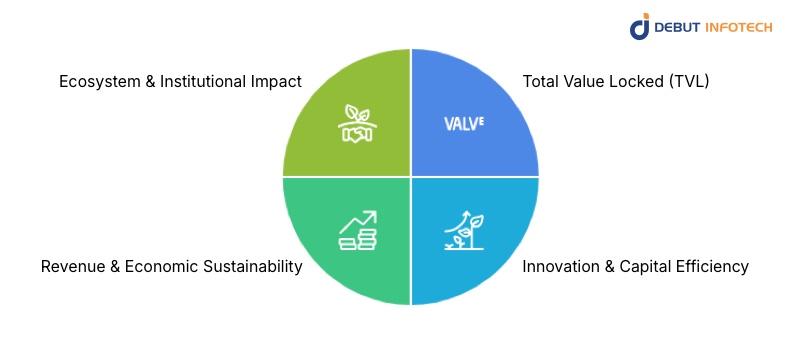
This measures the total capital deposited within a protocol. It simply tells us how much money has been deposited into a protocol, helping users trust the system’s depth and market dominance. However, it doesn’t guarantee sustainability or long-term trust. And that’s where innovation and capital efficiency come in.
Unlike TVL, which only checks the total capital deposited, this evaluates structural long-term value. Beyond protecting the legacy of each protocol, this checks the actual long-term value of each DeFi protocol. As such, DeFi protocols that come up with new ways to earn money or interest, use money efficiently, operate across multiple blockchains, secure, and improve on old models automatically get higher scores than others that can’t. Basically, the smarter, safer, and more innovative the platform, the better it ranks.
This is where we analyse how DeFi protocols generate revenue without breaking out. In other words, how it yields sustainability.
We check whether the given token can be utilized and how well the protocol is designed for long-term growth and survival. This is very important because it evaluates the protocol’s viability at depth. And it’s important to note that sustainable revenue streams ranked higher than incentive-driven liquidity spikes in all ramifications.
This is where reputation matters in the entire evaluation process. In this process, protocols were evaluated based on developer activity, which measures how many developers are building or contributing to each protocol. More activity on the protocol indicates it is evolving and improving.
We also looked at governance participation, which measures how much a user can shape what happens on the app. Evaluating this gives users the opportunity to shape the future.
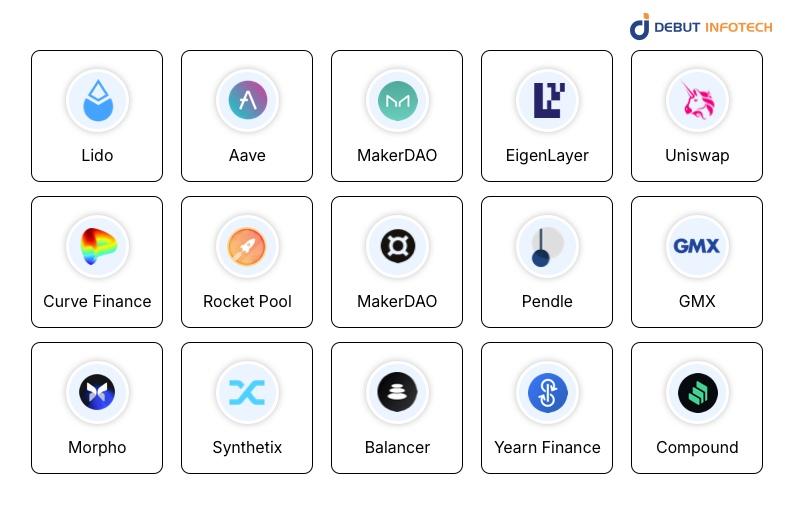
Based on the criteria listed above, the following are the top 15 DeFi protocols in 2026.
| Protocol | Category | Primary Chain | Key Strength |
| Lido | Liquid Staking | Ethereum | Market dominance |
| EigenLayer | Restaking | Ethereum | Economic security innovation |
| Aave | Lending | Multi-chain | Institutional adoption |
| Maker | Stablecoin | Ethereum | DAI stability |
| Uniswap | DEX | Ethereum | Deep liquidity |
| Curve | Stablecoin DEX | Multi-chain | Low slippage |
| Rocket Pool | Staking | Ethereum | Decentralization |
| Pendle | Yield | Ethereum | Yield tokenization |
| Balancer | AMM | Ethereum | Custom pools |
| PancakeSwap | DEX | BSC | Low fees |
| Compound | Lending | Ethereum | Algorithmic rates |
Lido is currently at the center of one of the largest money flows in DeFi Ethereum staking. Over the years, staking on Ethereum has become one of the main places capital sits in crypto. Users lock up their Billions of dollars worth of ETH just to secure the network and earn a steady income. However, this leaves them without access to their ETH or without ever using it again.
Lido solves this problem by providing an alternative. Instead of forcing users to lock their ETH and forget about it, it provides a contract that allows them to exchange stETH for the locked ETH. stETH is just a liquid version of their staked ETH. This means users can keep earning after locking their ETH.
Aside from that, Lido gives us an Innovation Edge: ETH is usable, and stETH can be used in other DeFi protocols, which is a big advantage. Also, Lido is strategically positioned as the core yield infrastructure of the DeFi industry. In other words, those major advantages are why Lido is rated first for restaking integrations and cross-chain staking expansion in the DeFi crowdfunding industry.
Aave is one of the biggest and most trusted lending and borrowing pools in crypto. There’s a ton of money locked on the platform, which signals industry-wide patronage and trust.
The beauty of Aave is that it has remained consistent.
Is Ethereum price affecting DeFi protocols today?
Doesn’t matter with Aave because people are still using it even when the crypto market is fluctuating. The product team behind Aave has also continued to enhance the platform over time, releasing new iterations, expanding support for other blockchains, and building a more cost-effective system. So it’s not just lying there.
The other key issue is that Aave is not a hype-driven protocol. It’s popular because it works. People deposit their crypto; others take out loans against it; interest accrues; and the system continues to run. It’s the real activity that brings it back again and again toward the top. So honestly, Aave is ranked second because it’s big, trusted, and actually useful, not just talked about.
MakerDAO, as a decentralized protocol, powers DAI, one of the most significant stablecoins in the cryptocurrency space. Aside from that, we know how important stablecoins are; they basically provide stability to users in a highly unstable market. DAI is available when users want to hold value without price fluctuations, traders want safety, or other protocols require a dependable dollar-pegged asset.
EigenLayer has earned a reputation due to the bold idea of restaking. And honestly, that idea alone changed the conversation in DeFi.
Normally, staking Ethereum merely contributes to its security. That’s all.
But what if that same ETH could do more?
That’s the question that EigenLayer’s unique value proposition answers. With EigenLayer, you can reuse the ETH you’ve already staked to secure additional protocols rather than securing new funds for each new service or network. That is a significant issue. It implies more efficient use of funds, thereby increasing potential rewards. Additionally, it enables new projects to bootstrap security more quickly without starting from scratch.
The Uniswap protocol is a peer-to-peer system built to help both retail and institutional traders exchange cryptocurrencies without order books or middlemen. The platform simplifies trading by creating liquidity pools where anyone could contribute money and trade. Furthermore, it uses an automated market maker to facilitate peer-to-peer trades between participants worldwide. The technology is proven, the brand is strong, and it is constantly evolving.
Given its area of expertise, Curve’s ranking of number six makes sense. Curve is primarily focused on trading stablecoins and related assets; it is not attempting to do everything. Its strength lies in that specialization. Its optimization for stable assets results in extremely low slippage and effective swaps for traders. Because of this, it is very helpful for big stablecoin transactions. Curve’s liquidity is even used by many DeFi protocols in the background. Despite having very important infrastructure, it doesn’t receive as much funding or general attention as the top five, which is why it is ranked sixth. Although it stays in its lane, it dominates its niche. sturdy, dependable, and necessary.
Rocket Pool is a decentralised staking protocol providing liquid and node staking products for the Ethereum ecosystem. Without requiring all 32 ETH needed to run a validator, it enables decentralized ETH staking. As one of the thriving DeFi investment platforms to watch in 2026, it lowers the barrier to entry into DeFi lending and borrowing while preserving the decentralized nature of staking. However, compared to more extensive liquid staking protocols, it manages a smaller percentage of total wealth. As a result, seventh place represents that balance: a sound objective and a dependable system, but not on the scale of the top players.
Frax, at number eight, strikes the balance between a new concept and an experimental idea. It began with a novel stablecoin model that combined algorithmic incentives and collateral backing. In the meantime, Frax is evolving with lending and staking and even launching its own Layer 2 solutions. That expansion shows ambition. But due to the past risks and challenges around algorithmic stablecoins, growth has been more measured. So it’s in eighth place, cutting-edge and under development, but not as prominent as the higher-ranked protocols.
At number 9, we have Pendle, one of the world’s largest crypto yield trading platforms. On Pendle, users can easily separate the yield from an asset (the 4% paid out twice a week) and trade it independently. That’s a sophisticated concept. It appeals to more advanced DeFi users who are familiar with yield strategies. The reason it comes in ninth isn’t that it’s unoriginal; it’s actually quite imaginative. But its niche is smaller, and it doesn’t capture as much total value as broader lending or trading protocols.
Also Read this – Top 15 Defi Yield Farming Platforms
GMX rounds out the top ten at number ten. This is a decentralized perpetual exchange allowing users to trade with leverage directly on-chain. GMX is interesting because it generates real revenue and has a reward model for liquidity providers. It became particularly popular during periods when decentralized derivatives trading was on the rise. But derivatives trading is more volatile and responsive to market cycles. That’s one reason it comes in at number ten, solid use case, loyal user base, but still more cyclical by comparison
Morpho is ranked eleven due to its emphasis on using technology to make lending in DeFi more efficient. It is built on top of existing lending facilitators like Aave and Compound to make borrowing cheaper and lending more lucrative. It’s like an upgrade or a refresh that leverages economies of scale, optimizes the system, and gets more value out of it. It’s at number eleven because while it is clever and gradually more adopted, as compared to the larger, more established platforms it is still growing. Its niche audience pulls it just outside the top 10.
Synthetix comes in at twelve. Its chief attraction is synthetic assets, essentially digital tokens that track the value of real-world assets such as stocks, commodities, or currencies. It enables DeFi users to trade things they wouldn’t normally be able to touch on-chain. Its position on the list is a tribute both to its innovation and its specialization. Synthetix is awesome for derivatives traders, but that niche appeal means it doesn’t have the same TVL as lending giants or top DEXes.
Balancer holds the thirteenth spot. Its claim to fame is allowing users to provision flexible liquidity pools with multiple tokens and tailor-made weights. It’s like an auto-fund manager works and rebalances your portfolio while earning fees. It’s ranked thirteenth because it’s a tool for liquidity providers and advanced users, not an all-purpose platform. It’s hugely useful to the ecosystem, but its technical complexity means it won’t achieve mass adoption like Aave or Uniswap.
Number fourteen would be Yearn Finance, and it’s all about automation. It shifts your crypto around various protocols to maximize yields without you having to do a thing. Yearn is super for people who want to earn more on their crypto without active management. Its emphasis on yield optimization is what lands it in this ranking. It’s brilliant, but since it relies on other protocols for actual lending and trading, it doesn’t have as much of its own TVL as some of the big standalones.
Compound, a pioneer of DeFi lending, completes the top fifteen. Its early simplicity helped it become a pillar of the ecosystem by enabling users to lend their cryptocurrency to earn interest or borrow against their holdings. It is now in fifteenth place, not because it is deficient, but rather because more recent platforms have attracted more funding and grown more quickly. Still, Compound maintains a devoted user base, continuously enhances its platform, and is a reliable, consistent force in the DeFi industry.
Finally, we would say that In 2026, DeFi protocols are no longer speculative experiments, like they used to be years back. Rather, they now represent a parallel financial system built on transparency, yes transparency and sustainability, as well as automation, and decentralization.
So from liquid staking giants like Lido to lending leaders like Aave and Maker, and the others, they show how strong and patient the DeFi industry has come, they simply show resilience, innovation, and expanding institutional adoption. Whether you’re an institutional trader or an enterprise looking to get involved in DeFi platform development or trading, you can hire DeFi developers from us at Debut Infotech Pvt Ltd today.
A. A DeFi protocol is a blockchain-based application that enables financial services like lending, borrowing, trading, or staking without intermediaries. It uses smart contracts to automate transactions, increase transparency, and allow users to retain full control of their digital assets.
A. There is no single “best” DeFi protocol, as it depends on user needs. For example, Aave is popular for lending, while Uniswap leads in decentralized token swaps and liquidity provision.
A. Major DeFi protocols include MakerDAO for stablecoin issuance, Compound for algorithmic lending, and Curve Finance for stablecoin trading and liquidity optimization.
A. DeFi protocols run on blockchain networks using smart contracts that automatically execute transactions when conditions are met. They remove intermediaries, enabling peer-to-peer lending, borrowing, and trading while ensuring transparency, automation, and user custody of funds.
A. DeFi protocols provide open access to financial services without banks or centralized control. They offer greater transparency, global accessibility, potential yield opportunities, and full asset ownership, making them attractive for users seeking decentralized financial alternatives.
A. DeFi protocols can be secure if audited and widely adopted, but risks remain, including smart contract bugs, hacks, and market volatility. Users should research protocol audits, liquidity, and community trust before investing funds.
A. DeFi protocols generate revenue through transaction fees, interest rate spreads, liquidation fees, and token incentives. These fees are often distributed to liquidity providers, token holders, or protocol treasuries to sustain ecosystem growth and operations.

Our Latest Insights
USA
2501 Chatham, Rd Suite R Springfield, IL 62704
+1-708-515-4004
info@debutinfotech.com
UK
7 Pound Close, Yarnton, Oxfordshire, OX51QG
+44-770-304-0079
info@debutinfotech.com
Canada
154 Eden Oak Trail, Kitchener, ON N2A 0H9
+1-708-515-4004
info@debutinfotech.com
INDIA
Sector 101-A, Plot No: I-42, IT City Rd, JLPL Industrial Area, Mohali, PB 140306
9888402396
info@debutinfotech.com