ON THIS PAGE
Progress0%






Our Global Presence :



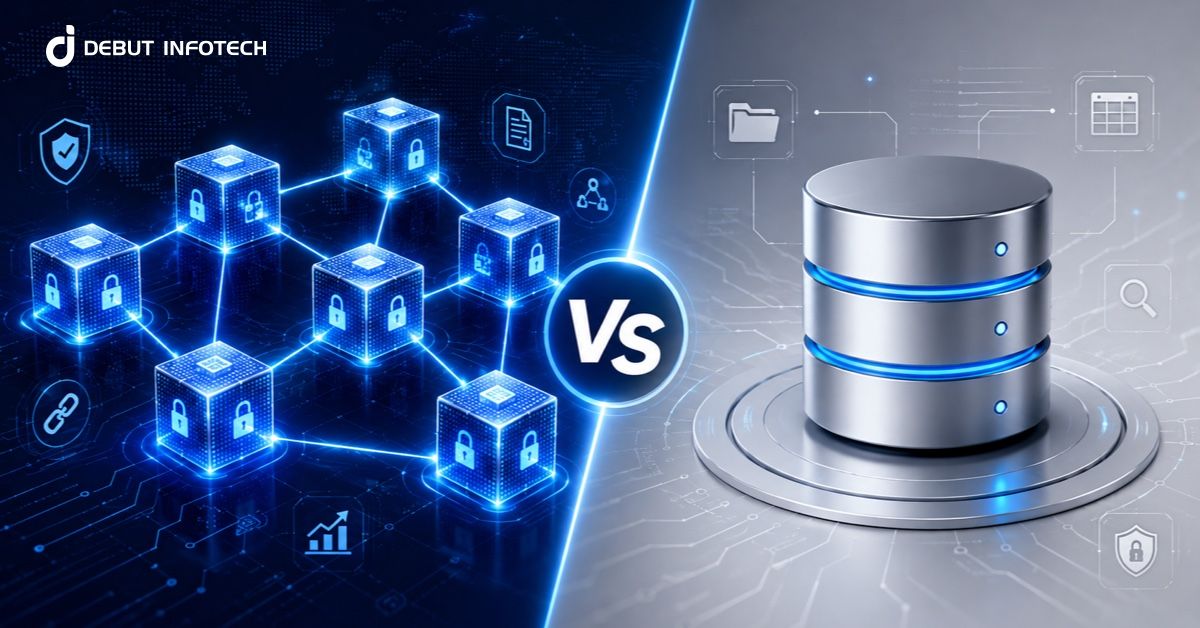


Choosing between blockchain vs database is not really about which technology is more advanced. It’s about which technology is right for the job.
A blockchain is suitable when there are multiple parties that need to exchange and confirm data without a single owner.
This is applicable in scenarios like tracking goods through supply chains, clearing financial transactions, managing online identity and audit-intensive processes where trust, transparency and immutability are important.
A traditional database, on the other hand, is generally the preferred option when a single organisation owns the system and requires speed, flexibility, easy data change, sophisticated data searches and reduced costs of operation. For many everyday business applications, a well-designed database is faster, simpler, and more practical than blockchain.
In real projects, the best answer is often not one or the other. Many businesses use a hybrid approach, where operational data is stored in a database, while important proofs, hashes, timestamps, or transaction records are recorded on a blockchain for verification.
The simplest way to think about it is this: databases are built for efficient data management, while blockchain is built for shared trust. IBM describes the key difference as centralisation, while NIST defines blockchain as a tamper-evident and tamper-resistant distributed ledger, usually operating without a central authority. This guide breaks down when to use each option, when to combine them, and how to avoid choosing blockchain for a problem that a database can solve better.
The best choice depends on the problem you are solving, not on which technology sounds more advanced. In simple terms, a database is designed to store data, and blockchain is designed to establish trust between parties who don’t necessarily trust each other.
So before comparing features, ask this:
Does your project need speed and control, or does it need shared trust and proof?
That answer will usually point you in the right direction.
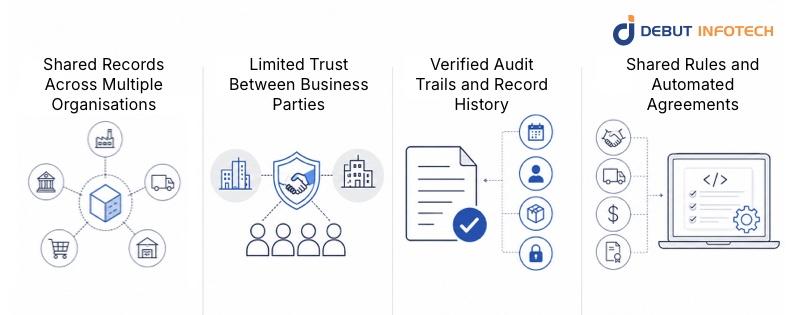
Blockchain is worth using when the record itself needs independent verification. It becomes valuable in situations where several parties are involved, no single owner should control the full history, and the business needs clear proof of what happened. In that kind of environment, blockchain is not just a storage tool, it becomes a trust layer.
1. Shared Records Across Multiple Organisations
Blockchain is valuable in situations where multiple organisations need to collaborate with a single source of truth.
For instance, a supply chain may be made up of manufacturers, transport firms, warehouses, retailers and regulators. Each party may update or verify information at different stages. If one organisation keeps all the records, others may be concerned that the records can be altered or concealed.
Blockchain allows this problem to be solved by sharing a record that can be verified. It gives every approved party confidence that the information has not been quietly changed by one central owner.
2. Limited Trust Between Business Parties
If everyone already trusts one organisation to manage the system, blockchain may not be necessary. But when trust is limited, blockchain becomes more valuable.
This is common in industries such as finance, logistics, insurance, real estate, and cross-border trade. In these cases, different parties may have different interests, different systems, and different levels of control.
Blockchain can reduce the need for one party to act as the only source of authority.
The real value is not just storing data. The value is creating a system where records can be checked and trusted by all relevant parties.
3. Verified Audit Trails and Record History
Blockchain is useful when a record’s history is important.
If you’re trying to demonstrate the date and time of an event, the approval of a transaction, the origin of something, or whether it has been tampered with, blockchain can help create an audit trail. This can be used for supply chain, certificates, compliance, financial settlement and transfer of ownership.
But that does not mean that all details need to be blockchain-based. It is often better to record only the proof (hash, date and time, or transaction ID) and store other information off chain.
4. Shared Rules and Automated Agreements
Blockchain can also make sense when multiple parties follow the same business rules and those rules can be automated.
For example, payment may be released only when delivery is confirmed. Ownership may transfer only when both parties meet agreed conditions. A certificate may not be valid until it is verified.
In such cases, smart contracts can streamline processes, eliminate disputes and manual verification. However, they should be well-designed, tested and secure, as mistakes in code can be expensive.
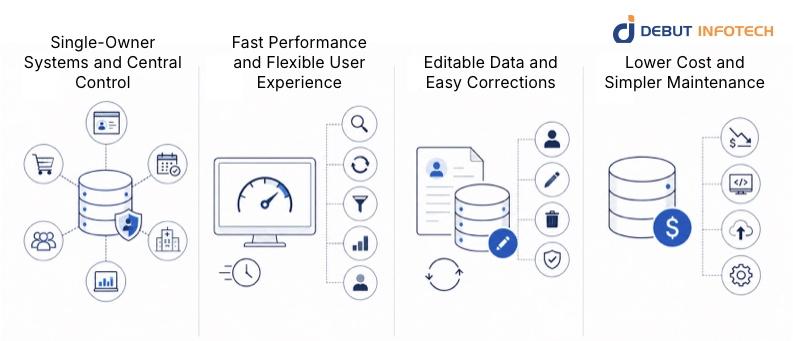
A database is the right choice when the system needs to be fast, flexible, and easy to control. It’s ideal where there is a single organisation providing and maintaining the data, and the users just need the application to work. If the key requirements are to update quickly, perform well, report and save money, a database will work better.
1. Single-Owner Systems and Central Control
For most business apps, a database remains the preferred option.
If one entity owns and controls the data, decides about who can access it and is responsible for its accuracy, then a database is usually easier and more convenient. This includes applications such as CRM systems, booking systems, e-commerce, HR systems, hospital appointment systems, school portals and internal dashboards.
In these cases, blockchain often adds complexity without adding enough value.
2. Fast Performance and Flexible User Experience
Databases are designed for fast performance. They can handle quick searches, frequent updates, large volumes of transactions, reporting, filtering, and real-time user activity.
This matters because users care about how the product works. They want fast-loading web pages, seamless transactions, and realtime reports.
If you need your application to be fast and handle lots of transactions, a database will typically be better.
3. Editable Data and Easy Corrections
A database is better when information changes often.
Customers may update their profiles. Staff may correct errors. Businesses may remove outdated records. Compliance teams may need to respond to privacy requests. Traditional databases are built for this kind of editing and control.
Blockchain is different because it is designed to preserve records. That is powerful for audit trails, but it can become a challenge when data must be updated or removed.
4. Lower Cost and Simpler Maintenance
A database is generally more affordable and easier to develop, manage, scale and maintain.
Blockchain projects often require specialist developers, security reviews, governance planning, smart contract testing, partner onboarding, and long-term network management. This is worthwhile only if there’s a clear business need.
For many projects, a database gets the job done faster, with fewer risks and lower operating costs.
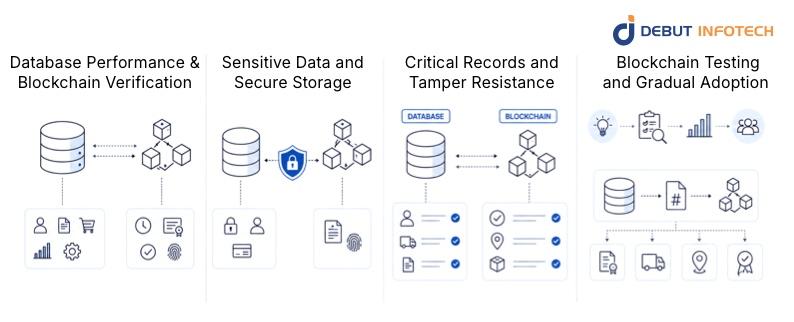
Sometimes it’s better to use the technology that’s best at each task. The database can support the live application, and the blockchain can capture the parts that need to be verified, like approvals, ownership transfer, time stamps, audit trails etc. This will provide the business with stability and performance while maintaining the advantages of proof.
1. Database Performance and Blockchain Verification
A hybrid model is often the best choice when the business needs both speed and verification.
In this model, the database supports routine operations like user accounts, documents, transactions, dashboards and reporting. Blockchain is used only for the data that requires greater verification, like timestamps, certificates, hashes, approvals, or ownership transfers.
This allows the business to enjoy the advantages of database and blockchain without having to store every piece of data on a distributed ledger.
2. Sensitive Data and Secure Storage
Hybrid systems are beneficial when the project includes private, financial, medical, legal or other personal information.
Rather than storing sensitive data on a blockchain, the system can store it securely in a database. The blockchain can then store a proof that the data was present or verified at a particular time.
This enables transparency while minimising privacy and regulatory risks.
3. Critical Records and Tamper Resistance
For instance, a delivery company may store driver information, customer information and delivery notes in a database. But it may track proof of delivery, delivery checkpoints or even product of origin on a blockchain.
This way, the business can keep things simple, while ensuring critical data is secure.
4. Blockchain Testing and Gradual Adoption
A hybrid system is also a good option for companies that want to experiment with blockchain.
Rather than moving the entire system to blockchain, you can start with one use case, like document authentication, proof of delivery, supply tracking or digital certification.
This will help you test the cost, speed, partner acceptance and business value of blockchain before investing more.
When deciding on whether to use blockchain technology, ask yourself first: does the business problem really require blockchain, or can it be solved with a database?
This approach is about not overbuilding. It is designed for founders, CTOs, product managers and business owners who want an easy approach to decide before they spend time and money on the wrong solution.
1. Do multiple parties need to share the same source of truth?
Blockchain is best used when multiple parties need to be in agreement about a shared source of truth.
For instance, a supplier, a transport company, retailer and government regulator may each need to confirm the shipment of goods. If they each have their own records, it can lead to disputes. Blockchain can solve this problem by providing a common ledger for all parties to validate.
But if the system is owned and managed by a single company, a database will do.
Simple rule:
If only one company owns the data, use a database. If several independent parties need the same trusted record, blockchain may be useful.
2. Is there a trust problem between the parties?
Blockchain is useful when there is limited trust between the parties or when there should not be a single party in control.
If there is already a trusted organization that people can rely on to manage the data, then blockchain may be less valuable. In this situation, it might add cost and complexity for no real benefit.
But if trust is low, blockchain can offer an impartial layer where the records are verified by consensus rather than by a central authority.
Ask yourself:
Can the other parties trust a single company? If yes, a database may be enough. If not, blockchain should be considered.
3. Do you need a tamper-evident audit trail?
Some systems need more than storage. They need proof.
This is important in those industries where companies need to show what took place, when it occurred, who authorised the action, and whether it has been altered. These include supply chain management, certifications, financial, insurance and regulatory reporting.
A database can be used to maintain logs, but they are usually managed by the same entity that owns the system. Blockchain provides stronger tamper-evidence because it is more difficult to change records without it being noticed.
Simple rule:
If proof of integrity is central to the business case, blockchain may be justified.
4. Does the system need high transaction speed?
If transaction speed is crucial, a regular database is probably better.
Databases are built for quick search, real-time updates, sophisticated queries and high transaction volume. It makes them a great choice for e-commerce, booking systems, dashboards, mobile apps and internal business tools.
Blockchains often need to be validated and reach consensus. These features enhance trust, but can also lead to a costlier and slower system.
Ask yourself:
Do people need real-time information and speedy access? If yes, start with a database unless blockchain solves a stronger trust or verification problem.
5. Will users need to edit or delete data often?
This is one of the biggest practical issues.
Databases are built for change. You can edit records, fix errors, delete data, and change the structure of the data as the business evolves.
Blockchain is built to preserve history. This is great for an audit trail, but dangerous if you need to change or delete data.
If your system stores user profiles, personal data, medical records, customer accounts or anything else that might need to be edited or deleted in the future, don’t store that data on the blockchain.
Better option:
Store editable data in a secure database and use the blockchain only for proofs, hashes, timestamps or verification.
6. Is personal or regulated data involved?
If it involves personal or financial data, health care data, legal data or sensitive enterprise data, the architecture needs to be carefully considered.
One of the most common pitfalls is attempting to store too much data on-chain. It is often better to store sensitive information off-chain and rely on blockchain to certify that the data was in a certain state at a certain time.
This is where blockchain integration needs expert planning. The goal is not to put everything on the blockchain. The goal is to use blockchain only where it adds trust, proof, and accountability.
Simple rule:
Sensitive data should usually stay off-chain. Blockchain should verify, not expose.
7. Is there a clear business case beyond “we want blockchain”?
This final question is the most important.
Don’t use blockchain if it’s not needed. It should be used to solve a problem like reducing conflict, enhancing traceability, enhancing audit trails, eliminating central point of control, or enabling trusted multi-party collaboration.
If the business case is weak, start with a database. If there is some value but uncertainty remains, begin with a small proof of concept. If both performance and verification matter, consider a blockchain database approach, where the database handles daily operations and blockchain records only the critical proof layer.
Final test:
Can you clearly explain why a normal database is not enough? If not, blockchain is probably not the right starting point.
The blockchain vs database decision should not just end with a comparison. It should result in a technology strategy that aligns with your business objectives, secures user information, and delivers value. This is where Debut Infotech combines technical expertise and business acumen.
As an industry-leading enterprise blockchain development company, Debut Infotech works with businesses to determine whether they need a database, a blockchain-based system, or a combination of both. We analyse your use case from all relevant perspectives including trust, data control, speed, regulatory risk, integration, scalability and maintenance.
We have helped clients transform their most innovative ideas into secure and scalable digital products through blockchain consulting, smart contract development, dApp development, tokenization platforms, enterprise blockchain solutions, and blockchain integration with legacy systems.
Rather than simply use blockchain where it is not needed, Debut Infotech concentrates on what is essential to your business success: enhanced transparency, process efficiency, risk mitigation, and future-proofed architecture. If you want to build with confidence, let Debut Infotech help you decide, design and develop the right solution.
A. A database is usually controlled by one organization. It is built for speed, easy updates, searches, and everyday business operations.
A blockchain stores records across a network of nodes. Once data is added, it is difficult to change without detection.
The key difference is simple: databases are best for fast data management, while blockchain is best for shared trust, transparency, and tamper-evident records.
A. Blockchain is useful for trust, transparency, and tamper-resistant records. But compared to traditional databases, it can be slower, more expensive, harder to scale, and less flexible.
Databases are usually better for apps that need fast transactions, frequent updates, easy data editing, complex searches, and low-cost storage.
In simple terms, use blockchain when trust and record integrity matter most. Use a database when speed, flexibility, and efficiency are more important.
A. Blockchain vs database use cases depend on whether you need speed or shared trust.
Use a traditional database when one organization controls the data and needs fast updates, searches, and reporting. Common examples include ecommerce platforms, CRM systems, booking apps, payroll tools, and internal dashboards.
Use blockchain when multiple parties need to verify the same records without relying on one central authority. Common examples include supply chain tracking, financial settlement, digital identity, certificate verification, and audit trails.
In short, databases are best for efficiency. Blockchain is best for trust, transparency, and tamper-resistant records.

Our Latest Insights
USA
2501 Chatham, Rd Suite R Springfield, IL 62704
+1-708-515-4004
info@debutinfotech.com
UK
7 Pound Close, Yarnton, Oxfordshire, OX51QG
+44-770-304-0079
info@debutinfotech.com
Canada
154 Eden Oak Trail, Kitchener, ON N2A 0H9
+1-708-515-4004
info@debutinfotech.com
INDIA
Sector 101-A, Plot No: I-42, IT City Rd, JLPL Industrial Area, Mohali, PB 140306
9888402396
info@debutinfotech.com