ON THIS PAGE
Progress0%






Our Global Presence :






Smart contract architecture sits at the core of how decentralized applications are designed, deployed, and scaled. It defines how contracts manage state, enforce logic, and interact with external systems in a predictable and secure way. The scale of adoption highlights its importance.
The Ethereum ecosystem recorded over 8.7 million smart contract deployments in a single quarter of 2025, reflecting rapid developer activity and real-world use cases. In addition, smart contracts now underpin major financial systems, with $90–$100 billion locked in DeFi protocols, much of it running on structured contract designs.
This growth increases the need for a well-defined smart contract architecture. Without a clear structure, contracts become difficult to scale, audit, or secure, leading to higher risks and operational inefficiencies across blockchain-based systems.
In this article, we will explain what smart contract architecture is, why it matters, what components are required for smart contract architecture, and provide a smart contract blueprint.
Smart contract architecture refers to the structured design of how contracts are organized, interact, store data, and enforce logic on a blockchain. It goes beyond writing isolated functions. It defines how components fit together, how state evolves over time, and how external systems interact with on-chain logic.
A well-designed architecture brings predictability, reduces risk, and supports long-term scalability. Without it, even simple contracts become difficult to extend, audit, or secure as usage grows.
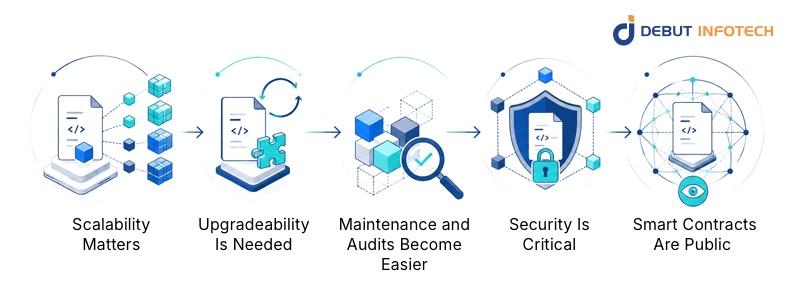
Enterprise smart contract architecture decisions shape how contracts behave in real-world conditions. These choices affect cost, reliability, and the ability to adapt over time. Weak structure tends to surface later as high gas fees, upgrade limitations, or security gaps.
Smart contracts must handle increasing transaction volume without degrading performance or driving up costs. Efficient architecture reduces unnecessary storage writes, minimizes computational overhead, and supports batching where possible. Poor scalability design leads to congestion, failed transactions, and high gas fees, especially on networks like Ethereum, where resource usage directly impacts user cost and system responsiveness.
Smart contracts are not static systems. Business rules change, vulnerabilities are discovered, and integrations evolve. Without a clear upgrade path, contracts risk becoming obsolete or unsafe. Architectural approaches such as the Proxy Pattern allow logic updates while preserving state, ensuring continuity. Planning upgradeability early avoids costly migrations and protects both users and developers over time.
Well-structured smart contract architecture simplifies ongoing maintenance and external audits. Modular design isolates logic into smaller components, making it easier to review, test, and update individual parts without affecting the entire system. Auditors can focus on specific modules to improve accuracy and efficiency. This clarity reduces the likelihood of overlooked vulnerabilities and speeds up both internal reviews and third-party security assessments.
Smart contracts operate in open, adversarial environments where attackers actively search for weaknesses. Architecture determines how well a system resists threats such as reentrancy attacks, unauthorized access, and logic manipulation. Firms providing smart contract development services must embed security at every level, from function design to permission control. Strong architectural decisions reduce risk exposure and help maintain trust in applications deployed on public blockchains.
Smart contracts are deployed on transparent networks, where code and transaction history are publicly visible. This openness increases accountability but also exposes weaknesses. Poor design decisions cannot be hidden and can be quickly exploited.
A well-structured architecture ensures clarity, predictability, and resilience, reinforcing user confidence and supporting reliable interaction across decentralized ecosystems and applications.
The core logic layer defines how the smart contract behaves, including business rules, state transitions, and transaction processing. It acts as the foundation of the system, ensuring deterministic outcomes. This component must be precise, as any flaw directly affects contract integrity, user balances, and overall system reliability.
The storage layer manages how and where data is stored on-chain. It includes variables, mappings, and structured data that persist across transactions. Efficient storage design reduces gas costs and improves performance. Careful planning also ensures compatibility with upgrade patterns, preventing issues when contract logic evolves over time.
An access control system defines who can execute specific actions within the contract. It enforces permissions via role-based or ownership models, restricting sensitive operations such as upgrades or fund withdrawals. Properly configured access control prevents unauthorized actions, reduces attack risks, and ensures that administrative responsibilities remain clearly defined and controlled.
The external interface layer defines how users, applications, and other contracts interact with the smart contract. Standards like ERC-20 improve interoperability across the ecosystem. Clear interfaces ensure predictable behavior, reduce integration errors, and make it easier for developers to build applications that interact reliably with the contract.
The security and validation layer ensures that all inputs, operations, and interactions follow defined rules. It includes checks for data integrity, transaction conditions, and safe execution patterns. This layer acts as a safeguard against exploits, helping maintain consistent behavior and protecting the contract from malicious or unintended usage.
The contract surface area includes every externally accessible function, endpoint, and interaction point exposed to users or other contracts. Keeping this surface minimal reduces potential attack vectors and simplifies validation.
Each public or external function should have a clear purpose and strict input controls. Internal logic should remain encapsulated wherever possible, ensuring that sensitive operations are not directly exposed and the overall contract remains easier to secure and audit.
The execution environment defines the operational boundaries of your smart contract, including gas costs, throughput limits, and available tooling. Platforms such as Ethereum and Solana impose different constraints that influence design decisions. These constraints affect how logic is structured, how frequently functions can be called, and how efficiently data is processed, making environment selection a foundational architectural decision.
Smart contracts should follow a deterministic state machine model, where each state transition is clearly defined and predictable based on inputs. This approach ensures that, given the same conditions, the contract always produces the same outcome. It improves reliability, simplifies debugging, and supports formal verification. Clear state transitions also make it easier for auditors and developers to understand how the contract behaves across different scenarios.
Storage design directly affects both cost and performance in smart contracts. Each variable stored on-chain consumes resources, so only essential data should be persisted. Structuring storage efficiently, grouping related variables, and avoiding duplication help reduce gas usage. Thoughtful storage layout also improves data retrieval efficiency and simplifies upgrades, especially when working with patterns that depend on consistent storage positioning across contract versions.
External interfaces define how users, dApps, and other smart contracts interact with your system. Clear and consistent interfaces improve usability and integration. Adopting standards such as ERC-20 and ERC-721 ensures compatibility across the ecosystem. Well-defined interfaces also reduce integration errors, provide predictable behavior, and make it easier for developers to build on top of your contract.
Permission design determines which actors can execute specific functions within the contract, thanks to blockchain technology. Role-based access control helps separate responsibilities, ensuring that administrative actions are restricted while user operations remain accessible. Each permission must be explicitly defined and enforced. Poorly configured access controls are a frequent source of vulnerabilities, so permissions should be carefully reviewed to prevent unauthorized actions and maintain system integrity.
An upgradeability strategy defines how a smart contract evolves after deployment without disrupting existing users or losing stored data. Patterns such as the Proxy Pattern separate logic from storage, allowing controlled updates. Planning this early avoids rigid systems that cannot adapt. Clear governance rules, version control, and testing of upgrade paths are required to prevent the introduction of new vulnerabilities during contract modifications.
Smart contracts often rely on external systems for data or functionality, including price feeds, randomness, or cross-chain inputs. Services like Chainlink Oracles introduce dependencies that must be validated and monitored. Data freshness, accuracy, and fallback mechanisms are critical considerations. A robust smart contract system architecture anticipates failures in external services and includes safeguards to prevent incorrect data from affecting contract execution or financial outcomes.
Security architecture begins with identifying potential threats, including reentrancy, front-running, and privilege escalation. A structured threat model outlines how attackers might exploit the system and the controls needed to prevent it. These controls include input validation, access restrictions, and safe interaction patterns. Security must be embedded into every layer of the blockchain contract infrastructure, ensuring resilience against both known vulnerabilities and emerging attack strategies.
Events act as structured logs that record important actions within a smart contract. These logs are consumed by off-chain systems, enabling applications to track state changes without constant on-chain queries. Well-designed event schemas improve traceability and performance. Indexing services like The Graph rely on these events to enable efficient querying, making event architecture a key factor in user-facing application responsiveness.
Testing architecture defines how thoroughly a smart contract is validated before deployment. It includes unit tests, integration tests, fuzz testing, and simulation of edge cases. Tools such as Hardhat and Foundry support automated testing workflows in Defi smart contract development. A strong testing approach ensures the correctness of the logic, uncovers vulnerabilities early, and builds confidence that the contract will behave reliably in real-world conditions.
Deployment and operations architecture focuses on how smart contracts are introduced and managed in live environments. This includes deployment scripts, verification processes, monitoring, and upgrade execution. Post-deployment oversight is critical, as contracts operate continuously once live. Proper operational planning ensures quick response to issues, supports controlled upgrades, and maintains consistent performance, helping the system remain stable and trustworthy over time.
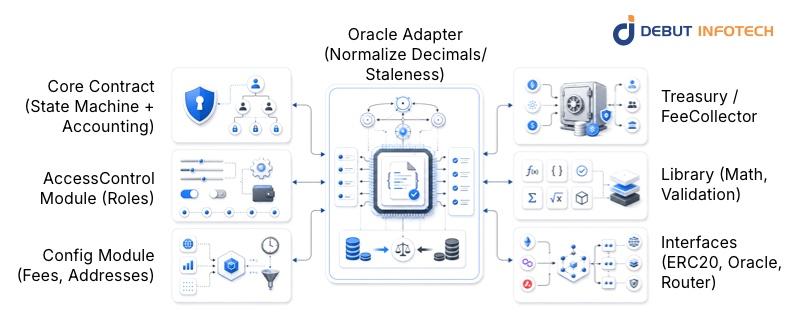
The core contract manages the system’s primary logic and state transitions. When you hire smart contract developers, they help track balances, process transactions, and enforce business rules through a deterministic state machine. Accuracy and consistency are critical, as errors here affect the entire system. This module should remain focused, avoiding unnecessary dependencies while ensuring all accounting operations are precise, transparent, and resistant to manipulation or unintended state changes.
The AccessControl module defines roles and permissions across the smart contract system. It restricts sensitive operations such as upgrades, parameter changes, or fund withdrawals to authorized accounts.
Role-based access improves security and operational clarity. By separating administrative privileges from user-level actions, this module reduces risk, ensures accountability, and provides a structured way to manage permissions as the system evolves.
The Config module stores adjustable parameters such as transaction fees, treasury addresses, and external contract references. Isolating these variables allows updates without modifying core logic, reducing deployment risk. It also supports governance mechanisms that allow authorized roles to adjust values when needed.
Keeping configuration separate ensures flexibility, simplifies maintenance, and prevents unnecessary changes to critical business logic during routine updates.
The Oracle Adapter standardizes and validates external data before it is used within the contract. It handles differences in decimal formats, checks for stale or outdated data, and ensures consistency across inputs. This module acts as a protective layer between external sources and internal logic, reducing the risk of incorrect calculations or exploits caused by unreliable or manipulated data feeds.
The Treasury or FeeCollector module manages the collection, storage, and distribution of funds within the system. It enforces rules for fee allocation, revenue sharing, or payouts.
Proper scalable smart contract design ensures transparency and prevents unauthorized access to funds. This module often includes safeguards such as withdrawal limits and audit trails, helping maintain financial integrity and supporting trust among users and stakeholders.
The Library module provides reusable functions for mathematical operations and input validation. By centralizing common logic, it reduces duplication and minimizes the risk of inconsistencies across the codebase.
Libraries improve readability and maintainability, allowing developers to rely on tested components and secure smart contract frameworks. This approach strengthens overall contract reliability and ensures that critical calculations are handled in a consistent and secure manner.
Interfaces define how the contract interacts with external tokens, data providers, and protocols. Standards like ERC-20 ensure compatibility with widely used tokens, while oracle and router interfaces enable integration with external services.
Clear interface definitions reduce integration errors, improve interoperability, and allow the contract to communicate effectively with other components in the broader blockchain ecosystem.
Modularization divides smart contract logic into smaller, well-defined components, each handling a specific responsibility. This separation reduces complexity, improves readability, and simplifies testing. Independent modules can be updated or replaced without affecting the entire system. It also limits the blast radius of potential bugs, making the contract easier to audit, maintain, and extend as requirements evolve.
Security-first enterprise blockchain contract design embeds protective patterns directly into contract logic from the start. Techniques such as checks-effects-interactions, reentrancy guards, and strict input validation reduce exposure to common exploits. Access controls must be explicit and consistently enforced. By prioritizing security at the architectural level, developers reduce the likelihood of vulnerabilities and strengthen the contract’s resilience in adversarial blockchain environments.
Using standardized interfaces ensures compatibility with the broader blockchain ecosystem in smart contract integration architecture. Protocols such as ERC-20 and ERC-721 allow seamless interaction with wallets, exchanges, and other contracts. Standardization reduces integration effort, minimizes errors, and improves developer adoption. It also provides predictable behavior, making the system easier to understand, test, and extend across different applications and platforms.
Gas optimization focuses on reducing the computational and storage costs of executing smart contracts. Efficient coding practices, such as minimizing storage writes and reusing variables, lower transaction fees for users. Optimized contracts perform better under load and remain accessible even during network congestion. Careful design ensures that performance improvements do not compromise readability, maintainability, or security within the contract system.
Comprehensive testing validates smart contract behavior across expected and edge-case scenarios before deployment. This includes unit tests, integration tests, fuzz testing, and simulation of real-world conditions. Tools like Hardhat and Foundry support automated workflows and detailed analysis. Strong testing practices reduce deployment risks, improve reliability, and provide confidence that the contract will perform as intended in production.
Smart Contract Architecture shapes how decentralized systems perform, scale, and remain secure over time. A structured approach improves clarity, reduces risk, and supports long-term adaptability. As blockchain adoption grows, well-designed smart contract deployment architecture becomes a requirement for reliable applications.
Teams that invest in strong foundations build systems that are easier to maintain, audit, and evolve without disrupting users.
Debut Infotech, a trusted blockchain development agency, helps businesses design and implement robust Smart Contract Architecture. Their expertise ensures secure, scalable, and future-ready solutions tailored to real-world use cases.
A. Enterprise smart contract architecture is usually layered. You’ve got the blockchain layer handling execution, a contract layer with business logic, and integration layers connecting to existing systems. There’s also identity, access control, and monitoring baked in. It’s less about a single contract and more about a coordinated system working together.
A. They’re broken into smaller, reusable modules rather than a single, bulky contract. Developers avoid heavy on-chain computation and push some logic off-chain. Upgradeability patterns help, too. Add load balancing across networks or layers, and you get something that can handle growth without slowing everything down or driving up costs.
A. Integration usually happens through APIs, middleware, or blockchain oracles. The smart contract doesn’t exist in isolation. It communicates with CRMs, ERPs, and databases via these connectors. Events from the blockchain trigger actions in enterprise systems, and vice versa. It’s a back-and-forth setup, not a one-way pipeline.
A. They run audits, use tested libraries, and follow strict coding standards. Access controls and role management are locked down. For compliance, they align contracts with regulations and log every transaction for traceability. Some even include fail-safes or pause functions to step in quickly if something goes wrong.
A. Smart contracts are self-executing programs stored on a blockchain that run when conditions are met. In Smart Contract Architecture, business logic is handled automatically. No middleman, no manual approval steps. Once deployed, they execute exactly as written, keeping processes consistent and removing guesswork from transactions.
A. Costs vary based on complexity, the chosen blockchain, and development time. Simple Smart Contract Architecture setups might be affordable, but enterprise-grade systems with integrations, audits, and scalability features can get expensive. You’re paying for development, testing, deployment, and ongoing maintenance, not just writing the contract itself.
A. Security depends heavily on how the contracts are written and tested. Strong Smart Contract Architecture includes audits, code reviews, and strict access controls. Once deployed, contracts can’t be easily changed, so mistakes are costly. That’s why teams focus hard on testing before anything goes live.
A. You’ll see Smart Contract Architecture used in finance, supply chains, insurance, and digital identity systems. It handles things like automated payments, tracking goods, and enforcing agreements. Anywhere rules can be clearly defined, smart contracts can step in to execute without manual intervention.
A. Timelines depend on scope. A basic Smart Contract Architecture setup might take a few weeks. Larger enterprise systems with integrations, security checks, and testing can stretch into months. Planning, audits, and revisions take time, especially when reliability and compliance are non-negotiable.

Our Latest Insights
USA
2501 Chatham, Rd Suite R Springfield, IL 62704
+1-708-515-4004
info@debutinfotech.com
UK
7 Pound Close, Yarnton, Oxfordshire, OX51QG
+44-770-304-0079
info@debutinfotech.com
Canada
154 Eden Oak Trail, Kitchener, ON N2A 0H9
+1-708-515-4004
info@debutinfotech.com
INDIA
Sector 101-A, Plot No: I-42, IT City Rd, JLPL Industrial Area, Mohali, PB 140306
9888402396
info@debutinfotech.com