ON THIS PAGE
Progress0%






Our Global Presence :


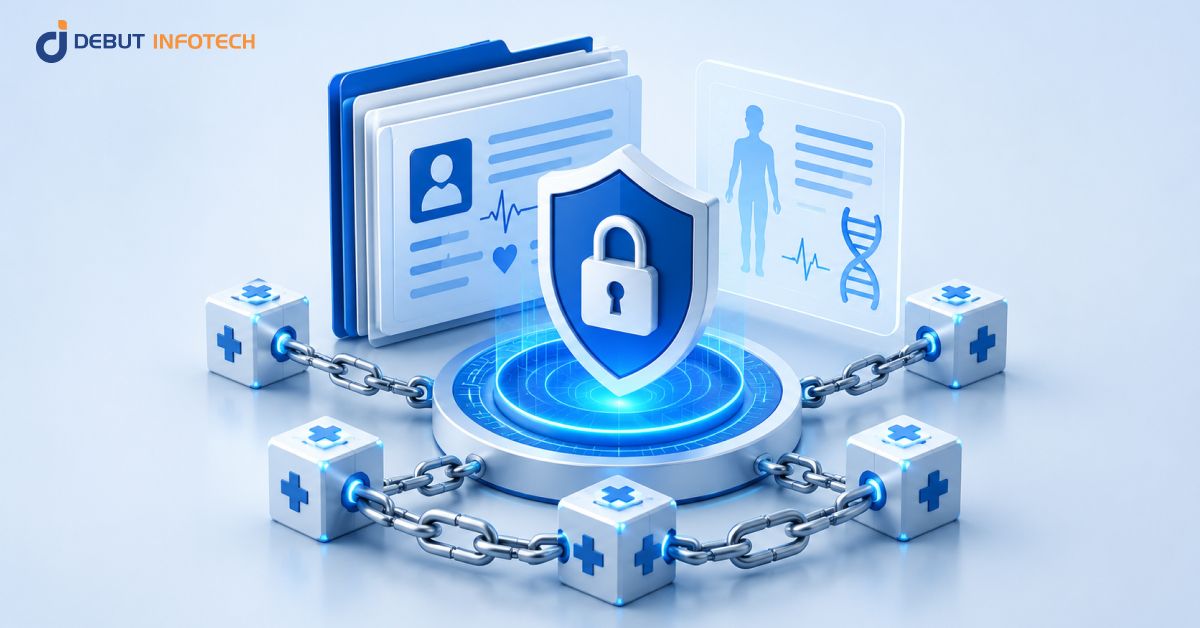


Blockchain strengthens EHR trust without replacing existing systems by verifying record integrity, managing consent, and creating tamper-evident audit trails while keeping sensitive patient data in secure off-chain storage.
Permissioned blockchain platforms such as Hyperledger Fabric, Quorum, Corda, and private Ethereum are better suited for healthcare because they provide controlled access, governance, and enterprise-grade privacy.
Smart contracts automate consent management and access control by enforcing predefined policies for authorized users, reducing manual administration while improving auditability and compliance.
Successful implementation depends on seamless integration with EHR infrastructure using standards like FHIR and HL7, alongside identity management, encryption, APIs, and secure interoperability workflows.
Blockchain complements rather than replaces cybersecurity controls because organizations still need multifactor authentication, encryption, endpoint protection, backups, continuous monitoring, and governance to mitigate evolving threats.
Deployment costs and complexity are driven primarily by integration, governance, scalability, and change management, making feasibility assessment and phased implementation essential before enterprise-wide adoption.
Healthcare organizations gain the greatest business value when multiple stakeholders share sensitive records, improving data integrity, patient privacy, compliance readiness, and trusted information exchange across hospitals, laboratories, insurers, and healthcare networks.
In the modern healthcare environment, electronic health records (EHRs) play a crucial role. They are used to coordinate care, share patient information, provide support for clinical history and facilitate informed decision making for hospitals, laboratories, insurers, cloud platforms, mobile health apps, and others. But the more data that passes through systems and organizations, the more risks of unauthorized access, inconsistent permissions, data manipulation, ransomware, weak audit trails, and privacy breaches occur.
Some of these risks can be mitigated with the use of blockchain for health records, which offers tamper-evident verification mechanisms, verifiable access history, shared audit trails, and more transparent consent-management processes. For instance, if a laboratory uploads a test result, the file can be encrypted and securely stored off-chain, while also having its digital fingerprint stored on a blockchain. This enables the parties with authorization to check if the record has been tampered with.
In most practical systems, blockchain does not take the place of the existing database in the EHR, or even store medical records on a distributed ledger. Instead, it works alongside existing infrastructure to verify data integrity, manage permissions, support secure information exchange, and strengthen trust across organizations.
This guide explains how blockchain in healthcare can support EHR security, including system architecture, smart-contract workflows, cyberattack protection, patient privacy, HIPAA-related considerations, EHR integration, benefits, implementation challenges, development costs, and Debut Infotech’s blockchain implementation capabilities.
Electronic health records enable improved clinical decision making, care coordination, billing, compliance and information sharing. But patient information is frequently transferred between hospitals, clinics, labs, pharmacies, insurers, telemedicine providers, health information exchanges, government agencies, research organizations, health applications and third-party vendors.
These organizations can have varying databases, access rules, user identities, audit tools, integration methods, and data formats, making it challenging to maintain trust throughout the information flow.
1. Unauthorized Access
Sensitive patient information is accessible by persons without a legitimate clinical, administrative, legal or operational reason to view such information.
2. Record Manipulation
The clinical or administrative data may be modified without clear, visible and independently verifiable documentation of the changes being made and the reasons for the change.
3. Fragmented Audit Trails
Separate systems often maintain separate access logs, making cross-platform investigations slower and more complex.
4. Weak Consent Visibility
Patient permissions may be recorded differently across providers and applications, creating uncertainty about how information can be shared or reused.
5. Data Silos
Incomplete patient records, duplicate records, and lack of patient care coordination can arise from disconnected systems.
6. Cybersecurity Incidents
Ransomware, system compromise, and other cyber-related events can cause disruptions in access to important records and impact healthcare operations.
7. Interoperability Gaps
Secure information exchange may be challenging due to differing standards, interfaces, vendor environments, workflows.
For instance, a patient might go from clinic to specialist, then to hospital and each of these providers may have their own records, permissions and audit logs. This can make it difficult to establish a complete and trusted view of the patient’s care journey.
Healthcare security must protect the confidentiality, integrity, and availability of electronic protected health information. While blockchain can enhance verification, auditability, consent tracking and data provenance, it needs to complement the existing tools of encryption, identity management, access control, cyber security monitoring, governance and reliable backup system.
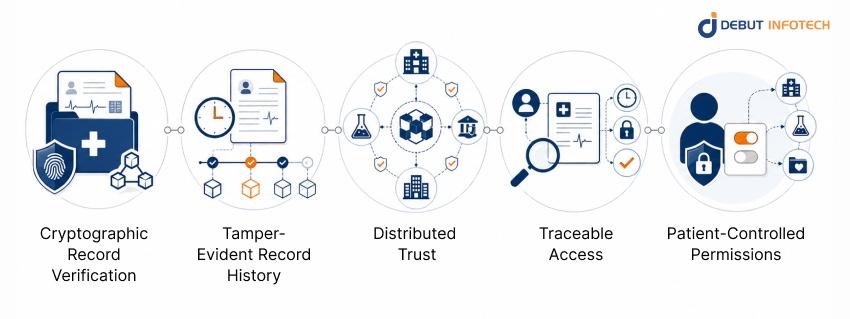
Blockchain can help healthcare organizations secure electronic health records by creating a shared, tamper-evident record of approved data activities. Instead of storing complete patient files on the blockchain, hospitals can keep encrypted health information within existing EHR platforms or secure off-chain databases. The blockchain can then record cryptographic hashes, timestamps, access permissions, consent decisions, and audit events.
Each time an electronic health record is created or updated, the system can generate a unique cryptographic hash. This hash acts as a digital fingerprint for a specific version of the record and can be stored on a permissioned blockchain.
To verify the record later, the system generates a new hash and compares it with the approved blockchain reference. If the two values do not match, the difference may indicate that the record has been altered, corrupted, or replaced with an unauthorized version.
This process confirms that the current record is consistent with the version previously recorded. It does not prove that the original diagnosis, test result, or clinical information was medically accurate.
Blockchain can create a traceable history of key EHR activities, including record creation, updates, corrections, access requests, data-sharing events, and changes to user permissions.
Because approved transactions are timestamped and linked to earlier events, attempts to change historical information may be easier to identify. This tamper-evident audit trail can support compliance reviews, security investigations, and health information governance.
A permissioned blockchain allows approved participants, such as hospitals, laboratories, insurers, and health information exchanges, to verify shared record events.
This reduces reliance on one organization’s database or audit system. Participating institutions can confirm that agreed actions occurred without receiving unrestricted access to the patient’s complete medical record.
Blockchain-based audit logs can help healthcare administrators determine who requested patient information, which organization made the request, when the request occurred, what authorization was used, and which record was involved.
The system may also show whether access was approved, denied, revoked, or expired.
For example, when a specialist requests access to a patient’s laboratory results, the blockchain can record the requesting hospital, time of access, consent status, and approved data scope without storing the laboratory report on-chain.
Blockchain-enabled consent tools may allow patients to review, grant, limit, or revoke selected data-sharing permissions through a secure patient portal.
These tools can improve transparency and give patients greater visibility into how their health information is used. However, patient preferences may still be subject to emergency access requirements, public health obligations, court orders, and other legally authorized uses.
Securing the electronic health records with blockchain is not just about integrating a distributed ledger into a current healthcare system. For a reliable architecture, it’s essential to integrate blockchain with identity verification systems, encryption, secure storage solutions, interoperability standards, access control mechanisms, monitoring systems, and governance structures. Each component serves a particular security or operational purpose, and the worth depends on how the components interact with each other.
These components should function as connected security layers rather than isolated technologies. For example, when a physician requests access to a patient’s laboratory results, the identity system may first verify the physician and apply multifactor authentication. The consent module can then confirm that access is permitted, while a smart contract applies the relevant access rules.
The clinical record does not go directly on the blockchain, but rather is kept in encrypted off-chain storage. It has a cryptographic hash that can be compared to the blockchain entry to verify that the record hasn’t been modified. The access event is then logged and accessible via audit and security monitoring tools.
Blockchain can enhance the integrity, traceability, consent management, and trusted information sharing within healthcare organizations. It should not, however, be considered as a comprehensive cybersecurity solution. It is best utilized as part of a larger, layered security solution that combines encryption, identity management, endpoint security, network security, monitoring, regulatory compliance and good governance.
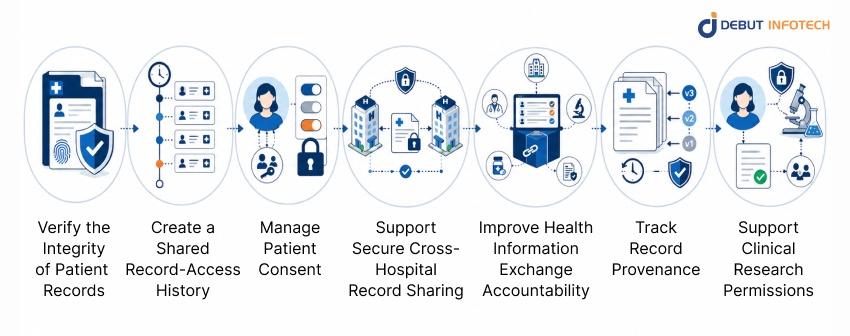
Blockchain can be used to enhance the security of electronic health records (EHRs) without directly storing patient information on the blockchain. The clinical information is kept encrypted in validated EHR systems or secure off-chain databases, while the verification information, consent permissions and access activity is logged on the blockchain.
1. Verify the Integrity of Patient Records
Organizations can generate a cryptographic hash for important health records, such as clinical summaries, laboratory reports, discharge information, prescriptions, care plans, and diagnostic reports.
This hash is similar to a digital fingerprint. If an authorized user compares the current record with the original blockchain reference, then any unauthorized change might be detected. This is to ensure that information has not been tampered with or altered beyond approved clinical or administrative procedures.
2. Create a Shared Record-Access History
An approved healthcare stakeholder can have access to a shared history of record access via a blockchain-based audit trail.
Rather than relying on separate logs kept by individual hospitals and vendors, authorised organisations can check a shared log that records when the data was accessed, by which organisation and what action was taken. This can aid improved accountability in audits, compliance reviews, and security investigations.
3. Manage Patient Consent
Blockchain-powered consent mechanisms will provide patients and healthcare institutions with more control over data access.
Consent can be given for a particular purpose, for a specific time, changed, renewed, withdrawn or audited. For instance, a patient might grant a specialist access to specific cardiology records for a 30-day period, but not to his or her other medical history.
4. Support Secure Cross-Hospital Record Sharing
A blockchain-supported exchange may follow this process:
This workflow can improve information sharing while preserving access control and patient privacy.
5. Improve Health Information Exchange Accountability
A shared ledger can help to improve the visibility within hospitals, clinics, labs, pharmacies, health information exchanges and healthcare apps.
Since approved participants are all using the same transaction history, it becomes easier for organizations to know who accesses the information and when.
6. Track Record Provenance
Blockchain can aid providers in confirming the source of information, the organization producing it, when it was submitted, if it has been updated, and which version is current.
Good record provenance can lessen confusion and prevent the use of outdated or unverifiable information by clinicians.
7. Support Clinical Research Permissions
Patients may authorize selected health data for research based on the study purpose, approved organization, access period, data category, and withdrawal status.
But blockchain does not necessarily anonymize patient data. Healthcare organizations need to remain responsible for applying encryption, de-identification, access controls, and other data governance measures.
Blockchain can provide an added layer of security for EHR systems, enabling healthcare organizations to confirm that data has not been modified without permission. It offers the most significant security benefits for hospitals, labs, insurers and other approved participants in terms of improved integrity, transparency and traceability.
In reality, patient data is typically kept in the EHR database or in a protected data storage system. The blockchain may instead store cryptographic hashes, access records, consent updates, or transaction references. Even slight changes to the original record will alter the result, so it becomes easier to spot the unauthorized changes.
| Cybersecurity Risk | How Blockchain May Contribute | Controls That Remain Essential |
| Unauthorized record modification | Hash comparison can reveal altered or inconsistent health information. | Access controls, application security, monitoring, and backups |
| Audit-log manipulation | Shared, append-only records can make historical changes harder to conceal. | SIEM tools, secure logging, continuous monitoring, and incident response |
| Insider misuse | Traceable access events can improve accountability and support investigations. | Least-privilege access, staff policies, access reviews, and behavior analytics |
| Credential theft | Smart contracts can apply access rules based on role, organization, purpose, or context. | Multifactor authentication, identity protection, and credential monitoring |
| Ransomware | Independent integrity records can support data verification during restoration and recovery. | Offline backups, endpoint protection, network segmentation, and recovery testing |
| Data exfiltration | Verified access histories can help investigators identify unusual or unauthorized activity. | Encryption, data loss prevention, endpoint security, and network monitoring |
| Unauthorized data sharing | Consent records and permission rules can help identify or restrict unapproved data exchange. | Secure APIs, authentication, privacy controls, and data-governance policies |
Consider a health information exchange that records the hash of every approved patient-data transfer. If the file is subsequently modified or swapped in an unauthorized workflow, the discrepancies will raise the security team’s awareness to a potential integrity problem. The blockchain doesn’t reveal the entire medical record, but it serves as a trusted reference to verify the record.
Blockchain does not protect EHR systems from cyber threats. A valid credential can be stolen and an attacker may compromise a clinical workstation, exploit an application vulnerability, or acquire encryption keys, yet still pose significant security threats. The implementation of blockchain should therefore be a part of a comprehensive approach to zero-trust identity-security, encryption, monitoring, backup and incident-response strategies.
Smart contracts are rules that are programmed to execute approved actions when certain conditions are met. In healthcare, they can be used to ensure that patient consent, access and data-use policies are being adhered to within electronic health records systems.
A smart contract can then assess the user’s identity, professional role, treatment purpose, patient consent status, and level of access to determine if a user can access the data, avoiding the need for manual review by staff. The system can now approve, limit or deny the request according to the set governance rules.
For instance, if a patient is moved from a hospital to a rehabilitation facility, the admitting health care team may be required to have access to the patient’s discharge notes, medication history, and follow-up care instructions. A smart contract can ensure that the transfer is authorized, validate the identity and role of the receiving provider, and only provide necessary information for ongoing treatment. The permission can expire automatically after the approved period, while each access event remains recorded for auditing and accountability.
Smart contracts can also support other operational healthcare scenarios:
While these features can enhance policy implementation, transparency, and auditability, smart contracts are not intended to be self-managing. They need to be reviewed, tested, independently audited and designed to facilitate updates where there are operational or regulatory changes to make.
Healthcare organizations should also make sure that the logic of the smart contracts is aligned with real-world clinical workflows and follows proper governance, privacy, security, and legal audit before being implemented.
Debut Infotech offers tailored smart contract development solutions for enterprise automation and facilitates permissioned blockchain platforms like Hyperledger Fabric that can be customized with controlled participation, identity-based access, and healthcare data governance.
Healthcare organizations do not have to abandon their existing EHR systems to implement blockchain. A more feasible solution is to implement blockchain as a verification and audit system to complement existing EHR systems, clinical applications, and healthcare data infrastructure.
Organizations planning to integrate blockchain with healthcare records can follow this practical workflow:
1. A clinician creates or updates a record in the existing EHR.
The clinical data remains within the hospital’s approved electronic health record environment.
2. The EHR sends an approved event through an integration layer.
This connection can be done through FHIR API, HL7, EHR vendor API, API gateways or other health care interoperability tools.
3. The system generates a cryptographic hash.
The hash represents the record or selected healthcare data object without exposing the complete clinical information.
4. The blockchain stores the verification reference.
This may include the cryptographic hash, record identifier, timestamp, authorized healthcare organization, version information, and relevant consent or access event.
5. The complete medical record remains in secure healthcare storage.
Clinical information continues to reside in an encrypted hospital database, cloud environment, health information exchange, laboratory system, or other approved repository.
6. An authorized user requests access.
The request may come through an EHR, provider portal, patient application, hospital information system, or connected healthcare platform.
7. The system verifies access permissions.
Identity, role, patient consent, and access policies are checked before the record is released. Single sign-on, OAuth-based authorization, identity matching, and master patient index systems can help connect the request to the correct patient and authorized user.
8. The approved record is retrieved and verified.
The system retrieves the information from its original storage location and may compare its cryptographic hash with the blockchain reference to confirm that the record has not been altered unexpectedly.
9. The access event is logged.
Documentation of the activity leaves a more traceable record of who viewed the information, when they did so and which organization was involved.
For instance, if a laboratory result is transferred from a laboratory information system to an EHR, the blockchain reference could capture the date the result was sent, the organization that sent the result, and ensure that the copy on the blockchain is the same as the source record.
FHIR can enable seamless electronic exchange of data across EHRs, healthcare applications, labs, patient portals, and health information exchanges. However, integration teams need to overcome issues like inconsistent data formats, duplicate patient identities, legacy EHR system limitations, vendor API constraints, inadequate data mapping, version conflicts, integration lag time, downtime planning, disruption of clinical workflows, and user training.
Healthcare organizations can leverage specialized blockchain integration services to integrate blockchain platforms with enterprise APIs and existing healthcare technology environments without the need to build the entire EHR ecosystem.
Blockchain technology does not come with HIPAA compliance. When used in a properly governed healthcare environment, a blockchain-based EHR platform can also help with the HIPAA requirements for data security, record integrity, access control, and auditability.
Compliance requires all components of the technology ecosystem, from the EHR platform to the data-storage environment, identity-management system, network controls, organizational policies, and user practices. The blockchain ledger is not enough to make a healthcare system compliant.
The HIPAA Security Rule requires that healthcare organizations employ administrative, physical, and technical safeguards to protect electronic protected health information (ePHI). These safeguards support three main security objectives:
A privacy-focused blockchain EHR architecture should not store patient identifiable information on a public blockchain. Rather, health information should be stored in authorized, encrypted databases, cloud systems, or other secure off-chain storage systems.
Only basic data like cryptographic hashes, timestamps, access events or limited metadata should be stored in the blockchain layer. These references can be used to validate the authenticity of a record and its history without revealing clinical information.
Important privacy and security controls may include:
For instance, a hospital system might store patient information in its current EHR system and make a cryptographic hash of each approved change in the patient record on a permissioned blockchain. Authorized users would be able to check if a record has been changed, without needing to store patient information, diagnoses or treatment details on the ledger.
Blockchain immutability also creates an important privacy challenge. When identifiable information is stored directly on-chain, there may be conflicting retention, correction or deletion requirements with the permanent record. Alternatives that could be more effective include off-chain data storage, minimal metadata, revocable access, permissioned governance, privacy-preserving architecture, and encryption-key destruction where legally allowed.
System design, robust governance, comprehensive risk management, and regular compliance monitoring are all essential components of a HIPAA-compliant blockchain healthcare solution.
A good blockchain EHR security system must consist of multiple layers rather than one single blockchain application. The architecture, with the help of blockchain for medical records, would need to ensure the security of patient information, compatibility with existing healthcare systems, and maintain a secure log of consent and access events.
| Architecture layer | Core components | Purpose |
| User layer | Patient portals, clinician interfaces, hospital dashboards, administrative consoles, mobile applications | Provides secure access points for patients, healthcare professionals, and administrators |
| Identity layer | Patient and provider identity, organization verification, MFA, digital credentials | Confirms the identity and legitimacy of users and participating institutions |
| Access-control layer | Role-based access, attribute-based access, consent rules, purpose restrictions | Determines who may access specific information and under what conditions |
| EHR integration layer | FHIR APIs, HL7 interfaces, EHR connectors, laboratory systems, HIE connections | Connects blockchain services with existing healthcare information systems |
| API and middleware layer | Authentication, validation, data transformation, event routing | Enables secure communication and data exchange across connected platforms |
| Smart-contract layer | Consent, permission approval, access expiration, emergency access, notifications | Automates approved access and consent policies |
| Permissioned blockchain layer | Hashes, timestamps, access events, consent events, shared audit records | Creates a verifiable record of important transactions and security activities |
| Encrypted off-chain data layer | Clinical notes, medical images, prescriptions, laboratory reports, patient records | Stores sensitive health information outside the blockchain |
| Key-management layer | Key generation, rotation, revocation, recovery, secure signing | Protects encryption credentials and supports controlled data access |
| Analytics, audit, and security operations layers | Dashboards, compliance reports, SIEM integration, threat detection, incident response | Supports monitoring, exception review, security alerts, and regulatory reporting |
| Governance layer | Membership rules, validator responsibilities, upgrades, dispute resolution | Defines network oversight, accountability, and decision-making authority |
For instance, if a doctor asks to see lab tests for a patient, the identity layer will first check the physician and healthcare organization. The access-control system then examines the physician’s role, treatment relationship, access purpose and patient’s consent preferences. If the request conforms to the approved rules, the smart contract grants access, the retrieved encrypted data is accessed from off-chain storage, and an audit event is added to the blockchain with timestamp.
Hyperledger Fabric, private Ethereum networks, Quorum-based architectures, Corda and other enterprise permissioned blockchain frameworks are options to consider for healthcare organizations. Permissioned networks are typically best suited for EHR systems, as only verified organizations with agreed privacy, security, and governance standards can be allowed to join the network.
The platform choice should be determined by the level of interoperability required, privacy policies, the volume of transactions and actions expected, governance structures, internal technical capabilities, scalability and ongoing expense expectations. There is no one blockchain solution for all healthcare settings.
Blockchain can enhance the methods that health care organizations use to confirm, share, and keep track of electronic health records. It is most useful when multiple hospitals, laboratories, insurers and other approved parties need to share trusted data. However, implementation also presents technical, operational and governance challenges which need to be handled carefully.
1. Stronger Data Integrity
Blockchain can enable the storage of cryptographic proof of an approved health record, which would allow authorized users to determine whether the data has been tampered with. This enhances the record verification process without the need to store sensitive clinical information directly on the blockchain.
2. Tamper-Evident Audit Trails
Access, updates, changes in consent and data-sharing events can be documented in a traceable and time-stamped order. This provides security, compliance and health information teams with greater clarity during audits and investigations.
3. Greater Visibility into Patient Consent
Smart contracts can have pre-defined consent and access rules. They can also document when patient consent is obtained, updated, or revoked, which promotes transparency throughout seamlessly integrated healthcare systems.
4. Improved Trust Across Organizations
Hospitals, diagnostic centers, specialist clinics, insurers, and health information exchanges can use a common network to validate approved information. This helps decrease reliance on a single central authority.
5. Better Data Provenance
Blockchain provides a means of tracing medical information back to its source, when it was shared, and the movement between authorized participants. This enhances the trust in clinical data history and authenticity.
6. More Accountable Record Sharing
Each approved exchange can create a traceable record, making it easier to determine who accessed or shared information.
7. Automated Access Control
Smart contracts can automatically enforce predefined policies for data access, consent, and information exchange.
8. Improved Audit Readiness
System activity can be tracked with structured records to assist in internal reviews, compliance testing and security investigations.
1. Integration with Existing Systems
The blockchain platforms need to be integrated with EHR software, legacy systems, health information exchanges, and interoperability protocols like the HL7 FHIR.
2. Scalability and Performance
Large healthcare networks can experience high transaction volumes, which can cause issues with processing time, storage, and network performance.
3. Data Standardization and Patient Matching
Patient records can be inaccurate or unreliable due to inconsistent data formats and duplicate patient identities.
4. Privacy and Immutable Records
Sensitive medical data must, largely, be kept off-chain. Organizations need to implement access controls, encryption, and secure storage along with blockchain verification.
5. Security, Governance, and Regulation
Complexity of implementation can arise from cryptographic key management, smart-contract vulnerabilities, institutional governance, participant onboarding and different regulatory requirements.
6. Cost and User Adoption
Implementation involves investment in system integration, staff training, change management and continuing network maintenance.
The most effective use of Blockchain is when a healthcare organization has a multi-party trust, auditability, consent, provenance, or record-integrity issue. It can create an unnecessary complexity when a regular secure database can be used more efficiently.
Securing EHRs with blockchain is not just about implementing a distributed ledger in an existing system. Healthcare organizations must determine the appropriate use case, safeguard sensitive clinical information, keep it interoperable, and fit the solution into current workflows.
Debut Infotech can assist in this process, starting from the initial assessment, to deployment and continuous maintenance.
Key capabilities include:
For instance, a hospital might store all patient details within an encrypted clinical database, while adding updates of consent, access, and verified data sharing transactions to a permissioned blockchain. This supports traceability without placing sensitive medical records directly on-chain.
As a healthcare app development company, Debut Infotech also brings experience in EHR and EMR development and healthcare interoperability.
By leveraging blockchain capabilities, healthcare software engineering, interoperability solutions, and implementation assistance, organizations can navigate the transition from feasibility study to a secure, scalable, and sustainable solution.
Blockchain can help secure electronic health records by creating a tamper-evident record of approved data events. Healthcare organizations may keep complete patient information in encrypted EHR or off-chain storage while recording hashes, timestamps, consent events, permissions, and access histories on a permissioned blockchain. This supports record-integrity verification, traceability, accountability, and controlled information sharing.
Blockchain may help detect unauthorized record changes, protect the integrity of audit histories, and improve visibility into data access. However, it does not prevent every cyberattack. Healthcare organizations still require encryption, multifactor authentication, endpoint protection, secure backups, network monitoring, identity management, vulnerability management, and incident-response procedures.
Potential benefits include stronger record-integrity verification, tamper-evident audit trails, improved patient-consent visibility, clearer data provenance, traceable information exchange, automated access rules, and stronger accountability between healthcare organizations. The value is greatest in healthcare environments where multiple organizations need to share or verify sensitive information.
Smart contracts apply predefined rules to patient-data access and sharing. They may verify user identity, professional role, organization, consent status, access purpose, permission duration, or emergency conditions before allowing a healthcare-data workflow to proceed. They can also record approvals, denials, revocations, expirations, alerts, and audit events.
Blockchain itself is not automatically HIPAA compliant. A blockchain-enabled healthcare system may support HIPAA-related integrity, access-control, audit, and security requirements when it is implemented with appropriate administrative, technical, and physical safeguards. Protected health information should generally remain in secure, encrypted healthcare storage rather than being placed directly on a public blockchain.

Our Latest Insights
USA

2501 Chatham, Rd Suite R Springfield, IL 62704
+1-708-515-4004
info@debutinfotech.com
UK

7 Pound Close, Yarnton, Oxfordshire, OX51QG
+44-770-304-0079
info@debutinfotech.com
Canada

154 Eden Oak Trail, Kitchener, ON N2A 0H9
+1-708-515-4004
info@debutinfotech.com
INDIA

Sector 101-A, Plot No: I-42, IT City Rd, JLPL Industrial Area, Mohali, PB 140306
9888402396
info@debutinfotech.com

9001:2015
Quality Certified

ISO 27001
Security Certified

A+ Rating
Accredited Business

Certik
Security & Audit


Copyright © 2026, Debut Infotech. All rights reserved. | Privacy Policy