ON THIS PAGE
Progress0%






Our Global Presence :






Blockchain without DeFi can modernize shared financial infrastructure by coordinating transaction state, settlement, reconciliation, compliance evidence, and multiparty workflows without requiring permissionless financial markets.
The right architecture depends on the trust and coordination model: centralized databases suit single-owner records, while permissioned DLT, public or hybrid blockchain, and DeFi address progressively different needs for shared state, external reach, liquidity, and composability.
Enterprise blockchain should be justified by measurable coordination friction, such as reconciliation effort, settlement delays, disputed records, manual processing, or fragmented multiparty workflows—not by blockchain adoption alone.
Governance, privacy, security, and compliance remain core production requirements. Identity, permissions, key management, smart-contract security, data controls, legal finality, incident response, and upgrade authority must be designed into the operating model.
Implementation should progress through gated validation: establish a baseline, define participant governance, design the architecture, test high-risk assumptions, and run a controlled pilot against measurable business and operational outcomes.
Platform selection requires workflow-specific evidence rather than headline performance. Hyperledger Fabric, R3 Corda, Hyperledger Besu, and public Ethereum differ in membership, privacy, execution, integration, governance, and operational requirements.
Enterprise blockchain cost is driven by more than development: network structure, workflow complexity, legacy integrations, security and compliance assurance, participant operations, support, upgrades, and lifecycle governance all influence the production economics.
Enterprises are adopting blockchain to fix specific infrastructure problems, not to recreate open crypto markets. Blockchain without DeFi enables banks, fintechs, and other institutions to coordinate records, automate specific workflows, and enhance payment or settlement processes within a specific governance and access management environment. It can be tokenized or can be implemented without tokens, since blockchain architecture, cryptocurrencies, and decentralized finance are different decisions.
The question is more challenging when it comes to enterprise financial infrastructure: Do multiple parties require a shared, verifiable state, and can the network satisfy privacy, compliance, security, finality, interoperability, and cost requirements? If those conditions are not present, a conventional database might be a better choice. Drawing on current platform documentation and institutional infrastructure projects, this guide examines how blockchain for financial infrastructure differs from DeFi, where it creates practical value, which platforms and controls fit, and how enterprises can plan implementation without overengineering the solution.
Blockchain is a way to maintain and coordinate transaction state across a network of participants. In enterprise financial infrastructure, that network may be governed by banks, payment providers, market operators, or business partners with defined identities and permissions. The ledger records agreed state changes, while smart contracts apply approved business rules. Hyperledger Fabric, for example, is designed as a permissioned DLT and can operate without a native cryptocurrency, according to its official documentation.
DeFi is not another word for blockchain. It describes financial services, such as trading, lending, or asset management, delivered through programmable protocols, commonly on public networks. Participation, governance, custody, and liquidity may be distributed differently across protocols; the Financial Stability Board notes that the actual level of decentralization varies widely. Blockchain is the underlying coordination technology, while DeFi is one application and operating model built on it.
Cryptocurrency is also a separate design choice. A network may use a native asset to pay fees or secure consensus, but enterprise participants can use other consensus and access models. Tokenization is broader still: it represents a deposit, security, collateral position, or other right digitally. The BIS Project Agorá prototype, for example, combined tokenized commercial bank deposits with tokenized central bank reserves on a governed shared platform, not an open DeFi market.
Enterprises are not using blockchain and DeFi as a single solution. They’re ensuring that they separate out what they need, which includes shared transaction state, programmable workflows, tokenization, and coordinated settlement, from exposures that their policies may not accept. The central question is not whether decentralization has value. It is the degree of openness and of distributed control that a specific workflow can accommodate without compromising the accountability.
Regulated finance has to be done with a known counterparty, documented permission, confidentiality, access to audit and an accountable operator. A network must also determine who will approve software changes, deal with incidents, settle disagreements, and be liable in case of a process failure. The use of identity, permissions and need-to-know visibility are essential components of regulated institutions in R3 Corda documentation. These controls can assist with blockchain compliance, however, customer due diligence, sanctions screening, reporting and legal review are other responsibilities.
DeFi changes that control model. Depending on the protocol, users may transact pseudonymously, retain their own assets, and rely on public smart contracts, external data feeds, and community-led governance. FATF’s 2026 DeFi report calls for a functional, risk-based approach that determines whether control exists rather than relying on labels. Businesses need to therefore evaluate practical authority, reliance and accountability. Blockchain security is not limited to code, it is also applicable to keys, data feeds, integrations, governance and incident response.
Banking infrastructure modernization usually requires a ledger to connect with core banking, payment rails, treasury systems, APIs, and legally recognized records. Swift’s blockchain-ledger initiative is designed to interoperate with existing and emerging networks, including fiat-currency rails. That model illustrates how digital financial infrastructure can evolve through connected layers instead of moving every system and dataset on-chain.
This separation carries a trade-off. Open DeFi can provide continuous markets, inspectable code, broad distribution, shared liquidity, and composability. Enterprises that exclude it automatically may sacrifice capabilities for their use case needs. A hybrid design can retain controlled onboarding and privacy while selectively using public infrastructure. Blockchain without DeFi is appropriate only when the additional control creates more value than the openness it gives up.
Blockchain without DeFi is not a single architecture. It can mean a permissioned ledger, a public network with controlled application access, or a hybrid system connecting blockchain to conventional rails. The phrase identifies what the enterprise is not adopting; it does not determine the platform, settlement asset, governance, or privacy model.
Use a centralized database when one accountable organization can own the record. Consider permissioned DLT when independent organizations need to confirm the same state but cannot accept one participant as the sole record keeper. Select public or hybrid infrastructure when external reach and interoperability justify the added privacy and integration work. Evaluate open DeFi when permissionless access, common liquidity, and composability are essential product requirements.
Before comparing vendors, classify requirements as mandatory controls, business preferences, or optional capabilities. Identity, confidentiality, legal finality, data residency, recovery, and authority to change software frequently act as hard constraints. Performance, lifecycle cost, integration effort, onboarding, and external liquidity then determine whether a technically viable model is economically credible.
| Decision criterion | Centralized database | Permissioned or consortium DLT | Public or hybrid blockchain | Open DeFi protocol |
| Best trigger | One trusted organization can own the record | Independent, identified organizations need shared state | External reach or interoperability is necessary | Open markets, liquidity, and composability are central |
| Identity and access | Controlled by the operator | Members are identified, vetted, and permissioned | Base network is public; application access may be restricted | Usually permissionless and wallet-based |
| Governance | One accountable owner | Consortium agreements and formal change control | Network governance plus application governance | Protocol governance varies by design |
| Data visibility | Private by default | Selective, need-to-know visibility | Public state unless privacy or off-chain controls are added | Transactions and protocol state are generally public |
| Asset model | Conventional money or database records | Conventional or tokenized assets; native token optional | Public fees and tokenized assets may be involved | Crypto-assets, stablecoins, and liquidity pools are common |
| Smart contracts and automation | Application or service-layer code | Governed workflows and business rules | On-chain contracts connected to controlled systems | Public, composable protocol contracts |
| Finality and errors | Operator-defined correction procedures | Consensus finality plus contractual remedies | Chain finality with compensating application actions | Usually requires another transaction or governance action |
| Performance and cost | Generally predictable; one operator funds operations | Depends on topology, consensus, workload, and shared operations | Depends on network capacity, scaling layer, congestion, and fees | Depends on the underlying network and protocol |
| Compliance and oversight | Centralized onboarding, monitoring, and reporting | Identity, policy, audit, and observer roles can be designed in | Controls sit across the application and public-network boundary | Depends on activity, control, custody, and jurisdiction |
| Integration and operations | Familiar enterprise stack | Nodes, identity, governance, and legacy integration | Legacy, public-network, privacy, and custody integration | Wallet, oracle, custody, and protocol dependencies |
| Main trade-off | Central trust and continued cross-party reconciliation | Governance overhead and narrower network effects | Privacy, fee, and network-dependency complexity | Less predictable control and greater protocol or user exposure |
Do not total the rows and choose the option with the most apparent advantages. Public composability has little value when participants cannot expose transaction metadata. Permissioned privacy may not justify consortium governance and node operations when a trusted operator already exists. Conversely, DeFi’s continuous markets may outweigh centralized control for a product built around global on-chain liquidity.
Test each shortlisted design against one production-like workflow, including a failed transaction, disputed record, compromised credential, software upgrade, and participant exit. Define who detects the event, who can act, which system is authoritative, and how recovery affects finality. The most defensible choice is the least complex architecture that meets the workflow’s business, legal, security, and network requirements.
This matrix synthesizes official Hyperledger Fabric, R3 Corda, Besu, and Ethereum DeFi materials. Actual behavior depends on platform configuration, software version, consensus, privacy controls, and operating rules.
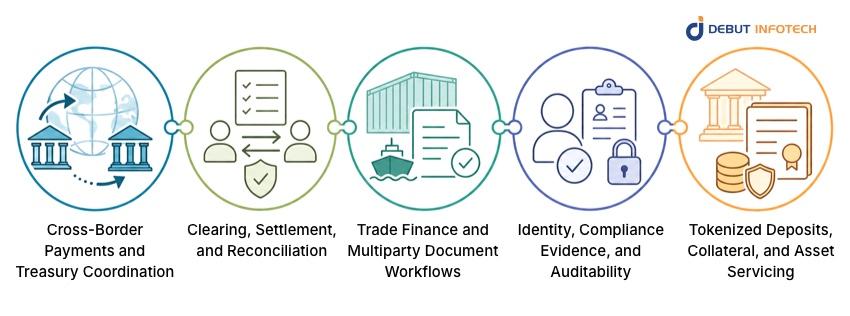
The most credible blockchain use cases without DeFi solve a multiparty record or workflow problem. They do not begin with tokens. Each case should be justified through four questions: What breaks today? How does a shared ledger change the mechanism? Which controls make it operable? Which KPI proves value? This keeps a pilot focused on business outcomes rather than transaction volume or technical novelty.
Cross-border payments can pass through different operating windows, correspondent relationships, ledgers, and liquidity accounts. A governed ledger can give participating institutions a synchronized view of payment status and execute approved conditions without opening the workflow to public lending or trading protocols. Swift announced its ledger was fully prepared for first use in July 2026, and 17 banks are already getting ready for piloting live transactions using tokenized deposits before settlement by the current systems. Controls need to cover all issues related to participant identity, sanctions screening, privacy, foreign exchange, liquidity and legal finality. Track completion times, returned payments, manual actions, prefunding and utilisation of liquidity.
Trading parties frequently maintain separate versions of the trade, asset, and cash records. A shared ledger can synchronize confirmed states and coordinate delivery-versus-payment when both legs are legally and technically connected. The design must also test whether shortening the settlement cycle reduces netting benefits or changes liquidity and funding needs. The Reserve Bank of Australia’s 2026 Project Acacia findings covered 20 tokenized-market use cases and several settlement assets. That variety illustrates why architectures must accommodate different forms of money and infrastructure. Define ownership, netting, finality, exception handling, resilience, and correction procedures. Track matching breaks, failed settlements, manual adjustments, elapsed settlement time, and intraday liquidity.
Importers, exporters, banks, carriers, and insurers may exchange the same information through disconnected document and approval processes. A common event history can show which document was issued, approved, transferred, or amended, while smart contracts initiate agreed steps after authorized inputs. UNCITRAL’s Model Law on Electronic Transferable Records is technology neutral and places emphasis on the importance of reliable control and record integrity; the use of a ledger does not create legal recognition or establish that there is a correlation between physical goods and their description. Maintain privacy of sensitive documents, establish authoritative signatures, and facilitate amendment and revocation. Track any document discrepancies, duplicate entry, approval time, financing turnaround and exception rates.
Repeated collection of customer and counterparty evidence increases onboarding effort and creates stale copies across institutions. A governed network can share signed attestations or record hashes while the underlying personal data remains in controlled repositories. The Hyperledger Fabric private-data design, for example, allows authorized organizations to hold confidential data while other network members use ledger hashes for validation. This is a practical form of blockchain without tokens. Production controls must cover issuer trust, credential scope, expiration, revocation, correction, access, consent, and retention. Track onboarding time, repeated document requests, stale credentials, review exceptions, and audit-preparation effort.
Cash, securities, collateral positions, and lifecycle events often sit in separate systems. A regulated claim can be represented digitally and connected to programmable payment, margin, coupon, redemption, or transfer instructions without becoming an open DeFi product. The 2026 prototype developed by BIS Project Agorá involved several tokenized commercial-bank deposits along with central bank reserves, which was used to illustrate atomic multi-currency settlement on a shared platform. The production use still needs to be determined by a legal claim, their issuer, redemption procedure, custody model, eligibility criteria, privacy controls and interoperability. Evaluate settlement time, collateral mobility, idle liquidity, exceptions in the servicing process, failed transfers and manual corrections.
Across all five cases, establish the current baseline before development. Blockchain creates value only if the shared state removes material coordination friction under an agreed governance model. When one trusted organization already owns the workflow, a database or shared API may achieve the same outcome with lower complexity.
No. Blockchain as a solution can only be justified if there is a coordination problem that a simpler design can’t solve as well. DeFi is more narrow: where open participation, on-chain assets, shared liquidity or composability is a requirement. Neither model should be selected merely to signal innovation or replace a functioning database.
Use the Enterprise Shared-State Suitability Test before approving a platform:
Passing all four gates does not automatically favor a permissioned network. If broad distribution, external liquidity, and protocol composability drive the product, a public-chain or DeFi model deserves evaluation. If identified participants, selective visibility, and accountable governance dominate, blockchain without DeFi may fit. When no meaningful cross-organizational trust boundary exists, neither is appropriate. The defensible choice is the least complex architecture that meets the workflow’s measurable business and control requirements.
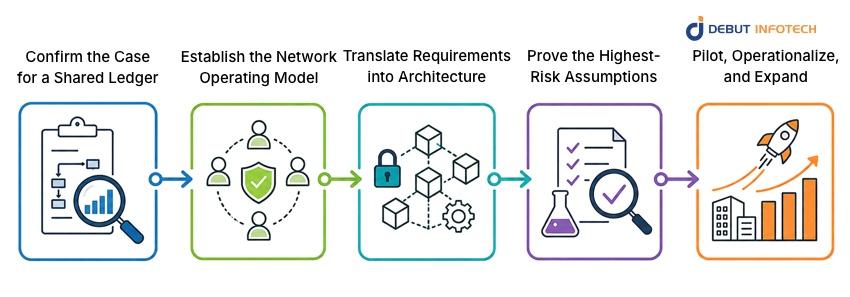
Getting an idea to production is not just a matter of proof of concept. An enterprise should have a gated program that ties the ledger to a business challenge, delegates authority to participants, and has a mechanism to determine if the network can function within a real financial, security and regulatory environment. The following roadmap keeps investment proportional to evidence.
Document the current workflow, participating organizations, systems of record, handoffs, reconciliation steps, exceptions, and control failures. Establish baseline measures for processing time, disputed records, manual effort, settlement exposure, and operating cost. Compare blockchain with a database, API, or managed shared platform. Proceed only if a distributed state creates a defensible advantage.
Output: An approved problem statement, baseline, target outcomes, and non-blockchain comparison.
Define participant roles before selecting a platform. Specify who may join, submit or validate transactions, view restricted information, change rules, fund the network, and respond to incidents. Legal and compliance teams should settle data ownership, liability, retention, dispute resolution, and exit provisions. This governance model is the institutional foundation for enterprise financial infrastructure.
Output: A signed governance charter and responsibility matrix.
Choose between permissioned, public and hybrid deployment based on identity, privacy, interoperability, resilience, performance and external distribution requirements. Describe on-chain and off-chain data boundaries, identity controls, key custody and integration patterns and upgrade mechanisms. Define blockchain security and blockchain compliance controls before the prototype is created, rather than after.
Output: An approved target architecture, threat model, and control plan.
Build a limited proof of value using representative transactions, permissions, integrations, and exception scenarios. Test whether smart contracts enforce agreed rules, authorized parties receive the correct data, failures can be recovered, and anticipated process improvements appear in practice. A polished demonstration is insufficient if it avoids the conditions most likely to cause failure.
Output: Test evidence and an explicit build, revise, or stop decision.
Run a controlled production pilot with limited participants and transaction volume. Full security, performance, resilience, recovery, audit and user-acceptance testing; training support teams; and documenting escalation procedures. Make comparisons between pilot results and original baseline. Expand only when service targets, governance procedures, and lifecycle economics remain acceptable as participation grows.
Output: A production acceptance record and evidence-based scaling plan.
Businesses can use blockchain consulting services to validate these gates before committing to full development. The successful outcome is not merely a live ledger; it is a governed network that improves a verified workflow and remains supportable throughout its operating life.
The right platform is one whose trust, privacy, execution and operating model aligns with the target workflow. Enterprises should not begin with a familiar vendor or headline throughput figure. Start with non-negotiable requirements, score candidates using evidence from a representative workload, and document every material trade-off.
| Platform | Native operating model | Consider when | Primary trade-off to validate |
| Hyperledger Fabric | Permissioned membership, policy-based governance, channels, private data collections, and endorsement policies | A consortium needs selective confidentiality and multi-organization transaction approval | Channel design, certificate operations, and chaincode governance add administrative complexity |
| R3 Corda | Permissioned application networks with need-to-know data sharing between transaction participants | Regulated parties need to exchange shared facts without broadcasting every record network-wide | Teams must align with Corda’s state, contract, flow, and JVM-based development model |
| Hyperledger Besu | Ethereum-compatible client supporting private permissioned networks, permissioning, and proof-of-authority options | The organization wants EVM tooling within a controlled validator network | Privacy, key management, permissioning, and operations require a complete supporting architecture |
| Public Ethereum | Public execution with open smart-contract interfaces and protocol composability | External verification, public assets, users, or ecosystem integrations are essential | Public data exposure, transaction fees, key custody, contract security, and regulatory controls |
Use weights based on business criticality, then eliminate candidates who have failed a mandatory privacy, security, legal or recovery control (even if they have a high total score). Permissioned design could suit a controlled membership in blockchain without DeFi, while public or hybrid infrastructure is still valid in cases where external verification and ecosystem reach is vital. The decision record should provide an explanation of why it was selected and what compromises have been made and what conditions would lead to reassessment.
The use of a distributed ledger does not remove operational risk from enterprises, it simply spreads the risk among organisations, nodes, identities and code. While committed records are protected by a ledger, other issues, such as faulty keys, incorrect entries, broken contracts or slow-moving governance, continue to interfere with service. Production review should therefore test failure and recovery, not rely on labels such as “immutable” or “permissioned.”
NIST defines blockchain as being tamper-evident and tamper-resistant. There’s still a much larger attack surface, including participant enrollment, private keys, nodes, APIs, administrator privileges, off-chain systems and smart contracts. Identity verification, key rotation and recovery, least-privilege access, hardening nodes, dependency management, code review, monitoring and incident procedures are essential components of effective blockchain security. The 2025 Smart Contract Top 10 features access-control, business-logic, input-validation and external-call vulnerabilities. Test invalid credentials, unauthorized membership, invalid input, contract failures, and node recovery before it is approved.
Blockchain compliance relies on the activity, participants, data and applicable jurisdictions, not on access being permissioned. Delegate accountability for data accuracy, lawful processing, data retention, data disclosure, accessibility for audits, corrections, regulatory reporting, outsourcing and transfer across borders. Implement sanctions or anti-money-laundering controls where appropriate for the service. Limit personal and confidential data that is recorded on-chain; if possible, capture source data in controlled environments and then note proofs or references on-chain. Legal, privacy, and compliance reviewers should approve the exact data flows.
Blockchain scalability should be judged by completed business processes, not raw ledger throughput. Capacity is determined by various factors such as endorsement requirements, privacy controls, execution of the contract, payload size, external APIs, reporting, node count, and the network conditions. Hyperledger Caliper offers a more holistic benchmark model that measures throughput, latency and resource usage. Test sustained peaks, bursts, node loss, ledger growth, catch up, batch processing and recovery. Establish thresholds for end-to-end latency, failure rate, resource usage and recovery time to grow the number of participating parties.
Technical consensus validates transactions under configured rules; it cannot assign liability or settle disagreements between institutions. A binding network charter should cover admission, removal, validation rights, upgrades, emergency action, incident communication, erroneous records, cost sharing, disputes, and termination. NIST CSF 2.0 places Govern alongside Identify, Protect, Detect, Respond, and Recover. Test the charter through scenarios involving a compromised operator, disputed upgrade, or unavailable validator.
A challenge is resolved only when an accountable owner accepts a measurable control, supporting evidence, and a recovery plan. These conditions belong in pilot exit criteria and participant agreements, keeping enterprise financial infrastructure supportable after launch.
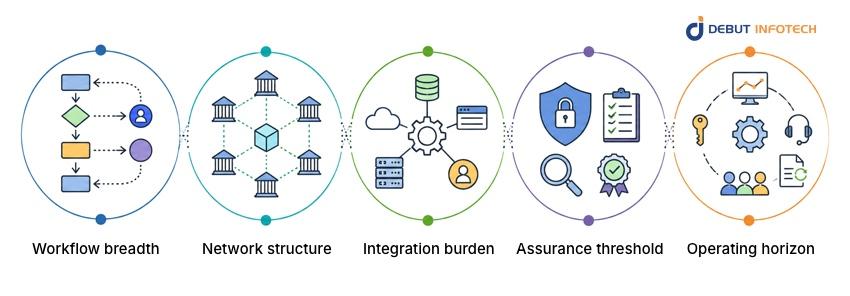
A credible budget starts with three artifacts: an approved process map, a participant and governance model, and an integration inventory. Without them, a price is largely an assumption. Five multipliers then determine how much design, engineering, assurance, and operating effort the project requires:
A proof of concept may omit high availability, full integrations, formal participant onboarding, and regulatory evidence. Its cost should not be treated as a production forecast. Ask the delivery partner to separate confirmed scope, provisional allowances, recurring expenses, exclusions, and the assumptions behind each estimate.
Blockchain without DeFi can reduce token, liquidity, public-wallet, and market-risk work, but it does not remove enterprise controls or shared-network operations. Blockchain development services should be priced after technical discovery, with estimated confidence increasing as architecture, integrations, and participant obligations become clearer.
Select a blockchain development partner who can establish that they are familiar with the business workflow, multiparty government, security requirements, and production operations, rather than just providing a list of supported chains. Apply an evidence first score card that has mandatory pass or fail controls.
Do a time-boxed discovery phase before giving full delivery. The problem statement must be validated, options for architecture, governance model, inventory of integrations, risk register, cost assumptions and proceed or stop recommendation. Give candidates the most clear weights and reject any partner that has failed a security, compliance, ownership or recovery requirement. The defensible choice is a qualified team that provides verifiable evidence and reduces lifecycle risk, not necessarily the lowest initial bid.
As a blockchain development company with hands-on experience since 2015, Debut Infotech has delivered solutions that move beyond proof of concept and into real business operations.
Our portfolio includes iFinca, a blockchain-powered coffee supply chain platform built for traceability and transparency, and IntegraLedger, applying blockchain for legal document integrity and verification. We have also supported Everledger with blockchain-based asset provenance and traceability for high-value goods.
Our digital asset work includes NDAX for crypto exchange and wallet infrastructure, PRC for real estate tokenization and digital asset trading, and RVA, a real estate tokenization platform built on Ethereum and Polygon using ERC-3643 smart contracts for permissioned fractional ownership and compliant investor workflows.
Our experience also spans crypto exchange ecosystems including OKX and DeFi solutions. Debut Infotech also created FabDep, a Hyperledger Fabric deployment framework that streamlines enterprise blockchain network setup.
This combination of enterprise blockchain and digital asset experience enables our teams to evaluate the right architecture before development and engineer solutions for real-world deployment, integration, and scale.
Planning to bring blockchain into your business? Let’s define the right use case and architecture.
Blockchain is a ledger and coordination architecture that allows multiple parties to share and verify transaction state under agreed rules. DeFi is an application model that uses public blockchain networks and open smart contracts to provide financial services. An enterprise can use blockchain for records, settlement, identity, or workflow automation without offering permissionless lending, trading, staking, or liquidity services.
The premise is not universal; some enterprises use or connect with DeFi. Others limit exposure because public participation, pseudonymous counterparties, token volatility, smart-contract vulnerabilities, oracle dependence, and uncertain legal responsibilities may exceed their risk tolerance. A controlled public-chain or hybrid model can still deserve evaluation when external liquidity, distribution, or protocol composability is essential to the product.
Yes. Permissioned networks can use verified participants, approved validators, and contractual governance without a native tradable asset. Blockchain without tokens can record events, verify documents, manage shared asset states, and coordinate approvals. Whether transaction fees or internal utility units are needed depends on the platform. A token should be introduced only when it performs a necessary operational or economic function.
Blockchain matters when independent institutions need a shared, tamper-evident transaction history and current processes rely heavily on reconciliation. It can synchronize evidence, preserve provenance, and execute agreed rules consistently across participants. However, it is not automatically superior infrastructure. If a trusted operator, conventional database, and secure APIs can satisfy the workflow, blockchain may introduce unnecessary governance and operational complexity.
A shared ledger can give participating institutions a consistent view of payment instructions, status changes, approvals, and settlement conditions. Smart contracts can coordinate conditional actions and reduce sequential handoffs. Faster settlement is not guaranteed, however. Benefits depend on integration with regulated money, foreign-exchange processes, compliance checks, operating hours, and final settlement systems; unresolved off-chain delays can remain the limiting factor.

Our Latest Insights
USA
2501 Chatham, Rd Suite R Springfield, IL 62704
+1-708-515-4004
info@debutinfotech.com
UK
7 Pound Close, Yarnton, Oxfordshire, OX51QG
+44-770-304-0079
info@debutinfotech.com
Canada
154 Eden Oak Trail, Kitchener, ON N2A 0H9
+1-708-515-4004
info@debutinfotech.com
INDIA
Sector 101-A, Plot No: I-42, IT City Rd, JLPL Industrial Area, Mohali, PB 140306
9888402396
info@debutinfotech.com