ON THIS PAGE
Progress0%
Our Global Presence :


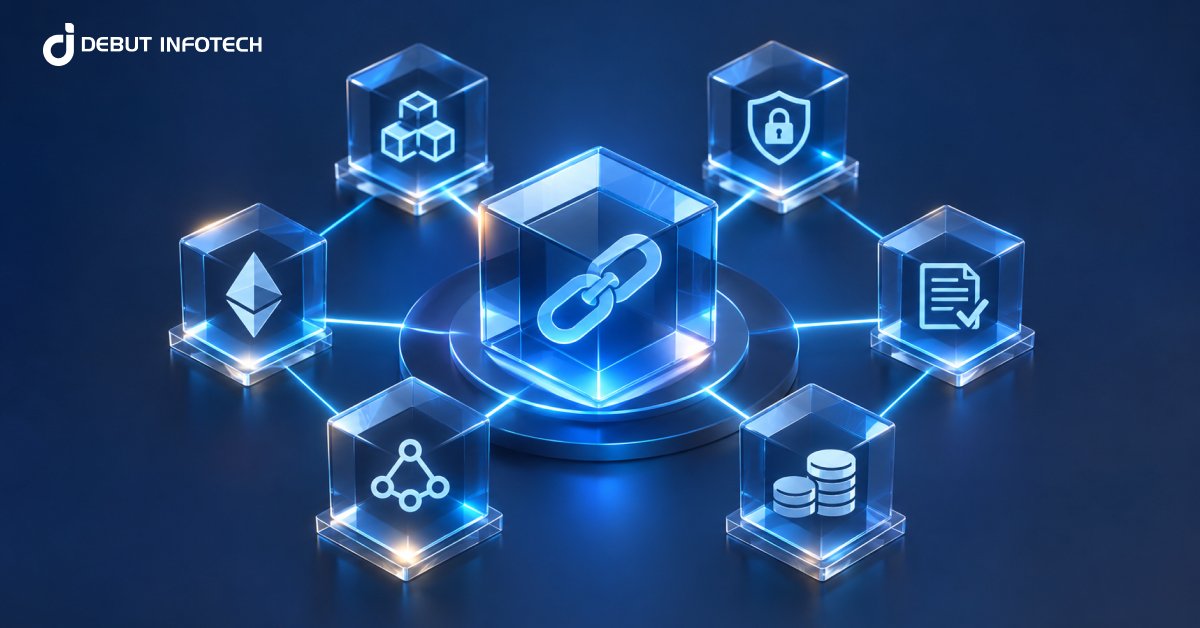


Some focus on DeFi, smart contracts, and protocol engineering, while others specialize in enterprise blockchain, RWA tokenization, exchanges, and full-stack Web3 applications.
Evaluate live blockchain deployments, documented project portfolios, mainnet experience, and post-launch support rather than relying solely on company-reported project counts.
Smart contract audits, multi-signature key management, penetration testing, transaction monitoring, and incident response should be core vendor evaluation criteria.
Development partners should connect blockchain infrastructure with existing ERP, CRM, cloud platforms, APIs, payment systems, and identity solutions.
Ethereum, Solana, Polygon, Hyperledger Fabric, Corda, and Layer 2 networks offer different trade-offs in scalability, privacy, governance, interoperability, and performance.
Proofs of concept may take several weeks, while production-grade platforms can require several months or longer, depending on smart contracts, integrations, compliance, and security audits.
Compare technical expertise, industry experience, regulatory awareness, delivery capabilities, communication, and long-term maintenance before making a vendor decision.
Blockchain has moved well beyond the phase where businesses were testing whether distributed ledgers could work outside cryptocurrency.
In 2027, the bigger question is whether blockchain can perform reliably inside financial infrastructure, tokenized asset markets, enterprise workflows, payments, supply chains, identity systems, and other production environments.
The economics around that shift are significant. Fortune Business Insights estimates the global blockchain technology market at $47.96 billion in 2026, with growth projected to reach $577.36 billion by 2034. North America accounted for 43.8% of the market in 2025. Grand View Research separately estimates that the U.S. blockchain technology market could reach roughly $402 billion by 2030. Fortune Business Insights
Growth, however, does not make blockchain implementation easier.
The engineering requirements have become more demanding as projects move into real-world environments. Smart contracts may control financial assets. Tokenization platforms can require identity, compliance, transfer restrictions, custody, and payment infrastructure. Enterprise blockchain networks may need to connect with ERP, CRM, cloud, data, and legacy systems.
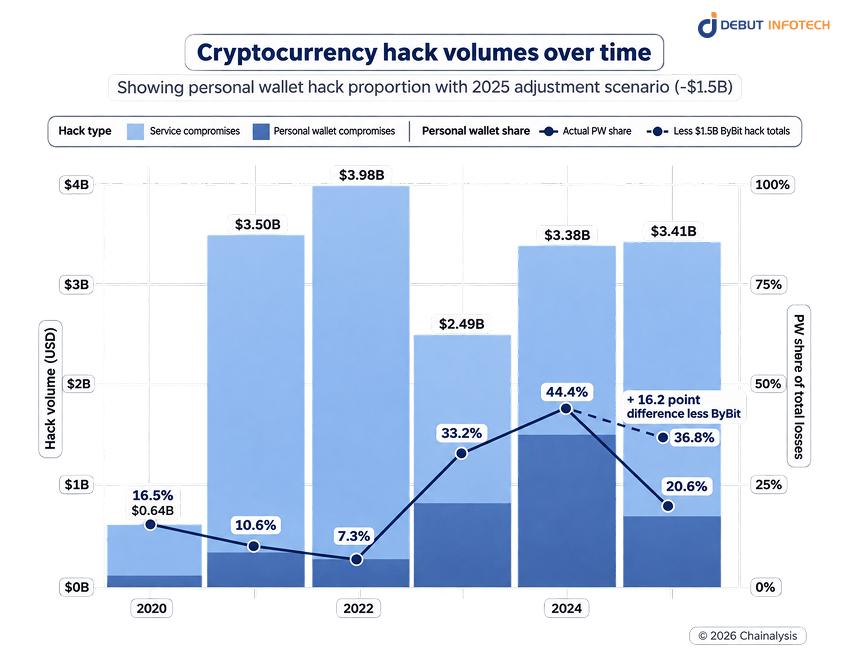
Security raises the stakes further. Chainalysis reported more than $3.4 billion in cryptocurrency stolen during 2025, with large compromises increasingly concentrated around high-value services and key infrastructure.
Against that backdrop, choosing the right blockchain development company is no longer a simple matter of finding developers who know Ethereum or Solidity.
Businesses need engineering partners capable of making the jump from an early idea to software that can survive production.
To make that search more practical, we evaluated blockchain development companies serving the market based on delivery experience, blockchain specialization, production evidence, full-stack capability, security maturity, and relevance to enterprise and Web3 use cases.
There is no single authoritative ranking of the best blockchain development companies. Clutch, GoodFirms, DesignRush, independent editorial publications, and company websites all surface different providers because each applies a different methodology. Some prioritize verified reviews. Others emphasize service concentration, market presence, project history, technical specialization, or sponsored visibility.
For this list, we looked at six factors that matter more directly to a technology buyer:
| Evaluation Area | What We Considered |
| Blockchain delivery | Production projects, live systems, mainnet deployments, and documented portfolio evidence |
| Technical depth | Smart contracts, DeFi, enterprise DLT, tokenization, exchanges, wallets, protocols, and infrastructure |
| Full-stack capability | Ability to connect blockchain with APIs, cloud, mobile, web, identity, data, and enterprise systems |
| Security | Auditing, testing, security engineering, key management, monitoring, and production controls |
| Market relevance | U.S. operations, market presence, clients, or established delivery to U.S. organizations |
| Independent signals | Reviews, external recognitions, partnerships, ecosystem contributions, and recurring market visibility |
The numbered order is therefore an editorial assessment, not a claim that one universal market ranking exists.
| Company | Best Suited For | Core Strength |
| Debut Infotech | Enterprise and digital asset products | Tokenization, exchanges, Hyperledger, wallets, enterprise blockchain |
| Protofire | Protocol and infrastructure programs | DeFi, RWA, oracles, validators, smart contracts |
| PixelPlex | Web3 and tokenization ecosystems | RWA, DeFi, custom protocols, cross-chain systems |
| ScienceSoft | Enterprise blockchain adoption | DLT, private networks, compliance, enterprise integrations |
| Appinventiv | Full-cycle blockchain applications | dApps, enterprise blockchain, tokenization, mobile integration |
| SoluLab | Multi-chain blockchain products | DEXs, DAOs, tokenization, Layer 1/2 |
| LeewayHertz | Enterprise technology programs | Blockchain plus AI, IoT, cloud, and software integration |
| Unicsoft | Tokenization and Web3 products | RWA, dApps, wallets, enterprise blockchain |
| Pharos Production | Security-conscious Web3 projects | Smart contracts, DeFi, audits, infrastructure |
| Boosty Labs | Blockchain-native infrastructure | Exchanges, DeFi, bridges, crypto infrastructure |
| Antier Solutions | Large Web3 ecosystems | Exchanges, DeFi, token economies, white-label products |
| Interexy | User-facing blockchain products | dApps, wallets, Web3, blockchain mobile apps |
| SDLC Corp | Full-cycle blockchain implementation | Exchanges, tokenization, wallets, enterprise DLT |
| Suffescom Solutions | Crypto and Web3 products | Exchanges, dApps, Layer 2, wallets, DeFi |
| Serokell | Advanced distributed systems | Protocols, smart contracts, cryptography, custom blockchain |

Best suited for: Enterprise blockchain, digital asset platforms, regulated tokenization, exchanges, and blockchain products requiring broader software engineering.
Debut Infotech has been active in blockchain development since 2015 and currently reports 50+ blockchain implementations supported by more than 100 engineers working across distributed ledger technologies and security. Its blockchain practice extends across Hyperledger, public chains, tokenization, smart contracts, crypto exchanges, wallets, DeFi, interoperability, and enterprise blockchain.
The differentiator is the range of operating environments represented in its portfolio.
NDAX combines exchange infrastructure, multi-chain wallets, trading automation, security, and regulated digital asset workflows. iFinca uses Hyperledger Fabric to create traceability across the coffee supply chain, while Integra Ledger applies distributed ledger technology to legal document authenticity and collaboration. Debut has also worked on real estate tokenization, private capital infrastructure, healthcare blockchain systems, ICO platforms, provenance systems, and enterprise DLT applications.
That breadth makes the company particularly relevant when blockchain needs to operate alongside mobile applications, cloud infrastructure, enterprise APIs, payment systems, AI, and traditional software.
Why it stands out: Blockchain is treated as part of the complete product architecture rather than an isolated ledger implementation.

Best suited for: Protocol engineering, institutional on-chain finance, DeFi, RWA infrastructure, oracles, indexing, and blockchain systems closer to the infrastructure layer.
Protofire is one of the most technically specialized companies in this comparison.
The company reports 250+ projects shipped since 2016 across 60+ blockchain networks and 95+ protocols. Its work extends far beyond conventional dApp development into stablecoins, lending protocols, DEXs, tokenized assets, vaults, validators, node infrastructure, indexing, oracles, governance, and interoperability.
Its open-source footprint adds another layer of technical credibility. Protofire maintains Solhint, contributes to the Chainlink ecosystem, works with Safe infrastructure, and has operated across ecosystems involving Aave, Balancer, MakerDAO, Filecoin, and the Ethereum Foundation.
This is not necessarily the team a company needs for a straightforward loyalty dApp.
It becomes considerably more relevant when the product itself depends on complex on-chain infrastructure, financial primitives, protocol integrations, or systems where the contracts and surrounding infrastructure carry material financial risk.
Why it stands out: Deep blockchain-native engineering and visible contributions to production Web3 infrastructure.

Best suited for: Custom Web3 products, real-world asset tokenization, public and private blockchain systems, DeFi, and technically ambitious decentralized ecosystems.
PixelPlex reports 13 years of blockchain experience and 47 blockchain projects launched, backed by a broader team working across Web3, protocol engineering, tokenization, smart contracts, wallets, DAO infrastructure, and custom blockchains.
Its current offering reflects where blockchain demand is moving.
Alongside Ethereum, Solana, Polygon, Hyperledger, and other established ecosystems, PixelPlex works with institutional and privacy-oriented infrastructure, tokenized assets, interoperability, Layer 1 development, and advanced Web3 security.
Its RWA work is particularly relevant for businesses considering blockchain for financial or ownership structures rather than purely crypto-native products. The company supports permissioned tokenization, secondary trading, KYC integration, and enterprise system connectivity.
PixelPlex also combines blockchain engineering with R&D and security work. That gives it a stronger fit for projects requiring custom technical design rather than a largely preconfigured platform.
Why it stands out: Broad Web3 engineering depth coupled with significant experience in tokenization, infrastructure, and custom blockchain R&D.

Best suited for: Established enterprises bringing blockchain into complex, regulated, or existing corporate technology environments.
ScienceSoft takes a noticeably enterprise-oriented approach.
The company has operated in custom software engineering since 1989 and has provided dedicated enterprise blockchain and cryptocurrency development since 2020. Its supported use cases include private and public networks, hybrid blockchain, tokenization, wallets, cross-chain systems, and enterprise blockchain applications.
Where ScienceSoft becomes particularly relevant is around integration and governance.
Its wider expertise covers cybersecurity, healthcare, insurance, financial services, retail, and manufacturing, while its blockchain material explicitly addresses compliance considerations such as SEC requirements, HIPAA, CCPA, NYDFS, and other case-specific frameworks.
The company also works with Ethereum, Hyperledger Fabric, Solana, Polygon, Polkadot, Corda, Avalanche, Cardano, and other distributed technologies.
For organizations that already have substantial enterprise infrastructure in place, those surrounding capabilities can matter more than pure Web3 specialization.
Why it stands out: Strong enterprise software, cybersecurity, compliance, and systems-integration background around the blockchain layer.

Best suited for: Full-cycle blockchain applications where decentralized functionality needs to connect with web, mobile, cloud, design, and broader digital product engineering.
Appinventiv approaches blockchain as part of a larger product engineering portfolio.
Its blockchain development offering covers consulting, dApps, smart contract development and auditing, Ethereum, Layer 2, permissioned networks, proofs of concept, wallets, exchanges, Solidity development, integrations, and enterprise blockchain systems.
Its dApp practice also extends into tokenization platforms, DAOs, DeFi applications, NFT marketplaces, and smart contracts, with published experience across networks such as Ethereum, Hyperledger, Polygon, Solana, Corda, Stellar, and Tezos.
What makes Appinventiv relevant is not protocol specialization alone. The company combines blockchain with a much larger engineering organization covering AI, cloud, mobility, data, IoT, and application development.
For buyers, that can be valuable when the decentralized element represents one part of a larger customer or enterprise platform.
Why it stands out: Strong full-cycle product engineering around blockchain-enabled applications, particularly where mobile and enterprise software are also required.

Best suited for: Multi-chain products, DeFi, exchanges, tokenization, DAOs, Layer 1 and Layer 2 ecosystems.
SoluLab reports 150+ blockchain projects delivered, positioning its practice around decentralized infrastructure that ranges from custom smart contracts and exchanges to tokenization platforms, DAO ecosystems, and enterprise blockchain applications.
The company has also expanded its capabilities around multi-chain interoperability, decentralized identity, launchpads, and blockchain systems that incorporate AI.
That gives SoluLab a broad coverage model.
It may be particularly relevant for founders or enterprises that need one development team to handle smart contracts, backend systems, frontend applications, security testing, and deployment instead of engaging multiple specialized blockchain vendors.
Its published portfolio includes multi-chain DEX architecture and enterprise blockchain-as-a-service implementations.
Why it stands out: Broad end-to-end coverage across both blockchain-native products and enterprise use cases, with strong emphasis on multi-chain development.

Best suited for: Enterprises where blockchain is part of a broader emerging-technology or digital transformation program.
LeewayHertz reports more than 15 years of software engineering experience and 160+ custom software products delivered. Blockchain sits alongside AI, IoT, cloud, mobile, and enterprise software within that wider engineering practice.
Its blockchain capabilities include Ethereum, Hyperledger, Stellar, Solana, smart contracts, decentralized exchanges, bridges, tokens, and blockchain-enabled enterprise platforms.
That positioning makes sense for organizations that are not building a Web3-native company but want distributed technology integrated into a wider operating system.
For instance, an enterprise blockchain initiative may also require analytics, customer applications, cloud services, business workflow automation, identity, or AI capabilities. LeewayHertz can cover several of those layers through the same engineering organization.
Why it stands out: The combination of blockchain with broader enterprise software and emerging technology capabilities.

Best suited for: Real-world asset tokenization, dApps, wallets, enterprise blockchain, and multi-protocol Web3 products.
Unicsoft reports 50+ dApps launched and experienced across more than 40 blockchain protocols. Its offering spans tokenization, enterprise blockchain, wallets, smart contracts, exchanges, DeFi, and other decentralized products.
Asset tokenization is one of its more notable focus areas.
The company works with asset types ranging from real estate and equities to intellectual property, precious metals, and loyalty assets. On the enterprise side, Unicsoft supports technologies including Hyperledger, Corda, and Quorum.
Its portfolio also reflects experience across FinTech, supply chain, manufacturing, retail, and other industries.
That makes Unicsoft a useful option for businesses that need blockchain-native capability while still expecting structured product delivery and conventional software engineering around it.
Why it stands out: Strong multi-protocol expertise with practical depth in tokenization and enterprise blockchain.

Best suited for: Smart contracts, DeFi, wallets, and blockchain products where security and technical review are major buying criteria.
Pharos Production reports 30+ blockchain projects and more than seven years in Web3, with a development model that places security and auditing relatively close to the core engineering process.
That security-first position is increasingly relevant.
Blockchain vulnerabilities can have immediate financial consequences, which makes the quality of contract testing, deployment controls, infrastructure protection, and monitoring materially important.
Pharos works across smart contract development, crypto wallets, blockchain applications, DeFi, and related infrastructure. Its public materials also highlight ISO 27001-aligned and SOC 2-aligned processes.
For organizations where asset security outweighs the need for a large, diversified technology partner, that narrower focus can be useful.
Why it stands out: Strong security positioning around blockchain application and smart contract engineering.

Best suited for: Exchanges, DeFi, bridges, crypto infrastructure, and engineering-intensive Web3 initiatives.
Boosty Labs describes itself as having roughly a decade of experience across blockchain, cryptocurrency exchange software, Web3, smart contracts, and multi-chain infrastructure.
Its market profile is notably blockchain-native.
The company has publicly associated its work with recognizable Web3 organizations and infrastructure-heavy projects rather than concentrating only on conventional business applications with a blockchain feature added.
This matters for buyers building systems such as exchange infrastructure, decentralized storage, bridges, crypto trading products, or complex DeFi services.
These products require engineering decisions that are quite different from those involved in a permissioned enterprise ledger.
Boosty Labs therefore makes more sense where blockchain is the product’s core infrastructure rather than one technology among several.
Why it stands out: Strong Web3-native engineering orientation with experience closer to crypto and decentralized infrastructure.

Best suited for: Large blockchain delivery programs, exchanges, token economies, DeFi, and white-label Web3 products.
The company states that it has 1,000+ professionals and 1,200+ enterprise implementations, while supporting ecosystems including Ethereum, Polygon, BNB Chain, Corda, Cardano, Avalanche, and others.
Its service footprint is particularly broad across exchanges, wallets, tokens, DeFi, NFTs, metaverse products, crypto launchpads, and Web3 infrastructure.
For buyers, scale is the main consideration.
Large development programs may require several engineering disciplines to move at the same time, and an organization with substantial delivery capacity can assemble those teams more quickly than a boutique Web3 studio.
Companies should still clarify how Antier defines “enterprise implementations,” since that is a company-reported metric rather than an independently audited project count.
Why it stands out: Large blockchain-focused workforce and extensive coverage of commercial Web3 product categories.

Best suited for: Startups and businesses developing user-facing blockchain, Web3, mobile, and decentralized applications.
Interexy operates at the intersection of blockchain and digital product development.
Its blockchain services include dApps, smart contracts, wallets, blockchain ecosystems, ICO-related technical development, bridges, DEXs, NFTs, and blockchain-enabled healthcare solutions.
The product-development orientation is important.
Not every blockchain project needs custom protocol engineering. A consumer wallet, marketplace, Web3 mobile application, healthcare product, or decentralized service also needs good user experience, application architecture, backend systems, and conventional product engineering.
That is where a firm such as Interexy can be more appropriate than an infrastructure-heavy blockchain consultancy.
Why it stands out: Combines blockchain with mobile and product development, making it relevant for customer-facing Web3 applications.

Best suited for: Companies seeking broad blockchain delivery across exchanges, tokenization, wallets, smart contracts, enterprise applications, and post-launch operations.
SDLC Corp reports 120+ blockchain projects delivered, alongside experience in crypto exchanges, tokenization, custody wallets, smart contracts, compliance, and enterprise blockchain.
The company’s service scope is wide.
Its exchange work covers CEX, DEX, and hybrid platforms, while its tokenization offering includes asset digitization, governance, vesting, and compliance modules. Security services include manual review, static analysis, fuzz testing, and smart contract controls.
For enterprise clients, SDLC also supports Hyperledger Fabric, Corda, Ethereum, Solana, Avalanche, and other distributed technologies.
The breadth gives buyers a large menu of services, though it makes portfolio validation especially important. Organizations should compare specific reference projects against the actual complexity of their planned system.
Why it stands out: Wide blockchain service coverage combined with enterprise integration and security capabilities.

Best suited for: Crypto exchanges, wallets, Layer 2 products, dApps, DeFi, and commercially oriented Web3 platforms.
Suffescom currently reports 250+ blockchain solutions delivered, 250+ certified experts, and support across more than 15 blockchain ecosystems.
Its portfolio emphasizes products that tend to sit close to the commercial side of Web3: centralized and decentralized exchanges, wallets, dApps, token platforms, Layer 2 development, DeFi, and crypto-oriented FinTech.
The company also highlights security controls, KYC and AML integration, smart contract auditing, continuous monitoring, and ISO 27001 certification.
For businesses trying to launch a market-facing Web3 product rather than invent a new blockchain protocol, that combination of breadth and delivery capacity can be attractive.
Why it stands out: Significant delivery scale across common commercial blockchain and Web3 product models.

Best suited for: Technically complex distributed systems, custom protocols, cryptography, formal engineering, and blockchain applications where conventional frameworks are not enough.
Serokell approaches blockchain from a software research and advanced engineering perspective.
Its services cover public and private blockchain systems, dApps, DeFi, cross-chain bridges, security audits, and fully customized distributed infrastructure. The company also works deeply with functional programming, cryptography, and distributed systems.
That makes Serokell somewhat different from the high-volume product companies elsewhere on this list.
The company may be particularly relevant when a project involves unusual consensus requirements, custom blockchain architecture, specialized smart contract languages, or technically demanding financial systems.
A straightforward wallet or NFT marketplace may not require that level of engineering.
A novel protocol might.
Why it stands out: Research-led engineering depth for blockchain problems that cannot be solved cleanly with off-the-shelf architecture.
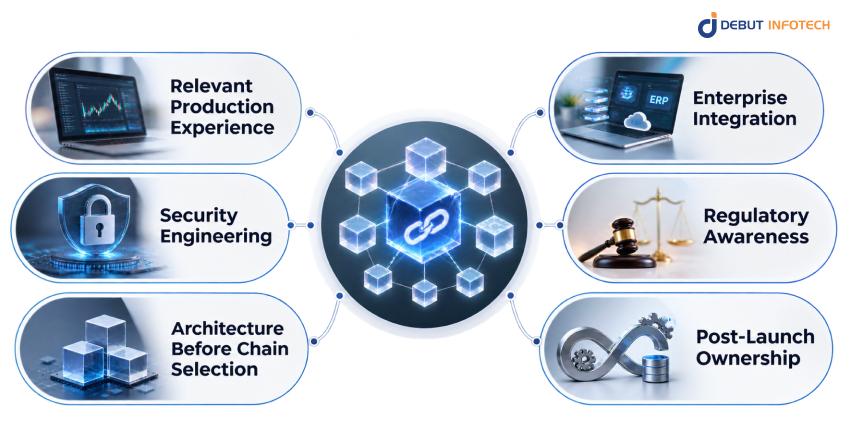
A long list of supported chains can look impressive, but it is rarely the best way to select a development partner.
The stronger question is whether the company has already dealt with problems similar to the ones your product will face.
A cryptocurrency exchange needs wallet security, trading infrastructure, liquidity, monitoring, identity controls, and regulatory workflows. A tokenized asset platform needs a very different combination of transfer rules, investor onboarding, custody, token standards, and legal coordination.
Enterprise blockchain changes the picture again.
These systems may depend on permissioned participation, privacy, governance, data synchronization, and integration with ERP, CRM, EHR, supply chain, or internal databases.
A useful evaluation should therefore cover the following areas.
Ask for live systems, not just technical demonstrations.
A team that has taken a comparable product into production is more likely to understand what surfaces after the proof of concept: infrastructure failures, transaction costs, smart contract upgrades, data migration, operational permissions, monitoring, and user behavior.
This is one area where blockchain projects have little room for shortcuts.
Chainalysis estimates that more than $3.4 billion in cryptocurrency was stolen during 2025. The largest incidents demonstrate just how quickly security weaknesses around infrastructure, keys, integrations, or authorization can become financial losses.
Ask how the development company approaches contract reviews, key management, multisig controls, independent audits, penetration testing, transaction monitoring, and incident response.
Be cautious if a development company recommends a blockchain before understanding the product.
Ethereum, Solana, Polygon, Hyperledger Fabric, Avalanche, Canton, Corda, and various Layer 2 networks solve different problems.
The architecture should follow the operating requirements.
Blockchain rarely replaces every existing system.
A production product may still rely on cloud infrastructure, databases, API gateways, payment processors, CRM, ERP, identity platforms, KYC providers, analytics, and mobile applications.
The blockchain team needs to understand those systems too.
Regulation becomes particularly important for exchanges, tokenization, financial services, healthcare, payments, identity, and custody.
A development company does not replace legal counsel, but its engineering team should understand how regulatory requirements translate into product controls.
Mainnet launch is a milestone, not the end of the project.
Network upgrade. Contracts may need controlled changes. Security threats evolve. Infrastructure costs fluctuate. New integrations appear.
Clarify maintenance responsibilities before development starts.
The best provider changes with the problem.
For a protocol, oracle, validator stack, or institutional DeFi infrastructure, a blockchain-native engineering company such as Protofire deserves serious consideration.
For RWA tokenization, Web3 platforms, and custom decentralized ecosystems, companies such as Debut Infotech, PixelPlex, Unicsoft, and SoluLab bring broader experience across the product stack.
If blockchain needs to sit inside an established enterprise architecture, ScienceSoft, Debut Infotech, LeewayHertz, and Appinventiv combine blockchain with wider enterprise and software engineering capabilities.
For product-driven Web3 applications, firms such as Debut Infotech, Interexy and Suffescom may offer the right mix of application development and blockchain expertise.
If the problem involves unusually complex distributed systems or low-level architecture, Serokell offers a different type of engineering depth.
The key is not to choose the company with the most blockchain logos on its website.
Choose the one whose previous engineering problems most closely resemble your business requirements.
There is no reliable universal price range because project complexity varies significantly.
A simple smart contract, a proof of concept, a multi-chain wallet, an institutional exchange, and a regulated tokenization platform require very different teams and infrastructure.
For procurement, request separate estimates for architecture, application development, smart contracts, integrations, security audits, infrastructure, third-party services, and post-launch support.
A focused proof of concept may take several weeks. A production-grade blockchain platform can take several months or longer.
The largest schedule drivers tend to be smart contract complexity, compliance workflows, external integrations, security audits, infrastructure, and the number of applications surrounding the blockchain.
There is no universally best network.
Ethereum offers deep ecosystem maturity. Solana is frequently selected for high-throughput consumer and financial applications. Polygon and other Ethereum scaling networks can reduce transaction friction. Hyperledger Fabric can suit controlled enterprise environments, while other networks offer different tradeoffs around privacy, interoperability, performance, and governance.
The appropriate chain should follow the use case.
Location is only one factor.
U.S. teams can simplify procurement, time-zone coordination, and stakeholder access. Distributed teams can provide larger talent pools and different cost structures.
Production experience, security practices, communication, architecture quality, IP ownership, and delivery governance generally matter more than geography alone.

Our Latest Insights
USA
2501 Chatham, Rd Suite R Springfield, IL 62704
+1-708-515-4004
info@debutinfotech.com
UK
7 Pound Close, Yarnton, Oxfordshire, OX51QG
+44-770-304-0079
info@debutinfotech.com
Canada
154 Eden Oak Trail, Kitchener, ON N2A 0H9
+1-708-515-4004
info@debutinfotech.com
INDIA
Sector 101-A, Plot No: I-42, IT City Rd, JLPL Industrial Area, Mohali, PB 140306
9888402396
info@debutinfotech.com