ON THIS PAGE
Progress0%






Our Global Presence :



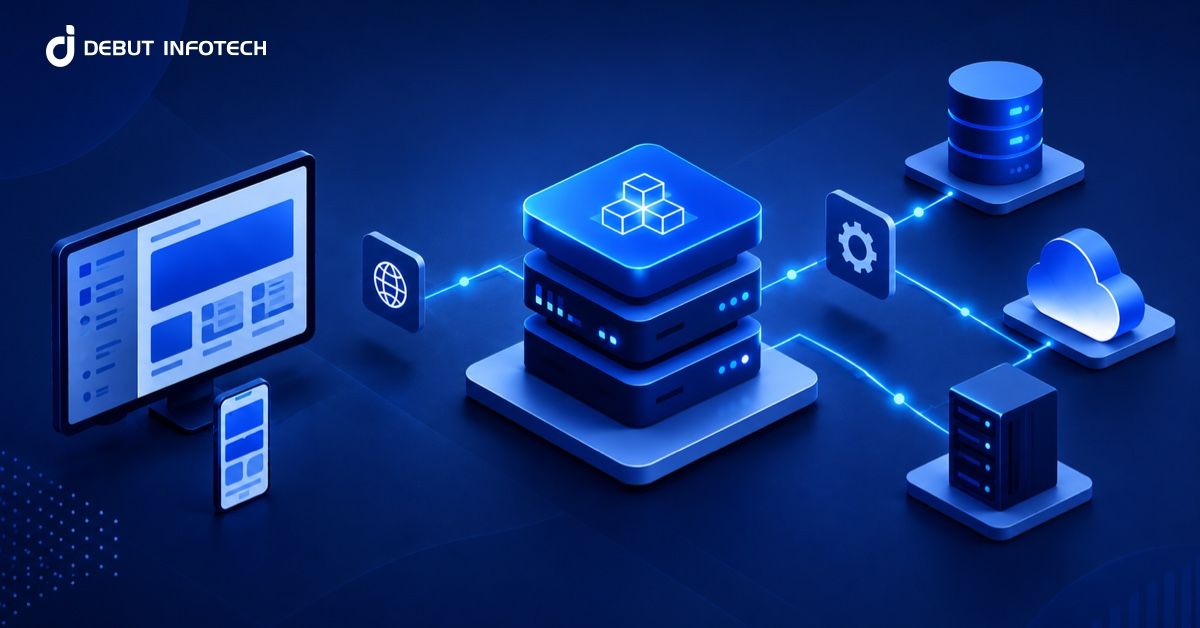


Today’s technology-enabled economy runs on applications, which are vital for driving business processes, engaging consumers, and generating income. Web app architecture is important because it is one of the most significant decisions any organization can make. If your application performs well, scales, and adapts to meet business needs, then you have a good architecture.
Applications need to manage millions of connected users. It also needs to function flawlessly on every device and connect to different services. That’s why organizations are migrating from inflexible systems to scalable web architecture. This also includes cloud-native web apps and flexible deployment strategies that enable innovation.
In this post, we’ll go over the structure, components, and best practices of modern web architecture, and help you get insight into developing systems that are not just efficient, but also future-ready.
To understand modern systems, we need to ask a simple question. What does modern web application architecture look like?
In current construction methods, scalability, dispersion, and modularity usually replace other, more traditional approaches. Instead of one huge software system, we now have a bunch of independent services that can communicate with each other via explicit interfaces.
At a high level, a modern web app architecture looks like this:
This modular strategy allows development teams to develop multiple components simultaneously, update components independently, and scale specific areas of the system without affecting the entire application.
Companies that invest in custom software development can develop new ideas faster and with less operational risk.
It is essential to comprehend the fundamental components driving existing applications in order to build efficient systems. Together, these components deliver a unified, but flexible environment
| Component | Role in Architecture | Common Technologies |
| Frontend Layer | Handles user interface and user experience | React, Angular, Vue |
| Backend Layer | Processes logic, handles requests, manages workflows | Node.js, Python, Java |
| API Layer | Connects frontend and backend systems | REST, GraphQL |
| Data Layer | Stores and manages application data | MySQL, PostgreSQL, MongoDB |
| Infrastructure Layer | Provides hosting, scaling, and deployment environment | AWS, Azure, Google Cloud |
| DevOps & CI/CD | Automates deployment and monitoring | Docker, Kubernetes, Jenkins |
The part users see in the program is called the frontend layer. This includes all the things a user can see and interact with, like interfaces, animations, and responsiveness.
Today’s frontend development is all about performance and usability. React, Angular, and Vue frameworks help developers create highly interactive interfaces that respond immediately to user interaction.
Further, the distribution mode of web applications has also been revolutionized by the advent of Progressive Web Apps. A PWA development company can aid organizations in developing applications that function like native mobile apps, yet operate inside a browser. This gives you easier access and less labor to produce.
The frontend layer is closely integrated with the backend services via APIs, making it an integral aspect of the frontend backend architecture.
The backend is the place where the requests are processed, the business logic is implemented, and the data flow is controlled.
Modern back-end systems are increasingly built in a web-style microservice architecture. We’ve broken the backend into smaller services; we don’t have one big application that handles everything. Each of those services does one unique task.
For example, in an eCommerce application:
This is a common technique inside organizations that develop business software to successfully manage intricate systems. It makes the system more scalable, and separate components are easier to maintain and update.
Together, APIs make current apps work. They provide communication between the front-end and back-end, as well as between different services inside the system.
Because of this API-driven architecture, all components can communicate, independent of the technology. Companies can incorporate third-party solutions, enhance functionality, and ensure consistency across platforms.
APIs provide integrations with such as:
These kinds of connections are essential for today’s distributed web systems, where several services must coordinate their actions in real-time.
This is the central location for storing, processing, and retrieving application data. This includes databases, caches, and data pipelines.
Modern applications commonly blend
This is critical for data management, so apps do not lag during a significant traffic load.
The foundation for apps is the infrastructure layer. Most programs today are delivered on the cloud, and cloud-native web applications are the norm.
Cloud platforms offer:
Building on cloud-native technology is a key long-term scalability factor for businesses that use web development services.
We can better understand current systems if we know how web app architecture patterns have changed over time.
Monolithic architecture entails the process of embedding and distributing all the application constituents in one unit, which is simple at the first stage but challenging to expand.
Layered architecture, however, enhances organization and management but is tightly coupled and is not scalable.
Microservices architecture solves this by separating applications and making them smaller, independent services to be able to scale and deploy. Serverless architecture allows developers to scale dynamically and operate without managing servers, without incurring the cost of maintaining servers.
| Architecture Type | Key Characteristics | Pros | Cons | Best Use Case |
| Monolithic Architecture | Single unified codebase | Simple to build, easy to start | Hard to scale, difficult to maintain | Small apps, MVPs |
| Layered (N-tier) | Separated into presentation, logic, and data layers | Better organization, easier maintenance | Limited scalability | Traditional enterprise systems |
| Microservices | Independent, loosely coupled services | Highly scalable, flexible, and fault isolation | Complex to manage, higher initial cost | Large, scalable web applications |
| Serverless Architecture | Code runs on-demand without server management | Cost-efficient, auto-scaling | Vendor lock-in, limited control | Event-driven apps, startups |
| Distributed Systems | Components spread across multiple servers/locations | High availability, global performance | Complex data consistency & coordination | Global, high-traffic platforms |
Microservices give you modularity, and APIs give you the means to communicate between those modules. Together, they create a flexible and scalable system.
This combination enables organizations to:
If a payment service goes down, it doesn’t knock down the whole application. This kind of robustness is a prerequisite in modern distributed web systems.
Scalability is not just about adding users. Rather, it is about maintaining good performance and reliability as demand grows.
A few strategies that enterprises focus on are:
A scalable web architecture is one that can handle sudden spikes in demand and yet provide a decent user experience.
These days, apps aren’t limited to a single server or location. They are, instead, distributed web systems with components dispersed across different areas.
There are certain advantages to this approach:
To overcome these obstacles, you need to plan carefully and use the right tech stack for web development.
Your choice of technology has a profound impact on the success of your architecture. Here are some things to consider while choosing the correct tech stack for web development:
Additionally, modern stacks generally have:
Using rapid web application development tools can further accelerate the development process, allowing businesses to launch products faster without compromising quality.
The best architecture can fail without the right implementation team.
Businesses typically face a choice between:
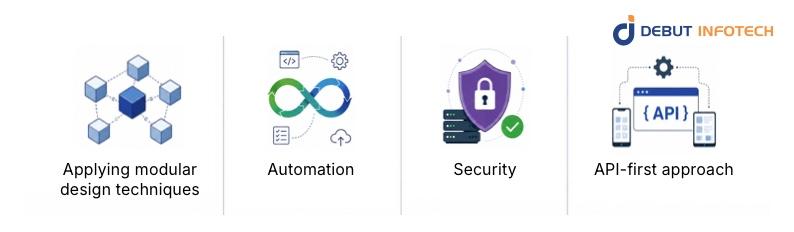
Building modern systems is more than just picking the proper tools or jumping on the hot technology. It takes discipline in architecture, performance, and long-term maintainability. When addressing the question, ” What are best practices for enterprise web applications?, the answer lies in a combination of strategic planning and technical execution.
Whether using a microservices architecture web or a hybrid model, breaking applications into smaller, independent components improves flexibility and reduces risk during updates. This implies team members can release new features without changing the entire system.
CI/CD pipelines automate the process of updating, reducing human error, and speeding up release cycles. Additionally, monitoring and logging technology ensures applications remain stable and performant as they scale.
Enterprise apps must use strong authentication methods, encrypt all data, and undergo frequent security assessments to safeguard sensitive information.
API-driven architecture means all components communicate through well-defined interfaces. This is particularly important for companies that need to deliver consistent experiences across web, mobile, and other digital channels.
The web application development cost varies based on several factors. These include architecture, features, technological stack, and team organization. Although monolithic applications may seem cheaper, it may be expensive to maintain. Scalable web architectures, in contrast, can be more expensive to invest in initially, but can be more valuable in the long run.
Real-time processing and high security are characteristics that add to development requirements. Costs are also affected by the decision to create an in-house team, outsource or recruit a dedicated software development team.
Companies ought to focus more on developing a strong infrastructure that will deliver quality and will aid growth in the future as opposed to just aiming at cutting costs.
With the digital transformation, there is a growing use of cloud-native web applications by companies in order to achieve a competitive advantage. They are usually containerized and orchestrated using orchestration tools, allowing standalone service deployment, automatic scaling, and rapid failure recovery.
This is in line with serverless web architecture. In this, developers can write event-driven code without managing servers, as the cloud provider handles scaling and maintenance. Consequently, operations become easier, enabling organizations to concentrate on innovation without taking a lot of care in managing infrastructure.
The current web application design is a business tool to achieve commercial prosperity. By having a faster, more reliable, and more scalable digital experience, those companies that invest in the appropriate architecture will have a competitive advantage.
An excellent design facilitates quick innovation. Modular systems and API-driven architecture enable teams to test new features, embrace new technologies, and quickly adapt to new changes in the market. Such agility is essential in a business where the client demands are evolving rapidly.
The scalable web architecture allows systems to grow in a gradual fashion, scaling to support the expansion without the need for significant redesign. This improves teamwork in the new architecture as well. It enables teams to work on separate sections of the program by disaggregating the components and standardizing them.
That reduces the bottlenecks and accelerates the development process. In the case of a company investing in custom or enterprise software development, these benefits will lead to increased efficiency, reduced operational risk, and a higher ROI.
Below are some essential reasons why selecting the right development partner, like Debut Infotech, is critical for growth.
The expansion of web technologies has transformed application design, deployment, and scaling processes. The web app architecture in the modern world is no longer concerned with creating fixed systems. It is all about creating dynamic, flexible ecosystems that can be changed as necessary by the business.
The shift towards modular, cloud-based systems is transforming the digital space of web microservices architecture into the serverless web architecture. These changes will leave the businesses that adopt them in the best position to develop superior user experiences, scale, and remain competitive.
Generally, when you are developing a new application or upgrading an old application, one of the most important choices that you can make is the architecture that you are going to adopt. By ensuring the correct approach, tools, and team, you will be able to create systems that are in line with the current needs and are prepared to meet future needs.
A. Web app architecture includes monolithic, layered (N-tier), microservices, serverless, and event-driven models. Monolithic is simple but less scalable, while microservices and serverless are better suited for modern, scalable web architecture. Large applications often use distributed models for better performance and flexibility.
A. There is no single best option, as it depends on your project needs. However, most modern applications benefit from a mix of microservices, API-driven architecture, and cloud-native web applications, as they offer flexibility, scalability, and easier maintenance over time.
A. The cost of web application development depends on factors such as architecture complexity, features, tech stack, and team expertise. Advanced setups like microservices or distributed web systems usually cost more initially but deliver better long-term scalability and performance.
A. Scaling involves using load balancing, caching, and horizontal scaling to handle increased traffic. Modern systems also rely on cloud-native infrastructure and distributed web systems to automatically adjust resources and maintain performance under high demand.
A. Modern web architecture uses frontend frameworks like React, backend technologies such as Node.js, and cloud platforms like AWS or Azure. Tools like Docker and Kubernetes support deployment, while rapid web application development tools accelerate delivery.
A. Modern web app architecture typically includes a frontend layer, backend services, APIs, databases, and cloud infrastructure. These components work together in a modular way, often using API-driven architecture to ensure flexibility and scalability.
A. APIs and microservices enable applications to be broken into smaller, independent services that communicate efficiently. This approach improves scalability, allows faster updates, and supports the development of flexible, distributed web systems.

Our Latest Insights
USA
2501 Chatham, Rd Suite R Springfield, IL 62704
+1-708-515-4004
info@debutinfotech.com
UK
7 Pound Close, Yarnton, Oxfordshire, OX51QG
+44-770-304-0079
info@debutinfotech.com
Canada
154 Eden Oak Trail, Kitchener, ON N2A 0H9
+1-708-515-4004
info@debutinfotech.com
INDIA
Sector 101-A, Plot No: I-42, IT City Rd, JLPL Industrial Area, Mohali, PB 140306
9888402396
info@debutinfotech.com