ON THIS PAGE
Progress0%






Our Global Presence :





The selection of the appropriate tech partner can mean the difference between a stable growth and costly failures. A bad choice will result in deadlines not being met, budgets overrun weak code, and platforms that cannot keep up with demand.
This is the reason why software consulting services are increasingly relied upon by many businesses to make the transition between business objectives and technical implementation. As a matter of fact, the software consulting industry in the world was estimated to be more than $327 billion in 2025 and is expected to rise at a high rate as businesses keep investing in digital transformation, cloud migration, and AI-based innovation.
The right consulting partner does much more than create software. They are useful in testing ideas, decreasing technical risk, increasing delivery speed, and developing systems that are geared towards long-term expansion.
This guide will help you know how to assess software agencies, offshore web development companies, and enterprise development companies using real buyer criteria that count. We will discuss technical know-how, communication guidelines, security, transparency of prices, and long term value- so that you can make a decision with confidence and prevent expensive errors.
The impact of partnering with a software development company goes beyond individual projects. It can determine the speed of your development, cost of your budget, and agility of your systems as you grow. A good partner allows you to accelerate development, identify and resolve issues swiftly, and deliver software that scales as your business grows.
A good partner also offers expertise in areas like architecture, scalability, and the right tech stack for web development. This expertise can help avoid costly mistakes and months of redirections. Rather than just coding, the right team plans for your business’s future.
On the other hand, the wrong decision can lead to delays, increased costs, communication issues, and ultimately software that is difficult to maintain. Many IT project failures can be traced back not just to technical problems, but also to a lack of clarity in requirements, collaboration and planning.
That’s why technical know-how is not enough. The right IT partners are not only technically skilled, but also communicate well, take responsibility, and have a deep understanding of your business goals.
When companies begin searching to hire software development partner services, most of them commit the error of comparing price and schedule only. Although such details are significant, they do not indicate whether a company is able to really deliver results, resolve issues, or help you grow in the long term.
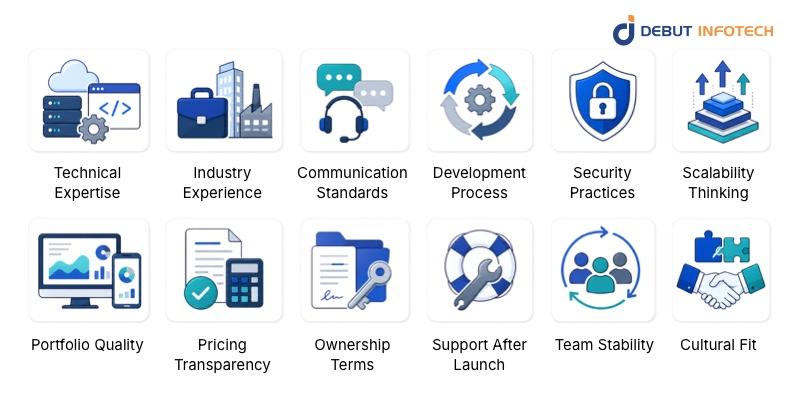
The correct choice is made by searching. You must know how the team operates, how they interact, how they develop safe systems and whether they can change with your business. Clarity in software vendor selection criteria can minimize risk and enhance successful project likelihood.
The following are the twelve things that any business should put into consideration before making the final decision.
1. Technical Expertise
One of the initial things that should be evaluated is technical expertise. A development partner must be comfortable working with the right tech stack for web development for your project. This can encompass front end structures, back end technologies, cloud services, databases, APIs and mobile tools.
By way of illustration, when creating a contemporary customer platform, the team ought to know about performance, responsiveness, integrations, and scalability. If mobile-friendly speed is important, experience in progressive web development can be particularly helpful since it enhances loading speed and cross-compatibility.
An effective technical team must also be capable of providing reasons as to why they suggest some technologies over others instead of just giving popular tools.
2. Industry Experience
An industry experienced partner tends to generate value much quicker. They are already aware of the usual pain areas, customer expectations, processes and rules in your industry.
To illustrate this, a medical site should have varied priorities compared to an eCommerce site. A fintech product might need more stringent security and compliance than a typical business portal.
Relevant industry knowledge can save time, minimize errors, and enhance the quality of decisions at the very beginning when it comes to selecting custom software development services.
3. Communication Standards
One of the largest causes of software project failures is poor communication. Technically, powerful teams may cause frustration even when the updates are unclear, or the questions remain unanswered.
Find a partner who speaks clearly and in an organised manner. They are expected to give progress reports, clarify technical issues using non-technical language, and reply within acceptable time limits and identify risks promptly.
If communication is challenging in the sales process, then it tends to get worse once the contract has taken effect.
4. Development Process
Any decent software company must have a formal development cycle. It is by doing this that they convert ideas into working products without disorder.
Inquire about how they deal with planning, user stories, design, development, testing, revisions, and release management. Teams with structured workflows like Agile sprints or milestone-based delivery tend to deliver improvements due to the review of work regularly.
A well-defined process additionally assists in monitoring progress and preventing expensive surprises at the end of the project.
5. Security Practices
Security is not something that can be considered as an additional benefit. Be it the customer accounts, payments, or the internal business data, a weak security can cause severe financial and reputational losses.
Questions to ask the partner include how they approach secure coding, user permissions, backups, encryption, vulnerability testing, and continuous monitoring.
A reliable company must have the capability to talk about security and how risks are addressed during development.
6. Scalability Thinking
Good software should not only work today. It must also work well as your business expands.
Scalability refers to the readiness of systems to accommodate additional users, traffic, additional features, and additional integrations. A short-sighted team can create something that is cheap which works temporarily only to fail later when it is put under strain.
The right partner does not just look at launch day but thinks of future growth, and designs accordingly.
7. Portfolio Quality
A portfolio must not just indicate attractive screenshots. It ought to demonstrate that the company is capable of addressing actual business issues.
Find case studies, quantifiable results and examples of products that are still in existence. Did they enhance revenue, lessen the amount of manual work, boost conversions, or produce enhanced customer experiences?
The real results are much more valuable than visuals.
8. Pricing Transparency
Price is important but clarity is more important. An effective enterprise tech partner evaluation must seek candid and fair pricing schemes.
You must be aware of what will be covered in the quote, what can attract additional charges, how change requests are managed, and what is covered in the post-launch support.
Extra charges tend to destroy confidence and can easily make a cheap quote a costly error.
9. Ownership Terms
Most businesses neglect ownership till after it is too late. Prior to the beginning of work, ensure that contracts clearly indicate the owner of the code, designs, documentation, databases and intellectual property.
Access to hosting accounts, repositories and third-party tools utilized in the project should also be verified.
Defined ownership conditions safeguard your business in case you switch vendors or in case of internal growth.
10. Support After Launch
The end of software projects is not when it is launched. Launch is in most instances just the start.
Applications must be updated, bugs fixed, performance tuned, security patched, and occasionally even improved with features as a result of user feedback. A trustworthy partner is required to provide continuous support and expectations of the service.
When a vendor goes out of business after making delivery, the problem can be very costly and inconveniencing.
11. Team Stability
Those who begin your project should preferably remain in the project. High employee turnover may stall development, decrease quality, and cause communication disconnects.
Enquire who will handle the account, who will write the code and whether the same persons will be deployed all through the engagement.
Consistent teams tend to provide a better experience and greater responsibility.
12. Cultural Fit
Technical expertise is not the key to a successful partnership. The manner in which a company operates is important as well.
There are businesses that require quick decision making and action. There are those who need in-depth approvals, documents and close governance. Even a talented team may prove hard to manage in case of a conflict of working styles.
Select a partner that has a culture that matches your expectations in terms of communication, accountability, speed and working together.
Prior to signing any software development agreement, step back and ask the questions that are going to tell you how the partner really performs rather than how they sell.
A good development company must be in a position to explain its process, provide realistic timelines, define who will work on your project and how risks will be addressed. This is particularly crucial when it comes to enterprise tech partner assessment, as the price of selecting an incorrect vendor can influence budgets, operations, security, and long-term growth.
Begin with real life questions such as:
These questions will assist you to see beyond the shiny proposals and knowing whether the partner is transparent, technical and ready to help your business once the contract is signed.Which security and quality checks are involved prior to launch?
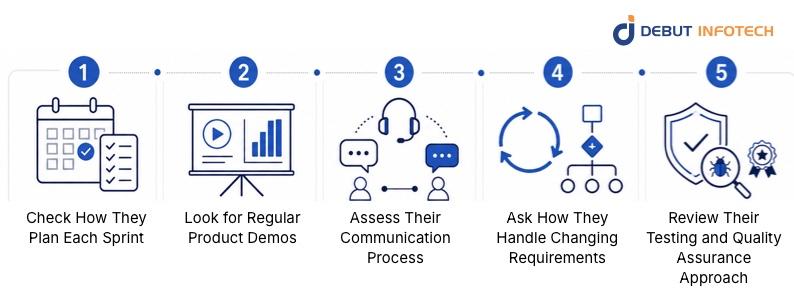
Finding a partner to help with agile software delivery is not a matter of finding a company that claims to use Agile methods. A lot of development teams adopt Agile language, yet not all of them are working in an agile manner.
A good agile partner must assist you in creating software in small, tested, and useful increments. They ought to engage you in the process, listen to feedback, deal with risks early, and ensure that the project is on track with your business objectives.
Check How They Plan Each Sprint
An efficient agile partner must start each sprint with proper planning. This implies they must concur on what to be built, why it is important, who is to do what section of the work and what can be realistically achieved during the sprint.
Inadequate sprint planning can result in confusion, delays, hurried work and uncompleted features. An effective partner will also assist you to give priority to the most valuable features first rather than building everything simultaneously.
They are also supposed to tell you what will be delivered at the end of every sprint so that you know what to expect in terms of progress.
Look for Regular Product Demos
One of the most obvious indications of actual agile delivery is regular demos. Your partner must not be away for weeks or months and come back with a product that may not satisfy you.
Rather, they ought to show you working features periodically. This will allow you to view what has been developed, experiment with the product direction, and provide feedback before the bigger mistakes will become costly to correct.
Trust is also established through product demos since progress can be seen.
You are not just reading status reports; you are seeing the actual software take shape.
Assess Their Communication Process
Agile software delivery requires the use of clear communication. An effective partner must inform you about the frequency of updates, who will be your primary contact, and what tools they will utilize to communicate with you and track the project.
This is particularly significant when dealing with an offshore development partner where time zone, language, and distance may cause a gap in case communication is not well managed.
An effective partner must have a straightforward communication system. The important thing is that you are never in the dark on what is going on, what is postponed, and what decisions require your feedback.
Ask How They Handle Changing Requirements
Flexibility is one of the key advantages of Agile. As your project progresses, you might find that certain features are no longer required, whereas other features become increasingly significant.
An agile partner must not get panicked with changing requirements. Rather, they ought to possess a clear method of examining changes, estimating the effects, and reprioritizing without hurting the entire project.
They should also be honest about trade-offs. For example, the introduction of a new feature can impact the schedule, budget, or scope. A credible partner will elaborate these effects to ensure that you make informed decisions.
Review Their Testing and Quality Assurance Approach
Agile delivery must be quick, yet not rushed. Proper testing needs to be incorporated in every sprint to ensure that the product is working as anticipated.
An effective partner must be able to describe their testing procedure prior to launch. This can involve manual testing, automated testing, performance testing, security checks and user acceptance testing.
Testing cannot be considered as an event that occurs at the end of the project. By integrating quality assurance into each sprint, it is easier to detect bugs, lower technical debt, and produce a more stable final product.
Selecting an appropriate software development partner goes beyond hiring a group of people to code. It is the collaboration with individuals who understand your business objectives, minimize technical risk, and assist you in creating software capable of expanding alongside your users.
That is where we come in at Debut Infotech.
Through our software development consulting services, we help businesses turn complex ideas into practical, scalable, and secure digital products. Our work goes beyond development. We help clients validate product ideas, define the right technical roadmap, choose suitable technology stacks, modernise outdated systems, and build solutions that are ready for long-term growth.
Over the years, we have supported businesses across industries with solutions such as custom web applications, enterprise platforms, mobile apps, blockchain-based systems, AI-powered products, and digital transformation projects. This experience allows us to look beyond surface-level requirements and identify what a product truly needs to perform well in the real world.
Our team works closely with clients from the early discovery stage to launch and post-launch improvement. We focus on clear communication, agile delivery, strong architecture, security-first development, and measurable business outcomes. Whether the goal is to improve operational efficiency, launch a new digital product, reduce manual processes, or scale an existing platform, we help businesses move forward with confidence.
At Debut Infotech, we do more than build software. We help you make better technology decisions, reduce development risks, and create digital solutions that are aligned with your business goals, user needs, and future growth plans.
A. Hiring software consultants gives your business access to expert technical advice and practical development support.
They help you choose the right technology, plan your project clearly, solve complex technical problems, and avoid costly mistakes.
Software consultants are also useful when your internal team lacks specialist skills or needs extra support to move faster.
In simple terms, they help you make smarter technology decisions, reduce technical risk, and build scalable software with more confidence.
A. Choosing the wrong development partner can lead to serious problems for your business.
You may end up with software that is poorly built, full of bugs, or difficult to scale. This can affect user experience, delay your launch, and create extra costs later.
A weak partner may also miss deadlines, misunderstand your requirements, or fail to communicate clearly during the project.
In many cases, fixing poor-quality software can cost much more than building it correctly from the start. That is why choosing the right partner is important for protecting your budget, timeline, and long-term growth.
A. The right partnership can make a product stronger over time. It gives a business access to expert skills, better planning, and extra support without depending only on internal teams.
This can lead to faster development, fewer costly mistakes, and a product that is easier to scale.
In the long run, a strong partner helps the product stay useful, trusted, and competitive.

Our Latest Insights
USA

2501 Chatham, Rd Suite R Springfield, IL 62704
+1-708-515-4004
info@debutinfotech.com
UK

7 Pound Close, Yarnton, Oxfordshire, OX51QG
+44-770-304-0079
info@debutinfotech.com
Canada

154 Eden Oak Trail, Kitchener, ON N2A 0H9
+1-708-515-4004
info@debutinfotech.com
INDIA

Sector 101-A, Plot No: I-42, IT City Rd, JLPL Industrial Area, Mohali, PB 140306
9888402396
info@debutinfotech.com

9001:2015
Quality Certified

ISO 27001
Security Certified

A+ Rating
Accredited Business

Certik
Security & Audit


Copyright © 2026, Debut Infotech. All rights reserved. | Privacy Policy