ON THIS PAGE
Progress0%






Our Global Presence :




White label tax compliance software development allows fintech companies, accounting firms, and SaaS providers to launch branded tax services using existing technology or custom-built platforms.
Choosing the right development model affects cost, flexibility, and ownership. Ready-made software, embedded tax APIs, and custom development offer different levels of control over branding, workflows, and source code.
Tax coverage must match customer and jurisdiction requirements. Sales tax, VAT, GST, income tax, payroll tax, and electronic reporting involve different rules, filing obligations, and update requirements.
Core platform features should support the complete tax workflow, including tax calculations, return preparation, electronic filing, exemption certificates, audit trails, and integrations with ERP and accounting systems.
Regulatory authorization and data security must be assessed separately. IRS e-file requirements, SOC 2 reports, ISO 27001 certification, and taxpayer data protection address different aspects of platform readiness.
. Development costs depend on customization and technical scope. Jurisdiction coverage, integrations, filing features, security requirements, and ongoing maintenance all influence the overall budget.
Platform reliability depends on proper testing and continuous updates. Validate tax calculations against real filing scenarios, conduct a pilot launch, and establish a process for monitoring changes in tax rules and regulations.
White label tax compliance software development helps businesses launch branded tax platforms without having to build every component from scratch. Fintech companies, accounting firms, payroll providers, and software vendors can add tax calculations, return preparation, electronic filing, and reporting to their existing services. The challenge is choosing a solution that meets customer needs while complying with tax, security, and filing requirements across relevant jurisdictions.
Digital adoption makes this opportunity worth considering. The OECD reported in 2025 that more than 80% of surveyed tax administrations were developing application programming interfaces (APIs), with over three-quarters making them publicly available for third-party use.
In the United States, the Government Accountability Office reported that nearly 97% of individual tax returns were filed electronically during the 2024 filing season.
However, launching a reliable platform requires more than branding existing software. You must evaluate tax coverage, integrations, data protection, authorization requirements, and ongoing maintenance.
This guide explains the available software models, essential features, development process, estimated costs, and how to choose the right development partner.
White label tax compliance software is a tax platform that a business can brand and offer to its customers. It may support tax calculations, return preparation, electronic filing, and compliance reporting.
The original provider supplies the technology, while your business manages its brand and customer relationships. The level of control depends on the agreement.
This model gives you a ready-made product with your logo, colors, and domain. You can launch without having to develop core tax features yourself. However, the provider usually owns the software and controls major updates. Customization depends on the licensing agreement and available configuration options.
An embedded tax API connects your application to an external provider’s tax services. Customers can calculate taxes or access selected compliance functions without leaving your platform. This offers more control over the user experience, but your product still depends on the provider’s coverage, pricing, and availability.
A development partner can build a tax platform around your business requirements. You can define its workflows, integrations, features, and branding. Source code ownership depends on your contract, so establish intellectual property rights before development begins.
White labeling allows you to present a product under your own brand. Traditional resellers may sell software with limited branding rights, while referral partners primarily introduce customers in exchange for commissions. Your agreement determines who controls pricing, support, customer data, and product updates.
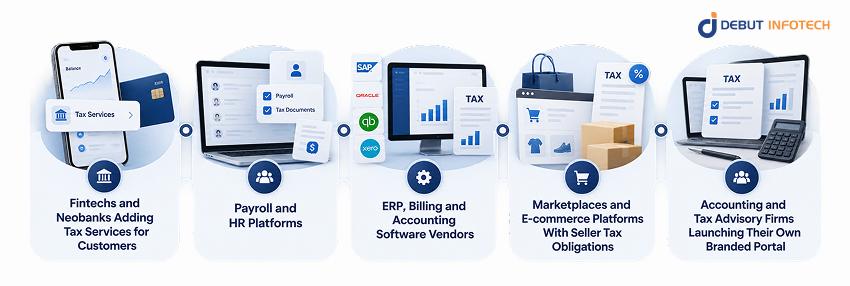
A white label tax compliance solution suits businesses whose customers need tax services alongside existing products. It can reduce development work and introduce additional services without requiring a company to build every tax function internally.
Fintechs and neobanks can offer tax estimates, income summaries, and filing connections within their financial applications. Customers gain easier access to tax information, while providers can expand their services. Strong consent and data-sharing controls remain important.
Payroll and HR platforms can add withholding calculations, employer tax reports, and employee tax documents. These features connect payroll records with compliance workflows and reduce manual administration. Coverage must match the jurisdictions where their customers employ workers.
ERP and accounting vendors can integrate tax calculations, reporting, reconciliation, and return preparation into existing workflows. They can offer these capabilities through premium subscriptions or bundled packages, while helping customers manage financial records in a single system.
Marketplaces can automate transaction tax calculations, track seller obligations, and prepare tax reports. The platform must distinguish between its own responsibilities and those of individual sellers because legal obligations vary by jurisdiction.
Accounting firms can provide branded portals for document uploads, filing updates, tax reports, and deadline reminders. This creates a consistent client experience and helps firms serve more customers without having to build every software component themselves.
White label tax compliance software can reduce development time and help businesses introduce tax services with less initial engineering work. However, the benefits depend on the provider’s capabilities, licensing terms, and the level of control your business requires.
Existing software shortens development because core features are already available. You may also avoid hiring a large engineering team. However, setup fees, licensing, integration work, and jurisdiction-specific configuration still affect the initial budget.
Businesses can charge subscriptions, transaction fees, or premium service rates for tax features. Integrating these services into an existing product may also encourage customer retention. Pricing should account for provider charges, support costs, and expected usage.
Your platform may depend on the provider for tax updates, new jurisdictions, and feature releases. If its priorities differ from yours, expansion can stall. Review service commitments, product roadmaps, and exit terms before signing.
Some providers restrict workflow changes, reporting options, or access to underlying data. Confirm who owns customer records, how data can be exported, and what happens when the agreement ends. These terms can affect your long-term flexibility.
White label tax software lets businesses launch a branded tax platform using an existing white label tax software solution, while custom-built software is developed to meet specific requirements. The main differences involve cost, development time, customization, control, and responsibility for maintenance and tax updates.
An embedded tax API provides another option by connecting your application to external tax services.
White label agreements generally provide branding rights and a license to use the software. The provider usually retains ownership of its underlying code. A custom build can offer greater control over the source code, architecture, and product roadmap if the contract grants those rights.
| Factor | White label | Custom-built |
| Branding | Configurable branding | Tailored to your business |
| Source code | Usually provider-owned | Contract-dependent |
| Customization | Limited by the product | Built around requirements |
| Roadmap | Provider-led | Business-led |
| Initial cost | Generally lower | Generally higher |
| Maintenance | Often provider-supported | Managed internally or externally |
An embedded API sits between these approaches. Your team builds the interface and customer workflows, while an external provider supplies selected tax functions. For example, Avalara’s APIs offer tax calculation and related compliance capabilities.
This model provides more control over the customer experience than a standard white label portal. However, you remain dependent on the API provider’s pricing, coverage, uptime, and service limits. Your developers must also manage authentication, integration errors, and API changes.
White label tax compliance platform for SaaS businesses generally launch faster because core functions already exist. API-based platforms require tax compliance software integration and testing, while custom builds need more planning and engineering.
The actual white label tax compliance software implementation timeline depends on feature complexity, jurisdiction coverage, and approval requirements.
Initial cost alone does not determine value. White label licensing fees may rise with usage, and API charges can increase with transaction volume. Custom software requires ongoing maintenance, security updates, and tax-rule management. Compare projected expenses over three to five years, including support and compliance operations.
Choose white label software when speed and existing features matter most. Select an embedded API when you want a native customer experience without having to build every tax function. Consider custom development when specialized workflows, source code ownership, or greater control justify the investment.
Before deciding, document your required jurisdictions, filing responsibilities, integrations, and expected transaction volume. Ask providers to demonstrate these requirements rather than relying on marketing claims. A limited pilot can expose technical gaps and recurring costs before a wider launch.
Tax coverage should match the obligations of your target customers. A platform for domestic online retailers may need different capabilities from one serving multinational employers. Define the tax types, filing responsibilities, and jurisdictions before choosing a provider.
Sales tax, value-added tax (VAT), and goods and services tax (GST) apply under different jurisdictional rules. Software should account for product taxability, customer location, exemptions, registration thresholds, and applicable rates. Cross-border businesses may also need reverse-charge support.
Income tax features may include taxpayer onboarding, income classification, deductions, credits, return preparation, and electronic filing. Individual and business returns have different requirements. Confirm support for relevant forms, amendments, filing periods, and submission procedures.
Payroll tax capabilities support withholding calculations, employer contributions, remittance workflows, and employment tax reports. Some businesses also need year-end forms. Coverage should reflect federal, state, local, and other applicable obligations wherever employees work.
Some jurisdictions require structured electronic invoices or digital transaction reports. A platform may need to validate formats, transmit records, and track acceptance or rejection. The European Union’s VAT in the Digital Age initiative includes phased changes, with cross-border digital reporting requirements scheduled to begin in July 2030.
Multi-jurisdiction platforms must manage differences in rates, filing calendars, registration requirements, currencies, and languages. They should also track the effective dates of rules and determine the correct jurisdiction for each transaction. Start with a defined coverage list and expand according to customer demand.
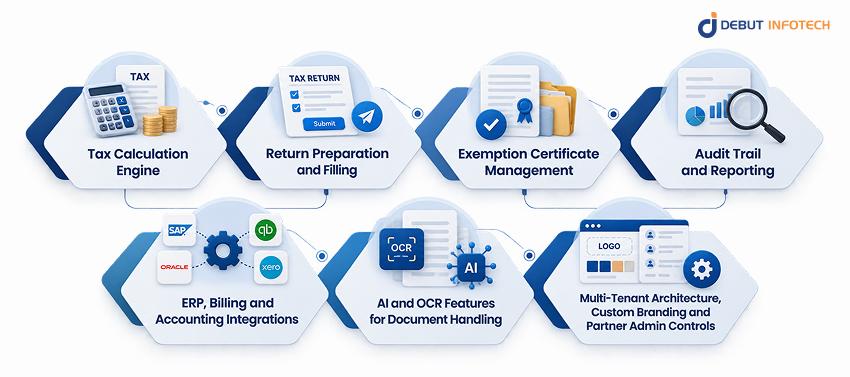
White label tax software should include the features customers need to calculate taxes, prepare returns, manage documents, and track filing statuses. Essential capabilities also include multi-jurisdiction support, secure data handling, reporting, third-party integrations, and tools for keeping tax rules and calculations up to date.
Essential features depend on the tax services you plan to offer. A basic product may focus on calculations and reporting, while a broader platform may include filing, document management, integrations, and partner administration. Prioritize functions that meet customer needs and support your selected jurisdictions.
The calculation engine applies relevant rates, thresholds, exemptions, and jurisdiction rules to transactions or returns. It should use current tax data, account for effective dates, and produce consistent results. Testing must cover rounding, tax-inclusive pricing, exemptions, and changes to transaction details.
Filing features should collect required information, validate entries, calculate liabilities, prepare returns, and track submission status. Where electronic filing is supported, the system should record acknowledgments, rejections, corrections, and deadlines. Automated submission requires appropriate authorization and technical connections.
Businesses need a reliable way to collect, validate, store, and renew exemption certificates. The system should link each certificate to the relevant customer and jurisdiction. Expiration alerts and missing-document reports help teams identify gaps before they cause incorrect tax treatment.
An audit trail should record changes to tax data, calculations, approvals, and filing events. Reports should show tax collected, liabilities, outstanding returns, and submission outcomes. Timestamps, rule versions, and supporting records help businesses explain calculations during audits or internal reviews.
Integrations connect tax workflows to systems that already hold financial data. Common connections include ERP platforms, accounting tools, payment systems, billing software, and payroll applications. Documented APIs, secure authentication, retry handling, and reconciliation checks help prevent missing or duplicated transactions.
Optical character recognition (OCR) can extract dates, totals, tax identifiers, and other fields from invoices and receipts. AI can classify documents, flag missing information, and route unusual cases for review. These tools reduce manual entry, but extracted data still requires validation.
Keep extracted values linked to their source documents and allow authorized users to correct mistakes. Record corrections and validate information before using it in calculations or filings. AI should not independently approve tax decisions that require professional judgment or taxpayer authorization.
Multi-tenant architecture allows multiple businesses to share a platform while keeping their data separate. Tenant isolation must cover databases, files, logs, and API access. Weak separation can expose confidential taxpayer information to unauthorized customers.
Branding features should support logos, colors, domains, email templates, and customer-facing language. Partner administration should allow authorized resellers to manage accounts, assign roles, configure subscriptions, and review usage. Access permissions should prevent partners from viewing data outside their authority.
Include multifactor authentication, encryption, backups, monitoring, and recovery procedures. These controls protect sensitive information and support reliable operations as the platform grows. Review permissions regularly and test security controls before expanding access to additional partners.
Branding does not transfer regulatory approval, certification, or legal responsibility from the technology provider to your business. Requirements depend on the services offered, the jurisdictions involved, and whether you calculate taxes, prepare returns, transmit filings, or process taxpayer data.
Electronic filing may require registration, testing, or approval from a tax authority. In the United States, the IRS e-file provider process includes applications and suitability checks for eligible providers. Establish who will transmit filings and obtain necessary approvals before launch.
SOC 2 reports assess controls related to areas such as security, availability, and confidentiality. ISO/IEC 27001 specifies requirements for an information security management system. Neither replaces tax-specific authorization. Verify which organization, services, and systems each credential covers.
Protect personal and financial information through encryption, access restrictions, retention policies, and secure backups. Data residency rules may limit where records can be stored or processed. Contracts should define responsibilities for breaches, data transfers, deletion requests, and regulatory notifications.
Liability depends on applicable law, the cause of the error, and the parties’ contractual responsibilities. A provider may be responsible for service failures, while your business may remain responsible for customer disclosures or data collection. Taxpayers may retain statutory duties regardless of the software arrangement.
Have legal and tax professionals review indemnities, insurance, service commitments, and correction procedures. A commercial contract cannot remove legal obligations imposed directly by a regulator. Identify those obligations before defining how costs and errors will be handled between partners.
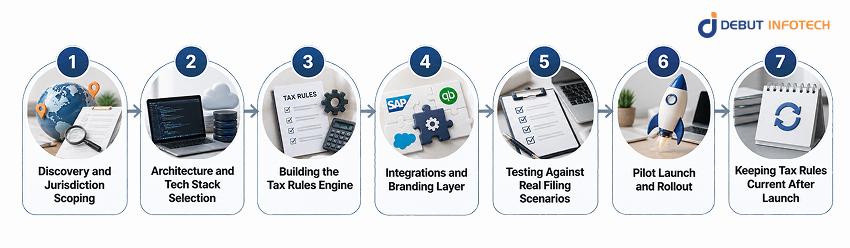
Developing a white label tax compliance platform starts with defining your target users, tax requirements, and business model. You then select a FinTech Software Development Services provider or development approach, configure branding, integrate essential services, implement security controls, and test tax workflows before launching and maintaining the platform.
These stages for developing a white label tax software for fintech companies provide a practical roadmap.
Identify target customers, tax types, jurisdictions, filing obligations, and expected transaction volumes. Map the customer journey from onboarding to filing confirmation. Document which tasks your platform performs and which are handled by the customer, tax professional, or external provider.
Choose an architecture that supports secure data separation, reliable integrations, and future expansion. A cloud-based application with documented APIs may suit a multi-tenant platform. Select programming languages, databases, hosting services, and monitoring tools based on team expertise, security needs, and expected workload.
Plan for encryption, access controls, backups, and disaster recovery. Keep tax rules separate from core application logic where practical. This makes jurisdiction-specific updates easier to manage without changing unrelated application functions.
Build or integrate a rules engine that handles rates, thresholds, exemptions, filing periods, and effective dates. Each rule should have a documented source and version. Automated tests should compare results against validated scenarios before changes reach production.
Connect the platform to relevant accounting systems, payment providers, ERPs, payroll tools, and tax APIs. Configure partner logos, colors, domains, notifications, and subscription options. Test failed requests, duplicate transactions, expired credentials, and interrupted connections.
Test every supported jurisdiction with representative filing scenarios. Include amended returns, exemptions, missing documents, unusual transactions, and rejected submissions. Tax specialists should review expected results, while security tests check access controls and tenant separation. A successful demonstration does not prove filing accuracy.
Start with a small customer group and a limited set of tax obligations. Monitor calculation differences, filing outcomes, support requests, and performance. Resolve critical issues before expanding access. Give customers clear instructions about their responsibilities and exception-handling procedures.
Tax compliance software needs ongoing updates as rates, legislation, forms, and deadlines change. Assign responsibility for monitoring official announcements, validating changes, testing updates, and documenting releases. A consistent tax compliance software maintenance process helps maintain accuracy as customer numbers and jurisdictional coverage grow.
White label tax compliance software development typically costs $40,000 to $400,000, depending on the platform’s complexity, tax jurisdictions, integrations, security requirements, and customization. A focused MVP may cost around 40,000–80,000, while advanced platforms can exceed $400,000.
Each jurisdiction can introduce new rules, forms, tests, and maintenance duties. Complex filing workflows cost more than basic calculations. Integrations add work when systems use different data formats. Tax compliance software security requirements, authorization processes, and specialist tax expertise also affect budgets and timelines.
These estimates illustrate possible initial project budgets. Actual quotes vary by provider, delivery location, licensing terms, and feature scope.
| Platform scope | Estimated initial cost | Typical scope |
| MVP or basic white label | 20,000–60,000 | Branding, core calculations, limited integrations |
| Mid-scale platform | 60,000–180,000 | Multiple workflows, reporting, several integrations |
| Enterprise platform | 180,000–400,000+ | Broader jurisdiction coverage, advanced controls, complex integrations |
Licensing an existing product may cost less than custom development, while multi-country filing or extensive income tax features can exceed the enterprise range. Request an itemized quote covering tax compliance software implementation, testing, third-party services, and launch support.
Recurring expenses include hosting, subscriptions, API usage, security monitoring, support, and tax-rule maintenance. Budget separately for jurisdiction expansion and filing-season preparation. Confirm which updates are included in the license and which incur additional fees.
Revenue models include subscriptions, per-return fees, transaction charges, and tiered packages. Some businesses bundle tax features into existing plans. Set prices after accounting for provider fees, support, payment processing, and expected usage. Allow for peak-season demand and unexpected compliance work.
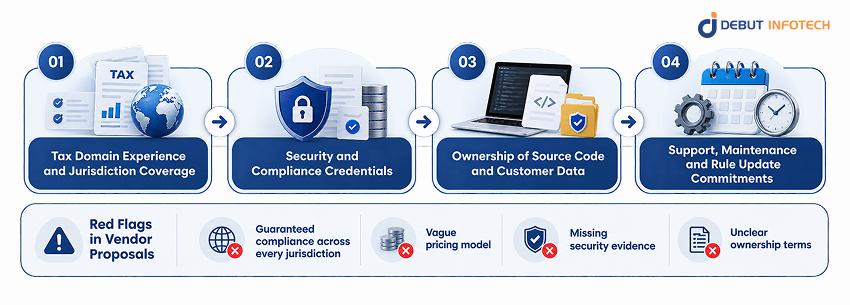
Your partner should understand tax workflows, secure SaaS tax software architecture, and the requirements of your target jurisdictions. Assess its ability to deliver the platform and support it after launch. A low initial quote has limited value if the provider cannot comply with tax rules or resolve filing issues.
Request examples of tax platforms, integrations, and compliance workflows the team has delivered. Verify that its experience matches your required tax types and jurisdictions. Ask for demonstrations of relevant features and an explanation of how calculations are validated.
Review security policies, access controls, testing practices, and incident response procedures. Confirm which organization holds each certification and what it covers. Ask how sensitive tax data is stored, accessed, backed up, and deleted.
Define ownership and licensing rights in writing. Your contract should explain who controls source code, custom features, customer records, and reports. Include data export and transition assistance so you can change providers without losing access to essential business information.
Agree on response times, uptime targets, tax-rule updates, security patches, and filing-season support. Clarify which services are included in recurring fees and how urgent legislative changes will be handled.
Be cautious of guaranteed compliance across every jurisdiction, vague tax compliance software pricing model, missing security evidence, and unclear ownership terms. A provider unable to explain its rule-update process or demonstrate realistic filing scenarios may leave costly gaps after launch.
Several mistakes when launching a white label tax compliance platform for SaaS businesses can increase costs, delay launch, or create compliance problems. Address these risks during planning instead of waiting until customers begin using the platform.
Tax rules change, so the white label tax reporting software needs ongoing monitoring, testing, and maintenance. Without clear ownership, outdated rates and forms can cause filing errors. Include rule updates in your operating budget and service agreement.
Filing authorizations, registration, and technical testing can delay launch. Identify requirements early and establish who will obtain approvals. A provider’s credentials do not automatically authorize your business to offer every filing service.
A provider that meets only current needs may restrict expansion. Review its roadmap, supported tax types, and process for adding jurisdictions before committing.
Testing only standard transactions can leave serious errors undetected. Validate exemptions, amended returns, missing information, and rejected submissions. Involve tax professionals and resolve critical issues before launch.
White label tax compliance software development can help businesses launch branded tax services faster, but success depends on the right model, jurisdiction coverage, security controls, and maintenance plan.
Debut Infotech is a top custom software development company that helps businesses build and launch secure, scalable software solutions. For companies planning a white label tax compliance platform, our team can support custom development, third-party integrations, backend systems, and user-focused interfaces.
From defining tax workflows to integrating reporting tools and access controls, we can help align the platform with your business goals and technical requirements. Our development team can also support testing and ongoing improvements as tax rules and customer needs change.
Implementing white label tax compliance software usually takes 2 to 8 weeks, depending on customization, integrations, and testing requirements. Basic setups can go live faster, while complex systems may take longer. Allow extra time for data migration, branding, staff training, and compliance checks before launch.
Tax compliance software typically needs integrations with accounting tools, ERP systems, payment gateways, banking platforms, and tax authority APIs. These connections help sync financial data, calculate taxes, track payments, and prepare returns. The exact integrations depend on your business operations, target market, and local corporate tax reporting requirements.
Tax compliance software needs strong security features to protect sensitive financial and taxpayer data. Essential safeguards include data encryption, multi-factor authentication, role-based access controls, audit logs, secure backups, and regular vulnerability testing. Compliance with relevant data protection laws also helps reduce legal risks and prevent unauthorized access.
White label tax software can connect to existing business systems through APIs, prebuilt connectors, or middleware. Start by identifying the systems that need to share data, such as accounting software, ERP platforms, and payment tools. Then configure data mapping, test synchronization, and check for errors before going live.

Our Latest Insights
USA
2501 Chatham, Rd Suite R Springfield, IL 62704
+1-708-515-4004
info@debutinfotech.com
UK
7 Pound Close, Yarnton, Oxfordshire, OX51QG
+44-770-304-0079
info@debutinfotech.com
Canada
154 Eden Oak Trail, Kitchener, ON N2A 0H9
+1-708-515-4004
info@debutinfotech.com
INDIA
Sector 101-A, Plot No: I-42, IT City Rd, JLPL Industrial Area, Mohali, PB 140306
9888402396
info@debutinfotech.com