ON THIS PAGE
Progress0%






Our Global Presence :





Billing automation connects charge calculation, invoice management, payment collection, exception handling, and reconciliation while keeping billing records traceable across financial systems.
The choice between buying, combining, or building billing software depends on pricing complexity, integration requirements, customization needs, and total ownership costs over the same operating period.
First-release features should support a complete billing cycle, including customer contracts, pricing rules, invoice approvals, payment integration, reconciliation, permissions, and audit history.
Automated billing software development requires documented billing rules, a clear data model, integration testing, and recovery procedures for duplicate payment events, failed transfers, and accounting mismatches.
An illustrative 1,000-hour project at $60 per hour, plus 15% contingency, requires a $69,000 initial budget before separately priced external services; hosting, maintenance, security reviews, and payment-processing fees add ongoing costs.
A limited billing software project may follow an illustrative 16-week schedule, provided requirements are approved, integrations are available, migration data is clean, and finance teams can review and approve the release.
Secure billing systems require access controls, financial approval rules, audit records, and appropriate compliance reviews; AI can assist with anomaly detection and billing reviews, while development partners should demonstrate their approach to testing, reconciliation, ownership, and support.
If your finance team is in constant need to manually correct invoices, add custom charges to spreadsheets, or track down discrepancies in payments, you should evaluate how the billing process fails. When your current billing tools are not able to cover all your pricing rules, approval processes, or integrations, automated billing software development is the next logical step.
The first question is whether to set up an existing platform, add custom components to it or create a separate platform. This should be done after proper assessment of requirements and ownership costs. Budget and delivery time will be influenced by development scope, data migration, payment integrations and testing.
This guide outlines the process for making that assessment, prioritizing features, and planning development through rollout. The trade-offs are made tangible with a build-versus-buy framework, billing workflow and an illustrative cost model, and technical guidance is based on the official payment documentation. You’ll also learn what evidence to request from a development partner.
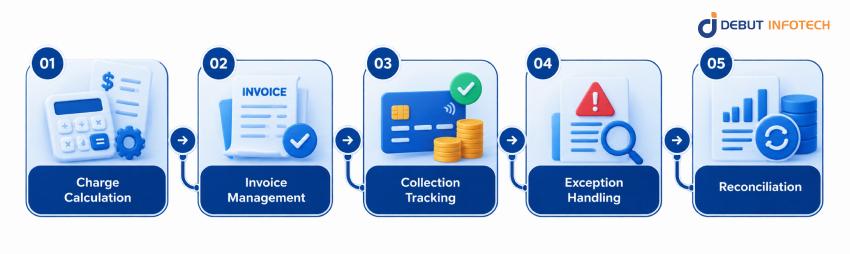
Billing automation software controls the rules and records that dictate what customers are owed, when they are billed, and what happens when they don’t pay. It’s not just about the invoice, it’s all about linking the customer agreements, calculation of charges, payment updates and the financial records in terms of a specific workflow.
A billing management system usually manages five activities:
These functions are bounded separately. The invoice generation process is associated with an amount due, and the payment process is associated with the collection transaction. In Accounting, recording and reporting financial activity is determined. However, a paid invoice does not necessarily mean that funds have been settled and revenue recognized.
Select the strategy that will satisfy your billing needs at an acceptable level of cost, control and responsibility. In the event that you need custom billing software development, first see if there are existing billing software platforms that can manage your core processes. Record any gaps and determine if they can be addressed through configuration, integrations or custom work.
| Decision factor | Buy a packaged platform | Combine existing and custom tools | Build a custom application |
| Pricing flexibility | Work within supported billing models | Extend selected rules through custom components | Implement rules around your requirements |
| Integration fit | Evaluate available connectors and APIs | Build connections for specific workflow gaps | Design integrations and data ownership explicitly |
| Delivery effort | Configure, integrate, and migrate | Add development and testing at system boundaries | Develop and validate the complete application |
| Operating responsibility | Manage configuration and vendor dependencies | Support both vendor services and custom components | Own application maintenance, supported by chosen providers |
| Long-term cost | Assess subscriptions, usage fees, and configuration | Include platform fees and custom maintenance | Include development, infrastructure, support, and external services |
In the case of a hypothetical B2B software company, typical subscriptions could be suitable for a packaged platform. If those gaps can be overcome in a clean fashion, then adding usage charges and customer-specific invoice approvals may be warranted for a hybrid approach. A custom application becomes more reasonable when interconnected requirements make extensions difficult to maintain.
Businesses considering custom software solutions should also define what they will continue to outsource. Existing payment and tax services are available to be used by a custom billing application. Before committing, make a comparison between the three methods and the same requirements and ownership period.
Your first release should support a complete billing cycle for the customers and pricing model included in the launch. Focus on features that enable finance teams to generate accurate invoices, monitor balances, clear exceptions and audit records. A feature is considered in the initial scope if its absence will cause that workflow to not function reliably.
The following matrix can help you differentiate between what you need to launch and what you need to build on based on your business model.
| Capability | First-release priority | When to expand |
| Customer and contract records | Store billing contacts, agreed rates, payment terms, and effective dates | Add account hierarchies when customers have multiple billing entities |
| Pricing and billing schedules | Support the charging rules required by the launch group | Add further pricing models as products or contracts change |
| Invoice approvals and adjustments | Define issuance permissions, approval rules, and traceable corrections | Introduce additional approval levels when responsibilities become more complex |
| Payment integration | Support the selected provider, payment methods, and payment-status updates | Add providers or methods when customer needs justify them |
| Reminders and failed-payment handling | Define follow-up rules and assign unresolved cases to an operator | Refine collection workflows using observed outcomes |
| Reconciliation and accounting synchronization | Identify mismatches and transfer agreed financial records | Expand matching rules and integrations as transaction sources grow |
| Permissions and audit history | Restrict sensitive actions and record who changed what | Extend controls as teams, roles, and entities expand |
Some capabilities are essential only for particular launch requirements. Usage metering belongs in the first release if charges depend on consumption. If customers can switch plans in the middle of a cycle, then a definitive policy is necessary for proration. When they fulfil an existing operational requirement that has been documented, multiple currencies, customer portals, and sophisticated dashboards should be included in scope.
Custom invoice software development might be adequate for a small invoicing process. Enterprise billing software may require multi-entity controls or more complex integrations from launch. In either case, billing accuracy, appropriate access controls, and recoverability remain baseline requirements.
Approve the scope against real examples: an invoice awaiting authorization, a failed collection, and an accounting mismatch. Finance users should be able to identify each issue and complete the agreed resolution process.
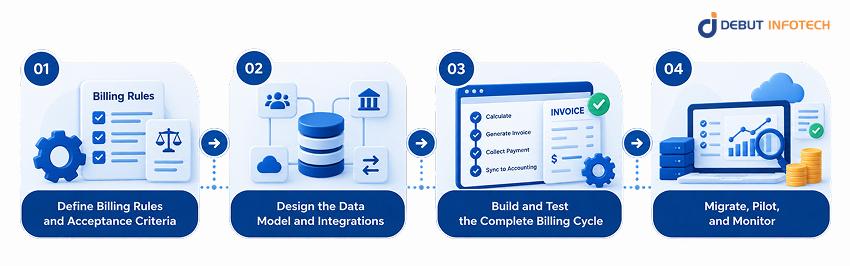
Begin automated billing software development by documenting your billing policies as rules, data flows, and acceptance tests. Before implementation, there should be a consensus of expected results between finance and engineering. Plan the delivery in four phases, each yielding evidence of the system’s readiness to move forward.
Solve real-world contracts involving finance, operations and product teams. Document the process of determining charges, when they are due, and who may authorize changes. Address any issues with the billing date, discount, cancellation policy, rounding before developers start coding.
Describe a rule catalog with sample data and desired results. In the case of a hypothetical subscription upgrade, input the effective date, proration method and the resulting adjustment. The test should ensure that the system implements the agreed policy and ensures that the original record of any settled invoice is maintained.
Include with these examples a list of the document’s operating conditions: supported currencies, applicable jurisdictions, anticipated volume, peak times of billings, and acceptable processing time. Designate a business owner to approve each rule and to address conflicting needs. This catalog is used as a reference for development and acceptance testing.
Explain the relationship between customer accounts, contracts, usage records, invoices, payments and accounting entries. Assign a stable identifier to each record, and determine the system that is responsible for the authoritative version. Define how updates move between systems, how conflicts are resolved, and how operators can trace an amount back to its source. Keep pricing rules and effective dates for each calculation to enable the explanation of historical charges.
Explicitly define precision of currency and rounding. Select the technology stack based on the transactions, integration requirements, workload and the team’s ability to maintain it. Stripe mentions that webhook events may come at multiple times or not in order. Check their signatures, identify duplicate processing, and get authoritative records when an event is processed in an ambiguous fashion.
Implement a complete workflow for one representative customer scenario. Track it from the source agreement to charge calculation, invoice approval, invoice collection and accounting synchronization. Allow finance users to examine the calculations and observe the presentation of outstanding issues in the application.
Test both calculations and interrupted workflows. Useful cases include:
Establish an expected recovery result for each test. For instance, if an accounting transfer is retried, it should result in an accounting request that shows up, and if it is not found, it should end up in an obvious review queue. Test peak workloads and normal usage and keep the result for release review.
Practice migration before deployment of live operations. Check customer information, current contracts, outstanding invoices, credits, and opening balances in relation to customer data in the system. Document which system remains authoritative during the transition.
Test the application with a limited number of customers. If you are using both systems, set one to calculate bills and only one to send bills and start collections. Determine the conditions for transfer of ownership and how to stop the rollout, and then how to follow up purchases of completed transactions during recovery.
Set rollout gates around billing accuracy, reconciliation results, recoverability, and finance acceptance. Prepare rollback procedures that address transactions already completed, including how those records will remain accessible.
Once it launches, monitor invoice corrections, unmatched transactions, integration failures and resolution time of exceptions. Set up owners and escalation rules for alerts. These operational outcomes will help determine when to scale up the rollout and which enhancements should be prioritised.
A billing management system must have controls in place to safeguard customer data and manage financial changes. Convert these requirements into specific permissions, approval rules and evidence to be reviewed to verify how each control works.
The use of an external card processor may also limit the PCI DSS scope, but the merchant is still liable. PCI SSC concludes provider oversight is an ongoing requirement, as is having written agreements and clearly defined responsibilities. Confirm validation requirements with the relevant acquirer or payment brand.
When integrating financial technology solutions, document which party owns each control. Obtain qualified review of tax, privacy, and e-invoicing requirements for the transactions and jurisdictions covered by the release.
Test AI-powered billing software for activities that take up review time, such as identifying suspicious billing, pulling proposed terms from documents, or summarizing disputed bills for an operator. For instance, an anomaly model might detect an unexpected jump in usage that could be investigated. The alert should prompt a check against source records before anyone changes the bill.
Evaluate each use case with sample, labeled examples. Track errors, false alarms and review time; establish acceptance levels prior to deployment. Limit data access and require approval for actions affecting customer balances. NIST’s voluntary AI Risk Management Framework provides a basis for organizing this evaluation.
Keep authoritative calculations and financial posting under explicit rules and approved controls. Automated billing can operate without AI; add it where evaluation demonstrates a useful improvement over the existing process.
A useful automated billing software development cost estimate starts with the work required to deliver your agreed scope. Using this as an example, 1000 delivery hours at a blended rate of $60/hour would cost $60,000. A contingency of 15% would take that budget to $69,000 (excluding separately priced external services). These assumptions are used in making the calculation and are not a market benchmark or a Debut Infotech quotation.
The scope behind the number matters:
| Scope | Included capabilities | What changes the estimate |
| Focused invoicing application | Defined charging rules, invoice templates, approvals, and basic exports | Contract variations, document requirements, and data cleanup |
| Integrated billing system | Payment integration, collection workflows, reconciliation, and accounting synchronization | Integration complexity, exception handling, and migration effort |
| Enterprise billing application | Multiple entities, complex pricing, higher volumes, and advanced controls | Performance testing, assurance requirements, and rollout complexity |
Use this formula to assess a proposal:
Initial delivery budget = estimated hours × blended hourly rate + separately priced setup costs + contingency
Discovery, design, development, testing, project management and deployment should be considered in estimated hours. The blended rate is the average rates assumed on those roles. Before comparing the overall price with other offers, ask the provider to demonstrate what is covered in their offer.
For the illustrative project above:
| Budget component | Calculation | Amount |
| Delivery work | 1,000 hours × $60 | $60,000 |
| Contingency | 15% of delivery cost | $9,000 |
| Initial planning budget | Delivery plus contingency | $69,000 |
Use contingency based on the lack of resolution of risks that could exist such as lack of migration data or undocumented integration. Agree separately on how new requirements will affect the price.
The cost to develop automated billing software is only part of the ownership cost. Plan for hosting, software subscription fees, monitoring and maintenance, security reviews, and support following the launch. Determine the payment-processing fee by using the fees of the provider you have chosen and your transaction mix.
Verify assumptions, exclusions, acceptance criteria and change control terms prior to approving the budget. Compare all options for the same period in operation so that a lower up-front bid doesn’t mask costs that may arise in the implementation or maintenance phases.
Given the scope, a limited billing software development project might be able to be planned with an illustrative 16-week schedule. This scenario assumes that two developers, shared design and QA support, finance decisions are made quickly, one payment provider, one accounting integration, and migration data is clean. It’s not a standard delivery time or a project commitment, it’s an example of planning.
| Stage | Example timing | Required outcome |
| Requirements | Weeks 1–2 | Approved billing rules and acceptance criteria |
| System design | Weeks 3–4 | Agreed data model and integration specifications |
| Development | Weeks 5–11 | Implemented workflows and component tests |
| Testing and migration rehearsal | Weeks 10–14 | Verified calculations, integrations, and migrated balances |
| Pilot and release review | Weeks 15–16 | Finance sign-off and operational readiness |
There may be some activities that overlap but if there are dependencies, the schedule may be longer. If the API access is not available, the billing policies are questionable, or the records are incomplete, then a new plan is warranted. Allow enough pilot time to observe the relevant billing events.
Make sure to differentiate between features completion and launch readiness. An MVP includes the agreed minimum workflows; production release also needs to be tested in terms of recovery, security, monitoring and support. Estimate calendar time based on dependencies and team capacity, not just total effort and team members.
Assess a development partner based on actual evidence of their billing procedures. Provide all shortlisted teams with the same sample contract, integration requirements and exception situations. Have each explain what it plans to do, any questions it has, and what it will consider successful. This creates a consistent basis for comparing their judgment and delivery plans.
For custom billing software development, request evidence in five areas:
Select the engagement model based on the capacity that you have. An in-house team provide direct ownership, a specialist agency can provide responsibility for a defined delivery scope, dedicated developers can add to an existing engineering team. Identify the owners of the architecture, QA, and production support in each arrangement.
Give preference to proposals that list hard choices early and describe what should be done to address those issues. Demand proof of guarantees to cost, time and performance.
Set the groundwork for your next billing project. At Debut Infotech, we can go over your existing processes and brainstorm the areas where custom billing software development can fit in.
Bring your pricing rules, integration requirements, and recurring billing issues to the conversation. Together, we can identify questions to resolve before estimating the work, including migration needs and priorities for an initial release.
Integration may be possible through supported APIs, connectors, or controlled file transfers. Before scoping billing system development, confirm which records must move between systems, how frequently they should update, and which application owns each record. Ask the delivery team to validate these connections early. API restrictions, custom fields, and older software can affect the implementation effort and available synchronization options.
Yes, if your existing system supports the necessary extensions or data exchange. Start by identifying the manual step you want to remove, such as transferring approved charges or tracking collection status. A focused integration may address that gap. Check whether the proposed addition preserves traceability and leaves users with a manageable workflow before committing to a broader replacement.
Yes, when both models are included in its design. Define how the system combines recurring fees with measured consumption, including billing periods, allowances, overage rates, and plan changes. For automated billing, clarify how late or corrected usage affects an invoice. Validate the calculations against agreed examples before enabling the model for customers, and retain the source records behind each charge.
You can recruit employees, engage independent specialists, or contract a development company. Choose according to the technical leadership and support capacity you already have. For custom billing software development, ask who will handle architecture, integrations, testing, and maintenance. Review relevant work and interview the proposed delivery team. If using a hiring platform or referral, verify experience directly rather than relying solely on profile claims.

Our Latest Insights
USA
2501 Chatham, Rd Suite R Springfield, IL 62704
+1-708-515-4004
info@debutinfotech.com
UK
7 Pound Close, Yarnton, Oxfordshire, OX51QG
+44-770-304-0079
info@debutinfotech.com
Canada
154 Eden Oak Trail, Kitchener, ON N2A 0H9
+1-708-515-4004
info@debutinfotech.com
INDIA
Sector 101-A, Plot No: I-42, IT City Rd, JLPL Industrial Area, Mohali, PB 140306
9888402396
info@debutinfotech.com