ON THIS PAGE
Progress0%






Our Global Presence :


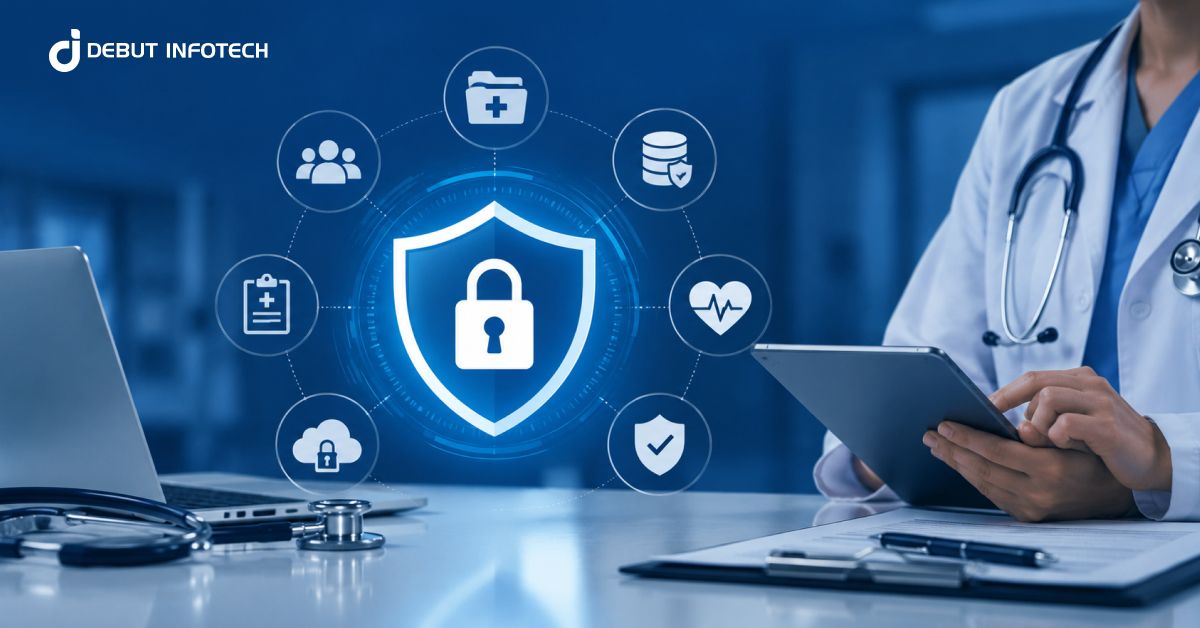


Healthcare cybersecurity solutions protect patient data and clinical operations by securing EHR/EMR systems, patient portals, telehealth platforms, cloud infrastructure, and connected medical devices.
Access controls, multifactor authentication, encryption, and network segmentation help reduce unauthorized access, data exposure, and the spread of threats across healthcare systems.
HIPAA compliance requires risk-based safeguards and documented accountability, including administrative, physical, and technical protections for electronic protected health information (ePHI).
AI-powered healthcare cybersecurity can support threat detection and investigation, but human oversight, data privacy, and controlled automation remain essential for clinical safety.
Healthcare cybersecurity costs depend on system complexity, integrations, staffing, and ongoing maintenance, making clearly defined project scope and service responsibilities critical when comparing providers.
The first step in selecting healthcare cybersecurity solutions is to identify where patient data goes, who has access to it, and what services have to stay up and running in the event of a security incident. The components of effective protection are access control, secure applications and infrastructure, monitoring and tested recovery. Your clinical workflows, connected systems, existing safeguards and regulatory requirements will determine the right priorities.
The challenge for healthcare leaders is to understand those needs and then incorporate them into real-world needs without adding to the friction for staff or patients. Each of these patient portals, EHR integration, and connected medical device comes with its own set of security implications. Based on HHS, NIST, and OWASP information, the guide clarifies the threats to consider, the controls to prioritize, the HIPAA considerations to be addressed, and the evidence to be requested when selecting an implementation partner.
Healthcare cybersecurity solutions need to protect patient information and the systems that create, exchange, and store it. These encompass EHR/EMR systems, patient portals, telehealth solutions, billing systems, cloud solutions, and connected medical gadgets. Staff credentials, administrative accounts, and third-party integrations are also in scope as they may give access to sensitive information or critical services.
Protected health information (PHI) is individually identifiable health information that is held or transmitted by a HIPAA-covered entity or business associate, with certain exceptions. The electronic version is referred to as ePHI. Security planning should be based on this information from collection to use, sharing, storage to disposal, including copies in backups, exports, and test environments.
There are three connected goals of healthcare data security, ensuring that only authorized users can access the data, ensuring that unauthorized changes to the data are not made, and ensuring that the data is available when needed. HIPAA’s Security Rule applies these confidentiality, integrity, and availability objectives to ePHI. Any system that prevents disclosure but does not have the ability to recover records is not meeting an important security requirement.
Healthcare data privacy is an issue that relates to the use and disclosure of patient information. Healthcare information security includes protecting information in electronic and other formats, whereas cybersecurity is about digital systems and threats. Establish the protection boundary by identifying information, users, systems and external connections and allocate responsibility for each.
Cybersecurity enables patients to make daily decisions and access services they rely on. In the absence of clinical systems, when records are not reliable, staff may have to delay activities, manually check information, or use downtime procedures. Depending on the systems involved, these interruptions might impact consultations, diagnostics, prescriptions, and billing.
Imagine a hypothetical clinic is unable to access their clinical records system. Reception staff can still register the patients, whereas clinicians require an alternative means of verifying patient medication histories before they can move on. An unauthorized disclosure presents another issue, services may be up and running, but the organization needs to determine if it has been exposed and what notification requirements exist.
Workload can be continued once systems return. Staff are required to reconcile paper records, to clear appointment backlogs and to validate restored information. Good healthcare data security planning takes into account the broader implications of an incident. Leaders are to ensure that services are prioritized based on their value to care, the impact of disruption, and availability of viable alternatives.
Identify threats based on the extent of exposure, access to sensitive information and the threat of disruption to care. It may be necessary to address a known vulnerability in an internet-facing application before an isolated application with restricted access. Evaluate your environment using the categories below, not as a ranking.
Attackers can take advantage of unpatched services or compromised accounts to encrypt files, steal data, or both. Backups can help you recover data but won’t eliminate data theft. Evaluate exposed systems, back-up protection and restoration preparedness as a single team to ensure that ransomware planning considers both service interruption and disclosure risks.
A convincing email or fake login page can provide the attackers with access via an existing account. Excessive permissions then allow them to access more. Check accounts that do not have multifactor authentication, shared accounts or access that does not expire on the employee’s departure. There should also be a way to differentiate between normal user accounts and privileged administrative accounts.
An application may verify a user’s identity but fail to check whether that person can access a particular record. In a hypothetical patient portal, changing a record identifier could expose another patient’s results. OWASP identifies this weakness as broken object-level authorization. Test permissions for each requested record and action.
Excessive permissions or exposed administrative tools can make information in the cloud available to unauthorized users. Check who has access to storage, its security, and its monitoring. Effective healthcare cloud security relies on clear accountability between the organization and its cloud service provider, and assurance that both parties are taking necessary measures to protect the information.
Systems that have unpatched vulnerabilities and unsecured vendor connections can create pathways to the wider system. Evaluate their connection, support and access rights. If immediate patching is limited due to clinical or manufacturer considerations, consider compensating protections with the appropriate teams. Implementing network segmentation and controlling of vendors to access can help reduce exposure and movement between systems.
Effective healthcare cybersecurity solutions link technical security measures with easy-to-understand operational tasks. Identify the gaps in the assessment and choose the controls, then specify the way in which your team will maintain the controls and check their effectiveness.
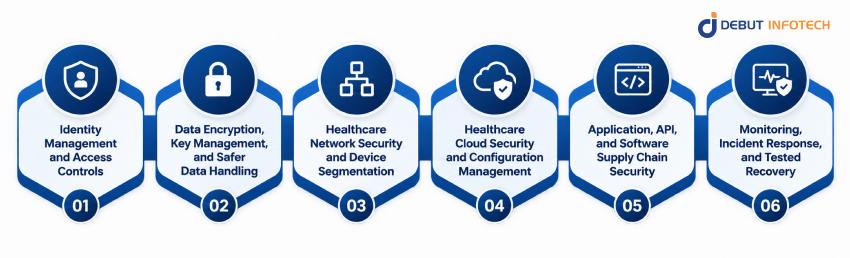
Centralized identity management aids organizations in managing access to applications, departments and external partners. Set permissions based on roles, require proper authentication, and alter permissions when roles change. HHS recommends separating everyday accounts from administrative accounts. Request future providers to show the workflow for granting, reviewing and revoking permissions on linked systems.
Use data encryption to protect sensitive information stored in databases, devices, and backups, as well as information moving between systems. Its effectiveness is dependent upon the proper management of encryption keys and access permission. Verify who is able to decrypt information, how the keys are secured, and how they can be recovered in the event that a key is lost.
Make healthcare network security a priority when the time feels right for clinical equipment, employee workstations and guest devices to connect freely. Segmentation restricts the ability to link different sets of systems, with endpoint protection and vulnerability management. Before changing network rules, map essential clinical dependencies. Validate the design by testing both blocked connections and the workflows that must remain available.
When running cloud-based applications, set acceptable security parameters and track differences in storage access, administration and network access. For healthcare cloud security, there needs to be a clear demarcation of responsibilities between you and your provider. Ask to be handed a written responsibility matrix, configuration-review output and a plan for how to resolve conflicts if the services and deployments change.
Implement security checks during software development, integration, and updates. Identifying different weaknesses with code review, authorization testing, dependency scanning, should be in accordance with the risks of the application. NIST recommends integrating secure practices into the development lifecycle. Review partners using remediation data, re-test scores and arrangements for keeping third party software components up to date post launch.
Use monitoring to identify suspicious activity across critical systems and assign alerts to people who can investigate and respond. Prior to an incident, agree on the escalation coverage, the authority over containment and the priorities for recovery. Ask for exercise documentation and restoration results to verify that the essential services can be restored within the agreed downtime and data-loss limits, including their dependency requirements.
Through AI-powered healthcare cybersecurity, security teams can more efficiently investigate activity by organizing related alerts, identifying suspicious activity, and summarizing evidence. Its value is dependent on the task, quality of available data and how staff validate the results. Cybersecurity agencies suggest using AI tools with human intervention and robust security measures.
A scenario might be a hospital that flags an account that accesses far more patient records than usual, using AI. The reviewer will then have to decide if the activity represents an approved assignment or possible misuse. Test the tool in a controlled pilot, and compare investigation time, false alarms and the number of test incidents to the existing process.
Prior to deployment, define the data that is fed into the service, where it is processed, and if it is saved or used for training. Restrict automated actions according to their potential impact on care. If a clinician’s account is disabled, for example, there must be an agreed escalation process and a means of accessing their account safely. These controls are based on NCSC guidance for sensitive data and actions that can be initiated by AI.
HIPAA establishes particular healthcare data security requirements for covered entities and business associates. Covered entities include healthcare plans, healthcare clearinghouses, and providers with certain electronic transactions. Business associates perform functions or services involving PHI on their behalf. Establishing your organization’s role helps determine the requirements your software, contracts, and operating procedures must support.
The Security Rule requires administrative, physical, and technical safeguards for ePHI. This entails risk analysis, workforce security practices, facility and device protections, access controls and audit mechanisms. Documented identified risks, selected safeguards and ownership of implementation. Re-evaluate protection when systems or operating conditions vary. Continuous organizational monitoring is needed in addition to technology to ensure compliance.
If a vendor becomes a business associate, develop a business associate agreement and define activities and safeguarding responsibilities. HHS explains that a cloud provider maintaining encrypted ePHI can remain a business associate even without the decryption key. Establish who is responsible for access, incident reporting and data return prior to transferring information.
HHS’s proposed Security Rule update remains identified as a proposal in the guidance reviewed for this article. HHS states that the current rule remains effective during rulemaking. Check the status before finalizing project requirements, and distinguish enforceable obligations from voluntary guidance or anticipated changes. A vendor’s “HIPAA compliant” label alone does not establish your organization’s compliance.
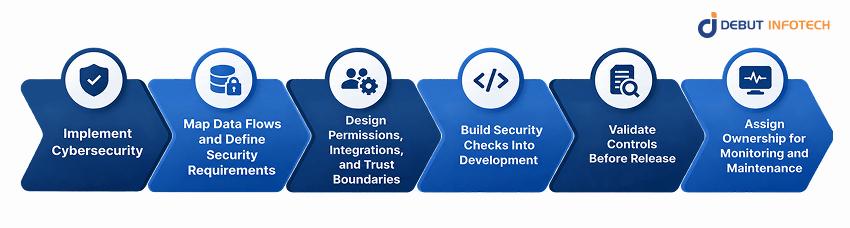
Integrate security in project requirements, development tasks and release decisions. Each safeguard must have an owner, a measurable acceptance criterion and a maintenance plan.
Track the flow of information from collection through storage, sharing and disposal. If you’re designing a patient portal, consider whether appointment reminders, analytics or support features are getting sensitive information that they don’t require. Apply threat modelling to uncover possible misuse scenarios and translate the results to specific requirements for developers, testers and operational staff.
Define a permission matrix that specifies what each user role and associated service can view, update or export. Implement those decisions on the server for all applicable requests. For instance, a portal’s support team can address account issues without having access to clinical notes.
Integrate code review, dependency security and secrets scanning into the regular development process. Specify how findings are assigned, corrected and tracked. When comparing healthcare app development services, include security requirements in the project scope and acceptance criteria. Agree on the testing evidence and maintenance responsibilities expected at handover.
Review access control, session management, auditing and data transfer mechanisms against the documented requirements. Use automated checks in combination with manual checks as appropriate to the application risks. Retest corrected vulnerabilities and document unresolved vulnerabilities. Release decisions should specify who is responsible for taking any residual risk, why the risk was taken and what corrective actions are planned.
Define who is responsible for alerts, updates, vulnerability remediation and escalation of incidents after the launch. Define roles within the internal team, developers and hosting company, including after hours support. Operating instructions and results of recovery testing should be included in handover so the production team can carry out safeguards and cope with failure of systems or dependencies.
Create a 90-day roadmap to prioritize, allocate resources, and monitor progress. Treat the schedule as an illustrative planning framework in which complex environments may need a longer timeline, while urgent exposures require action immediately.
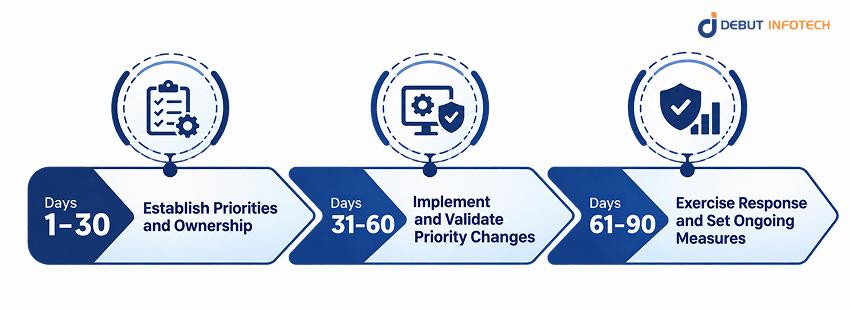
Coordinate IT, clinical operations, compliance and procurement to review results of assessments and determine any dependencies. Assess and prioritize work according to possible harm, exposure, and protection. Create a prioritised backlog of items, with an owner, target date and criteria for when it will be done. Escalate weaknesses that need to be addressed before the next phase.
Schedule changes around clinical availability and coordinate changes with impacted vendors. When disruption is possible, change your pilot, then check to see if critical workflows are still working. Verify and document work completed, including successful security testing or access removal. Document delays, temporary protections and decisions for additional funding.
Run an incident exercise involving technical and clinical teams, and test restoration of a critical service with its dependencies. Assess performance against agreed recovery goals. Assign follow-up actions and establish a recurring review of overdue high-risk findings, access reviews, and recovery readiness. HHS’s voluntary healthcare cybersecurity goals provide a useful reference for prioritizing this continuing work.
The cost of healthcare cybersecurity solutions depends on the environment being protected and the work needed to close its security gaps. The scope should be defined prior to getting estimates, including user accounts, locations, endpoints, connected devices, applications, integrations, and hours of support. The need for extra investments also depends on existing tools and staff capacities.
Poorly documented integrations, poor access control, and legacy systems can add to the effort of assessment, configuration, and testing. Adding changes that need to be clinically coordinated or vendor approved adds more dependencies. Request providers to break down discovery, remediation, integration and validation expenses, and have clear assumptions for what your team will do.
Plan for software subscriptions, monitoring, vulnerability remediation, workforce training, incident exercises and restoration testing, beyond deployment. Verify if pricing is based on users, devices, data usage or service coverage. An estimate should show details of what service is expected to continue and what extra costs will be incurred for applications, locations or after-hours incidents.
The internal team must have the proper expertise and operational coverage. Managed services bring in provider fees, but still require internal oversight and coordination of clinical services. A hybrid approach splits responsibilities between both the teams. Compare proposals based on the same scope, service hours, response commitments, exclusions and handover requirements to ensure that price differences are understood.
Select a partner who is experienced and responsible in the same area as your work. A healthcare security consulting company could audit the risk and make recommendations for changes, a development team could implement application controls, and a managed security provider could be hired to monitor operations. Verify the capabilities that are covered and where more specialists are needed.
Ask for an approved project example with explanation of what the provider actually contributed, the systems involved and security provided. Discuss how the team dealt with clinical dependencies and vendor coordination, and was able to have reduced maintenance windows. Relevant assessments may be a redacted assessment, remediation documentation, or a technical walkthrough. Establish whether the proposed team has comparable experience.
Request sample outputs and how findings are closed. Who makes changes, retests them and takes undecided risks? For continuing medical cyber security services, communicate what is being monitored, how incidents will be escalated, and who will be responsible for those incidents. A helpful suggestion spells out what the organisation needs to provide, and how tasks move from one team to another.
Prior to allowing access, set expectations around patient information, credentials, subcontractors and test environment. Verify any agreements that apply and ask for evidence of any certification claims, including scope of certification. The contract should also provide for documentation ownership, removal of access, return of data, deletion of data, and transition support to ensure that important security tasks are still addressed at the conclusion of the contract.
At Debut Infotech, we create healthcare software such as mobile health applications, EHR/EMR systems, and telemedicine platforms. Our healthcare app development services cover custom development, integration, testing, and ongoing support. For organizations developing or upgrading a product, these activities offer a chance to consider security requirements at each phase of product delivery.
Begin the conversation with your clinical processes, current systems, integration requirements, and patient information you will be using with the application. Apply these details to develop the safeguards, testing evidence and operational responsibilities for your project. Discuss scope of implementation and identify if specialist review is required before development.
Start with a risk assessment to identify urgent weaknesses. Prioritize individual user accounts, multifactor authentication, timely security updates, protected backups, and tested restoration. Train staff to recognize suspicious requests and report incidents. HHS’s voluntary healthcare cybersecurity goals provide a starting point, but implementation priorities should reflect the practice’s actual exposure and clinical needs.
No. HIPAA applicability depends on who operates the application and whether it handles information for a covered entity or business associate. An independently selected consumer wellness app may fall outside HIPAA. However, that does not remove other applicable privacy or security obligations. Assess the app’s functions, contractual relationships, and data flows before defining requirements.
No. HHS does not endorse or recognize private certifications as proof of compliance with the HIPAA Security Rule. A certificate does not remove legal obligations or prevent a subsequent finding of noncompliance. Examine the assessment’s scope, supporting evidence, unresolved findings, and the provider’s ongoing practices rather than relying on the certification label alone.
Yes, provided applicable requirements are met. For HIPAA-regulated organizations, this includes risk analysis, appropriate safeguards, and a business associate agreement with a qualifying cloud provider. Healthcare cloud security also requires clear responsibility for access, configuration, recovery, and incident reporting. Encryption does not eliminate a provider’s business-associate obligations when it maintains ePHI.

Our Latest Insights
USA
2501 Chatham, Rd Suite R Springfield, IL 62704
+1-708-515-4004
info@debutinfotech.com
UK
7 Pound Close, Yarnton, Oxfordshire, OX51QG
+44-770-304-0079
info@debutinfotech.com
Canada
154 Eden Oak Trail, Kitchener, ON N2A 0H9
+1-708-515-4004
info@debutinfotech.com
INDIA
Sector 101-A, Plot No: I-42, IT City Rd, JLPL Industrial Area, Mohali, PB 140306
9888402396
info@debutinfotech.com