ON THIS PAGE
Progress0%



Our Global Presence :





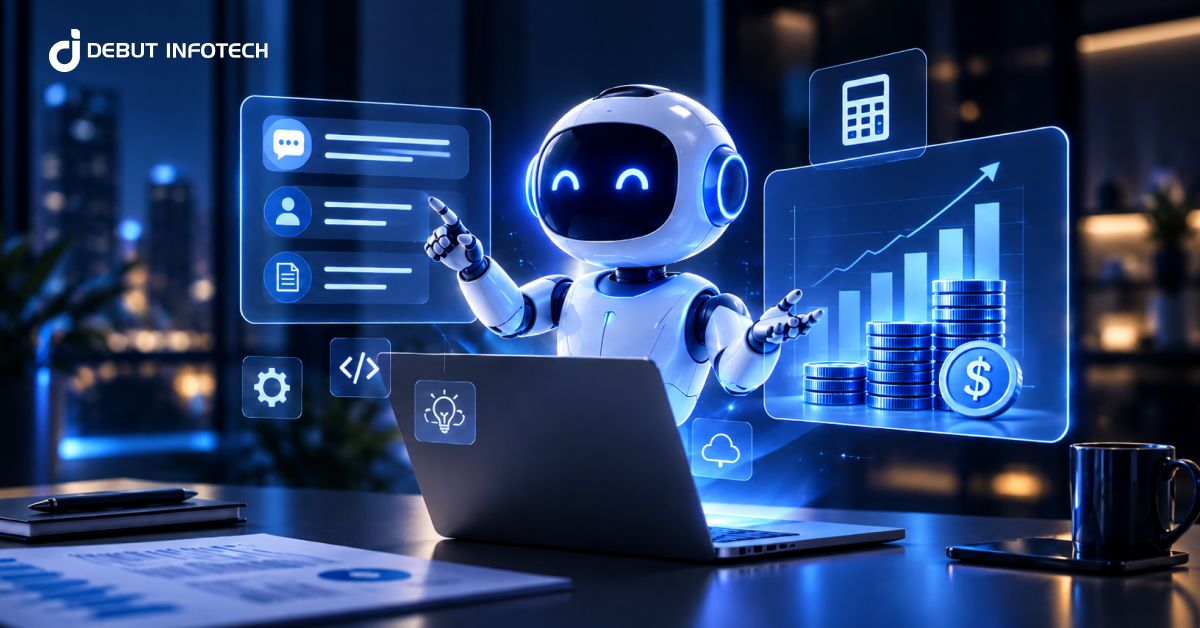
AI Agent Development Solutions are reshaping how modern businesses operate, automating complex workflows, improving service quality, and freeing human teams for higher-value work. In 2025, about 78% of organizations use AI agents in at least one business function, up from 55% the year before, indicating rapid adoption across sectors.
Companies leveraging these autonomous systems report up to 55% higher operational efficiency and a 35% reduction in costs, underlining their role in operational transformation. These solutions go beyond simple automation: they can learn, adapt, and make decisions that accelerate processes and improve outcomes. From customer service to supply chain orchestration, AI agents are unlocking measurable value.
This article explains what AI Agent Development Solutions are, their key benefits, essential components, real-world use cases, and how to choose and implement them effectively.
AI agent development solutions comprise frameworks, tools, and services for designing software agents that can act independently to complete tasks, make decisions, and interact with systems or users. These agents do not just follow static instructions. They observe inputs, apply logic or learned behavior, and take action toward defined goals. In business settings, they automate workflows, coordinate systems, and handle decisions that would otherwise require constant human input.
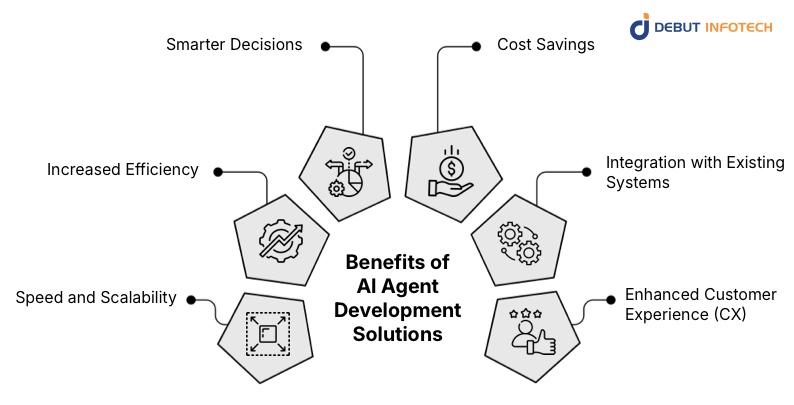
AI agent solutions are adopted to improve operational control, decision quality, and system responsiveness. When designed properly, they reduce friction across teams and processes while supporting growth without proportional cost increases.
AI agents execute tasks at machine speed and can scale horizontally without redesigning workflows. Once deployed, adding volume does not require adding staff. This is particularly useful in environments with variable demand, such as customer support, data processing, or monitoring systems that run continuously.
Agents remove repetitive coordination work that slows teams down. They handle task routing, data lookups, status checks, and follow-ups automatically. Human teams spend less time managing processes and more time on judgment-driven work where expertise matters.
AI agents combine real-time data access with decision logic or learned models. This allows them to evaluate multiple signals before acting. In practice, this leads to more consistent decisions, fewer errors caused by fatigue, and better handling of edge cases than manual processes.
Cost reduction comes from fewer handoffs, lower error rates, and reduced operational overhead. Over time, AI agents for small businesses also reduce reliance on external tools or manual intervention, stabilizing long-term operating expenses.
Well-built agents connect directly to existing databases, APIs, and enterprise software. This avoids disruptive system replacements. Organizations extend the value of existing infrastructure rather than rebuild it.
AI agents respond faster, maintain context across interactions, and provide consistent service quality. Customers experience fewer delays, clearer responses, and smoother resolution paths, even outside business hours.
A functional AI agent system relies on several foundational components working together.
The decision engine defines how an AI agent evaluates inputs and selects actions. It combines rules, probabilistic logic, or machine learning models to prioritize tasks, resolve conflicts, and handle exceptions. A well-designed engine ensures consistent behavior while allowing flexibility as conditions change.
This component allows agents to retain short-term conversational state and long-term historical knowledge. It enables continuity across interactions, awareness of prior actions, and contextual reasoning. Effective memory design prevents repetitive responses and supports informed decision-making across extended workflows.
Tool interfaces connect AI agents to external systems through APIs, databases, and enterprise applications. These connections allow agents to retrieve data, trigger workflows, and execute actions. Strong integration design ensures reliability, security, and minimal latency across interconnected systems.
This layer provides visibility and oversight across agent operations. It includes logging, performance metrics, audit trails, and escalation controls. Governance mechanisms allow human intervention, enforce compliance policies, and ensure agents operate within defined operational and ethical boundaries.
Related read: Vertical AI Agents: Enhancing Industry Workflows with AI
Healthcare organizations deploy AI agents to reduce clinician workload, improve care coordination, and support faster, data-informed medical decisions.
a) Clinical Scribes and Documentation
AI agents capture physician-patient conversations, convert them into structured clinical notes, and update electronic health records automatically. This reduces documentation time, improves record accuracy, and allows clinicians to focus more attention on patient care.
b) Medical Imaging and Diagnostics
Agents analyze imaging data to identify anomalies, prioritize urgent cases, and assist clinicians with preliminary assessments. They serve as decision-support AI tools, improving diagnostic consistency while reducing review time in high-volume radiology environments.
c) Remote Patient Monitoring
AI agents continuously track patient vitals from connected devices, detect abnormal patterns, and alert care teams proactively. This supports early intervention, reduces hospital readmissions, and enables scalable management of chronic conditions.
Financial institutions use AI agents to manage risk, process transactions at scale, and maintain regulatory compliance with minimal manual intervention.
a) Fraud Detection and Response
AI Agents monitor transactional behavior in real time, identify deviations from normal patterns, and trigger automated responses. This shortens detection cycles, limits financial exposure, and reduces reliance on manual fraud investigations.
b) Automated Onboarding (KYC)
AI agents validate identity documents, cross-check databases, and flag inconsistencies during customer onboarding. They speed up approval timelines while maintaining compliance with regulatory requirements across jurisdictions.
c) Algorithmic Trading
Agents execute trades based on predefined strategies, market signals, and risk parameters. They adjust execution dynamically, manage exposure, and operate continuously without emotional bias or manual delays.
Manufacturers rely on AI agents to maintain production stability, respond to disruptions, and coordinate complex supply networks efficiently.
a) Predictive Maintenance
Agents analyze sensor data from equipment to detect early signs of wear or failure. This enables scheduled maintenance before breakdowns occur, reducing downtime, extending asset lifespan, and lowering unplanned repair costs.
b) Supply Chain Orchestration
AI agents monitor supplier performance, logistics data, and demand signals simultaneously. They adjust sourcing, reroute shipments, and rebalance schedules when disruptions occur, improving resilience across distributed supply chains.
c) Inventory Optimization
Agents forecast demand using historical and real-time data, then adjust inventory levels automatically. This reduces overstocking, prevents shortages, and aligns procurement decisions with actual consumption patterns.
Retailers deploy AI agents to improve responsiveness, personalize customer journeys, and optimize pricing and engagement across digital and physical channels.
a) Autonomous Support
AI agents handle order tracking, returns, and common inquiries across channels. They maintain conversation context, resolve issues quickly, and escalate complex cases with full interaction history intact.
b) Dynamic Pricing
Agents adjust prices based on demand signals, competitor activity, inventory levels, and time-based factors. This allows retailers to protect margins while remaining competitive in fast-moving markets.
c) Personalized Concierges
AI agents guide customers through product discovery using preferences, browsing behavior, and past purchases. They offer tailored recommendations that increase conversion rates and improve overall shopping satisfaction.
Across departments, AI agents streamline internal operations, reduce manual coordination, and support consistent decision-making at enterprise scale.
a) Human Resources
Agents manage resume screening, interview scheduling, employee queries, and onboarding workflows. This reduces administrative burden while ensuring consistent application of hiring and HR policies.
b) Legal and Compliance
AI agents review contracts, monitor regulatory updates, and flag compliance risks. They support legal teams by accelerating document analysis and maintaining up-to-date policy awareness.
c) IT Operations (AIOps)
Agents monitor infrastructure performance, detect anomalies, and initiate remediation steps automatically. This improves system uptime, reduces incident response time, and supports scalable IT operations.
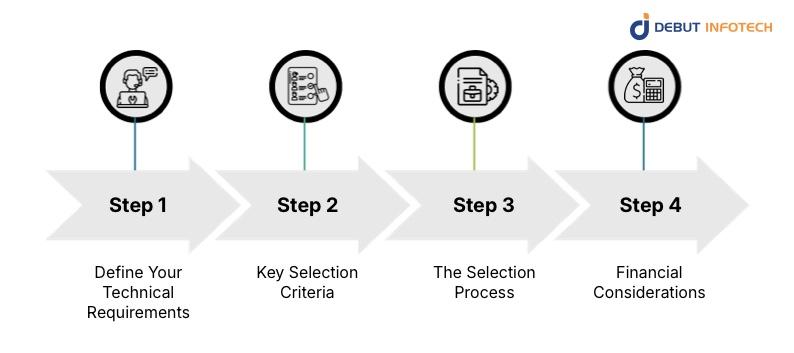
Selecting the right AI agent solution starts with understanding the level of intelligence, adaptability, and autonomy your workflows actually require.
a) Rule-Based Agents
Rule-based agents follow predefined logic paths and decision trees. They work best for stable, predictable processes where conditions rarely change, and compliance or deterministic outcomes matter more than adaptability or learning over time.
b) Learning Agents
Learning agents use machine learning models to improve performance through data and feedback. They suit environments with changing patterns, incomplete inputs, or uncertainty, where static rules cannot reliably capture real-world variability.
c) Enterprise-Grade Agents
Enterprise-grade agents are built for scale, governance, and cross-system coordination. They support role-based access, auditability, high availability, and centralized management across multiple departments, workflows, and data sources.
Beyond agent type, long-term success depends on technical fit, operational reliability, and the extent to which the solution aligns with enterprise constraints.
a) Technical Stack Expertise
The provider should demonstrate experience with relevant AI frameworks, cloud platforms, and orchestration tools. This ensures agents are built efficiently, maintained reliably, and aligned with your existing engineering standards and infrastructure.
b) Integration Capabilities
Strong integration support allows agents to connect smoothly with internal systems, APIs, and third-party platforms. This reduces implementation friction and prevents agents from operating in isolation or requiring costly system redesigns.
c) Data Security and Compliance
The solution must support encryption, access controls, audit logs, and compliance with applicable regulations. This is especially critical when agents handle sensitive customer, financial, or operational data across multiple systems.
d) Scalability
Scalability determines whether agents can handle increased workloads without performance degradation. The architecture should support horizontal scaling, distributed execution, and workload balancing as usage grows.
e) Customization vs. Off-the-Shelf
Off-the-shelf agents offer faster deployment, while custom-built agents provide better alignment with specific workflows. The right balance depends on process complexity, differentiation needs, and tolerance for long-term vendor dependency.
f) Post-Deployment Support
Ongoing support covers monitoring, updates, model tuning, and issue resolution. Strong post-deployment services ensure agents remain reliable, secure, and aligned with evolving business and regulatory requirements.
A structured evaluation process reduces risk and ensures the chosen solution delivers measurable value beyond initial deployment.
a) Define Clear KPIs
KPIs should reflect operational outcomes such as time savings, error reduction, cost efficiency, or service quality. Clear metrics help evaluate agent performance objectively and justify continued investment over time.
b) Shortlist and RFP
Shortlisting narrows options to AI Agents Companieswith relevant experience. A detailed RFP clarifies expectations for functionality, integration, security, timelines, and support, enabling a more accurate comparison across agentic AI security solutions.
c) Request a Proof of Concept (PoC)
A PoC validates agent behavior in real conditions using your data and systems. It exposes limitations early and confirms whether the solution meets performance, reliability, and usability expectations.
d) Check Industry Track Record
Proven experience in your industry reduces delivery risk. Case studies, references, and repeat deployments indicate the provider understands domain-specific constraints and operational realities.
AI agent development cost evaluation should extend beyond development fees to reflect the full lifecycle impact of deploying and maintaining AI agents.
a) Initial Cost
Initial costs include agent design, development, integration, testing, and deployment. These vary based on complexity, customization level, and required infrastructure, and should be clearly itemized upfront.
b) Long-Term Budget
Ongoing costs cover hosting, monitoring, updates, retraining, and support. Understanding these recurring expenses prevents budget overruns and ensures the solution remains sustainable as usage expands.
c) ROI Alignment
Return on investment should be directly linked to measurable improvements, such as cost reductions, revenue growth, or productivity gains. Clear ROI alignment helps secure stakeholder buy-in and guides future scaling decisions.
Begin with a narrowly scoped use case that addresses a specific operational problem. Define success criteria upfront, including measurable performance indicators. Early wins help validate assumptions, surface technical gaps, and build internal confidence before expanding agents into more complex or business-critical workflows.
Human oversight ensures accountability, especially in high-impact decisions. Design workflows that allow humans to review, override, or approve agent actions when needed. This reduces risk, supports regulatory compliance, and builds trust while agents mature through controlled, real-world exposure.
Security and ethics must be built into agent design from the start. Address data privacy, access control, and bias risks explicitly. Apply regular audits, testing, and governance checks to ensure agents behave consistently, protect sensitive information, and align with legal and organizational standards.
Modular architectures allow agents to retrieve accurate, up-to-date information without retraining core AI models. Using RAG improves reliability by grounding outputs in trusted data sources. This approach simplifies updates, reduces hallucinations, and supports scalable expansion across multiple use cases.
AI agents deliver value only when they can act within existing workflows. Integrate them cleanly through APIs, dashboards, and user interfaces. Seamless integration reduces friction, improves adoption, and ensures agents complement human work rather than introducing parallel processes.
Track agent performance using defined metrics tied to business outcomes. Monitor accuracy, latency, error rates, and cost impact. Continuous iteration based on real usage helps refine behavior, justify investment, and ensure agents remain aligned with evolving operational goals.
As a top-tier provider of AI Agent Development Services, Debut Infotech builds AI agent development solutions that move past theory and into daily operations.
Our team focuses on agents that integrate cleanly with existing systems, follow enterprise-grade security standards, and deliver measurable business outcomes.
From intelligent workflow automation to domain-specific agent design, we emphasize reliability, scalability, and long-term value.
Our approach balances technical depth with practical execution, helping organizations deploy AI agents that actually perform in real-world environments, not controlled demos.
AI Agent Development Solutions offer a practical path to transform business operations, cut costs, and improve decision quality. By automating routine tasks and integrating seamlessly with existing systems, these solutions free teams to focus on strategic priorities while enhancing customer and employee experiences. Whether in healthcare, finance, or retail, the impact is measurable.
Businesses that align their goals, select the right tools, and follow disciplined implementation practices will see sustained gains in efficiency and competitive advantage.
A. Businesses with repeat workflows, heavy data use, or constant customer interaction see the most significant gains. Think fintech, eCommerce, healthcare, logistics, SaaS, and customer support teams. Even mid-sized companies benefit when tasks like support, reporting, scheduling, or monitoring start eating up time and focus.
A. Traditional automation follows fixed rules and breaks when conditions change. AI agents adapt. They understand context, learn from data, and make decisions without constant reprogramming. Instead of just triggering actions, they analyze situations, handle variations, and improve performance as they interact with real-world inputs.
A. Timelines depend on complexity. A basic AI agent can go live in four to six weeks. More advanced agents with integrations, learning models, and custom workflows may take three to four months. Ongoing tuning usually happens after launch, not before.
A. Costs vary by scope and features. A simple AI agent typically starts around $20,000 to $30,000. Mid-level solutions range between $50,000 and $100,000. Enterprise-grade AI agent systems with deep integrations, security layers, and scalability can cost over $150,000.
A. Common issues include unclear use cases, messy data, integration limits, and internal resistance to change. Some teams expect instant results and underestimate the time required for training. Security and compliance also need attention early, especially when AI agents handle customer data or financial workflows.

Our Latest Insights
USA
2501 Chatham, Rd Suite R Springfield, IL 62704
+1-708-515-4004
info@debutinfotech.com
UK
7 Pound Close, Yarnton, Oxfordshire, OX51QG
+44-770-304-0079
info@debutinfotech.com
Canada
154 Eden Oak Trail, Kitchener, ON N2A 0H9
+1-708-515-4004
info@debutinfotech.com
INDIA
Sector 101-A, Plot No: I-42, IT City Rd, JLPL Industrial Area, Mohali, PB 140306
9888402396
info@debutinfotech.com