ON THIS PAGE
Progress0%





Our Global Presence :





Cybersecurity is no longer just a way to respond to threats. As attack surfaces grow and attackers use automation more and more, traditional rule-based security technologies are having a hard time keeping up. This has made people more interested in AI agents in cybersecurity. These are systems that can work on their own or with little help to watch, think, and act in complicated security situations.
AI agents work more independently than traditional AI-powered products. This lets them assess signals, make choices, and adjust to new threats. At the same time, there is a lot of hype around the space, with many solutions being called “agents” even though they don’t really give users freedom. This article talks about what AI agents in cybersecurity can achieve right now, where they still have problems, and what the future holds.
To understand the value of AI agents in cybersecurity, it’s important to distinguish them from traditional AI tools.
An AI agent is a system that:
In cybersecurity, this environment includes networks, endpoints, cloud workloads, applications, logs, and threat intelligence feeds.
Agentic AI in cybersecurity refers to the use of AI systems designed to act as agents rather than passive analytics engines. These agents don’t just flag anomalies—they reason about them, determine next steps, and execute actions such as:
This agent-based approach is a fundamental shift from static detection to adaptive defense.
Many cybersecurity tools already use machine learning, but that doesn’t automatically make them agentic.
| Aspect | Traditional Security Tools | AI Agents in Cybersecurity |
| Core Function | Rule-based detection and alerting | Autonomous or semi-autonomous reasoning and action |
| Threat Detection | Signature and rule-driven | Behavioral and context-aware |
| Response Model | Manual or scripted | Automated or agent-led with human oversight |
| Adaptability | Limited, requires manual updates | Learns and adapts over time |
| Context Awareness | Low to moderate | High (cross-system correlation) |
| Scalability | Requires additional analysts | Scales with minimal human intervention |
| Role of Humans | Central to all decisions | Supervisory and strategic |
This difference is critical when evaluating claims made by AI agents companies and cybersecurity vendors.
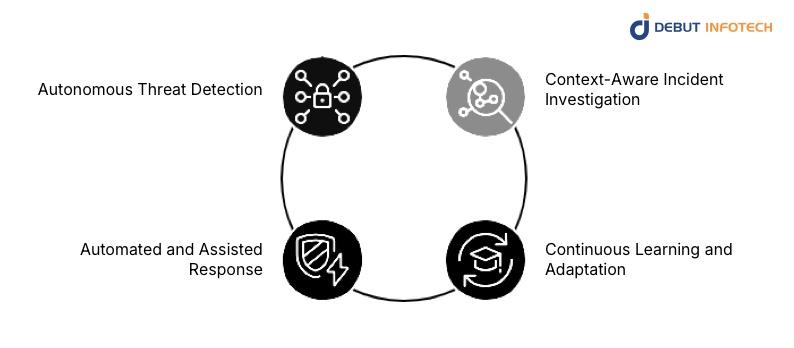
AI agents bring together multiple AI disciplines—machine learning, large language models, reinforcement learning, and decision systems—into coordinated architectures.
One of the most mature applications of AI agents in cybersecurity is threat detection.
Agents can:
The role of agentic AI in cybersecurity threat detection lies in its ability to connect weak signals across time, systems, and data sources.
Instead of generating isolated alerts, AI agents can investigate incidents end to end.
They may:
This dramatically reduces alert fatigue and shortens investigation timelines.
AI agents can execute or recommend response actions, including:
Most real-world deployments still keep humans in the loop, but the automation potential is significant.
Unlike static rule-based systems, AI agents learn from:
This allows them to adapt as attackers evolve—an essential capability in modern threat landscapes.
Understanding AI agent architecture is key to evaluating feasibility and maturity.
A typical agentic AI system in cybersecurity includes:
This modular design allows organizations to deploy Specialized AI Agents for specific tasks rather than one monolithic system.
Threat detection is where agentic AI currently delivers the most tangible value.
AI agents excel at identifying:
This makes them effective against zero-day and novel attack techniques.
Advanced threats rarely occur in a single step. AI agents can:
This is a major improvement over traditional SIEM-driven detection models.
Another emerging use case is agentic AI in cybersecurity penetration testing.
AI agents can:
This allows organizations to continuously test defenses rather than relying on periodic manual assessments.
In advanced setups, multiple agents collaborate:
This multi-agent approach mirrors real-world attacker strategies and provides deeper security insights.
While fully autonomous cyber defense systems remain rare, several real-world implementations demonstrate practical value.
AI agents assist analysts by:
This allows SOC teams to scale without proportional increases in headcount.
In complex cloud environments, AI agents help:
These agentic AI applications in cybersecurity are particularly valuable for large enterprises.
Organizations exploring agentic AI platforms often cite the following benefits:
For businesses working with an AI agent development company, these benefits translate into measurable security ROI when implemented correctly.
Despite real progress, the market is flooded with exaggerated claims.
In reality, most AI agents are assistive, not fully autonomous, and require careful governance.
AI agents in cybersecurity still face important constraints.
AI agents are best suited for:
Engaging experienced AI consultants early helps align expectations with real capabilities.
As powerful as AI agents in cybersecurity can be, their deployment introduces new categories of risk that organizations must actively manage.
AI agents can:
If these decisions are made without proper safeguards, they may:
This is why most production systems still rely on human-in-the-loop or human-on-the-loop models rather than full autonomy.
One of the biggest challenges with agentic AI is explainability.
Security teams, auditors, and regulators need to know:
Lack of transparency can limit adoption, especially in regulated industries such as finance, healthcare, and critical infrastructure.
AI agents themselves can become targets.
Potential attack vectors include:
This makes AI agents security a growing discipline of its own, requiring hardened architectures and continuous monitoring.
A critical design decision in agentic AI is the level of autonomy granted.
In this setup:
This model is currently the most common and trusted in enterprise cybersecurity.
Here:
This strikes a balance between speed and control.
Fully autonomous AI agents that operate without human oversight remain largely experimental and are typically confined to:
Most organizations are not ready for full autonomy—and vendors claiming otherwise should be evaluated carefully.
Adopting AI agents in cybersecurity is not just a technical decision—it’s a business one.
The AI agent development cost depends on factors such as:
Organizations working with an experienced AI agent development company can significantly reduce trial-and-error costs.
Companies typically choose between:
For most enterprises, hybrid models—combining commercial platforms with custom agents—offer the best balance.
ROI from AI agents often appears as:
These metrics matter more than raw automation percentages.
Read this blog: AI Agents Development Cost
Not all vendors offering “AI agents” deliver true agentic capabilities.
When evaluating AI Agents Companies, organizations should assess:
Vendors that support AI Agents for developerswith APIs and customization options tend to offer greater long-term flexibility.
Red flags include:
Experienced AI consultants can help organizations separate real capability from marketing.
AI agents do not operate in isolation—they are part of a broader ecosystem of AI tools, platforms, and workflows.
Successful deployments integrate with:
This integration allows agents to act contextually rather than in silos.
Agentic systems rely on multiple AI models and AI algorithms, including:
Understanding how these components interact is essential for secure deployment.
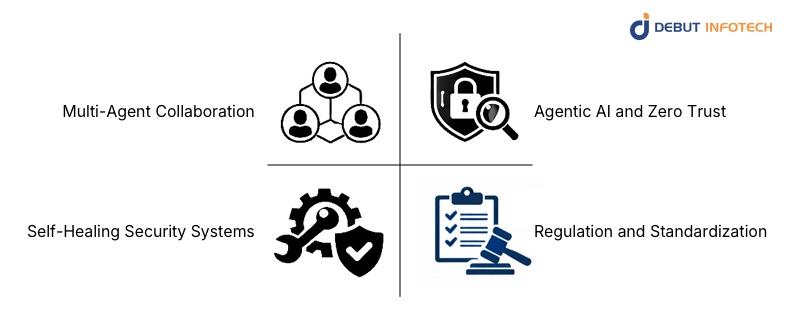
Looking ahead, several trends will shape the next generation of agentic AI.
Instead of single agents, future systems will use:
This mirrors how human security teams operate.
AI agents will increasingly support zero-trust architectures by:
Long-term, AI agents may enable:
This represents a shift from reactive defense to adaptive resilience.
As adoption grows, expect:
Organizations that prepare early will adapt more smoothly.
For leaders evaluating AI agents in cybersecurity, the next steps should be pragmatic and deliberate. Organizations should start small by deploying agents for narrow, high-impact use cases such as alert triage or investigation assistance, while maintaining human oversight to avoid rushing into full autonomy without proper governance and trust frameworks.
Rather than chasing hype, the focus should be on sound agent architecture, high-quality data, and seamless integration with existing security systems. Working with an experienced AI agent development company or AI development services provider can further reduce implementation risk and accelerate real, measurable value.
AI agents in cybersecurity represent a meaningful evolution in how organizations defend digital assets. When implemented thoughtfully, they enhance detection, accelerate response, and help security teams operate at scale. However, they are not a silver bullet.
The real value of agentic AI lies not in replacing humans, but in augmenting them—handling complexity, reducing noise, and enabling faster, more informed decisions. Organizations that approach AI agents with clarity, governance, and realistic expectations will be best positioned to benefit as this technology matures.
As agentic AI continues to evolve, it will become a defining pillar of modern cybersecurity strategy—one that blends intelligence, autonomy, and human judgment into a more resilient defense posture.
A. AI agents in cybersecurity are autonomous or semi-autonomous systems that can observe security environments, analyze threats, make decisions, and take or recommend actions. Unlike traditional tools, they adapt continuously to evolving attack patterns.
A. Agentic AI in cybersecurity refers to AI systems designed to act as agents rather than passive analytics tools. These systems combine perception, reasoning, decision-making, and action to assist or automate security operations.
A. AI agents improve threat detection by analyzing behavioral patterns, correlating signals across systems, and identifying anomalies that signature-based tools often miss. This makes them effective against advanced and zero-day threats.
A. Most AI agents in cybersecurity today are not fully autonomous. They typically operate in human-in-the-loop or human-on-the-loop models to ensure oversight, reduce risk, and meet compliance requirements.
A. Key benefits include faster threat detection and response, reduced alert fatigue, improved scalability of security operations, and better adaptation to new and emerging threats.
A. Limitations include dependence on data quality, challenges with explainability, vulnerability to adversarial attacks, and the need for strong governance. These factors mean AI agents should augment—not replace—human security teams.
A. Organizations should begin with focused use cases such as alert triage or incident investigation, maintain human oversight, and work with experienced AI development services providers to design secure and scalable agent architectures.

Our Latest Insights
USA
2501 Chatham, Rd Suite R Springfield, IL 62704
+1-708-515-4004
info@debutinfotech.com
UK
7 Pound Close, Yarnton, Oxfordshire, OX51QG
+44-770-304-0079
info@debutinfotech.com
Canada
154 Eden Oak Trail, Kitchener, ON N2A 0H9
+1-708-515-4004
info@debutinfotech.com
INDIA
Sector 101-A, Plot No: I-42, IT City Rd, JLPL Industrial Area, Mohali, PB 140306
9888402396
info@debutinfotech.com