ON THIS PAGE
Progress0%



Our Global Presence :





AI adoption has moved from experimentation to execution, forcing enterprises to make clear decisions about how to deploy it. According to McKinsey’s State of AI report, 65% of organizations now regularly use generative AI. In comparison, overall AI adoption has reached 72% across business functions, showing how quickly it has become embedded in operations. Furthermore, scaling remains a challenge, with many organizations still struggling to turn early wins into enterprise-wide value.
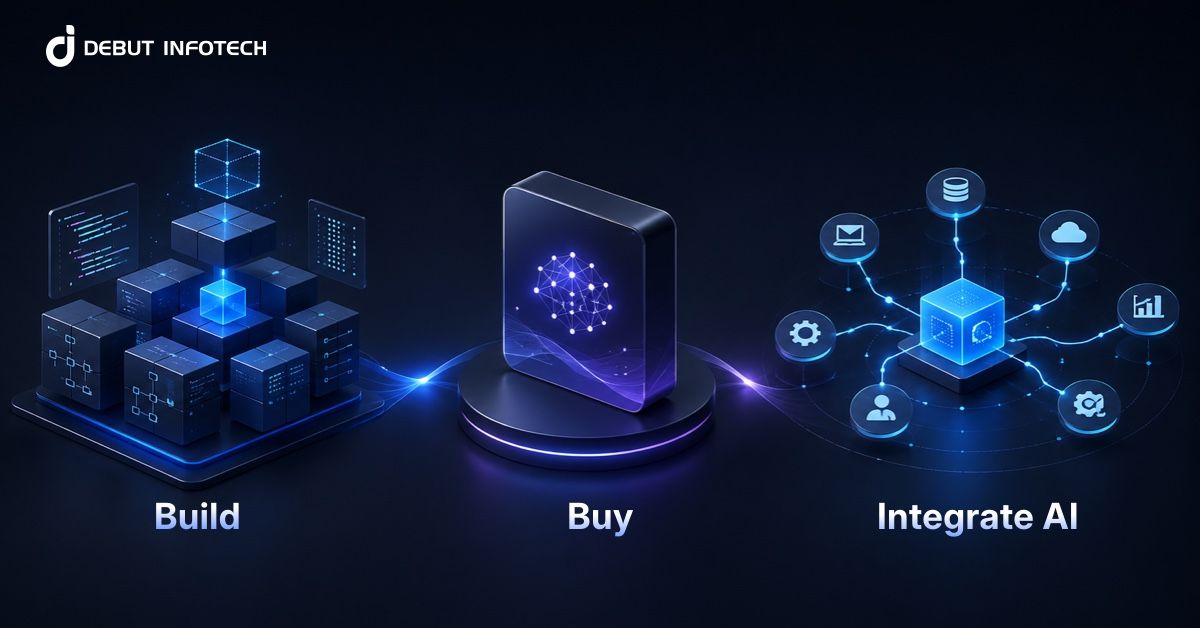
This is where the build vs buy AI decision becomes critical. Enterprises must choose between building custom systems, buying ready-made solutions, or integrating external models into existing products. Each approach affects cost, speed, control, and long-term flexibility in different ways.
Selecting the right path is not a technical preference; it is a strategic decision that shapes how AI delivers value, scales across the organization, and supports competitive advantage over time.
A buying strategy involves adopting pre-built AI products from external vendors, typically delivered through SaaS platforms or packaged software. It entails selecting, configuring, and deploying ready-made solutions rather than developing models internally.
The process relies on vendor-managed infrastructure, where organizations integrate tools into workflows, access features via dashboards or APIs, and scale usage based on subscription tiers or consumption models.
Buying AI solutions means adopting pre-built tools or platforms delivered as software or APIs. This route is often the fastest way to operational results, especially for organizations focused on execution rather than experimentation.
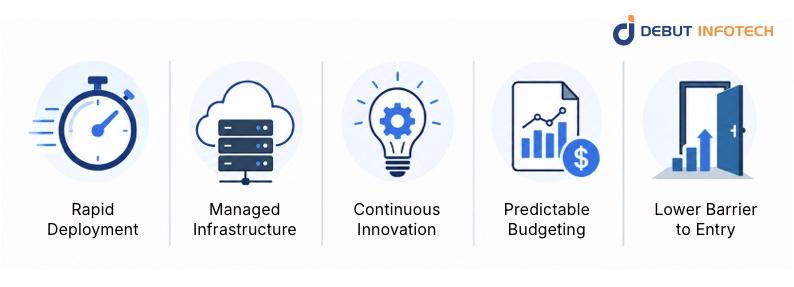
Pre-built AI solutions allow organizations to move from decision to execution with minimal delay. Instead of spending months on development and testing, teams can deploy functional systems quickly, often within weeks. This speed supports faster experimentation, earlier value realization, and quicker alignment with evolving business needs.
Vendors take responsibility for hosting, scaling, monitoring, and maintaining the underlying infrastructure. This removes the burden on internal teams to manage servers, uptime, or performance tuning. As a result, organizations can focus on using generative AI capabilities effectively rather than investing time and resources in operational maintenance.
AI vendors continuously improve their products by releasing updates, enhancing models, and introducing new features. Organizations benefit from these advancements without needing to allocate internal resources for research or upgrades. This ensures access to improving performance and capabilities without disrupting existing workflows or systems.
Most AI products follow subscription or tiered pricing models, which simplifies financial planning. Organizations can estimate costs based on expected usage, avoiding large upfront investments. This predictability helps align AI spending with business budgets while reducing uncertainty around development overruns or infrastructure scaling costs.
Buying AI reduces the need for specialized expertise, making advanced capabilities accessible to a wider range of organizations. Teams without deep machine learning knowledge can still deploy effective solutions through intuitive interfaces or simple integrations. This accessibility enables faster adoption and lowers the complexity of getting started with AI initiatives.
Despite the convenience, buying comes with constraints that affect long-term flexibility and control.
Relying on a single provider can make it difficult to switch platforms later. Data formats, integrations, and workflows often become tightly coupled with the vendor’s ecosystem, increasing migration complexity and limiting flexibility when better or more cost-effective alternatives emerge.
Pre-built enterprise AI solutions are designed for broad use cases, which can restrict their ability to meet highly specific requirements. Organizations may find it difficult to tailor features, workflows, or outputs, leading to compromises that affect performance or alignment with unique business needs.
When using vendor-provided AI, the underlying models and technology remain the provider’s property. This limits opportunities to build proprietary assets or differentiate offerings, as organizations cannot claim ownership over the core intelligence powering their solutions or outputs.
Processing sensitive or regulated data through external platforms introduces compliance and security risks. Even with safeguards in place, organizations must trust vendors with critical information, which can create risks related to data handling, storage, and jurisdictional regulations.
Buying works best in scenarios where speed and simplicity outweigh the need for deep customization.
Buying AI solutions is appropriate when time constraints are tight and delays directly affect business outcomes. Organizations can bypass long development cycles and deploy ready-made tools quickly, enabling faster decision-making, quicker market entry, and immediate operational improvements without waiting for internal build processes.
When the required AI capability is common across industries, such as chatbots, transcription, or document analysis, buying becomes practical. These use cases rarely demand deep customization, making pre-built solutions sufficient while avoiding unnecessary investment in building systems that offer limited differentiation.
Organizations with limited access to AI engineers, infrastructure, or research capabilities benefit from buying. Instead of assembling specialized teams, they can rely on vendor expertise, reducing internal workload while still gaining access to advanced AI features that would otherwise be difficult to develop independently.
Buying reduces uncertainty by leveraging solutions that are already tested and widely used. Organizations can adopt proven tools with predictable performance, minimizing the risks associated with experimentation, model failure, or unexpected technical AI scalability and integration challenges that often arise during custom AI development efforts.
An integrating AI strategy involves embedding third-party AI models or services into existing systems using APIs or middleware. It entails connecting external intelligence with internal applications, allowing data to flow between systems. The approach works by sending inputs to external models, processing responses, and combining them with proprietary data to deliver context-aware outputs within existing workflows.
Integration involves connecting external AI models or APIs into existing systems. It sits between buying and building, offering flexibility without full ownership responsibilities.
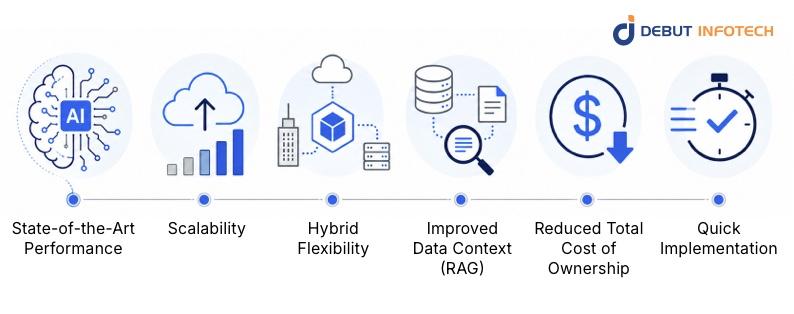
Integration provides access to advanced AI models developed by leading providers without requiring internal development. Organizations can leverage cutting-edge capabilities that are continuously improved, ensuring high performance and accuracy while avoiding the cost and complexity associated with building comparable models from scratch.
External AI services are designed to scale with demand, allowing organizations to handle increased workloads without infrastructure changes. As usage grows, providers automatically manage capacity, ensuring consistent performance and availability without requiring internal teams to plan or invest in additional resources.
Integration allows organizations to combine multiple AI providers or models within a single system. This flexibility supports experimentation, optimization, and vendor switching when needed, enabling teams to adapt quickly to changing requirements without being locked into a single technology or approach.
By combining external models with internal data sources, organizations can generate more relevant and accurate outputs. Retrieval-Augmented Generation enables systems to reference proprietary information, improving response quality while maintaining control over sensitive data, thereby enhancing decision-making and operational effectiveness.
Integration avoids the high upfront costs associated with building AI systems while still delivering strong capabilities. Organizations pay based on usage, which can be more cost-efficient in early stages, reducing financial risk and allowing budgets to scale gradually as adoption increases.
APIs and development kits simplify the process of embedding AI into existing systems. Teams can integrate capabilities without extensive reengineering, reducing development time and enabling faster deployment of new features that enhance products, services, or internal workflows.
Usage-based pricing can fluctuate as demand increases, making budgeting less predictable over time. High-volume requests, especially in production environments, may lead to rising expenses, requiring careful monitoring, cost controls, and optimization strategies to prevent overspending as adoption scales.
Relying on third-party providers introduces operational risks tied to service availability, pricing changes, or policy updates. Any disruption from the provider can directly impact system performance, making organizations dependent on external reliability rather than having full internal control over critical AI capabilities.
Calling external APIs can introduce delays, particularly in real-time or high-frequency applications. Network conditions, server response times, and geographic distance all contribute to latency, which may affect user experience and limit suitability for time-sensitive or performance-critical use cases.
Many AI models impose limits on the amount of data they can process in a single request. These constraints can limit complex workflows, requiring additional engineering effort to split, summarize, or restructure inputs before processing, thereby increasing system complexity and development overhead.
Integration is effective when organizations need to apply external AI models to internal data for common tasks. This approach allows businesses to combine proprietary datasets with powerful models, delivering tailored outputs without the need to build or train systems from the ground up.
Organizations that prioritize adaptability benefit from integration, as it allows them to test, switch, or combine different AI providers with minimal disruption. This flexibility supports ongoing experimentation and optimization, enabling teams to respond quickly to changing requirements or technological advancements.
When AI is used to improve current offerings rather than define them, integration provides a practical path. Teams can embed features such as recommendations, automation, or analysis into existing systems without rebuilding core architecture or significantly altering established workflows.
Integration works well when AI is a supporting feature rather than the main product. In such cases, organizations can add intelligent capabilities without investing heavily in infrastructure, ensuring efficient use of resources while still delivering meaningful enhancements to users or internal processes.
A building strategy involves developing AI systems entirely in-house, including models, data pipelines, and infrastructure. It entails designing, training, and deploying custom AI development solutions tailored to specific business needs. The approach leverages internal data, specialized talent, and dedicated infrastructure to create fully controlled, optimized systems that closely align with organizational goals and long-term scalability requirements.
Building AI systems from scratch gives organizations full control over design, data, and performance. It is the most resource-intensive path but offers the highest level of differentiation.
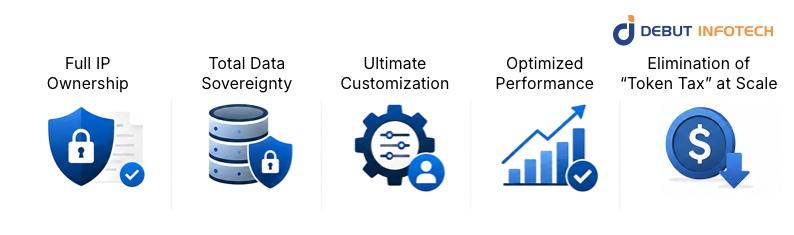
Building AI internally ensures that all models, AI algorithms, and outputs remain the organization’s property. This ownership enables long-term strategic control, supports competitive differentiation, and allows businesses to refine and reuse their technology without restrictions imposed by external vendors or licensing agreements.
Organizations retain complete control over how data is collected, stored, processed, and secured. This is critical for industries with strict regulatory requirements, as it reduces exposure to external risks and ensures compliance with internal governance policies and data protection standards.
Custom-built AI systems can be tailored to highly specific business needs, workflows, and objectives. This level of customization allows organizations to solve unique problems more effectively, optimize outputs for their context, and avoid compromises that often come with generic, pre-built solutions.
Internal development enables fine-tuning models based on specific datasets and use cases. This targeted optimization improves accuracy, efficiency, and response quality, ensuring that the AI system performs consistently in real-world conditions aligned with the organization’s operational requirements and expectations.
Over time, building AI can reduce reliance on usage-based pricing models tied to external providers. For high-volume applications, this eliminates recurring per-request costs, allowing organizations to achieve better cost efficiency as usage scales and workloads become more predictable.
The control that comes with building also introduces significant operational demands.
Developing AI systems requires significant investment in infrastructure, tools, and skilled personnel. Costs can escalate quickly during research, experimentation, and deployment phases, making it a capital-intensive approach that may not be feasible for organizations with limited budgets.
Building AI from scratch involves extended timelines for data preparation, model training, testing, and validation. This delay can slow down business initiatives, especially when immediate results are needed, making it less suitable for time-sensitive projects or competitive market conditions.
Successful AI development depends on access to experienced data scientists, machine learning engineers, infrastructure specialists, or even AI development companies. Recruiting and retaining such talent can be challenging and costly, particularly for organizations without an established technical foundation in AI.
AI systems require continuous monitoring, updates, and retraining to remain effective. This ongoing effort and AI solution lifecycle management add operational complexity, as teams must manage performance issues, data drift, and evolving requirements while ensuring the system remains reliable and aligned with business goals.
Building is justified when AI becomes central to competitive advantage.
Building AI is appropriate when it plays a central role in defining competitive advantage. Organizations can create unique capabilities that competitors cannot easily replicate, strengthening their market position and enabling them to deliver distinct value through proprietary technology and innovation.
When business problems are highly specialized and cannot be addressed by generic solutions, building becomes necessary. Custom AI enables organizations to design systems tailored to their workflows, ensuring better alignment with operational needs and delivering more precise, effective outcomes.
Organizations that handle sensitive or regulated data benefit from building AI capabilities internally. This enterprise AI transformation roadmap ensures full control over data access, processing, and storage, reducing exposure to external risks and supporting compliance with strict legal, regulatory, or industry-specific requirements.
Building AI provides complete control over system design, updates, and evolution. Organizations can adapt quickly to changing requirements, integrate new capabilities, and refine models without relying on external providers, ensuring long-term flexibility and alignment with business strategy.
During the AI ROI decision making process, it’s crucial to understand the differences between buying, Integrating, or building AI.
| Factor | Buy AI | Integrate AI | Build AI |
| Cost | Lower upfront costs with predictable subscription pricing, but expenses can increase over time as you scale and add premium features. | Moderate cost with usage-based pricing, which can fluctuate depending on API calls and system demand. | High upfront investment in infrastructure, talent, and development, but can become cost-efficient at scale over time |
| Time to Deployment | Fastest option, often deployed within weeks since the solution is pre-built and ready to use. | Moderate speed, requiring time for API integration, testing, and workflow alignment. | Slowest approach, as it involves designing, training, testing, and deploying systems from scratch |
| Expertise Required | Minimal technical expertise is needed, as vendors handle complexity and provide user-friendly interfaces. | Requires moderate technical skills to manage integrations, APIs, and data flow between systems | Demands high-level expertise, including data scientists, ML engineers, and infrastructure specialists. |
| Customization | Limited customization, as solutions are designed for broad use cases with fixed capabilities. | Moderate customization by combining external models with internal data and logic. | Full customization, allowing complete control over features, performance, and system behavior. |
| Scalability | Easily scalable through vendor-managed infrastructure, though often tied to pricing tiers. | Highly scalable, with flexibility to adjust usage and switch providers if needed. | Fully scalable based on internal design, but requires planning and investment in infrastructure |
| Control | Low control over models, data handling, and system behavior, as vendors manage core components. | Partial control, with ownership over data and integration logic, but reliance on external models | Complete control over models, data, infrastructure, and system evolution. |
| Maintenance | Minimal maintenance is required, as vendors handle updates, monitoring, and system improvements. | Shared responsibility, with vendors managing models while internal teams handle integration and workflows. | High maintenance burden, including updates, retraining, monitoring, and infrastructure management. |
| Support | Vendor-provided support, documentation, and service-level agreements ensure reliability and assistance. | Support depends on the provider’s APIs and the internal team’s ability to resolve integration issues. | Fully internal support responsibility, requiring dedicated teams to manage issues and improvements. |
| Best Use Case | Ideal for standardized tasks, quick deployment needs, and organizations with limited resources or expertise | Best for enhancing existing systems, combining proprietary data with external AI, and flexible experimentation. | Suitable for strategic, highly specialized use cases where differentiation, control, and long-term value are priorities. |
Decision-making should be grounded in measurable business priorities rather than technical preference. Here are some key factors to consider when choosing an enterprise AI strategy framework:
Organizations need to determine whether AI is central to their value proposition or simply a supporting capability. If AI drives differentiation, building or integrating may be more suitable.
If it supports routine operations, buying can be sufficient. This clarity helps align technical decisions with long-term business priorities and competitive positioning in the market.
The urgency of delivering results plays a major role in decision-making. Buying offers immediate deployment; integration provides moderate speed; building takes longer but offers deeper control.
Organizations must evaluate how delays affect revenue, customer experience, and operational efficiency before selecting the approach that best aligns with their timelines.
Costs extend beyond initial investment and include maintenance, scaling, and operational overhead.
Buying may seem cost-effective initially, but it can become expensive with scale, while building requires an upfront investment but may reduce long-term expenses.
Integration sits between both, requiring careful analysis of expected returns over time.
The availability of skilled professionals and build vs buy vs integrate AI consulting firms significantly influences the decision.
Building requires experienced engineers, data scientists, and infrastructure support, while integration demands moderate technical capability.
Buying minimizes internal requirements. Organizations must realistically assess their capacity to develop, deploy, and maintain AI systems before committing to any strategy.
Data privacy, compliance, and operational risks must be carefully evaluated.
Buying and integrating introduces external dependencies, while building offers greater control but increases internal responsibility.
Organizations need to consider regulatory requirements, data sensitivity, and risk tolerance to ensure the chosen approach aligns with governance standards and security expectations.
AI systems must adapt to changing demand and evolving business needs.
Buying provides scalable solutions with limited flexibility, integration offers adaptability across providers, and building enables full control over scaling strategies. Organizations should assess how easily each option can evolve as usage grows and requirements shift over time.
A hybrid AI strategy combines building, buying, and integrating approaches within a single architecture to balance speed, cost, and control.
It entails using pre-built tools for common tasks, integrating external models for flexibility, and developing custom systems for critical functions. This approach works by assigning each method to specific use cases, allowing organizations to optimize performance, manage risk, and adapt as requirements evolve.
A hybrid strategy spreads operational and financial risk by avoiding dependence on a single approach, while allowing organizations to direct investments toward areas that deliver the strongest returns.
It supports long-term adaptability as AI technologies evolve, enabling teams to adjust strategies without major disruption.
A hybrid approach also improves responsiveness to changing business needs, while allowing sensitive workloads to remain securely managed in-house and less critical tasks to be handled externally. This creates a balanced system that combines efficiency, control, and flexibility.
A hybrid approach introduces architectural complexity as multiple systems, tools, and workflows must be designed, coordinated, and maintained together.
Integration friction can slow development due to compatibility issues between platforms.
Data may become fragmented across environments, reducing consistency and visibility.
Costs can also overlap when organizations pay for multiple solutions simultaneously, requiring careful governance to prevent inefficiencies and unnecessary spending.
The build vs buy AI decision model shapes how enterprises balance speed, cost, and control. Buying delivers quick results, integration offers flexibility, and building enables full ownership and differentiation. Most organizations evolve across these options over time. The right choice depends on business priorities, internal capabilities, and long-term goals, not just technical preference.
Partnering with Debut Infotech helps enterprises navigate this complexity. We offer AI development services and support the building, integration, or scaling of AI solutions aligned with business goals. Our goal is to ensure practical execution, reduce risk, and deliver faster time-to-value across real-world enterprise use cases.
A. There’s no one-size answer. If you need tight control or something unique, build it. If speed matters and the problem is common, buy. If you already have solid systems, integrate AI into them. Most enterprises mix all three, depending on use case, budget, and internal expertise.
A. You’ll find a mix of big consulting firms, cloud providers, and niche AI development companies. Names like Accenture, Deloitte, IBM, and AWS come up a lot. Then there are specialists like Debut Infotech that focus on custom builds and integrations tailored to specific business needs and workflows.
A. It usually starts with identifying a clear use case, not chasing hype. Teams assess whether to build, buy, or integrate based on cost, speed, and complexity. Then come pilot testing, data preparation, and gradual scaling. Most companies don’t go all in at once—they roll things out in phases.
A. The big players include Accenture, Deloitte, McKinsey, and PwC. They handle strategy, vendor selection, and implementation at scale. For more hands-on development or faster turnaround, smaller AI-focused firms often step in. The “best” option depends on your budget, timeline, and the complexity of your requirements.
A. Look past the sales pitch. Check their past projects, ask how they handle data security, and see if they’ve worked in your industry before. A good vendor won’t push one approach every time. They’ll help you weigh build vs buy vs integrate AI based on your actual business goals.
A. There isn’t a clear winner. Build vs buy AI depends on what you need. Building works when customization and control matter. Buying fits when you want speed and proven solutions. Most companies mix both, building where it counts and buying where it saves time.
A. Building AI means higher upfront costs. You pay for talent, infrastructure, and long-term upkeep. Buying AI through subscriptions spreads costs, which feel lighter early on but can add up. Integration costs sit somewhere in between. The smarter move is to focus on long-term returns, not just start-up costs.
A. Outsourcing makes sense when internal expertise is limited or when timelines are tight. It also helps when testing ideas without committing to full-time hires. External teams often bring experience from multiple projects, which can speed things up and reduce mistakes during early development stages.
A. In-house AI can drain resources if not planned well. Hiring skilled engineers is hard, and projects can stall without clean, usable data. Teams sometimes build more than they need, chasing perfection rather than results. Without clear direction, the effort can grow without delivering meaningful outcomes.
A. Focus on proven experience and relevance to your industry. Ask how they handle data security and scaling. Pay attention to how they communicate, not just what they promise. A reliable vendor will help you evaluate build vs buy AI based on your goals, not push one option.

Our Latest Insights

USA
2501 Chatham, Rd Suite R Springfield, IL 62704
+1-708-515-4004
info@debutinfotech.com
UK
7 Pound Close, Yarnton, Oxfordshire, OX51QG
+44-770-304-0079
info@debutinfotech.com
Canada
154 Eden Oak Trail, Kitchener, ON N2A 0H9
+1-708-515-4004
info@debutinfotech.com
INDIA
Sector 101-A, Plot No: I-42, IT City Rd, JLPL Industrial Area, Mohali, PB 140306
9888402396
info@debutinfotech.com