ON THIS PAGE
Progress0%






Our Global Presence :






AI in insurance delivers the highest value when applied to targeted business problems, with 50% of European non-life insurers and 24% of life insurers already using AI across parts of the insurance value chain, signaling growing enterprise adoption.
Traditional automation and AI serve different operational needs, with rules-based workflows handling repetitive processes while machine learning, NLP, computer vision, and generative AI enable predictive analytics, document understanding, and intelligent decision support.
Successful AI implementation relies on more than model accuracy, requiring high-quality data, seamless integration with policy and claims systems, robust governance, security controls, and human oversight to deliver measurable business outcomes.
Phased AI deployment reduces implementation risk and accelerates time to value, starting with a proof of concept, validating measurable KPIs, and then scaling across insurance workflows as data readiness and governance mature.
AI strengthens fraud detection, claims processing, and underwriting by analyzing large volumes of structured and unstructured data, helping insurers identify anomalies, prioritize high-risk cases, and improve operational efficiency while keeping critical decisions under human review.
Insurance AI success depends on selecting the right technology and implementation partner, combining domain expertise, secure integrations, compliance-ready architecture, and continuous model monitoring to maximize long-term ROI and reduce operational risk.
The use of AI in insurance is rapidly evolving into a tangible business tool that enhances underwriting, claims management, fraud detection, customer services, and policy handling. The integration of technologies like machine learning in insurance, predictive analytics, natural language processing, computer vision and generative AI allows insurance companies to process vast amounts of data, automate tasks, and facilitate more accurate and efficient decision-making.
The success of AI solutions for insurance companies depends on more than choosing the right technology. Insurers must begin with a clearly defined business problem, reliable data, suitable system integrations, strong security controls, and appropriate human oversight. For instance, a claims automation platform has a different architecture and governance model than an underwriting engine, fraud detection system or customer service copilot.
This guide outlines key areas in the insurance value chain where AI can provide measurable value and how AI works in the insurance industry. It addresses key technologies, real-world applications, implementation processes, business value, development expenses, adoption obstacles, measuring ROI, and the criteria insurers should take into account when choosing a seasoned AI development partner.
AI in insurance is the use of data-based systems to recognise patterns, interpret data, forecast outcomes, and help with insurance decisions. Unlike rules-based software, which executes only predefined actions, AI insurance technology can process the changing data and uncover relationships that might not be apparent from manual analysis.
Its role varies according to the insurance function involved. In underwriting, AI can structure risk data and identify aspects that need more attention. In claims operations, it can categorize submissions, gather the information needed and prioritize claims by severity or complexity. It can also identify unusual behaviour for fraud investigation and help service teams retrieve policy information more efficiently.
These systems are not independent of the current insurance system. The integration of AI in the insurance industry typically involves integration with policy administration systems, claims management systems, customer databases and documents, and analytics tools. Their outputs are then fed into existing workflows where employees can view recommendations, handle exceptions and make accountable decisions.
The benefit of AI is the effectiveness of its contribution to a particular process. A model that is accurate on its own is not necessarily business valuable unless it can connect with current models, communicate its results, and be used by the stakeholders who will make decisions based on the results.
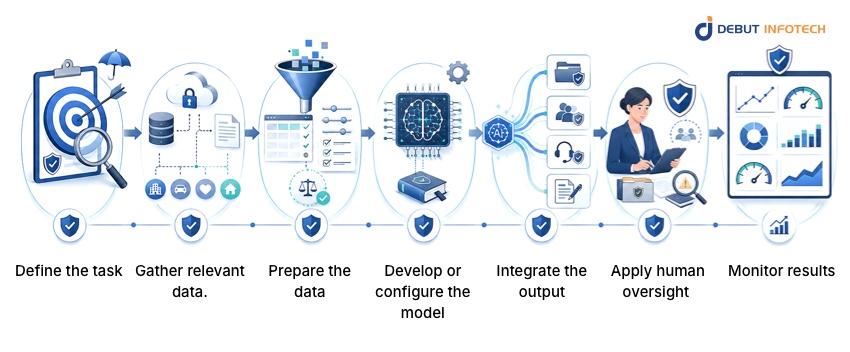
A typical AI implementation in insurance follows seven stages which include the following:
This process demonstrates that, in addition to the AI model itself, workflow design and governance are essential to successful insurance AI.
Insurers are dealing with an increasing amount of policy records, claims documents, customer correspondence, images, data from connected devices and third party risk information. Meanwhile, policyholders want decisions to be made quickly, services to be tailored to their needs, and their digital experience to be convenient. These pressures are driving AI adoption in insurance to become a strategic business decision and not just an isolated technology experiment.
This shift is already visible across the industry. The European Insurance and Occupational Pensions Authority reported that 50% of surveyed European non-life insurers and 24% of life insurers were already using AI across different areas of the insurance value chain. The findings show that AI has moved beyond early experimentation, although adoption levels still vary by insurance segment and use case.
Structured transactions and rule based processes work well with traditional systems. But they frequently cannot handle unstructured documents, recognize intricate patterns, or adjust to evolving customer and risk circumstances. AI insurance solutions can help insurers analyse information, predict outcomes, classify documents, prioritise cases, and provide employees with relevant decision support.
There are several business pressures driving this change:
The impact of enterprise AI for insurance hinges on the alignment of technology with the measurable business needs. Insurers should focus on use cases that have relevant data, transparent success criteria, robust system integration, and the right level of human supervision. This method enables AI to enhance decision-making and processes, and serve regulatory, operational, and customer-service functions.
Traditional automation and AI in insurance both help insurers to improve efficiency, but they focus on different kinds of work. Traditional automation is rule-based and takes the same action every time certain conditions are fulfilled. AI systems can understand information, recognize patterns, forecast outcomes, and provide suggestions for action when inputs or conditions change.
For instance, a rules-based workflow can issue a renewal notice when a policy is about to expire. An AI model can analyze the likelihood of non-renewal and determine the optimal retention strategy, based on customer behavior, payment history, policy changes, and previous interactions.
| Comparison Area | Traditional Automation | AI-Driven Automation |
| Decision logic | Follows fixed rules and predefined conditions | Uses data to identify patterns, predictions, or recommendations |
| Data type | Works mainly with structured data | Processes structured and unstructured data |
| Adaptability | Requires manual changes when rules or processes change | Can improve through retraining, monitoring, and updated data |
| Best use | Stable, repetitive, and predictable tasks | Complex, variable, or data-intensive activities |
| Insurance example | Sending renewal reminders automatically | Predicting which customers may not renew |
| Claims example | Routing a completed form to an adjuster | Estimating claim severity and prioritising review |
| Monitoring | Tracks whether workflow steps were completed | Tracks workflow performance, model accuracy, bias, and drift |
The strongest insurance workflows often combine both approaches. Insurance automation can manage predictable activities such as notifications, data transfers, document routing, and record updates. AI insurance technology can then analyse claim descriptions, classify documents, detect unusual activity, or generate recommendations for employees.
AI is not automatically the better option for every process. A stable task with clear rules may not require a predictive model. Incorporating AI where traditional automation methods will do the job can add unnecessary costs, monitoring needs, and risks to the deployment process.
Insurers should consider the complexity of the workflow, the data needed, the risk of making a decision and the likely outcome. AI automation in the insurance industry is best suited for tasks that involve interpretation, prediction, or pattern recognition, whereas traditional automation is appropriate for repetitive and routine activities.
Insurers deal with vast amounts of policy information, claims paperwork, customer correspondence, photos, financial details and even risk information. But many insurers are still relying on disjointed systems and manual workflows that prevent them from effectively leveraging this data. These operational constraints are driving the need for AI in the insurance sector, not the desire to embrace technology for its own sake.
This practical need for AI in the insurance industry is due to operational gaps such as:
Traditional insurance automation remains effective for stable tasks with clearly defined rules. It becomes less suitable when a process requires interpretation, prediction, or analysis of unstructured information. This is where AI solutions for insurance provide additional value.
The objective is not to automate every insurance decision. It is to improve how information is processed, help employees focus on complex cases, and create faster and more reliable workflows across the organisation.
Modern AI insurance technology isn’t just one tool. It integrates multiple technologies which perform data analysis, document interpretation, pattern recognition, document generation and workflow decision. The best technology will be determined by the insurance process, available data, desired outcome, and level of human oversight needed.
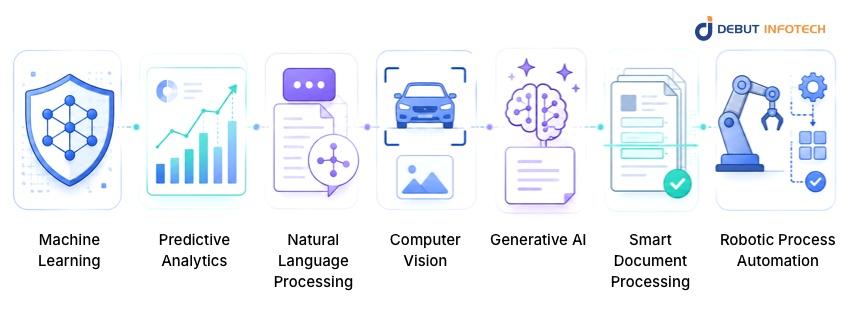
Machine learning in insurance relies on past and present data to uncover patterns and enhance prediction accuracy. Insurers can use machine learning models to risk score, classify claims, detect fraud, segment customers, provide price-support and analyze customer renewal.
For instance, a model can look at past claims, policy features, customer actions, and factors outside of the policy to calculate claim severity. Its recommendations should be reviewed, particularly in the context of coverage, pricing and claims decisions.
Predictive analytics in insurance involves using statistical techniques, machine learning models, and past data to predict future outcomes.It can be used to aid insurance companies in predicting claims frequencies, loss severity, customer attrition, fraud risk, and exposure of the portfolio.
These forecasts enable underwriting, claims and risk teams to allocate their resources more effectively. But predictive models are as accurate as the data and assumptions upon which they are based. Insurers should keep an eye on accuracy, bias and performance variations over time.
Natural language processing (NLP) is a technology that can be used to interpret, categorize, and understand the meaning of written or spoken language. Insurance companies can use it to process:
Natural language processing can reduce manual document review and help employees locate relevant information faster. It is particularly valuable when insurers manage large volumes of unstructured text.
Computer vision is the ability of software to analyse images and videos. In insurance, it can aid in the inspection of vehicles, property damage, identity document verification, and evaluation of visual claims evidence.
A computer vision model may identify damaged vehicle components or compare property images before and after an incident. These outputs can improve claims triage, but complex or disputed cases should remain subject to professional assessment.
Generative AI can generate, summarize, and restructure content according to given data and instructions. Insurers can leverage it to create policy assistants, claims copilots, internal knowledge tools, customer service systems and document-drafting applications.
For example, a claims copilot may summarise case documents and prepare a draft response for an adjuster. Insurers using generative AI development services should implement controls that reduce inaccurate or unauthorized outputs, including:
Generative AI should support employees rather than make unsupervised high-impact decisions.
Intelligent document processing is a combination of optical character recognition, natural language processing, machine learning and validation rules. It can classify documents, extract important fields, verify the information and route files to the appropriate workflow.
In the context of AI in insurance claims processing, this technology can identify names, policy numbers, dates, claims information, invoice amounts, and any supporting documentation. It can help claims teams identify incomplete or inconsistent claims, and can help to reduce data entry effort.
Robotic process automation is used to execute repetitive tasks based on a set of rules. It can update records, move records between systems, notify, create routine documents and initiate steps in workflow.
RPA becomes more capable when combined with AI. The AI component can interpret a document or recommend an action, while RPA completes the approved transaction. This combination supports insurance workflow automation without requiring artificial intelligence for every task.
The most effective AI solutions for insurance often combine several of these technologies. A claims platform, for instance, may use document processing to extract information, machine learning to estimate severity, computer vision to analyse damage, and automation to route the case. The value comes from how these technologies work together to improve a defined insurance outcome.
The most significant advantages of AI in insurance lie in its ability to enhance the way insurance companies handle information, make decisions, and interact with policyholders. AI can eliminate repetitive tasks, enhance risk assessment and aid teams to get responses faster. But these gains aren’t guaranteed. They rely on accurate information, safe integrations, transparent management and manual controls.
AI can be used to extract information from forms, invoices, photos, medical records, and supporting documents for insurance claims. It can categorize claims, flag missing information, assign severity ratings and pass cases on to the appropriate team.
This will save claims professionals time in routine reviews and allow them to dedicate more time to cases that are more complex or disputed. Policyholders can likewise acquire faster updates and prevent unnecessary delays.
The integration of policy data, customer information, external risk indicators, and historical claims in underwriting and risk assessment can be achieved through AI. It can draw attention to relevant patterns and facilitate uniform and regular reviews between underwriting teams.
The technology should be used for aiding, not replacing, professional judgment. Review by a human is still necessary if the decision pertains to pricing, insurance coverage, exclusions or access to insurance products.
Using AI to detect insurance fraud can help spot anomalies, repeated claims, suspicious relationships, and inconsistencies with large volumes of data. This gives investigators the freedom to concentrate on cases that have higher risk indicators.
An AI alert should not be considered as proof of fraud. It should facilitate investigation and be evaluated in conjunction with policy terms, evidence and existing review procedures.
AI-powered customer service in insurance can assist policyholders in tracking claim status, comprehending coverage, notifying them of renewal periods, and handling standard requests. It can also help service teams with summarizing conversations and finding relevant information in the policy.
Key customer benefits include:
Even if the request is complex, sensitive, or disputed, it should be dealt with by trained employees.
The automation of insurance with AI can eliminate repetitive manual tasks like data entry, document validation, review, routing, and standard correspondence. It can also lower processing mistakes and aid in the better utilization of employee time.
Insurers remain liable for development, integration, infrastructure, security, maintenance and monitoring expenses. The financial value should therefore be measured against the total cost of implementation and operation.
In the insurance industry, predictive analytics can be used to forecast the likelihood of a claim, the severity of a loss, customer churn, and exposure of insurance portfolios. These insights help to make more informed pricing, underwriting and resource allocation.
As risks evolve, it is necessary to keep monitoring and updating models.
A key advantage of AI in insurance is that it helps employees with summaries, predictions, recommendations, and information retrieval quickly. Claims handling, underwriting, fraud investigation and service representatives can save time locating records or performing repetitive tasks.
This gives them the opportunity to work on tasks where they need to use judgment, empathy, negotiation or special knowledge.
Insurance analytics can help insurance companies gain insights into customer behavior, coverage needs, renewal patterns, and service preferences. These insights can help provide relevant products, communication, and recommendations.
Personalisation needs to be coupled with privacy, fairness and explainability. Insurers should not use sensitive or biased data in such a way that it leads to unfair outcomes.
The usefulness of AI solutions for insurance companies relies on the extent to which the technology is integrated with a particular business challenge. Effective data governance, well-defined success metrics, staff participation, and continuous monitoring are key to making AI initiatives yield long-term impact.
The most beneficial use cases for AI in insurance are those that rely on handling extensive amounts of data, repetitive document reviews, pattern recognition, or decisions that must be made quickly. Insurers should make use of the business value, data readiness, regulatory risk, integration complexity and human judgment that is needed for the applications.
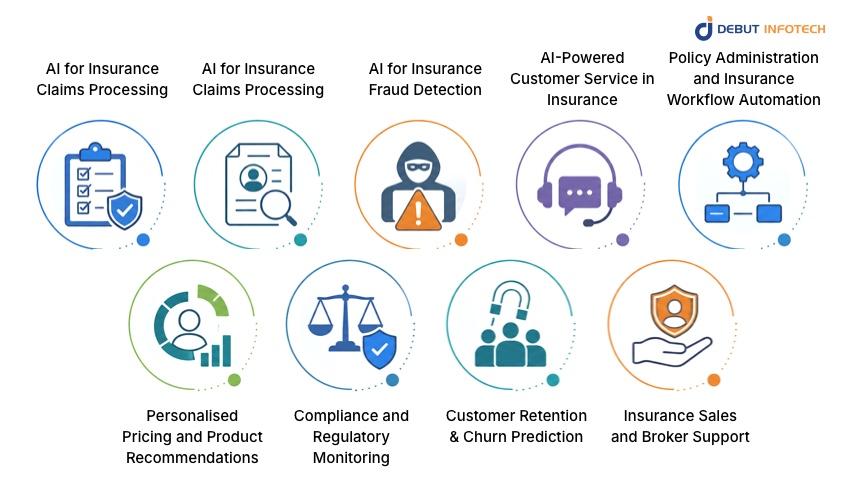
Claims management entails taking in loss notifications, reviewing documentation, examining coverage, determining damage, identifying discrepancies, and interacting with policyholders. AI for insurance claims processing can assist with these tasks by scanning and analyzing data from forms, images, invoices, medical reports, and adjuster observations. Common applications include:
Routine claims may move through the workflow faster, while complex or disputed cases can be directed to experienced professionals. Human review remains necessary for coverage decisions, settlement approval, and exceptions.
In underwriting and risk assessment, AI tools assist insurers in streamlining data, spotting risk factors, and conducting more uniform evaluations of applications. Models can analyse historical losses, policy details, customer information, property characteristics, and approved external data. Relevant applications include:
AI-generated recommendations should support professional judgment rather than automatically determine coverage or pricing. Insurers also need explainability controls so underwriters can understand the information influencing a recommendation.
AI for insurance fraud detection can identify unusual patterns across claims, transactions, customer records, service providers, and repair networks. Unlike fixed rules, machine learning models can compare several signals and relationships simultaneously. Fraud-related applications include:
An AI alert should be treated as a risk indicator, not proof of fraud. Investigators must assess the model’s findings alongside policy terms, evidence, customer explanations, and established investigation procedures.
In insurance, AI-driven customer service can guide policyholders to get information and handle basic requests without needing human intervention. It can also help service representatives by providing information about policies, summarizing interactions and recommending responses. Typical applications include:
Customer-facing systems should provide clear escalation paths. Complex, sensitive, or disputed matters require trained employees who can apply judgment and respond with empathy.
Policy administration includes data entry, document generation, endorsements, renewals, billing updates, and record maintenance. Insurance workflow automation can reduce manual processing by combining intelligent document processing, business rules, and robotic process automation. Applications may include:
This approach helps to streamline workflow and maintain human-approved changes to coverage or contract terms.
Insurance analytics and predictive models can provide an understanding of customer behavior, coverage requirements, risk profiles, and renewal trends for insurers. This information could help make product recommendations more relevant and provide personalised communication.
However, pricing and product models require careful governance. Insurers are required to check for unfair results, resist the use of sensitive information at inappropriate times, and have the ability to consider and discuss influential factors.
AI can assist compliance teams by scanning documents, communications, transactions, and operational records for any anomalies. It may also help organise evidence for audits and regulatory reporting. Possible applications include:
The use of automated output alone should not be the basis for compliance decisions. Legal and regulatory experts need to approve the rules, interpretation and reporting obligations in each jurisdiction.
Predictive analytics can help insurance companies pinpoint customers who are not likely to renew. Models may assess service interactions, claims experience, payment behaviour, policy changes, and engagement patterns.
Retention teams can use these insights to prioritise outreach, resolve service problems, and provide relevant renewal information. The purpose should be to improve customer support rather than apply unfair pressure or discriminatory treatment.
AI solutions for insurance companies can help sales teams and brokers review customer requirements, match products, summarise submissions, and prepare proposals more efficiently. Applications include:
The strongest insurance AI solutions connect these use cases with existing claims, policy, customer, and analytics systems. Insurers should begin with a focused process where outcomes can be measured before expanding AI automation for insurance across the enterprise.
The key to successful AI implementation in insurance starts with a problem to solve, data to trust, and metrics to track. Insurers should not implement wide-ranging AI initiatives without first determining what aspect of their workflow, decision or customer outcome needs improvement. A phased design would minimize the risk and enable the organisation to test value first before scaling up the solution.
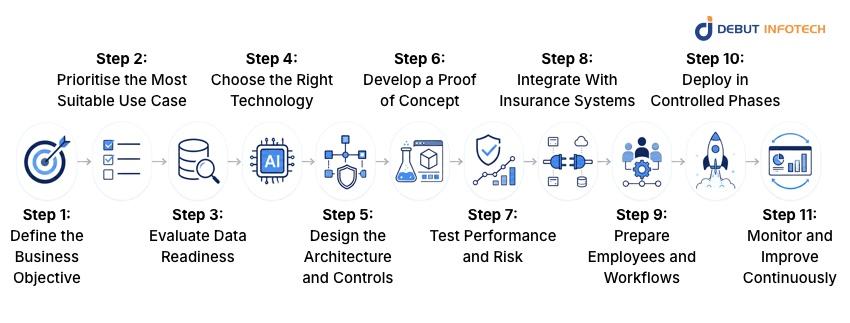
First, it’s essential to define a measurable problem, like slow claims processing, irregular underwriting, backlogged document review and lots of customer service volume. Develop baseline measures including processing time, error rates, manual workload, or customer satisfaction, so the organisation can assess improvements following deployment.
Evaluate potential uses on business value, data readiness, compliance risk, complexity of integration and time to value. A well-focused process with easily available data and an unambiguous set of success criteria is often the best beginning.
Effective AI solutions for insurance require accurate, complete, accessible, and representative data. Prior to the development of any models, insurers should first recognize the absence of records, inconsistencies in record format, duplication, historical bias, limitations on record ownership, and privacy concerns.
Not all processes need to be powered by AI. Rules-based insurance automation might be suitable for predictable tasks, and machine learning in insurance, natural language processing, computer vision, or generative AI might be suitable for prediction, interpretation, and complex document analysis.
The architecture should illustrate the flow of data into the system, how the model operates with the data, and where the employees review the output. It should also include APIs, user interface, system integration, access controls, audit logs, and security monitoring and human review processes.
A proof of concept is a way of testing a proposed solution using limited data and pre-defined performance targets. It can uncover technical, operational and data constraints prior to committing to full production development by the insurer.
Testing can be done based on accuracy, data quality, privacy, security, fairness, user acceptance, compliance, and failure scenarios. Those outputs that could influence pricing, coverage, claims or customer eligibility should be kept under the control of the authorised human review.
This solution might need to integrate with policy administration, claims, customer relationship management, document, and analytics platforms. In cases where legacy infrastructure does not allow direct connections, APIs or middleware can help with integration.
Employees need to be aware of the system’s strengths and weaknesses, as well as escalation and review protocols. To achieve digital transformation in the insurance industry, it is essential to redesign the workflows instead of simply integrating AI into the existing processes.
Start with a single team, product line or customer segment that you can manage. A phased rollout allows easier tracking of inaccurate outputs, technical issues, employee worries, and customer impact.
Monitor accuracy, processing time, false results as well as workflow exceptions, user adoption, customer complaints, model drift, and business outcomes. Sustainable AI adoption in the insurance industry involves ongoing monitoring, governance, maintenance, and enhancement
The use of AI in insurance can enhance operational efficiency, speed up the decision-making process, and boost customer service, but it also comes with its share of risks. Addressing technical, ethical, and organisational issues up front will help insurers overcome inaccurate outcomes, regulatory issues, security problems, and employee resistance to the adoption.
1. Poor data quality: Incomplete, outdated, duplicated, and inconsistent data can diminish the accuracy of insurance analytics and model results. Insurers need to validate, standardise and clean the data before the development phase and to set accountability for data quality.
2. Legacy system integration: Some existing policy, claims, and billing systems might not seamlessly integrate with current insurance AI tools. APIs, middleware and secure data pipelines can help insurers move towards the gradual integration approach without having to replace all current systems all at once.
3. Bias and limited explainability: Models may produce unfair or difficult-to-explain recommendations, particularly when supporting AI in underwriting and risk assessment. Insurers should experiment with outputs for different customer segments, record significant factors and keep human interaction for pricing, coverage and claims.
4. Privacy and security risks: AI solutions for insurance companies often process sensitive personal, financial, and claims information. Therefore, encryption, role-based access, audit logs, vendor assessment and incident response procedures are vital.
To ensure responsible adoption of AI in insurance, employee training, continuous monitoring, and accountability for every AI-assisted decision are essential.
Choosing the best AI development partner for an insurance project is not just about technical skills. The right partner needs to be knowledgeable of insurance workflows, data quality, system integration, security, model governance and human oversight. Debut Infotech tackles the development of insurance AI solutions by first identifying the business problem, understanding the readiness of the data, and choosing the right technology and designing a solution that can be integrated with the existing business.
We offer features like custom machine learning, predictive analytics, intelligent document processing, AI copilots, data engineering, workflow automation, cloud deployment, and post-launch monitoring. These services can help make practical AI solutions for insurance companies, such as claims processing, underwriting support, customer service, insurance workflow automation and analysis of fraud risk.
Insurers can work with Debut Infotech as an AI development company to develop secure, scalable, and business-focused solutions. Companies planning policy assistants, claims copilots, or internal knowledge systems can also explore our generative AI development services.
A strong engagement should begin with one measurable use case. This enables the insurer to confirm feasibility, understand integration and governance needs, determine cost, and develop a realistic roadmap for insurance growth with AI prior to deployment in additional departments. It also minimizes risks of unnecessary enterprise-wide deployment.
AI in insurance supports underwriting, claims processing, fraud detection, policy administration, customer service, pricing, risk assessment, and compliance monitoring. Insurers use it to analyse data, extract information from documents, identify unusual patterns, predict outcomes, and assist employees with recommendations. Human professionals should still review decisions that significantly affect policyholders.
The AI development cost for insurance depends on project scope, data preparation, model complexity, integrations, user interfaces, infrastructure, security, testing, compliance, and ongoing maintenance. A document-processing tool will generally require fewer resources than an enterprise underwriting or fraud-detection platform. A discovery assessment is necessary for a defensible estimate.
AI for insurance claims processing can extract data from forms, invoices, images, medical records, and supporting documents. It can classify claims, identify missing information, estimate severity, flag unusual patterns, and route cases for review. Claims involving coverage disputes, complex losses, or settlement decisions should remain subject to professional assessment.
The ROI of AI insurance solutions can be measured through changes in claims processing time, underwriting turnaround, manual review volume, cost per transaction, fraud investigation yield, customer retention, and service quality. Insurers should establish baseline metrics before implementation and compare financial gains or avoided costs with development and operating expenses.
The timeline depends on the use case, data quality, integration requirements, security controls, testing, and organisational readiness. A limited proof of concept may be completed faster than a production system connected to several claims, policy, or customer platforms. Enterprise deployment usually requires phased implementation, user training, governance, and post-launch monitoring.

Our Latest Insights

USA
2501 Chatham, Rd Suite R Springfield, IL 62704
+1-708-515-4004
info@debutinfotech.com
UK
7 Pound Close, Yarnton, Oxfordshire, OX51QG
+44-770-304-0079
info@debutinfotech.com
Canada
154 Eden Oak Trail, Kitchener, ON N2A 0H9
+1-708-515-4004
info@debutinfotech.com
INDIA
Sector 101-A, Plot No: I-42, IT City Rd, JLPL Industrial Area, Mohali, PB 140306
9888402396
info@debutinfotech.com