ON THIS PAGE
Progress0%






Our Global Presence :






HIPAA compliance covers the full ePHI lifecycle, from voice data and transcripts to storage, access, and deletion.
Secure architecture separates AI from critical actions, using authorization controls, human oversight, and EHR safeguards.
Start with one defined workflow with clear goals, risk controls, escalation rules, and measurable outcomes.
Secure EHR integration requires auditable transactions, using standards such as HL7 FHIR and SMART App Launch.
Testing should cover more than accuracy, including security, clinical outputs, latency, failures, and human handoffs.
Cost and timelines depend on complexity, integrations, security, validation, deployment, scale, and ongoing maintenance.
A medical voice assistant can record conversations, create clinical notes, provide information or take administrative actions, but each function leads to a different journey for protected health information.
Developing a HIPAA compliant medical voice assistant begins with determining the intent of the workflow, identifying all parties involved in processing ePHI, and mapping the data from the microphone through AI processing, storage, logs, integrations, and eventual deletion.
Compliance cannot be added after the prototype works. It must shape vendor selection, access controls, deployment, EHR integration, human review, testing, incident response, and ongoing governance. The most secure architecture also implies distinguishing probabilistic AI from consequential actions – the AI models interpret or draft, the rules are deterministic and authorize, the transaction layer executes and the EHR is authoritative.
This guide outlines a practical approach for deciding, estimating the cost and time to decide, validating the system and choosing an acceptable development partner.
A medical voice assistant is considered to be in a HIPAA-regulated environment when it generates, receives, stores, or sends ePHI on behalf of a covered entity or a business associate. Compliance therefore depends on the use case and full operating model, not a feature list. HHS does not certify software, vendors, or individuals as “HIPAA compliant,” so an encryption claim or compliance badge is not proof.
The first task is to trace the data. A spoken exchange may begin as oral PHI, but once the system records, streams, transcribes, stores, or places it in a prompt, the electronic versions can be ePHI. That data may also appear in model outputs, audit logs, analytics, backups, or support tools. Every organization in that path must have a defined role, permitted purpose, and appropriate safeguards.
A Business Associate Agreement is generally required before a vendor handles ePHI on a regulated entity’s behalf, with corresponding obligations extending through relevant subcontractors. Still, the agreement is only one control. The implementation should also consider risk analysis, access authorisation, audit controls, data integrity, data transmission security, staff policies, incident response and periodic evaluation.
As such, a buyer should seek such evidence: current data-flow map, vendor inventory and executed agreements, control test results, access reviews, retention rules and incident procedures. In cases where HIPAA does not apply, certain products may be impacted by the FTC Health Breach Notification Rule. Qualified legal and compliance reviewers should also check the final scope for applicability of state privacy laws, biometric laws, or recording laws.
A medical voice assistant turns spoken language into a governed healthcare workflow. It doesn’t just record the speech and then pass it onto a chatbot. In a production system, individual parts record audio, transcribe it, understand what is meant, ensure that policy is adhered to, access approved records, perform an allowed function and keep evidence of the activity.
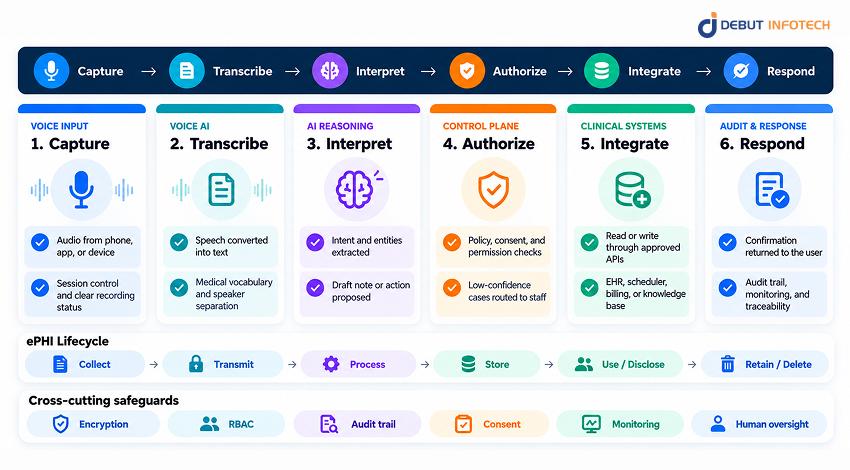
The interaction starts through a phone line, mobile app, workstation, or ambient device. The system establishes the user and session, makes activation or recording clear, and uses voice activity detection and noise processing to isolate usable speech. Audio may be processed locally, streamed securely, or divided between edge and cloud services according to the approved architecture.
Automatic speech recognition produces a timestamped transcript. Medical vocabularies improve recognition of drug names, diagnoses, numbers, and specialty terms, while speaker diarization attributes statements to the correct participant. The system should retain confidence signals and send uncertain terms for confirmation or review.
An NLU model or LLM can classify the request, extract entities, retrieve approved context, or draft a note. Because this layer is probabilistic, its output is a proposal, not an authorization or final clinical record.
A deterministic rules layer checks identity, permissions, consent, workflow eligibility, required fields, risk thresholds, and escalation conditions. Requests that are high impact, ambiguous or with low confidence are passed to an authorized employee instead of proceeding automatically.
An integration service reads from or writes to the EHR, scheduler, billing platform, or knowledge base. HL7 FHIR offers a standard for representing and sharing healthcare data, and SMART App Launch leverages OAuth 2.0 in any applicable certified API environment. The adapter should verify fields, identify duplicate transactions, record the provenance, verify results, and be able to reconcile failures.
The assistant returns a spoken or on-screen response and requests explicit confirmation where necessary. Audit events record the user, action, time, system, and result without copying unnecessary ePHI. Monitoring then tracks errors, latency, security events, model versions, and handoffs, creating a feedback loop for controlled improvement.
HIPAA shapes architecture by determining what data may enter, who may handle it, how ePHI is protected, and what evidence remains after an incident or audit. A HIPAA-compliant AI voice assistant needs a documented control model across its lifecycle, not security added after development. Because the Security Rule is technology-neutral, safeguards must follow documented risk.
| Requirement | Architectural consequence | Evidence to retain |
| Privacy and permitted use | Define why audio, transcripts, prompts, outputs, logs, and backups are processed. Apply minimum necessary where relevant; prohibit unapproved analytics or model training. | Data inventory, purpose map, access policy, and retention schedule |
| Security safeguards | Protect ePHI confidentiality, integrity, and availability through risk-based identity, access, audit, transmission, device, recovery, and continuity controls. | Risk analysis, access matrix, configurations, and test results |
| Business associates | Identify speech, model, cloud, telephony, analytics, observability, and support vendors handling ePHI. Establish required agreements and downstream obligations. | Vendor map, BAAs, service terms, and subcontractor records |
| Breach readiness | Detect, contain, investigate, document, and escalate suspected incidents through a response process. | Alerts, incident plan, exercise results, and notification decisions |
Live audio, buffers, recordings and transcripts, prompt context, embeddings, outputs, API payloads, logs, analytics and backups. The minimum-necessary standard generally limits certain uses, disclosures, and requests for PHI, but exceptions include disclosures to or requests by healthcare providers for treatment. The design must reflect the workflow instead of applying “minimum necessary” identically in every situation. Vendors must not retain or reuse ePHI for unapproved training or analytics.
HHS describes risk analysis as the foundation for selecting safeguards. Results should inform role-based access, authentication, audit controls, integrity checks, secure transmission, workstation or edge-device protection, backups, continuity, and recovery. Encryption, MFA, segmentation, secrets management, and vulnerability management are common measures, but their scope must match identified threats and responsibilities. “Addressable” implementation specifications are not automatically optional; organizations must evaluate them and document the chosen measure or reasonable alternative.
Review speech, LLM, cloud, telephony, analytics, observability, integration, and support providers. A vendor may be a business associate even when it stores only encrypted ePHI and lacks the decryption key. Required BAAs should define permitted use, safeguards, subcontractors, access, return or deletion, and incident reporting. Contracting does not replace the regulated entity’s own risk analysis and governance.
Audit logs should support investigations without becoming unnecessary stores of ePHI. Retain current data maps, risk decisions, agreements, access reviews, test results, incidents, and change records. The Breach Notification Rule may require action after a breach of unsecured PHI. As of September 21, 2026, HHS still describes the Security Rule update as proposed and confirms that the current rule remains effective. Any proposed requirement must be labeled clearly and rechecked before publication.
The first release of a medical voice assistant should complete one narrow workflow reliably, not imitate a universal clinical copilot. Prioritize the backlog by the harm an incorrect transcript, disclosure, or action could cause, and assign one workflow owner to approve the release.
| Risk tier | Appropriate scope | MVP decision |
| Administrative | Appointment requests, approved FAQs, reminders, and routing | Include with identity checks, confirmations, and human handoff. |
| Documentation support | Transcription, draft notes, and structured summaries | Include as draft-only output with speaker attribution, correction tools, and clinician sign-off. |
| Clinical decisions or patient guidance | Triage, diagnosis, treatment, or medication recommendations | Defer pending clinical-safety and FDA regulatory assessment. |
The final tier needs separate scrutiny: many decision-support functions may remain medical devices. FDA criteria for certain non-device clinical decision support also depend on clinicians independently reviewing a recommendation’s basis.
For the chosen workflow, include:
Do not make voiceprints the sole login method. NIST’s existing digital-identity guidance does not permit using voice for biometric comparisons and does not consider biometrics to be an independent authenticator. Aim to explore new specialties, languages or move onto clinical autonomy once initial workflow has reached agreed accuracy, escalation, privacy and user-acceptance levels.
Instead of beginning with a model or microphone, navigate through nine controlled decisions to create a HIPAA compliant medical voice assistant. Start with the workflow and responsibility boundary and follow the data throughout architecture, integration, validation and operation. Each stage should yield a product which can be considered, evaluated, and revised.
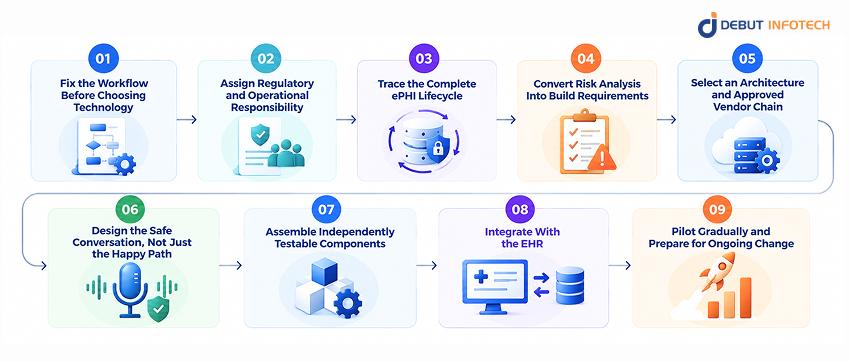
Select one task, one user, and one accountable workflow owner. Document the trigger, current steps, intended result, operating environment, and consequences of a wrong or delayed response. Compare the proposed assistant with the existing baseline, then define pilot outcomes such as successful completion, correction frequency, escalation quality, and time saved. Avoid combining scheduling, documentation, and patient guidance in the initial scope.
Artifact: Use-case charter, workflow map, success measures, and risk tier.
Identify which organization is the covered entity and its vendors or subcontractors that may create, hold, receive, maintain or transmit PHI on its behalf. HHS notes that qualifying subcontractors can also be business associates. Determine product, clinical, privacy, security and operational decision makers, and evaluate HIPAA, FDA, FTC, state privacy, biometric, recording and professional-practice issues. Provide unconfirmed interpretations to qualified legal or compliance reviewers.
Artifact: Responsibility matrix, vendor chain, required-agreement list, and open-questions register.
Map more than saved recordings. Live audio, buffers, transcripts and prompts, retrieved records and embeddings, generated drafts, structured fields, API payloads, EHR updates, logs, analytics, backups and access to support. For each state, explain why it is there, who is able to use it, where it goes, how long it stays, and how its deletion can be determined. This prevents a team from deleting audio while leaving identifiable derivatives in another service.
Artifact: End-to-end ePHI data-flow diagram and processing inventory.
Assess how each component could affect confidentiality, integrity, availability, patient safety, and workflow continuity. HHS describes risk analysis as the first step toward selecting reasonable and appropriate protections. Give every material risk an owner, treatment, acceptance condition, and evidence requirement. Translate those decisions into test cases for unauthorized access, patient mismatch, unsupported output, incorrect write-back, service failure, lost connectivity, and recovery.
Artifact: Risk register, control plan, acceptance criteria, and evidence matrix.
Explore the trade-offs between cloud, on-premises, edge, and hybrid processing on the metrics of accuracy, latency, isolation, scalability, region, retention, allowed data use, observability, failover, cost, and exit. Review and verify services provided under contracts and BAAs; HHS permits cloud processing of ePHI “where appropriate” as long as the appropriate BAA is in place and applicable HIPAA requirements are met. If de-identification is part of a design decision, don’t do basic redaction, use the HIPAA Safe Harbor or Expert Determination path.
Artifact: Architecture decision record, approved-vendor register, and data-retention schedule.
Specify activation and recording notices, identity checks, disambiguation, correction, confirmation, refusal, accessibility, and human handoff. Treat information retrieval differently from actions that change a record. Require step-up verification and explicit confirmation where consequences justify them. Define what the assistant says and does when confidence is low, a patient match is uncertain, a request exceeds scope, or an integration fails.
Artifact: Conversation flows, authorization rules, exception paths, and escalation runbook.
Build audio capture, automatic speech recognition, speaker attribution, language interpretation, policy enforcement, workflow adapters, and output as separable modules. The AI may interpret speech or draft content, but deterministic policy should authorize sensitive actions. The transaction layer executes approved changes, while the EHR or designated clinical platform remains authoritative. Minimize ePHI in prompts and telemetry, separate environments, protect credentials, and block unapproved training reuse. Teams can use AI development services providers for architecture and orchestration support.
Artifact: Traceable prototype, component tests, and control-implementation record.
Map validated data to approved fields instead of copying a generated response into the record. FHIR can represent and exchange health information, while SMART App Launch uses OAuth-based authorization patterns for relevant EHR-connected applications. These standards do not replace access scoping, validation, provenance, human approval, error handling, idempotency, or reconciliation. Healthcare app development services should also account for sandbox access, vendor-specific workflows, and recovery when an update partially succeeds.
Artifact: Interface specification, test environment, field mapping, and reconciliation plan.
Use synthetic or controlled data, then use an evaluation phase and then release to a small number of approved users. Establish go-live gates for accuracy, safe refusal, escalation, security, privacy, reliability, accessibility and user acceptance. Prior to expansion, train users, test downtime and rollback procedures, and assign support and incident ownership.
Artifact: Go-live record, operations runbook, monitoring plan, and review schedule.
This sequence creates a reviewable chain from business need to production evidence. Adding a specialty, language, model, vendor, or autonomous action should reopen the affected decisions and tests instead of bypassing the process as an update.
A medical voice assistant can accurately transcribe a conversation but still choose the wrong patient, forget to include a negation, provide ePHI or repeat a transaction. Production testing must therefore cover the entire path from audio capture to human review or system-of-record update.
| Release question | Evidence to collect |
| Did it hear correctly? | Word error rate and errors involving medical terms, numbers, dosages, dates, negation, and speaker attribution. |
| Did it perform the task correctly? | Intent, required fields, confirmation, transaction accuracy, safe refusal, and escalation. |
| Is the generated content supportable? | Unsupported claims, omissions, contradictions, provenance, and clinician edits before approval. |
| Does it work for intended users? | Results across specialties, accents, speech impairments, devices, noise, cross-talk, and connection conditions. |
| Does it protect data and access? | Authentication, authorization, prompt injection, leakage, unsafe logs, API abuse, retention, deletion, and recovery. |
| Does it fail safely? | Latency percentiles, timeouts, retries, duplicate prevention, failover, rollback, and disaster recovery. |
| Can people retain control? | Notice comprehension, interruption, correction, handoff success, accessibility, and alert burden. |
Build the evaluation set from synthetic or properly governed representative data. Break results down by user group, environment, task, and error severity instead of reporting one average. Aggregate accuracy can hide repeated failures involving medication names, negation, or specific accents. Include expected interactions, unclear speech, missing information, malicious inputs, and unavailable downstream services.
Clinical, privacy, security, and operational owners should approve release thresholds according to the intended use and potential harm. A draft note that requires clinician approval should not share acceptance criteria with an assistant authorized to change a record. There is no universal accuracy or latency target for every workflow.
Record the tested dataset, model, prompt, policy, configuration, and integration versions as the release baseline. After deployment, monitor failures and drift, rerun regression tests after material changes, and maintain a tested rollback path. NIST’s AI Risk Management Framework places documented ownership, continuous monitoring, and periodic review across the AI lifecycle, not only before launch.
There is no secure or HIPAA compliant deployment model. The right choice for healthcare voice AI is the one the organization can govern, observe, recover, and support across the complete ePHI lifecycle.
| Option | Potential fit | Critical trade-offs |
| Cloud | Distributed access, variable demand, and managed services | BAA coverage, vendors, data use, retention, region, outages, egress, and exit |
| On-premises | Direct infrastructure control or coupled local systems | Staffing, hardware, patching, keys, monitoring, scaling, backup, and recovery |
| Edge/on-device | Low latency, unreliable connectivity, or less raw-audio transmission | Device loss, storage, fleet updates, compute limits, model freshness, and synchronization |
| Hybrid | Local capture or transcription with cloud processing | More boundaries, orchestration, identity flows, observability, and failure ownership |
HHS states that a cloud provider may handle ePHI under an appropriate business associate agreement when the parties otherwise satisfy the HIPAA Rules. Cloud use is therefore a risk-management decision, not a compliance failure. A BAA still cannot compensate for weak configuration or vendor review.
Base the decision on two diagrams: the normal data path and the failure path. Understand what each component receives, where the data is stored, who can access it, and how the deletion of the data is confirmed. Then model outages, lost devices, failed synchronization, and partial EHR updates.
“Data stays local” addresses location, not access control, maintenance, monitoring, backup, or incident response. Hybrid processing may reduce latency or transmission at one stage while adding handoffs elsewhere. Select the model whose controls, evidence, skills, recovery procedures, and long-term operating burden the organization can sustain.
The cost of AI development projects usually falls between $20,000 and $400,000+ and can cost more than $1 million for enterprise systems with multiple integrations and governance layers when planning for 2026. This is a general AI development range and not a fixed quote for a medical voice product. The actual cost of a HIPAA compliant medical voice assistant is dependent on workflow, risk level, channels, deployments, integrations, validation, scale and operating requirements.
| Project level | Representative scope | Main cost pressure |
| Administrative pilot | One workflow and channel, approved responses, human handoff, and one scheduling or routing integration | Conversation design, identity checks, speech services, deterministic transactions, auditability, and pilot testing |
| Documentation product | Multi-speaker capture, specialty vocabulary, draft notes, clinician review, and EHR write-back | Diarization, note quality, provenance, field mapping, reconciliation, and representative evaluation |
| Enterprise platform | Multiple departments, workflows, channels, languages, integrations, and availability requirements | Enterprise IAM, vendor governance, environment isolation, resilience, disaster recovery, monitoring, and change control |
A viable medical voice assistant development estimation service should break down discovery, data mapping, user experience, speech processing, AI orchestration, policy logic, integrations, infrastructure, security controls, privacy, clinical testing, performance and accessibility testing. Otherwise, a low quote may cover a demonstration rather than a governed production system.
Separate implementation from recurring expenses. Ongoing costs can include speech recognition, model inference, speech generation, telephony, hosting, storage, observability, backups, evaluation, security reviews, incident readiness, maintenance, and support. Model usage is only one part of the total.
If you require an estimate that is specific to your needs, you will need to specify expected users, volumes of interactions and sound, integrations, environments, languages, retention rules, availability targets, and human-review requirements. Request vendor to capture assumptions, exclusions, optional features, recurring costs and cost impact of scope changes. This allows easier comparison with competing proposals and identifies requirements that have not been included until the start of development.
Published 2026 benchmarks place conversational AI projects at 6–28 weeks, depending on channels and integration complexity. For medical AI voice assistant development, treat this as a planning range, not a fixed promise. Access to the EHR, vendor contracts, security audit, clinical supervision and remediation can push this date up or further.
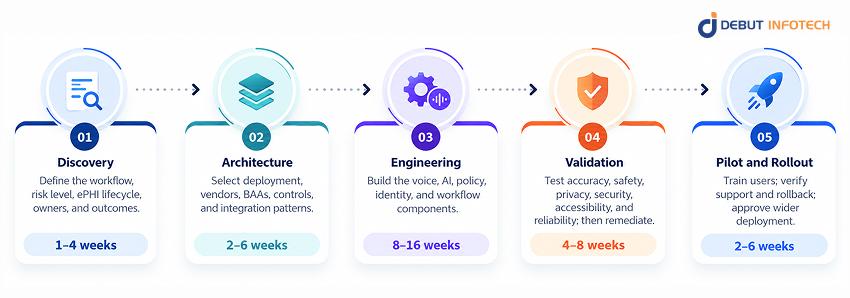
Plan delivery through five milestones:
The largest delays often come from procurement, EHR sandbox or API access, representative data, specialty vocabulary, reviewer availability, additional languages, and failed validation gates. Estimate each milestone separately, document its dependencies, and define the evidence required to proceed. Keep prototype, pilot, and production dates distinct so an early demonstration is not mistaken for deployment readiness.
Select a partner that makes risk, ownership, and evidence visible. If it markets itself as a HIPAA-compliant AI development company, use that term as a claim and not an assumption that their subcontractors are compliant.
Use six questions during evaluation:
Verify the answers through case studies, references, reviewers, and sample artifacts. Ask what the team delivered rather than relying on logos. Guaranteed compliance, hidden subcontractors, vague failure procedures, and undocumented limitations are warning signs. The partner should connect recommendations to an owner, acceptance test, and reviewable evidence artifact.
A viable medical voice assistant starts with an operational outcome, reducing missed calls, drafting notes, or routing requests, not with a preferred model. Mapping the workflow reveals the users, ePHI, human decisions, failure consequences, and systems that must remain authoritative.
Debut Infotech combines custom AI development with healthcare software engineering. Our published capabilities include AI strategy, workflow and system integration, deployment, monitoring, EHR/EMR development, and experience with standards such as HL7 and FHIR. This foundation can support voice workflows that connect AI interpretation to clinical or administrative systems.
Custom healthcare AI development should begin with a working session that maps the process, data lifecycle, environment, vendor dependencies, and release evidence. The scope can cover the voice and AI layers, deterministic authorization, human review, EHR transactions, validation, staged deployment, and monitoring. Each control should have an owner and an acceptance test.
This approach can support HIPAA obligations, but it does not transfer responsibility or guarantee compliance. Legal, privacy, security, operational, and clinical owners must approve the intended use and safeguards.
Bring one workflow, its integration environment, and your risk requirements to a scoping discussion with Debut Infotech. Those inputs can be translated into delivery boundaries, phases, evidence requirements, and a project-specific estimate.
Start with one bounded workflow, map ePHI touchpoints, and keep the EHR or approved clinical system authoritative. Architect AI to interpret requests, deterministic rules to authorize actions, and the transaction layer to commit approved changes. Then complete vendor due diligence, BAAs, risk analysis, safety validation, a human-supervised pilot, and production monitoring.
Compliance comes from the full operating environment, not an AI model or hosting label. Limit PHI collection and use, apply risk-based encryption, enforce role-based access, log activity, manage retention, assess risks, prepare incident procedures, and execute BAAs with applicable vendors and subcontractors. Legal and security teams should approve the design.
A broad AI development benchmark ranges from $20,000 to $400,000+, while complex enterprise systems can exceed $1 million. This is not a fixed medical voice quote. AI development cost depends on workflow scope, channels, speech and language requirements, EHR integrations, vendor fees, security controls, validation depth, deployment model, adoption, and ongoing operations.
A first release should solve one defined workflow and include reliable speech capture, identity and authorization checks, consent or notice handling where required, structured data extraction, EHR integration, audit logs, human review, correction paths, fallback routing, and monitoring. Add multilingual support, analytics, or broader automation only when evidence justifies expansion.
No. A BAA defines permitted PHI uses, safeguards, reporting duties, subcontractor obligations, and other contractual responsibilities, but it does not make the product or deployment compliant by itself. The regulated organization and relevant business associates must also implement required safeguards, perform risk analysis, configure the system correctly, train users, and maintain evidence.

Our Latest Insights


USA
2501 Chatham, Rd Suite R Springfield, IL 62704
+1-708-515-4004
info@debutinfotech.com
UK
7 Pound Close, Yarnton, Oxfordshire, OX51QG
+44-770-304-0079
info@debutinfotech.com
Canada
154 Eden Oak Trail, Kitchener, ON N2A 0H9
+1-708-515-4004
info@debutinfotech.com
INDIA
Sector 101-A, Plot No: I-42, IT City Rd, JLPL Industrial Area, Mohali, PB 140306
9888402396
info@debutinfotech.com