ON THIS PAGE
Progress0%






Our Global Presence :





AI scheduling assistants streamline patient access: They can automate booking, rescheduling, cancellations, and waitlist workflows while keeping approved rules and staff oversight in place.
EHR integration determines scheduling reliability: Live availability, FHIR resources, vendor APIs, and confirmed write-back are essential for accurate appointment transactions.
Healthcare compliance requires a secure architecture: Identity verification, role-based access, encryption, audit trails, data controls, and HIPAA safeguards should be incorporated from the start.
Human handoff protects complex workflows: Clear escalation rules allow staff to handle exceptions, sensitive requests, system failures, and scheduling scenarios outside the AI’s approved scope.
Development costs vary by scope and integration complexity: A healthcare AI scheduling solution may range from $40,000 to $350,000+ based on channels, EHR integrations, AI capabilities, security requirements, and enterprise needs.
Phased implementation supports safer adoption: Starting with a defined workflow, validating integrations, testing transactions, and expanding based on measurable results can reduce implementation and operational risks.
Building an AI scheduling assistant for healthcare is a worthwhile option when it addresses a clear patient access challenge (like missed calls, inefficient rescheduling, or empty appointment slots), while it maintains accuracy, privacy and staff control. It should engage in more than a conversation.
The system must understand a patient’s request, verify identity, apply approved booking rules, check current EHR availability, complete an authorized transaction, and route exceptions to a human. The design that’s right for you will depend on channels, the complexity of the appointments, integrations, HIPAA security, volume, and reliability expectations.
This guide explains how to implement AI scheduling for healthcare, what you have to build, risks to manage, and how to measure the cost and ROI of development, based on existing interoperability, security and risk-management guidance.
An AI healthcare scheduling assistant is a patient-access system that comprehends appointment requests and arranges approved booking actions throughout linked healthcare systems. Patients can use voice, chat, SMS, a mobile app, or a patient portal to find, book, reschedule, or cancel a visit. The assistant translates that request into the structured information, including the type of visit requested, preferred location, provider, date, as well as accessibility requirements.
It is more than a digital calendar or static booking form. A basic form displays available times, while an AI appointment scheduling assistant can manage a multi-turn conversation, clarify missing details, apply organization-approved rules, call authorized APIs, and escalate exceptions to staff. It also differs from a general clinical assistant: its primary role is administrative scheduling, not diagnosis, treatment advice, or independent triage.
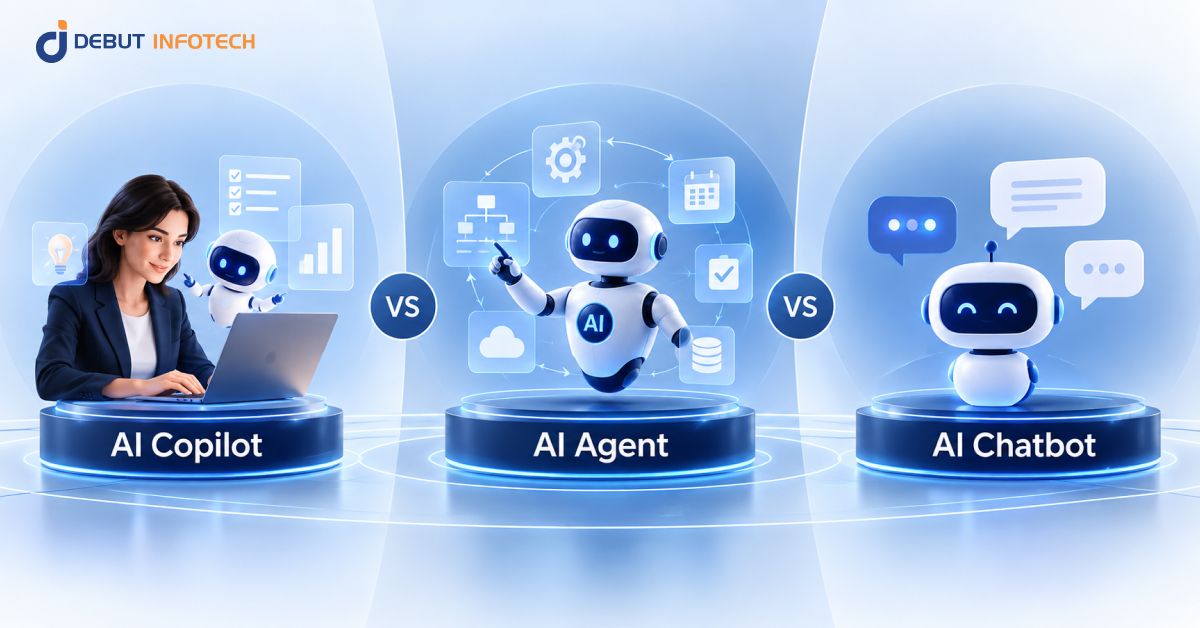
The terms assistant and agent describe different levels of autonomy. An assistant typically responds to a patient’s instructions; an agent may complete several permitted steps through software tools. In either model, the EHR or designated scheduling platform remains the source of truth for availability and confirmed appointments. AI interprets the request, but governed rules and transaction controls determine what the system may book.
Reliable healthcare appointment scheduling depends on accurate availability, consistent rules, connected systems, and sufficient staff capacity. When one element fails, delays and errors can spread. Before deciding where AI belongs, providers should identify the operational gaps behind missed calls, schedule conflicts, unused slots, and poor patient experiences.
A booking may depend on visit type, patient status, provider qualifications, referrals, duration, location, and room or equipment availability. When these rules sit across separate systems and staff knowledge, teams must reconcile them manually. This fragmentation slows medical appointment scheduling and increases the chance of offering an unsuitable slot.
Peak call volumes can produce long holds and missed requests, while after-hours patients must wait for staff to return. A web form only shifts the workload when employees still need to validate and enter every request manually.
Provider absences, cancellations, and new requests continually alter availability. Appointment rescheduling may also affect waitlists, room assignments, linked visits, and other providers’ calendars. Without a final availability check, patients can receive stale options or multiple requests can compete for the same slot.
Last-minute cancellations may leave capacity unused because staff cannot reach an eligible waitlisted patient quickly enough. No-shows create more uncertainty, but blanket overbooking can increase delays when more patients arrive than expected. Better utilization requires accurate matching and timely action.
Patients may repeat information, receive different answers across channels, or wait for confirmation. Multi-location and multi-provider care creates further friction when teams follow different processes, increasing frustration for patients and follow-up work for staff.
AI scheduling for healthcare can connect natural-language access to approved rules, current availability, and consistent communication. It can maintain regular bookings, cancellations, reminders and waitlist actions without interruption and can email exceptions to the staff with context. AI, however, cannot fix bad data or un-documented policies. Its worth relies on reliable integrations, standard rules, quantifiable benchmarks, accountable proprietors and a human fallback.
An open-ended patient request is transformed into a verified, policy driven action with effective AI appointment scheduling for healthcare. For instance, a patient may call in and request that a follow-up appointment with a cardiologist be rescheduled for another clinic in the coming week. To perform that action in a safe manner needs more than just comprehension of the sentence.
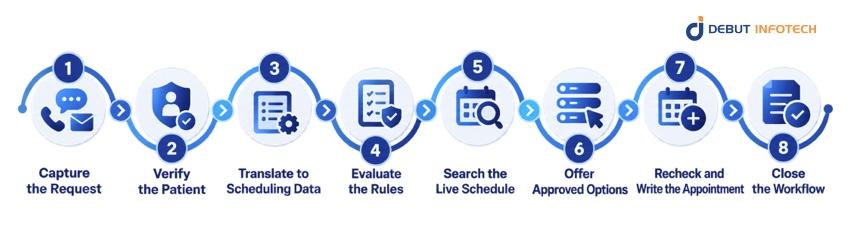
This process separates language understanding from operational authority. The AI interprets and communicates, approved rules determine what is permitted, and a transactional service completes appointment rescheduling or booking. The EHR or designated scheduler remains the source of truth throughout.
A useful feature set must be able to move a request from initial contact to a confirmed record, without compromising the accuracy, privacy and control of staff. When evaluating appointment scheduling software for healthcare, prioritize capabilities that support the organization’s actual appointment rules and exception paths. A long feature list adds little value if the system cannot complete routine work reliably.
Patients should be able to experience the same service in voice, chat, SMS, mobile apps and portals. Language preferences, session continuity and easy to use interfaces should be carried across the channels. Following WCAG 2.2 also helps teams design web and app interactions for people with different access needs.
The assistant should be responsible for the actions allowed under its scope, such as searching, booking, rescheduling, cancellation, confirmation, enrolling appointments to the waitlist and follow-up appointments. Status messages must be clear, allowing patients to know if a request was done, still being reviewed by staff or rejected.
An open time is not automatically a valid option. Matching may need to account for visit type, patient status, referrals, provider qualifications, appointment length, location, rooms, equipment, preparation periods, and linked visits. The system should recognize when a rule requires staff judgment.
The assistant needs current information from the authoritative scheduling platform. It should recheck a selected slot before submitting the booking, prevent duplicate writes during retries, and communicate success only after the source system confirms the change. Failed transactions should enter a visible recovery path.
Verification should reflect the sensitivity of the requested action. Useful controls include patient matching, step-up authentication, proxy or caregiver access, communication preferences, and records of applicable permissions or consent. The system should request only the information needed to complete the approved workflow.
Automation needs defined stopping points. Warm transfers, exception queues, staff alerts, configurable escalation rules, and outage procedures allow people to take control when requests are unusual, sensitive, or unsupported. Preserving verified context prevents patients from repeating the conversation after transfer.
Role-based access, scoped credentials, encryption, secrets management, audit events, retention controls, redaction, and security monitoring should be built into the operating model. A HIPAA-compliant scheduling assistant is not created by one feature or badge; HHS states that it does not certify products as HIPAA compliant. Compliance depends on implementation, safeguards, contracts, and ongoing oversight.
Track completion, abandonment, handoffs, response time, failed writes, booking conflicts, waitlist conversion, channel performance, and cost per completed appointment. These measures reveal whether the assistant improves the intended workflow automation and where integrations, rules, or conversations require attention.
No-show prediction, dynamic overbooking and automated prioritization are not essential features. They should only be added once the core workflow is reliable and the organization has confirmed the data, fairness testing, governance and human review and approval of decisions that may influence access to care.
Integration requirements should follow the appointment workflow, not a standard vendor checklist. Begin by identifying which system owns each data element, which actions the assistant may perform, and where staff must retain control. Every connection should either supply authoritative information, complete an approved action, or preserve an operational record.
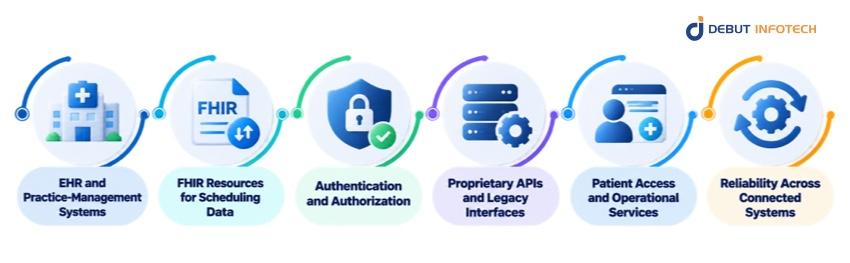
The patient record, provider schedules, types of visits, visit locations, and visit status are typically stored in the EHR, EMR, or practice-management platform. EHR integration for AI appointment scheduling must therefore cover the specific read and write operations in scope. Confirm whether the deployed product permits searching, creating, changing, canceling, and confirming appointments through an API. Access to general clinical data does not prove that scheduling write-back is available.
When the EHR supports the required operations, FHIR integration for AI healthcare scheduling can exchange scheduling information through HL7 FHIR. In FHIR R4, Schedule groups slots for a service or resource, Slot is a time that might be available, and Appointment is the scheduled event. Provider, site, and service rules can be applied to the context provided by Patient, PractitionerRole, Location, and Healthcare Service.
SMART App Launch provides OAuth 2.0-based patterns for authorizing applications to work with FHIR systems and supports OpenID Connect identity context. The assistant should receive only the scopes required for its approved workflow. The ONC standardized API test method identifies standards used in certified US health IT, but implementation teams must still verify the versions and capabilities available in the provider’s installed environment.
FHIR support varies by vendor, product version, and deployment. A healthcare scheduling API may rely on proprietary endpoints, custom extensions, webhooks, or an integration engine when standard resources do not cover the complete workflow. Older environments may also exchange scheduling events through HL7 v2 SIU messages. Review sandboxes, capability documentation, rate limits, write permissions, and error behavior before finalizing the design.
The assistant may also connect to patient portals, mobile apps, telephony or contact-center platforms, SMS and email services, identity providers, provider directories, eligibility systems, payment services, and analytics tools. Add each integration only when the approved workflow requires it, and avoid duplicating patient information across unnecessary systems.
The key features for reliable AI appointment scheduling API integration are timeouts, monitored APIs, safe retries, idempotency, event handling, audit records, and reconciliation with the source platform. In case of an integration failure, the assistant should display a pending or failed status, and send the request to the correct destination instead of indicating success.
A qualified healthcare software development company can help assess these capabilities before development, reducing uncertainty around EHR access, legacy interfaces, and workflow-specific constraints.
An AI-powered healthcare scheduling assistant is not a single model that’s hardwired to an EHR. It is a layered architecture which keeps patient interaction, identity, scheduling policy, transaction processing, integration and operational oversight separate. The separation reduces the amount of information that each part of the system can access, and simplifies the detection and containment of failures.
The implementation stack could be Python, Java, NET services (Node.js); a relational database; a cache; a queue; FHIR adapters; and managed or privately deployed AI models. The vendor agreement, the terms for data retention and model training, residency, latency, reliability, team skills and overall operating cost should all be taken into account when making a selection.
The first step in creating an AI scheduling assistant for healthcare is to start with the scheduling workflow, not the AI model. Precisely specify the assistant’s responsibilities, the kind of patients and appointment types to be included, the systems to be accessed, and when the staff should take over. The idea is to have a controlled workflow where the AI understands the request, approved rules are used to determine what is allowed, the transaction layer handles the bookings, and the EHR or scheduling system is the source of truth.
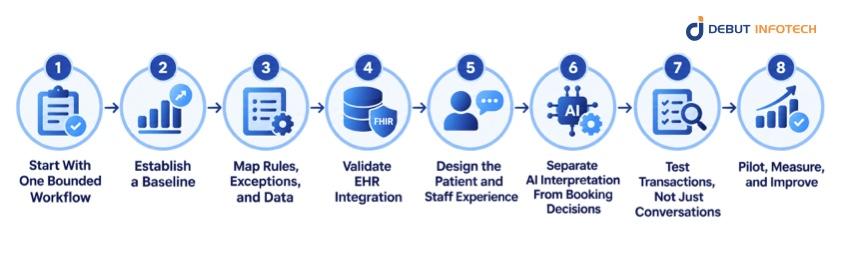
Choose one scheduling process with clear limits. Define the patient group, appointment type, locations, channel, and desired outcome. For example, an initial workflow might handle established-patient appointment rescheduling through web chat.
A narrow scope makes testing and risk management more practical. It also helps determine which actions the assistant can complete independently and which situations require human intervention. Expand the scope only after the initial workflow performs reliably against defined requirements.
Measure the existing scheduling process before introducing AI. Track metrics such as booking completion, abandonment, staff transfers, average handling time, booking errors, cancellation-slot fill, no-show rates, and slot utilization.
This baseline will provide the team with something to compare with after the deployment. It also aids in distinguishing AI-driven changes from other factors, such as seasonal demand, staffing variations, or changes in appointment availability.
Document the rules that determine whether an appointment can be offered. They can be visit types, provider specialization, location, appointment length, room/equipment needs, referral needs, scheduling times and conditions of escalation.
Then trace the data that goes into each step. Understand the source of patient information in the workflow, the systems used for scheduling information, the people who have access to it, and the vendors or subprocessors that are used. Prior to development, security, privacy, retention, access control, auditability and contractual obligations should be considered.
Verify the functionality of the EHR or practice-management system first before deciding on the technical design. Review its supported FHIR version, scheduling resources, read and write support, vendor APIs, rate limits, webhooks, sandbox environment, and any custom integration needs.
FHIR can offer standardized resources for scheduling, but cannot ensure quick integration. Actual capabilities vary by EHR implementation. Where standard APIs are incomplete, the solution may require vendor-specific APIs, integration engines, or legacy interfaces.
Design the conversation and human handoff together. Determine how the assistant verifies identity, asks clarifying questions, presents valid appointment options, confirms completed actions, and handles exceptions.
The experience should also account for accessibility, language needs, communication preferences, and outage scenarios. Human escalation is an important control, not simply a fallback for poor AI performance. Cases outside the approved workflow should move to staff rather than forcing the assistant to make unsupported decisions.
The architecture should keep language interpretation separate from scheduling authorization. The LLM can understand a request and convert it into structured information. A rules or policy engine should determine whether the requested action is permitted. A transaction service should then recheck availability and commit the approved appointment.
This separation is central to dependable AI appointment scheduling for healthcare. The model should not invent available slots, bypass scheduling rules, or directly determine whether a booking succeeds. The authoritative scheduling system must confirm the transaction.
A convincing conversation does not prove that the scheduling workflow is safe. Test duplicate requests, simultaneous bookings, stale availability, failed EHR writes, authentication, authorization, privacy, accessibility, load, outages, recovery, and prompt-injection scenarios.
Testing should also verify that the assistant distinguishes between an attempted booking and a confirmed booking. It should never inform a patient that an appointment was booked without confirmation from the source system.
Launch with a limited workflow and human oversight. Compare performance with the baseline and review failed transactions, escalations, policy exceptions, and unexpected user behavior.
After deployment, continue monitoring booking accuracy, EHR write failures, latency, transfers, operating costs, model behavior, and integration changes. An AI development company can support model integration, workflow orchestration, testing, deployment, and ongoing optimization as requirements evolve.
The objective is not simply to make appointment booking conversational. It is to build a governed transaction workflow that remains accurate, auditable, secure, and maintainable as scheduling rules and healthcare systems change.
The value of AI scheduling for healthcare should be measured against the scheduling problems it is designed to solve. Providers should establish a pre-deployment baseline and evaluate results by workflow, channel, and patient-access use case. This makes it easier to distinguish genuine operational improvements from changes caused by seasonality, staffing levels, appointment availability, or other process changes.
An AI scheduling assistant can increase access by handling routine requests outside of the typical contact-center hours. Providers can determine if they have an increase in patients completing their booking, rescheduling, or cancellation process without staff interaction.
Useful measures include:
These measures show whether automation is improving the scheduling process rather than simply increasing interaction volume.
Routine appointment requests can consume substantial staff time. Providers can track average handling time, scheduling contacts per completed appointment, and the volume of work transferred to patient-access teams. Returned staff time, however, is not necessarily a cash saving unless it results in a change in staffing, overtime, outsourcing or measurable throughput.
The patient-facing metrics should cover satisfaction, complaints, abandonment and successful completion of the supported channels. Accessibility and language performance should also be evaluated across relevant patient groups.
The ROI case should separate hard-dollar savings from capacity gains and recovered appointment value. A useful model is:
Annual benefit = verified labor savings + avoided operating costs + contribution from additional completed appointments + other validated gains
Then compare that benefit with implementation and ongoing operating costs. Track no-show rates and provider or room utilization as well, but avoid attributing every change to AI. A credible measurement plan compares similar cohorts and accounts for operational changes outside the scheduling assistant.
The strongest business case is therefore not AI reduces costs. It is evidence that the assistant improves access, completes appropriate scheduling work reliably, returns measurable capacity, and creates additional appointment value without introducing unacceptable operational or compliance risk.
Healthcare scheduling is challenging as an appointment is more than just a calendar event. Medical appointment scheduling needs to manage patients, providers, locations, visit types, and resources, eligibility rules, and availability of the source-systems. An AI assistant introduces yet another layer of complexity, as natural-language interpretation needs to be linked to transactions that impact patient access and capacity. The primary problem is then the control of what the system can perceive, determine or alter.
An assistant may need patient information to identify the correct record, understand an existing appointment, or complete appointment rescheduling. This poses a danger if the identity authentication is weak or if access rights are more extensive than they have to be.
Perform risk-based verification, least privilege access, scoped sessions and appropriate human review for sensitive actions. Providers should also map which systems and vendors handle ePHI and establish the required contractual safeguards. HHS states that covered entities and business associates must protect ePHI through appropriate safeguards, while business-associate relationships can require BAAs when PHI is handled on another organization’s behalf.
An LLM can generate a plausible response without having authoritative knowledge of current appointment availability. If it presents an invented slot, incorrect preparation instruction, or unsupported scheduling rule as fact, the conversational experience can become an operational error.
The control is architectural: use live source-system data, structured tool outputs, allowlisted actions, and deterministic policy validation. The model should communicate only options that the scheduling service has authorized. This principle applies across patient appointment scheduling, including booking, cancellation, and rescheduling.
A slot can become unavailable between the moment it is displayed and the moment a patient selects it. Two requests can also attempt to claim the same appointment concurrently. Simply checking availability once is therefore insufficient.
The transaction layer should revalidate availability immediately before committing the appointment. Various source systems can help prevent duplicate or conflicting bookings through temporary holds, idempotency keys, transaction locking, and reconciliation processes. The system should only consider the write successful when the authoritative scheduler confirms the write.
Healthcare scheduling API capabilities vary significantly between environments. An EHR may expose some scheduling functions through FHIR while reserving other operations for proprietary APIs or integration engines. Legacy HL7 interfaces may also remain necessary.
FHIR does not eliminate integration discovery. Teams must verify the deployed version, profiles, extensions, write capabilities, rate limits, authentication requirements, and actual appointment semantics. A robust integration layer should isolate vendor-specific behavior rather than embedding it throughout the assistant.
HIPAA compliance for AI depends on how the organization designs, deploys, and operates the complete system. A vendor or product should not be described as HIPAA certified. Private certifications are not recognized by HHS as compliance and organizations must assess their own safeguards and obligations
This involves evaluating data flows, access controls, encryption, logging and retention, incident response, vendor relationships and risk management. Cloud services handling ePHI may also require an appropriate BAA and compliance with the HIPAA Rules.
Administrative scheduling can sometimes expose symptom-related language. That does not mean the assistant should automatically perform clinical triage. If the workflow moves into clinical decision support, additional regulatory and specialist review may be necessary. The guidance issued by the FDA in January 2026 covers the evaluation of certain aspects of the functionality of clinical decision-support software covered by applicable medical-device provisions.
Ensure that supported clinical advice is clearly written, block out unsupported clinical advice, ensure that there is escalation language, and ensure that there are qualified clinical and legal reviewers when the workflow invades the realm of clinical decision making.
A system can work technically while creating barriers for particular patient groups. Testing should cover supported languages, disabilities, communication channels, locations, and different patient workflows. Accessible alternatives and staff-assisted pathways should remain available.
Providers should also monitor staff adoption, exception volumes, and workflow mismatches. AI risk management is an iterative process, as outlined by the NIST AI Risk Management Framework that includes three phases: Govern, Map, Measure, and Manage; it does not include a single point of approval, but it is ongoing and iterative.
The lesson to be learned is that, when it comes to healthcare scheduling, it goes beyond what you might think of as an accurate conversation. Reliable AI appointment scheduling healthcare depends on identity controls, authoritative availability, transactional safeguards, secure integrations, defined clinical boundaries, accessible experiences, and continuous oversight working together.
The cost to develop AI healthcare scheduling software depends more on workflow and integration complexity than on the AI model itself. Current 2026 healthcare software benchmarks place simpler MVPs around $40,000–$100,000, while EHR-integrated and enterprise healthcare systems can reach $250,000–$500,000 or more.
For an AI healthcare scheduling assistant, a practical planning range is approximately $40,000–$80,000 for discovery and prototyping, $80,000–$180,000 for a narrow production MVP, and $180,000–$350,000+ for a complex enterprise implementation. These are market-informed planning ranges, not Debut Infotech quotes. Actual pricing should follow technical discovery and scope validation.
Channels: Web chat, mobile, SMS and voice presents unique interface, infrastructure, testing and operating requirements. Speech recognition, text-to-speech, telephony integration, and other monitoring may be needed for voice as well.
Scheduling workflow: A system that can only search for available appointments is less complex than one that allows for booking, cancelling appointments, rescheduling appointments, waitlists, referrals, follow-up appointments, and multi-resource scheduling.
EHR and API integration: EHR integration for AI appointment scheduling can become a major cost driver. Teams will have to integrate FHIR resources, vendor-specific APIs, vendor identity services, integration engines, webhooks or legacy interfaces. The actual capabilities of the target EHR must be verified before estimating the work.
AI complexity: Cost can increase when the solution requires LLM orchestration, intent classification, automatic speech recognition, multilingual interactions, structured outputs, or optional prediction and optimization capabilities. Model selection should consider data handling, retention, training terms, latency, reliability, and usage costs, not simply model performance.
Security and compliance: A healthcare system may require identity controls, access management, audit logging, encryption, data-flow analysis, security testing, documentation, vendor review, and appropriate BAAs. HHS notes that a cloud service provider handling ePHI on behalf of a covered entity or business associate may qualify as a business associate and require a BAA.
Product and operating requirements: Total cost is impacted by product and operating requirements including patient interfaces and staff consoles, analytics, policy configuration and monitoring, disaster recovery, support, cloud infrastructure, messaging, telephony, and ongoing integration maintenance.
A practical cost of building an AI appointment booking system should be developed in stages:
| Scope | Indicative 2026 planning range | Typical cost considerations |
| Discovery and prototype | $40K–$80K | Workflow mapping, integration assessment, architecture, and proof of concept |
| Narrow production MVP | $80K–$180K | One channel, defined scheduling workflow, primary EHR integration, security controls, testing, and human handoff |
| Enterprise platform | $180K–$350K+ | Multiple channels and locations, complex rules, enterprise integrations, analytics, reliability, security, and ongoing support |
These ranges should be treated as planning benchmarks, not fixed quotes. Each estimate should state assumptions, exclusions, integrations, reliability expectations, and recurring operating costs. Published 2026 benchmarks also show that EHR integration and compliance can materially increase healthcare software budgets.
The right question is therefore not simply “How much does an AI healthcare scheduling assistant cost?” What scope, integrations, controls, and operating model does the organization actually need? Once those variables are validated, a technology partner can produce a project-specific estimate rather than relying on generic industry averages.
Choosing a partner for AI appointment scheduling for healthcare requires more than LLM development partners. The team must understand healthcare workflows, EHR integration, security controls, and the transaction logic behind reliable appointment booking.
Debut Infotech brings these capabilities together across healthcare software engineering and AI development. Our healthcare work includes EHR/EMR and patient-engagement solutions, while its AI capabilities support model integration, virtual assistants, agent workflows, testing, deployment, and ongoing optimization.
This matters because an AI appointment booking system must connect several layers. Patient-facing channels need to communicate with scheduling systems, identity services, APIs, business rules, notifications, analytics, and human handoff workflows. The architecture must also keep language interpretation separate from authorization and transaction execution.
For each project, Debut Infotech can assess the existing scheduling workflow, EHR environment, integration capabilities, security requirements, expected volume, and business KPIs before defining the implementation scope. That assessment can inform the MVP, architecture, testing approach, and operating model.
The aim isn’t to implement AI just for the sake of it. If there is already an EHR scheduler or rules-based workflow in place that addresses the organization’s requirements, then extending it might be more appropriate. Where AI can drive measurable value, it’s important to establish an AI-governed, maintainable scheduling workflow that’s tailored to the healthcare environment.
Not necessarily. A rules-based system can handle predictable scheduling workflows without an LLM. An LLM becomes useful when patients express requests in natural language or when the workflow needs conversational AI interactions. In either approach, the scheduling rules and transaction services should control what actions are permitted rather than allowing the model to determine availability or commit appointments.
Yes. EHR integration for AI appointment scheduling can use FHIR resources, vendor-specific APIs, integration engines, or legacy interfaces, depending on the EHR environment. The team must verify the deployed FHIR version, available scheduling operations, read/write permissions, authentication, rate limits, and vendor-specific appointment behavior. FHIR can standardize parts of the integration, but it does not guarantee that every EHR supports the same scheduling capabilities.
A reliable AI appointment scheduling assistant should recheck availability immediately before committing an appointment. Transaction controls such as idempotency keys, temporary holds where supported, conflict handling, and reconciliation can help prevent duplicate bookings. The assistant should also wait for confirmation from the authoritative EHR or scheduling system before telling the patient that the appointment has been successfully booked.
HIPAA-compliant scheduling assistant is better understood as a system designed and operated to support an organization’s HIPAA obligations, rather than as a government-certified product. Controls may include appropriate identity verification, least-privilege access, encryption, audit logging, retention policies, risk analysis, incident response, and BAAs where required. HHS does not certify products as “HIPAA compliant,” so compliance depends on the organization’s complete implementation and safeguards.
There is no reliable universal timeline. Delivery depends on the scheduling workflow, channels, EHR environment, API capabilities, security requirements, testing scope, and number of integrations. A narrow MVP with one workflow and integration may require substantially less work than a multichannel, multi-location platform. A project estimate should follow discovery and integration validation rather than relying on a generic development timeline.

Our Latest Insights
USA
2501 Chatham, Rd Suite R Springfield, IL 62704
+1-708-515-4004
info@debutinfotech.com
UK
7 Pound Close, Yarnton, Oxfordshire, OX51QG
+44-770-304-0079
info@debutinfotech.com
Canada
154 Eden Oak Trail, Kitchener, ON N2A 0H9
+1-708-515-4004
info@debutinfotech.com
INDIA
Sector 101-A, Plot No: I-42, IT City Rd, JLPL Industrial Area, Mohali, PB 140306
9888402396
info@debutinfotech.com