ON THIS PAGE
Progress0%





Our Global Presence :





AI in healthcare can improve operational and clinical workflows through applications such as documentation, medical coding, claims processing, scheduling, and clinical decision support.
Data readiness and interoperability are critical for implementation, particularly when connecting AI solutions with EHRs, laboratory platforms, imaging systems, and legacy technologies.
Healthcare AI requires strong privacy, security, and regulatory controls, including consideration of HIPAA, GDPR, FDA requirements, governance, and responsible AI practices.
Implementation costs vary significantly by complexity, with investment influenced by infrastructure, integrations, customization, cybersecurity, compliance, and ongoing maintenance requirements.
MVPs and focused pilots reduce implementation risk by allowing organizations to validate technical feasibility, workflow integration, user adoption, and model performance before scaling.
Responsible scaling depends on cross-functional expertise, combining clinical, technical, cybersecurity, compliance, and operational capabilities to support sustainable enterprise AI adoption.
AI in healthcare is transforming how healthcare organizations deliver care, manage operations, and make critical business decisions. Hospitals, insurers, pharmaceutical companies, and medical technology providers are adopting AI to improve diagnostics, automate workflows, enhance patient experiences, and support clinical decision-making.
What started as an emerging technology has evolved into a practical solution for addressing some of healthcare’s biggest challenges, including rising costs, workforce shortages, and increasing data complexity.
The growing adoption of AI in healthcare operations is driven by the need for more efficient, accurate, and scalable healthcare systems. Traditional software can automate predefined tasks, but AI can analyze complex medical information, identify patterns, generate predictions, and support better decision-making.
From medical imaging and drug discovery to revenue cycle management and virtual care, AI is creating measurable value across different areas of the healthcare ecosystem.
As healthcare organizations continue investing in AI, understanding its business impact has become essential for technology leaders, providers, and healthcare innovators.
This guide explores the benefits, applications, challenges, implementation strategies, costs, regulations, and future trends shaping AI adoption in healthcare through 2026 and beyond.
AI is becoming one of the fastest-growing technology investments in healthcare. Hospitals, insurers, pharmaceutical companies, and healthcare technology providers are expanding AI adoption to improve clinical outcomes, automate operations, and manage rising costs.
Growth is being driven by advances in machine learning, generative AI, cloud computing, and the increasing availability of healthcare data.
According to Grand View Research, the global AI in healthcare market is projected to reach $187.95 billion by 2030, growing at a compound annual growth rate (CAGR) of 38.5% from 2024 to 2030. This growth is being fueled by increasing adoption of AI-powered medical imaging, clinical decision support systems, drug discovery platforms, remote patient monitoring solutions, and healthcare automation tools.
AI adoption among healthcare organizations is accelerating as more providers move from experimentation to real-world deployment. According to the 2024 HIMSS & Medscape AI Adoption in Healthcare Report, 57% of healthcare professionals reported that early AI implementations delivered substantial or notable efficiency and productivity gains across their organization. This growing interest reflects the shift toward using AI as a practical tool for solving healthcare delivery challenges.
Healthcare organizations are also increasing AI investments because of the measurable operational value these technologies can create. A Deloitte survey found that healthcare executives are prioritizing AI adoption to improve efficiency, enhance patient experiences, and support better decision-making. Investments are increasingly moving toward generative AI, automation, predictive analytics, and AI-powered clinical tools that can be integrated into existing healthcare workflows.
The financial opportunity created by artificial intelligence in healthcare is equally significant. McKinsey & Company estimates that generative AI could create up to $360 billion in annual value across healthcare by improving productivity throughout the healthcare value chain.
Much of this value is expected to come from automating clinical documentation, supporting medical decision-making, accelerating drug discovery, optimizing administrative processes, and reducing operational inefficiencies.
These market indicators show that AI adoption in healthcare is moving beyond early experimentation. Healthcare organizations are increasingly treating AI as a long-term strategic capability that supports better clinical outcomes, operational efficiency, and sustainable growth.
Healthcare providers continue to face shrinking operating margins due to rising labor costs, inflation, reimbursement challenges, and increasing administrative expenses.
Many hospitals spend a significant portion of their budgets on manual processes such as documentation, scheduling, billing, and claims management.
AI helps automate these repetitive tasks, allowing staff to focus on higher-value clinical work while reducing operational costs.
Organizations that delay AI adoption risk falling behind competitors that already use intelligent automation and predictive analytics. Hospitals with AI-assisted diagnostics can improve turnaround times.
Insurers using AI can process claims faster. Pharmaceutical companies leveraging AI can shorten research cycles.
As AI technologies in healthcare become a standard capability, organizations that fail to adopt it may struggle to maintain operational efficiency and patient satisfaction.
Healthcare mergers and acquisitions continue to create larger health systems with increasingly complex operations.
Managing multiple hospitals, clinics, laboratories, and physician networks requires scalable technology that can standardize workflows and improve visibility across the organization.
AI supports this transformation by analyzing enterprise-wide data, optimizing resource allocation, and identifying operational inefficiencies that would be difficult to detect manually.
Health insurers increasingly use AI to automate claims processing, assess risk, detect fraud, and manage utilization. This shift places additional pressure on healthcare providers to modernize their own systems.
Providers adopting AI can improve documentation quality, reduce claim denials, strengthen coding accuracy, and respond more efficiently to payer requirements.
As value-based care models expand, generative AI in healthcare also helps providers monitor patient outcomes and improve care quality while controlling costs.
Traditional healthcare software follows predefined rules to complete structured tasks.
AI systems go a step further by learning from data, recognizing patterns, generating predictions, and continuously improving their performance. This enables healthcare organizations to make faster, more informed decisions in environments where medical information is complex and constantly changing.
AI vs Traditional Healthcare Software
| Feature | Traditional Healthcare Software | AI-Powered Healthcare Systems |
| Decision-making | Follows predefined rules | Generates predictions and recommendations |
| Data handling | Works mainly with structured data | Processes structured and unstructured data |
| Learning capability | Requires manual updates | Improves through training and feedback |
| Output | Produces reports and workflow actions | Provides insights, predictions, and automation |
| Use cases | Scheduling, billing, record management | Diagnosis support, forecasting, personalization |
| Human interaction | Supports administrative processes | Supports clinical and strategic decisions |
AI works in healthcare by collecting clinical data, preparing it for analysis, applying trained machine learning models, generating insights for healthcare professionals, incorporating human review, and continuously improving through feedback. This process enables faster, data-driven clinical and operational decisions.
AI systems in healthcare typically follow a structured workflow that converts raw clinical data into actionable insights. While the underlying technologies vary by use case, most AI applications follow the same lifecycle.
Understanding this process helps healthcare leaders evaluate where AI fits within existing clinical and operational workflows and where human oversight remains essential.
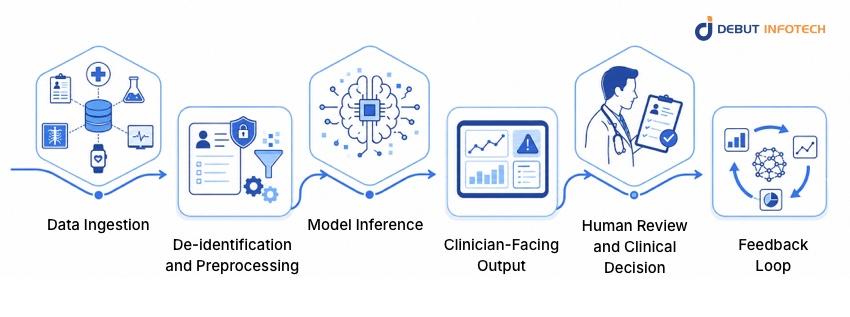
Here’s an in-depth breakdown of the process:
Every AI system begins with data. Healthcare organizations collect information from electronic health records (EHRs), laboratory information systems, medical imaging devices, wearable sensors, pharmacy systems, insurance claims, genomic databases, and patient portals.
Depending on the use case, AI may process structured data such as laboratory values and medication records, or unstructured data such as physician notes, radiology reports, pathology slides, and medical images.
Data quality directly influences AI performance. Incomplete, inconsistent, or outdated information can reduce prediction accuracy and introduce bias.
Many healthcare organizations invest significant time in improving data governance before deploying AI solutions because reliable data produces more reliable clinical insights.
Before data reaches an AI model, it undergoes preprocessing.
Patient identifiers are removed or masked where required to protect privacy and comply with regulations such as HIPAA and GDPR. The data is then cleaned by correcting errors, removing duplicate records, standardizing formats, and filling missing values where appropriate.
Medical images may be resized or normalized before analysis. Clinical notes can be converted into structured formats using natural language processing (NLP). This preparation ensures the AI model receives consistent, high-quality inputs that improve prediction accuracy and reduce unnecessary variation.
Once the data is prepared, it is processed by a trained AI model.
The model analyzes the information, compares it with patterns learned during training, and generates predictions or recommendations. The type of model depends on the application.
A computer vision model may identify abnormalities in an MRI scan, while a large language model summarizes physician notes or drafts clinical documentation.
Unlike traditional software that follows predefined rules, AI evaluates probabilities.
Rather than producing a simple yes-or-no answer, it often provides confidence scores, risk assessments, or ranked recommendations that help clinicians make informed decisions.
AI findings are presented through interfaces integrated with existing clinical systems.
Depending on the workflow, clinicians may receive alerts, diagnostic suggestions, patient risk scores, treatment recommendations, or automatically generated documentation.
The goal is to support decision-making without disrupting routine clinical practice.
Successful AI systems deliver concise, relevant information at the right time. If recommendations are difficult to interpret or require clinicians to switch between multiple systems, adoption rates decline.
User experience therefore plays a critical role in successful AI implementation.
AI supports healthcare professionals rather than replacing them. Physicians, nurses, radiologists, and other clinicians review AI-generated insights alongside their own expertise, patient history, laboratory results, and clinical judgment before making treatment decisions.
Human oversight is particularly important for complex diagnoses, high-risk treatments, and situations involving ethical considerations.
Maintaining clinicians as the final decision-makers helps reduce risks associated with incorrect predictions while improving trust in AI-assisted workflows.
AI systems improve over time through continuous monitoring and feedback. Healthcare organizations evaluate model performance by comparing predictions with actual clinical outcomes.
Errors, false positives, false negatives, and changing patient populations are monitored to identify opportunities for retraining.
This feedback loop allows AI models to adapt to new medical evidence, evolving clinical guidelines, and changing healthcare environments.
Continuous improvement also supports regulatory compliance and helps maintain long-term model reliability.
AI matters in healthcare because it helps organizations address rising costs, workforce shortages, administrative inefficiencies, growing patient expectations, and expanding healthcare data. It also enables providers to improve care quality while increasing operational efficiency and supporting long-term digital transformation.
AI adoption is accelerating because healthcare organizations face structural challenges that traditional technologies cannot fully address.
Rising demand for healthcare services, increasing operational complexity, and growing financial pressure require more intelligent systems capable of supporting both clinical and business decisions.
Healthcare spending continues to increase worldwide, placing pressure on governments, insurers, and providers to deliver better outcomes without proportionally increasing costs.
Administrative processes, inefficient resource utilization, preventable hospital readmissions, and delayed diagnoses contribute significantly to overall expenditure.
AI in medical industry helps reduce unnecessary costs by automating routine administrative tasks, improving diagnostic accuracy, optimizing staffing schedules, predicting patient demand, and supporting earlier interventions. These efficiencies allow healthcare organizations to allocate resources more effectively while maintaining quality of care.
Healthcare systems across many countries continue to experience shortages of physicians, nurses, laboratory professionals, and administrative staff.
Growing patient populations further increase demand on already stretched clinical teams.
AI improves workforce productivity by handling repetitive activities such as appointment scheduling, medical documentation, coding, triage, and image analysis.
Rather than replacing clinicians, AI reduces administrative workload so healthcare professionals can devote more time to direct patient care.
Administrative work consumes a substantial portion of healthcare resources. Clinicians often spend hours documenting encounters, updating patient records, processing referrals, and completing billing requirements.
AI-powered healthcare automation streamlines these workflows by generating clinical notes, extracting information from documents, automating coding, verifying insurance details, and processing claims. Reducing administrative complexity improves staff satisfaction while increasing organizational efficiency.
Patients increasingly expect healthcare services that are convenient, personalized, and digitally accessible. They want shorter waiting times, faster diagnoses, online appointment scheduling, virtual consultations, and continuous communication throughout their care journey.
AI enables healthcare organizations to meet these expectations through virtual assistants, personalized treatment recommendations, intelligent scheduling systems, symptom checkers, and remote patient monitoring. These technologies improve accessibility without placing additional strain on clinical staff.
Modern healthcare generates enormous volumes of information from electronic health records, diagnostic imaging, laboratory tests, wearable devices, genomic sequencing, and connected medical equipment.
Much of this information remains underutilized because it exceeds the capacity of traditional analytical tools.
AI processes these large datasets quickly, identifies meaningful relationships, detects hidden trends, and supports evidence-based decision-making.
Organizations can use these insights to improve patient outcomes, identify operational inefficiencies, and develop more personalized care strategies.
Healthcare organizations continue to modernize their technology infrastructure through cloud computing, interoperability initiatives, telemedicine platforms, and digital patient engagement tools.
AI complements these investments by adding intelligence to existing digital systems rather than replacing them.
As healthcare digital transformation accelerates, AI is becoming a foundational capability across clinical care, operations, finance, research, and population health management.
Organizations that integrate AI into their broader digital strategy are better positioned to improve efficiency, strengthen patient outcomes, and remain competitive in an increasingly data-driven healthcare landscape.
AI improves healthcare by enhancing diagnostic accuracy, accelerating clinical decisions, reducing administrative work, lowering costs, personalizing treatments, and optimizing hospital operations. These benefits help healthcare organizations deliver better patient outcomes while improving efficiency and financial performance.
Although the benefits of AI in healthcare vary by use case, the following advantages consistently drive AI adoption in healthcare.
AI in diagnostics analyzes medical images, pathology slides, laboratory results, and clinical records with remarkable speed and consistency.
It can identify subtle abnormalities that may be difficult for humans to detect, particularly when reviewing large volumes of data. This supports earlier disease detection and reduces the likelihood of missed diagnoses.
Clinicians often need to evaluate large amounts of patient information within limited timeframes.
AI in medicine rapidly processes medical histories, laboratory findings, imaging results, and clinical guidelines to provide relevant recommendations.
Faster access to insights helps clinicians make timely decisions, especially in emergency and critical care settings.
Earlier diagnosis, more accurate risk prediction, and personalized treatment recommendations contribute directly to improved patient outcomes.
AI also supports continuous monitoring, allowing healthcare teams to detect clinical deterioration before serious complications develop. These capabilities improve recovery rates while reducing avoidable hospital admissions.
Every patient responds differently to treatment. AI evaluates genetic information, medical history, lifestyle factors, biomarkers, and previous treatment responses to recommend therapies tailored to individual needs.
Personalized medicine improves treatment effectiveness while minimizing unnecessary interventions and adverse reactions.
Hospitals manage thousands of operational decisions every day, from bed allocation and operating room scheduling to staff deployment and inventory management.
AI in healthcare operations optimizes these workflows by analyzing demand patterns and recommending resource allocation strategies that improve productivity and reduce bottlenecks.
Administrative activities account for a significant portion of healthcare spending and consume valuable clinician time.
AI automates tasks such as appointment scheduling, patient registration, prior authorization, clinical documentation, medical transcription, insurance verification, claims processing, and billing support.
Reducing administrative overhead allows physicians, nurses, and support staff to spend more time on patient care rather than paperwork.
AI helps healthcare organizations identify inefficiencies that increase operating costs.
Predictive analytics can forecast patient admissions, optimize staffing levels, reduce unnecessary diagnostic testing, and improve supply chain planning.
Artificial intelligence in healthcare also minimizes claim denials by improving documentation and coding accuracy, contributing to healthier financial performance across the organization.
Modern patients expect convenient, personalized healthcare experiences.
AI for patient care supports this expectation through virtual health assistants, intelligent chatbots, personalized reminders, medication adherence monitoring, and automated follow-up communication. These tools improve patient satisfaction while encouraging greater participation in long-term care plans.
Healthcare resources are limited, particularly during periods of high patient demand.
AI analyzes historical trends, seasonal patterns, staffing availability, and patient flow to optimize the allocation of beds, operating rooms, medical equipment, and clinical personnel.
Better resource planning reduces delays, improves service delivery, and maximizes the utilization of existing infrastructure.
One of AI’s greatest strengths is its ability to anticipate future events rather than simply react to them.
Predictive models estimate disease risk, identify patients likely to deteriorate, forecast hospital readmissions, and detect populations that may benefit from preventive interventions. This enables healthcare organizations to shift from reactive care to proactive care, improving outcomes while lowering long-term treatment costs.
AI is applied throughout healthcare to support medical imaging, disease diagnosis, drug discovery, hospital operations, virtual care, predictive analytics, medical coding, fraud detection, cybersecurity, and patient monitoring. These applications improve both clinical decision-making and operational efficiency.
Here’s a full breakdown of AI use cases in healthcare:
Medical imaging remains one of the most mature applications of AI in healthcare.
AI models analyze X-rays, CT scans, MRI scans, mammograms, ultrasounds, and pathology images to detect abnormalities that may indicate disease.
Radiologists use AI as a decision-support tool rather than a replacement.
AI in medical imaging highlights suspicious regions, prioritizes urgent cases, measures anatomical structures, and compares current scans with historical images. This accelerates image interpretation while reducing diagnostic variability.
Artificial intelligence assists clinicians in diagnosing conditions by combining information from symptoms, laboratory results, imaging studies, patient history, and genetic data.
Machine learning models identify complex relationships that may not be immediately apparent through manual analysis alone.
AI in disease diagnosis is increasingly used to support the diagnosis of cancer, cardiovascular disease, diabetes, neurological disorders, infectious diseases, and rare genetic conditions.
Earlier diagnosis often improves treatment success and reduces healthcare costs.
Clinical decision support systems use AI to provide evidence-based recommendations during patient care. These systems review patient records alongside clinical guidelines, medication histories, laboratory values, and allergy information to assist physicians in making informed treatment decisions.
AI in clinical decision support can alert clinicians to potential drug interactions, recommend additional diagnostic tests, identify high-risk patients, and suggest treatment pathways based on current medical evidence.
Traditional drug development requires years of research and substantial financial investment.
AI in drug discovery accelerates this process by analyzing biological data, predicting molecular interactions, identifying therapeutic targets, and screening millions of potential drug compounds far more quickly than conventional methods.
Pharmaceutical companies also use AI to optimize clinical trial design, identify suitable participants, predict treatment responses, and reduce research costs throughout the drug development lifecycle.
Personalized medicine focuses on tailoring treatments to individual patients rather than applying standardized therapies.
AI in personalized medicine analyzes genomic information, biomarkers, lifestyle factors, environmental influences, and previous treatment outcomes to recommend therapies most likely to produce positive results.
This approach improves treatment effectiveness while reducing unnecessary medications, adverse drug reactions, and trial-and-error prescribing.
Hospital operations involve thousands of interconnected processes every day.
AI automation in healthcare improves efficiency by optimizing operating room schedules, bed management, patient flow, discharge planning, staffing allocation, and inventory management.
Predictive models also forecast patient admissions and emergency department demand, allowing hospitals to prepare resources before capacity constraints occur.
Administrative automation extends beyond scheduling and billing.
AI extracts information from medical documents, processes referrals, manages prior authorizations, verifies insurance eligibility, automates document classification, and assists with compliance reporting.
These capabilities reduce processing times, improve accuracy, lower administrative costs, and help organizations maintain regulatory compliance.
AI-powered virtual assistants provide patients with continuous access to healthcare information and basic support outside traditional clinical settings.
They answer common health questions, schedule appointments, provide medication reminders, monitor symptoms, and direct patients toward appropriate care pathways.
These systems improve patient engagement while reducing the workload placed on administrative staff and call centers.
Connected wearable devices, smart medical equipment, and home monitoring systems continuously collect patient health data.
AI in remote patient monitoring analyzes this information to detect early signs of deterioration, identify abnormal trends, and notify clinicians when intervention may be required.
Remote monitoring supports chronic disease management, post-operative recovery, elderly care, and preventive medicine by enabling earlier clinical intervention without requiring frequent hospital visits.
Predictive analytics in healthcare helps healthcare organizations anticipate future events using historical and real-time data.
AI models estimate patient demand, predict disease outbreaks, forecast readmissions, identify patients at risk of complications, and optimize staffing requirements.
These insights enable healthcare leaders to make proactive operational and clinical decisions rather than reacting after problems occur.
Population health initiatives focus on improving outcomes across large patient groups rather than individual cases.
AI identifies high-risk populations, detects health disparities, predicts disease prevalence, and recommends targeted preventive interventions.
Healthcare providers and public health agencies use these insights to allocate resources more effectively and improve long-term community health.
Revenue cycle management directly affects the financial health of healthcare organizations.
AI automates insurance verification, claims submission, denial prediction, payment forecasting, and collections management.
By reducing coding errors and identifying reimbursement risks before claims are submitted, AI improves cash flow while lowering administrative costs.
Medical coding traditionally requires specialists to review clinical documentation and assign standardized billing codes.
AI accelerates this process by analyzing physician notes and automatically suggesting appropriate ICD, CPT, and HCPCS codes.
Human coders remain responsible for final validation, but AI significantly improves productivity, consistency, and coding accuracy while reducing claim denials.
Healthcare fraud remains a major financial challenge for providers, insurers, and government healthcare programs.
AI detects suspicious billing patterns, duplicate claims, unusual provider behavior, and anomalous reimbursement activity that may indicate fraudulent practices.
Continuous monitoring enables investigators to identify potential fraud earlier, reducing financial losses while protecting healthcare resources.
Healthcare organizations manage highly sensitive patient information, making them attractive targets for cybercriminals.
AI strengthens cybersecurity by detecting unusual network behavior, identifying malware, monitoring user activity, recognizing phishing attempts, and responding to security incidents in real time.
As healthcare systems become increasingly connected, AI-driven cybersecurity plays an essential role in protecting patient data, maintaining regulatory compliance, and ensuring uninterrupted clinical operations.
Healthcare organizations use AI differently depending on their business model and operational needs.
Hospitals such as Mayo Clinic use AI for clinical decision support, laboratories like Labcorp use AI to improve diagnostic workflows, pharmaceutical companies such as Insilico Medicine use AI to accelerate drug discovery, insurers like Optum use AI to optimize claims and care management, and medical technology firms such as Siemens Healthineers use it to enhance diagnostic equipment.
Here are detailed examples of real-world AI use cases in healthcare:
Mayo Clinic uses AI to enhance clinical decision-making, accelerate diagnosis, and improve patient care through advanced data analysis.
Rather than replacing physicians, AI in hospitals acts as a clinical support tool that helps specialists interpret complex medical information more efficiently.
One major area of focus is medical imaging. AI assists radiologists and pathologists by identifying abnormalities in imaging studies and pathology slides that warrant closer examination. This reduces review time while helping clinicians prioritize urgent cases.
Mayo Clinic also uses AI to analyze large clinical datasets, enabling researchers to identify disease patterns, evaluate treatment effectiveness, and develop more personalized care strategies.
Beyond diagnostics, Mayo Clinic has invested heavily in AI research and innovation through collaborations with technology partners. These initiatives focus on developing responsible AI solutions that integrate seamlessly into clinical workflows while maintaining physician oversight.
The organization’s approach demonstrates how AI can improve care quality without disrupting the clinician-patient relationship.
Diagnostic laboratories process millions of laboratory tests every year, making efficiency and accuracy critical business priorities.
Labcorp uses AI to improve laboratory operations by optimizing testing workflows, analyzing diagnostic data, and supporting more accurate result interpretation.
AI helps prioritize laboratory samples, detect anomalies in testing processes, and identify patterns across large datasets that may indicate disease or quality control issues. By automating routine analytical tasks, laboratory professionals can focus on reviewing complex cases that require specialized expertise.
Labcorp also applies AI in precision medicine initiatives by combining laboratory results with genomic and clinical information. This enables healthcare providers to make more informed treatment decisions while supporting earlier disease detection and personalized patient care.
Insilico Medicine has built its business around using AI to transform drug discovery.
Instead of relying solely on traditional laboratory research, the company uses advanced machine learning models to identify potential drug targets, generate novel molecular structures, and predict which compounds are most likely to succeed during development.
AI significantly reduces the time required during the early stages of pharmaceutical research. Rather than screening millions of compounds manually, researchers use AI to narrow the search to the most promising candidates before laboratory validation begins. This accelerates research while reducing development costs.
Insilico Medicine also applies generative AI to design entirely new molecules with desired biological properties. This represents a major shift from conventional drug discovery, where researchers primarily evaluate existing chemical libraries.
AI-generated molecules expand the range of potential treatments available for complex diseases.
Health insurers manage enormous volumes of claims, clinical records, provider data, and financial transactions every day.
UnitedHealth Group, through its technology and healthcare services division Optum, uses AI to improve operational efficiency, support care management, and strengthen payment integrity.
AI analyzes insurance claims to identify inconsistencies, detect potential fraud, and reduce processing delays. Predictive models also estimate patient health risks, enabling care managers to identify members who may benefit from early intervention before medical conditions become more severe.
Optum further uses AI to support population health management by analyzing clinical and claims data across large patient populations. These insights help healthcare providers improve chronic disease management, reduce avoidable hospital admissions, and deliver more coordinated care while controlling costs.
Teladoc Health uses AI to improve virtual care experiences rather than focusing primarily on diagnosis. AI helps patients navigate digital healthcare services before, during, and after virtual consultations.
Intelligent symptom assessment tools gather patient information before appointments, helping clinicians understand medical concerns in advance.
AI also supports appointment routing by directing patients to the most appropriate healthcare professional based on symptoms, medical history, and urgency.
Following consultations, AI assists with patient engagement through personalized follow-up reminders, chronic disease monitoring, medication adherence support, and health coaching. These capabilities help extend care beyond individual appointments, making virtual healthcare more proactive and continuous.
Siemens Healthineers integrates AI directly into medical devices and imaging equipment.
Rather than functioning as standalone software, AI enhances the performance of MRI scanners, CT scanners, X-ray systems, ultrasound devices, and laboratory diagnostic platforms.
AI improves image acquisition by automatically adjusting scanning parameters, reducing image noise, and shortening scan times without compromising quality.
During interpretation, AI identifies anatomical structures, highlights suspicious findings, performs automated measurements, and assists radiologists with routine image analysis.
Beyond imaging, Siemens Healthineers uses AI to improve workflow orchestration across hospitals by connecting imaging systems, laboratory platforms, and clinical information systems. This reduces bottlenecks, accelerates diagnosis, and enables clinicians to make faster treatment decisions while maintaining high diagnostic standards.
Different healthcare challenges require different AI model architectures. There is no single AI model capable of handling every clinical or operational task.
Healthcare organizations select model types based on the nature of the data being analyzed, the complexity of the problem, and the required level of accuracy.
| AI Model | Primary Healthcare Use Cases | Why It’s Used |
| Convolutional Neural Networks (CNNs) & Vision Transformers (ViTs) | Medical imaging, radiology, pathology, dermatology, ophthalmology | Excellent at identifying visual patterns, anatomical structures, and subtle abnormalities in medical images |
| Large Language Models (LLMs) & Transformers | Clinical documentation, ambient scribing, medical coding, physician notes, patient communication | Understand and generate human language, summarize clinical notes, automate documentation, and improve administrative efficiency |
| Graph Neural Networks (GNNs) | Drug discovery, protein interaction analysis, genomics, molecular research | Model complex biological relationships between genes, proteins, diseases, and chemical compounds more effectively than traditional machine learning methods. |
| Time-Series Models | Remote patient monitoring, ICU monitoring, deterioration prediction, wearable devices | Analyze continuous streams of patient data such as heart rate, blood pressure, oxygen saturation, and ECG signals to identify early signs of clinical deterioration. |
Healthcare organizations increasingly combine multiple model architectures within a single solution.
For example, a hospital may use computer vision to analyze chest X-rays, a large language model to summarize physician documentation, and time-series models to monitor intensive care patients in real time. This multimodal approach produces more comprehensive clinical insights than relying on a single AI model.
The next generation of healthcare AI extends far beyond traditional machine learning.
New technologies are making AI more capable, context-aware, and better integrated into everyday clinical practice. These innovations are expected to reshape healthcare delivery over the next several years.
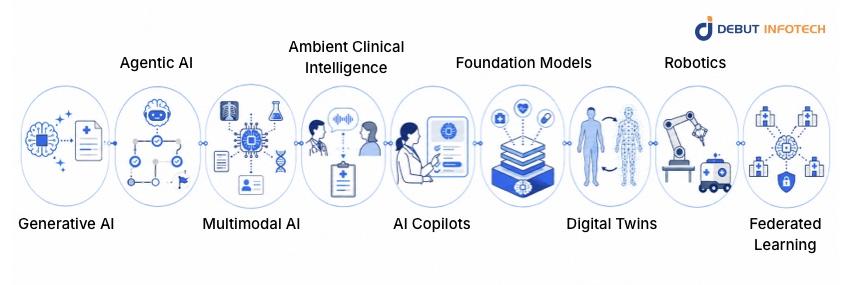
Generative AI creates new content rather than simply analyzing existing data.
In healthcare, it generates clinical documentation, summarizes patient records, drafts discharge instructions, supports medical research, and assists healthcare professionals with complex information retrieval.
It significantly reduces documentation time while improving knowledge accessibility.
Agentic AI represents a shift from AI systems that simply respond to prompts toward systems capable of planning, reasoning, and completing multi-step tasks independently.
In healthcare, AI agents may coordinate appointments, retrieve patient information, initiate follow-up workflows, or assist clinicians with administrative processes while operating within predefined governance controls.
Healthcare decisions rarely rely on one type of information.
Multimodal AI combines medical images, laboratory results, physician notes, genomic information, and patient histories into a unified analytical model. This enables AI to produce more comprehensive recommendations than systems analyzing a single data source.
Ambient clinical intelligence automatically captures conversations between clinicians and patients during consultations.
Then, AI converts these conversations into structured clinical documentation without requiring physicians to type notes manually, reducing documentation burden while allowing clinicians to focus on patient interactions.
AI copilots function as intelligent assistants for healthcare professionals. They retrieve clinical guidelines, summarize patient histories, answer medical questions, draft documentation, and recommend next steps without replacing clinician judgment. These systems improve productivity while supporting informed decision-making.
Foundation models are large AI models trained on diverse datasets before being adapted for specific healthcare applications.
Instead of building separate AI models for every task, organizations fine-tune foundation models for medical imaging, clinical documentation, diagnostics, research, or patient communication. This reduces development time while improving scalability.
Digital twins are virtual representations of patients, organs, medical devices, or healthcare facilities that continuously update using real-world data.
By combining clinical records, medical imaging, laboratory results, and sensor data, digital twins simulate how changes in treatment or disease progression may affect outcomes.
Healthcare providers can use patient digital twins to evaluate treatment options before administering therapy.
Researchers can simulate disease progression, while hospitals can create digital twins of their facilities to optimize patient flow, equipment utilization, and resource planning. These simulations reduce uncertainty and support more informed decision-making.
AI-powered robotics is transforming both clinical care and hospital operations.
Surgical robots assist physicians by providing greater precision, stability, and control during minimally invasive procedures.
AI also powers autonomous robots that transport medications, laboratory samples, medical supplies, and equipment throughout healthcare facilities.
Beyond surgery, robotic systems are increasingly used in rehabilitation, elderly care, pharmacy automation, and infection control. These applications improve operational efficiency while allowing healthcare professionals to focus on patient-centered responsibilities.
One of the biggest barriers to healthcare AI is access to high-quality patient data while maintaining privacy.
Federated learning addresses this challenge by allowing AI models to learn from data stored across multiple hospitals without transferring sensitive patient information to a central database.
Instead of sharing raw medical records, participating organizations train AI models locally and share only model updates. This approach strengthens privacy protection, supports regulatory compliance, and enables healthcare organizations to build more accurate AI models using diverse datasets from multiple institutions.
AI in healthcare faces challenges such as data privacy, cybersecurity, algorithmic bias, regulatory compliance, explainability, system integration, implementation costs, workforce readiness, and ongoing model monitoring.
Healthcare organizations must address these issues carefully to maximize AI’s benefits while protecting patients, maintaining compliance, and ensuring long-term reliability. Here is a detailed insight into the challenges of AI in healthcare:
Healthcare organizations handle highly sensitive patient information, making data privacy a primary concern.
AI systems require access to large datasets for training and inference, increasing the importance of secure data handling, consent management, and privacy-preserving technologies.
Organizations must establish clear policies governing data collection, storage, sharing, and retention.
Strong data governance reduces legal risks while strengthening patient trust.
Healthcare has become one of the most targeted industries for cyberattacks.
AI systems introduce additional attack surfaces that must be protected against unauthorized access, ransomware, data manipulation, and model theft.
Effective security requires encryption, access controls, continuous monitoring, vulnerability assessments, and secure software development practices throughout the AI lifecycle.
AI models learn from historical data.
If that data contains demographic, geographic, or socioeconomic biases, the resulting predictions may unfairly disadvantage certain patient groups.
Organizations should evaluate AI models using diverse datasets, perform fairness testing, and continuously monitor outcomes to identify and reduce unintended bias before it affects patient care.
Many advanced AI models operate as “black boxes,” making it difficult to understand how predictions are generated.
In healthcare, clinicians need transparent reasoning before relying on AI recommendations.
Explainable AI techniques help reveal the factors influencing predictions, improving clinician confidence while supporting regulatory requirements and clinical accountability.
AI solutions must comply with evolving healthcare regulations across different jurisdictions.
Requirements vary depending on how AI is used, whether it influences clinical decisions, and whether it qualifies as a regulated medical device.
Organizations should involve legal, compliance, and clinical experts throughout AI development and deployment to reduce regulatory risks.
Many healthcare providers operate complex technology environments that include electronic health records, laboratory systems, imaging platforms, billing software, and legacy applications.
Integrating AI across these systems can be technically challenging.
Successful implementation depends on interoperability standards, well-designed APIs, and close collaboration between healthcare providers, software vendors, and implementation partners.
Technology alone does not guarantee successful AI adoption. Healthcare professionals must understand how AI supports their work and how it fits into existing clinical workflows.
Comprehensive training, transparent communication, executive sponsorship, and clinician involvement during implementation help reduce resistance while increasing user adoption.
Enterprise AI initiatives often require substantial investment in infrastructure, software, cloud services, cybersecurity, integration, governance, and workforce training.
Organizations should prioritize high-value use cases with measurable business outcomes before expanding AI across the enterprise.
A phased implementation approach typically delivers stronger long-term returns.
Building and maintaining AI healthcare solutions requires expertise in machine learning, clinical informatics, data engineering, cybersecurity, cloud infrastructure, regulatory compliance, and healthcare operations.
Because professionals with both healthcare and AI expertise remain in limited supply, many organizations partner with specialized AI development firms to accelerate implementation while reducing project risk.
AI deployment is not the final step. Clinical environments evolve continuously as patient populations, treatment protocols, and medical evidence change.
Organizations should continuously monitor model accuracy, fairness, reliability, and operational performance.
Regular retraining and validation ensure AI systems remain safe, compliant, and clinically effective over time.
Healthcare AI operates within one of the world’s most highly regulated industries. Compliance extends beyond protecting patient information.
Organizations must also demonstrate that AI systems are safe, transparent, reliable, and appropriately governed throughout their lifecycle.
In the United States, the Health Insurance Portability and Accountability Act (HIPAA) establishes requirements for protecting patient health information.
AI solutions handling protected health information (PHI) must implement administrative, technical, and physical safeguards to maintain confidentiality, integrity, and availability.
Organizations serving patients within the European Union must comply with the General Data Protection Regulation (GDPR).
The regulation emphasizes lawful data processing, informed consent, data minimization, transparency, and individuals’ rights regarding their personal information.
Healthcare organizations deploying AI internationally should design privacy protections that satisfy multiple regulatory frameworks rather than treating compliance as a regional requirement.
In the United States, AI software performing medical functions may fall under the Food and Drug Administration’s medical device regulations. This includes AI applications supporting diagnosis, treatment planning, medical imaging, and clinical decision-making.
Developers must demonstrate safety, effectiveness, clinical performance, and appropriate risk management before regulated AI solutions reach the market.
Responsible AI focuses on developing systems that are fair, transparent, secure, accountable, and aligned with ethical healthcare practices.
Organizations should establish governance policies that guide AI development from design through deployment.
AI governance consulting defines how organizations oversee AI throughout its lifecycle.
Effective governance includes executive oversight, clinical review, model validation, documentation, performance monitoring, risk assessment, and ongoing compliance management.
Every healthcare AI implementation introduces operational, technical, legal, and clinical risks.
Structured risk management helps organizations identify potential failures, evaluate their impact, and implement appropriate mitigation strategies before deployment.
Ethical AI extends beyond legal compliance. Healthcare organizations should ensure AI supports equitable care, protects patient autonomy, maintains clinician oversight, and promotes transparency in decision-making.
Ethical considerations should remain central throughout AI development rather than being addressed only after deployment.
The latest AI trends in healthcare include agentic AI, autonomous workflows, AI-powered hospitals, precision medicine, digital twins, ambient AI, intelligent automation, and interoperable healthcare systems. Together, these innovations are reshaping how care is delivered and managed.
The following trends are expected to shape the future of AI in healthcare through 2026 and beyond.
AI agents are moving beyond simple task automation toward managing complex, multi-step healthcare workflows.
Future AI agents will coordinate scheduling, retrieve patient records, generate documentation, initiate referrals, and assist with care coordination while operating under human supervision.
Administrative workflows will become increasingly autonomous as AI handles routine approvals, documentation, coding, claims processing, and operational coordination with minimal manual intervention.
Human oversight will remain essential for exceptions and high-risk decisions.
Hospitals are integrating AI across clinical, operational, and financial functions.
Intelligent command centers, predictive staffing, automated patient flow management, AI-assisted diagnostics, and smart resource allocation are transforming hospitals into more responsive and data-driven organizations.
Personalized medicine will continue to expand as AI enables treatment decisions based on each patient’s genetic profile, medical history, lifestyle, biomarkers, and environmental factors.
Rather than applying standardized treatment plans, clinicians will increasingly use AI to recommend therapies tailored to individual patients.
This approach improves treatment effectiveness while reducing unnecessary procedures, adverse drug reactions, and healthcare costs.
As genomic sequencing becomes more affordable and accessible, AI will play a larger role in translating complex genetic information into practical clinical recommendations.
Healthcare is gradually shifting from reactive treatment to proactive prevention.
AI models are becoming more accurate at identifying patients who are likely to develop chronic conditions, experience disease progression, or require hospitalization before symptoms become severe.
Predictive healthcare enables providers to intervene earlier through preventive care, personalized monitoring, and targeted treatment plans. This improves patient outcomes while reducing emergency admissions, hospital readmissions, and long-term healthcare expenditures.
AI is enhancing surgical planning, intraoperative guidance, and post-operative care.
Surgeons increasingly use AI to analyze medical images, identify anatomical structures, recommend surgical approaches, and improve procedural precision.
Combined with robotic-assisted surgery, AI helps reduce variability, improve surgical accuracy, shorten recovery times, and support better patient outcomes.
While surgeons remain fully responsible for clinical decisions, AI serves as an intelligent assistant throughout the surgical workflow.
Digital twin technology is expected to become more sophisticated as healthcare organizations integrate real-time patient data, wearable devices, medical imaging, and genomic information into virtual patient models.
These digital representations will allow clinicians to simulate disease progression, evaluate treatment options before intervention, and personalize care plans with greater confidence.
Digital twins also have applications in hospital operations, medical device testing, and pharmaceutical research.
Precision medicine combines AI, genomics, clinical data, and population health insights to identify treatments that are most effective for specific patient groups.
AI accelerates this process by analyzing large datasets that would be impossible for humans to evaluate manually.
As genomic databases continue to expand, precision medicine will become more practical across oncology, cardiology, neurology, rare disease management, and other specialized medical fields.
Intelligent automation will continue to reshape administrative operations across healthcare organizations.
AI will increasingly manage patient scheduling, prior authorizations, claims processing, billing, medical coding, clinical documentation, inventory management, and workforce planning.
Automating routine tasks allows healthcare professionals to focus on patient care while reducing operational costs, improving productivity, and strengthening organizational resilience.
Healthcare organizations rely on information from multiple systems, including EHRs, laboratory platforms, imaging systems, pharmacies, insurers, and connected medical devices. AI adoption is increasing the need for seamless interoperability between these technologies.
Future healthcare platforms will place greater emphasis on standardized data exchange, API-driven integrations, and cloud-based ecosystems that enable AI to access accurate, real-time clinical information across the care continuum.
Ambient AI is expected to become a standard feature in clinical environments.
Rather than requiring physicians to manually document every patient interaction, AI will automatically capture conversations, generate structured clinical notes, update medical records, and summarize consultations.
This technology reduces documentation fatigue, improves record accuracy, and enables clinicians to maintain greater focus on patient communication instead of administrative tasks.
Successful AI implementation requires more than selecting the right technology.
Healthcare organizations need a structured strategy that aligns AI initiatives with business objectives, clinical priorities, regulatory requirements, and organizational readiness.
Organizations that adopt a phased approach are more likely to achieve measurable results while minimizing implementation risks.
Table: AI Implementation Roadmap for Healthcare Organizations
| Stage | Key Activities | Expected Outcome |
| Identify goals | Define clinical and business objectives | Clear AI strategy |
| Assess data readiness | Review data quality, availability, and governance | Reliable AI foundation |
| Select use case | Prioritize high-impact problems | Faster ROI potential |
| Build MVP | Develop and test initial AI solution | Validate feasibility |
| Pilot deployment | Measure performance and user adoption | Identify improvements |
| Scale implementation | Expand across departments | Enterprise AI adoption |
| Monitor performance | Track accuracy, security, and compliance | Long-term reliability |
Here is an AI healthcare implementation guide:
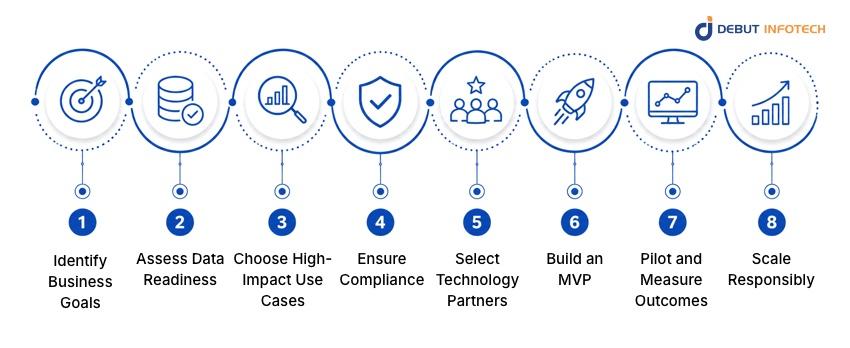
Every AI initiative should begin with clearly defined business and clinical objectives.
Organizations should determine whether the primary goal is improving diagnostic accuracy, reducing administrative costs, enhancing patient engagement, optimizing hospital operations, accelerating research, or strengthening financial performance.
Well-defined objectives help prioritize investments, establish measurable success criteria, and ensure AI projects remain aligned with broader organizational strategy.
AI performs best when trained and deployed using high-quality data. Healthcare organizations should evaluate the completeness, accuracy, consistency, accessibility, and governance of their clinical and operational data before implementation begins.
This assessment should also identify integration challenges across EHR systems, laboratory platforms, imaging systems, financial applications, and other enterprise technologies.
Rather than attempting enterprise-wide transformation immediately, organizations should begin with use cases that deliver measurable business value within a reasonable timeframe.
Examples include automating clinical documentation, improving medical coding, optimizing appointment scheduling, supporting radiology workflows, enhancing claims processing, or deploying AI-powered clinical decision support.
Early success builds organizational confidence and provides evidence for broader adoption.
Regulatory compliance should be incorporated into every stage of AI implementation.
Organizations must address patient privacy, cybersecurity, governance, risk management, transparency, and applicable healthcare regulations before AI solutions enter production.
Cross-functional collaboration between clinical leaders, legal teams, compliance officers, cybersecurity specialists, and Hire AI expert developers helps reduce implementation risks while maintaining patient trust.
Healthcare AI projects often require expertise across artificial intelligence, cloud computing, cybersecurity, healthcare interoperability, regulatory compliance, and enterprise integration. Few organizations possess all of these capabilities internally.
Choosing experienced technology partners helps accelerate deployment, reduce technical complexity, improve integration quality, and support long-term scalability.
Organizations should evaluate partners based on healthcare expertise, technical capabilities, security practices, implementation experience, and post-deployment support.
Developing a minimum viable product (MVP) allows organizations to validate AI solutions before making large-scale investments.
A focused pilot reduces technical risk while providing valuable insights into workflow integration, user adoption, model performance, and operational impact. Feedback gathered during the MVP phase guides future enhancements and broader deployment.
Every AI implementation should include measurable performance indicators.
Organizations may evaluate diagnostic accuracy, documentation time, patient satisfaction, clinician productivity, operational efficiency, claim denial rates, or financial performance depending on the selected use case.
Continuous measurement helps organizations determine whether AI is delivering meaningful business value while identifying opportunities for optimization.
Once pilot projects demonstrate measurable success, organizations can gradually expand AI across additional departments, facilities, and clinical workflows.
Scaling responsibly requires continuous governance, performance monitoring, cybersecurity assessments, workforce training, and periodic model retraining.
Organizations that treat AI as an ongoing capability rather than a one-time technology deployment are better positioned to achieve sustainable long-term success.
The cost of implementing AI in healthcare typically ranges from $20,000 for basic AI solutions to more than $2 million for enterprise-grade platforms. The final investment depends on the use case, system complexity, regulatory requirements, integrations, customization, and long-term maintenance needs.
| AI Solution | Estimated Cost (USD) |
| AI chatbot or virtual health assistant | $20,000–$75,000 |
| Medical coding and documentation automation | $50,000–$150,000 |
| Predictive analytics platform | $80,000–$250,000 |
| Clinical decision support system | $150,000–$500,000 |
| Medical imaging AI solution | $200,000–$750,000 |
| Remote patient monitoring platform | $150,000–$600,000 |
| Enterprise healthcare AI platform | $500,000–$2 million+ |
These estimates typically include AI model development or customization, software engineering, cloud infrastructure, cybersecurity, regulatory compliance, system integration, testing, deployment, and user training.
Long-term costs also include ongoing maintenance, model monitoring, updates, and technical support.
Healthcare organizations should evaluate AI investments based on long-term business value rather than implementation costs alone.
Well-designed healthcare solutions for hospitals often generate measurable returns through improved operational efficiency, lower administrative expenses, faster clinical workflows, better patient outcomes, reduced claim denials, and more effective resource utilization.
Building enterprise AI solutions for healthcare requires more than expertise in machine learning. It demands a deep understanding of healthcare workflows, regulatory compliance, data security, interoperability, and enterprise system integration.
Debut Infotech combines AI engineering with healthcare technology expertise to help organizations develop secure, scalable, and business-focused AI development solutions that deliver measurable operational and clinical value.
Whether you are implementing AI-powered diagnostics, clinical decision support, hospital workflow automation, predictive analytics, virtual health assistants, or revenue cycle optimization, Debut Infotech provides end-to-end development services.
From AI strategy and MVP development to enterprise deployment, compliance, and long-term optimization, the team works closely with healthcare organizations to build solutions that align with their clinical objectives and business goals.
Artificial intelligence is becoming a foundational technology across the healthcare industry. AI in healthcare supports clinicians in making better decisions, helps administrators improve operational efficiency, accelerates medical research, enhances patient engagement, and strengthens financial performance.
As healthcare organizations continue to face rising costs, workforce shortages, and increasing demand for personalized care, AI provides practical solutions that address both clinical and business challenges.
However, successful AI adoption requires careful planning. Organizations must establish clear business objectives, invest in high-quality data, ensure regulatory compliance, implement strong governance frameworks, and continuously monitor AI performance after deployment.
Treating AI as a long-term strategic capability rather than a standalone technology project leads to more sustainable outcomes.
AI is important because it helps healthcare providers diagnose diseases faster, automate repetitive tasks, analyze large amounts of patient data, and personalize treatment plans. It reduces administrative work, supports better clinical decisions, and gives doctors more time to focus on patient care instead of paperwork.
Yes. AI can improve healthcare outcomes by detecting diseases earlier, identifying patterns that humans might miss, and helping doctors make faster, more informed decisions. It also supports personalized treatment plans, reduces medical errors, and improves patient monitoring, leading to better recovery rates and overall quality of care.
The biggest ethical concerns include patient privacy, data security, algorithmic bias, lack of transparency, and accountability when AI makes mistakes. Healthcare providers also need to ensure patients give informed consent and that AI supports clinical decisions rather than replacing qualified medical professionals.
AI will become more deeply integrated into everyday healthcare, from predictive diagnostics and virtual health assistants to robotic surgery and personalized medicine. As the technology matures, expect faster diagnoses, more proactive patient care, greater automation, and stronger collaboration between AI systems and healthcare professionals.
AI itself is not automatically HIPAA compliant. Compliance depends on how it’s designed, deployed, and managed. Healthcare organizations must use secure infrastructure, encrypt patient data, control access, maintain audit logs, and work with AI vendors that meet HIPAA requirements for handling protected health information.
AI Implementation in healthcare usually takes anywhere from three months to over a year, depending on the project’s complexity. Simple AI tools for scheduling or documentation can go live quickly, while custom diagnostic systems often require data preparation, integration with existing software, testing, regulatory checks, and staff training.
Yes. Small clinics can adopt AI without building expensive systems from scratch. Many cloud-based AI solutions offer affordable features like appointment scheduling, medical transcription, billing automation, and clinical decision support. Clinics can start with one use case and expand as their needs and budget grow.
AI can be highly accurate, especially for tasks like medical imaging, disease detection, and predictive analytics, but its performance depends on the quality of the data and how it’s trained. It works best as a decision-support tool that helps clinicians, not as a replacement for medical judgment.

Our Latest Insights

USA
2501 Chatham, Rd Suite R Springfield, IL 62704
+1-708-515-4004
info@debutinfotech.com
UK
7 Pound Close, Yarnton, Oxfordshire, OX51QG
+44-770-304-0079
info@debutinfotech.com
Canada
154 Eden Oak Trail, Kitchener, ON N2A 0H9
+1-708-515-4004
info@debutinfotech.com
INDIA
Sector 101-A, Plot No: I-42, IT City Rd, JLPL Industrial Area, Mohali, PB 140306
9888402396
info@debutinfotech.com