ON THIS PAGE
Progress0%



Our Global Presence :





Enterprises are moving fast with AI, but speed without oversight creates blind spots.
AI Governance Consulting helps organizations turn responsible AI principles into daily processes teams can follow, from intake and approvals to monitoring and audit-ready documentation. That matters because AI is already embedded across operations. In OpenAI’s 2025 enterprise report, 75% of surveyed workers said AI improved the speed or quality of their work.
At the same time, governance pressure is rising. Stanford’s 2024 AI Index found AI mentions in legislative proceedings jumped to 2,175 in 2023, up from 1,247 in 2022. And Gartner forecasts worldwide AI spending will hit nearly $1.5 trillion in 2025, which raises the cost of getting governance wrong.
In this guide, we will explain what AI governance consulting is, why organizations need it, signs your organization is ready, the pathway to implementing AI governance, and how to choose the right partner.
AI governance is the policies, roles, and controls that guide how an organization builds, buys, uses, and monitors AI. It sets clear accountability for model decisions, data use, approvals, and ongoing oversight. Strong governance reduces bias, privacy, and security risks, and regulatory risks, while keeping AI aligned with business goals. It also enforces documentation, testing, and audit-ready evidence.
AI governance consulting is professional support that helps organizations build, operationalize, and scale AI governance. A consultant doesn’t just hand you a policy document. They allow you put a working system in place.
That usually means setting up decision-making structures, mapping AI risks, aligning with existing compliance processes, and building repeatable workflows for approvals and monitoring. It also includes selecting the right governance frameworks, designing controls that fit how your teams work, and embedding governance into product delivery so it doesn’t become a blocker.
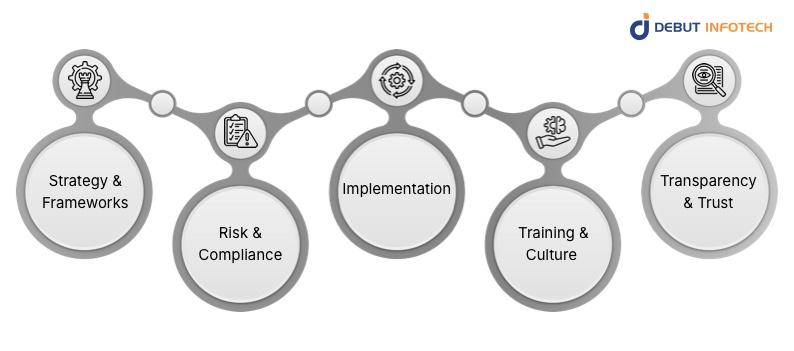
An AI governance consultant helps you define governance goals, scope, and decision-making structure across the AI lifecycle. They design frameworks that fit your operating model, not generic templates. This includes defining risk tiers, approval pathways, review boards, and documentation standards that scale across teams.
Consultants identify AI risks like bias, privacy exposure, security weaknesses, and model drift, then map them to practical controls. They align governance with internal policies and external expectations, including sector rules. This often includes risk scoring, compliance checklists, audit evidence planning, and incident response workflows.
This is where governance moves from paper to practice. AI Consultants embed governance into product delivery, procurement, and MLOps workflows. They set up AI inventories, intake processes, review gates, monitoring requirements, and reporting dashboards. The aim is repeatable governance that supports delivery speed and reduces surprises.
Governance fails when teams treat it as “someone else’s job.” Consultants design role-based training for engineers, product teams, legal, and executives. They also build adoption plans, internal playbooks, and communication support. Hence, governance becomes normal operating behavior rather than an annual compliance exercise.
Consultants improve transparency through explainability standards, model documentation, audit trails, and clear user disclosures. They help teams define what must be visible to stakeholders and regulators, and what can remain internal. This strengthens accountability and builds confidence that AI decisions are consistent, reviewable, and defensible.
Different departments are rolling out AI tools on their own, using separate standards and vendors. That creates inconsistent decision-making, duplicate spend, and hidden risk. Governance consulting helps introduce shared guardrails, approval workflows, and common evaluation criteria without slowing teams down.
If you can’t list your AI systems, you can’t manage them. No inventory means you don’t know what data is used, who owns models, or where failures could happen. Government AI Consulting helps build an AI inventory, risk register, and ownership model that stays current.
When people don’t know who signs off on AI work, projects either stall or launch without proper checks. That usually leads to messy escalations later. Consultants clarify decision rights, define review stages, and assign accountable owners so approvals are predictable and traceable.
Legal and compliance getting involved late is a red flag. It often means tools are already processing sensitive data or influencing decisions without controls. Governance consulting shifts reviews earlier, sets intake processes, and ensures privacy and security checks are built into deployment plans.
Leadership wants a clear view of AI exposure, but responses vary across teams, tools, and regions. That makes it hard to act decisively. Consulting creates a consistent risk language, dashboards, and reporting structure so executives can track risk, controls, and readiness.
Having AI principles is a start, but principles don’t run projects. If teams aren’t using them in design reviews, testing, and deployment decisions, they won’t protect you. Consultants translate principles into policies, checklists, documentation standards, and real enforcement steps.
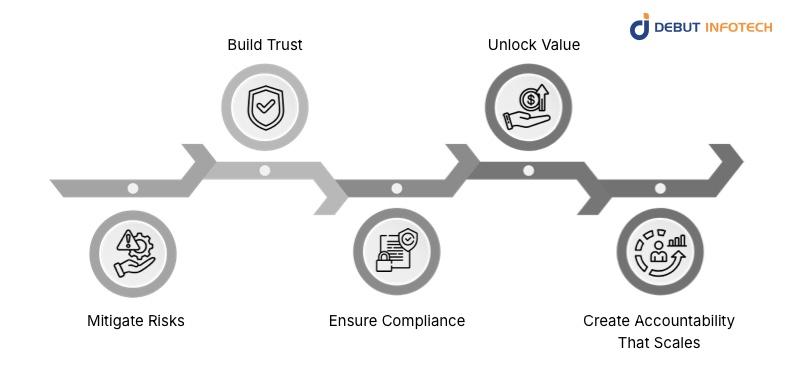
AI risks aren’t theoretical. Models can drift, leak sensitive data, produce biased outcomes, or behave unpredictably in production. Governance consulting helps you identify where failures are likely to occur, define risk thresholds, and implement controls such as documentation, testing gates, monitoring, and incident response. It prevents “ship now, fix later” from turning into real damage.
Trust comes from consistency, not promises. Customers, regulators, and internal teams want proof that AI decisions are fair, explainable, and responsibly handled.
Governance consulting builds practices that instill confidence: model transparency, audit trails, accountability, and clear escalation paths when things go wrong. It also helps teams communicate responsibly about what AI can and can’t do.
AI regulation and expectations are moving quickly across regions and industries. Without structure, compliance becomes reactive, expensive, and messy. An AI consultant for government agencies helps map obligations to practical controls, standardize documentation, and maintain audit evidence. It also reduces surprises by defining what must be reviewed, what needs approval, and what monitoring is required for high-impact systems.
Governance isn’t meant to slow AI down. Done properly, it speeds up adoption by removing uncertainty and repeated debates. Consulting helps establish reusable templates, clear review steps, and a shared language for risk. Teams spend less time arguing about approvals and more time deploying AI systems that are reliable, measurable, and easier to scale.
As AI spreads across teams and vendors, ownership can get blurry fast. When issues happen, nobody knows who is responsible for model behavior, data quality, or user impact. Governance consulting creates a scalable accountability model with defined roles, decision rights, and oversight routines. That way, AI growth stays controlled, traceable, and easier to manage in the long term.
A current-state review of AI usage, controls, gaps, and risk level. This often includes interviews, process reviews, and validation of technical practices.
Governance touches product, data, security, legal, compliance, HR, procurement, and leadership. Consultants map who needs to be involved and how decisions should flow.
This includes policies, operating model, committees (where needed), decision rights, and escalation processes. The design typically scales by risk level, not by bureaucracy.
Practical policies and controls, such as model documentation requirements, data handling rules, approval workflows, and monitoring expectations.
Mapping obligations and standards into actionable requirements. This often includes global principles such as those of the OECD and human rights-oriented governance approaches.
Most teams don’t need more theory. They need reusable assets like:
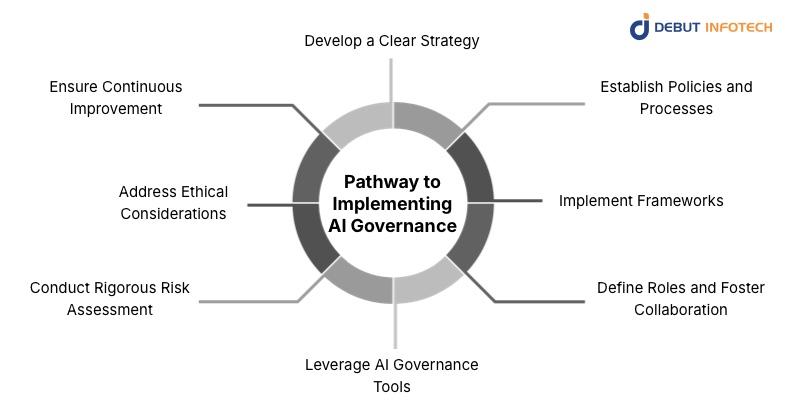
Start by defining what AI governance is meant to protect and enable in your organization. Prioritize AI systems that affect customers, finances, safety, or sensitive data.
Set clear risk tolerance levels by use case and business unit. Tie governance goals to measurable outcomes like fewer incidents, faster approvals, and cleaner documentation across the AI lifecycle.
Build policies that teams can follow without slowing down delivery. Define what counts as “AI,” what needs review, and what documentation is mandatory before deployment.
Set a simple intake process for new tools, plus approval steps for high-impact use cases. Include rules for data handling, third-party vendors, monitoring, and how incidents get reported and resolved.
Frameworks provide a proven structure for managing AI risk, ethics, and accountability without building everything from scratch.
Use NIST AI RMF to classify AI risks, define governance functions, and standardize controls across teams. It helps align monitoring, evaluation, documentation, and ongoing improvement with real operational workflows.
Apply OECD AI Principles to guide responsible AI decisions across fairness, transparency, accountability, and human-centered values. They help set expectations for safe outcomes while supporting innovation and business growth.
Use the EU Ethics Guidelines to operationalize trustworthy AI by setting requirements for human oversight, transparency, technical robustness, and accountability. It supports structured self-assessment and consistent decision-making across deployments.
Reference this convention to align governance with human rights, democracy, and rule-of-law expectations. It supports lifecycle controls, documented accountability, and risk management for high-impact AI systems.
Assign clear ownership so governance doesn’t fall between teams. Define who sponsors AI initiatives, who reviews risk, and who approves deployment for different risk levels. Create collaboration between product, data, security, legal, and compliance so reviews are fast and consistent. Define escalation paths for disputes and incidents, and publish the associated responsibilities in plain language.
Tools help you manage governance at scale by automating tracking, testing, documentation, and monitoring, especially when AI adoption grows quickly across departments.
Use governance platforms to consolidate AI inventories, approvals, documentation, and audit trails in a single place. They improve traceability, enforce workflow consistency, and reduce manual effort in compliance reporting.
Use bias and fairness tools to test model outputs for disparate impact across user groups. They support fairness metrics, dataset inspection, mitigation techniques, and repeatable evaluation before production release.
Explainability tools help teams understand why AI models make certain predictions. They generate interpretable insights, support stakeholder reviews, and improve trust when AI decisions affect customers, employees, or regulated outcomes.
Monitoring tools track drift, performance drop-offs, anomalies, and data changes after deployment. They support alerting, automated checks, rollback decisions, and long-term model reliability in production environments.
Data governance platforms manage lineage, access controls, quality checks, and retention rules. They strengthen AI reliability by ensuring models use consistent, secure, and auditable data across training and production pipelines.
MCP supports standardized connections between AI assistants and business tools. It improves control over tool access, reduces insecure integrations, and helps manage permissions and traceability across agent-based workflows.
Run risk assessments before deployment, not after complaints. Evaluate impact level, user harm potential, AI data security or sensitivity, model explainability, and misuse risk.
Score systems based on severity and likelihood, then assign required controls like testing depth, human oversight, and monitoring intensity. Document assumptions, limitations, and mitigations so risk decisions are traceable and reviewable.
Ethics becomes practical when it’s measurable. Define fairness expectations for each use case, set rules for sensitive attributes, and require explainability where decisions affect people directly.
Add human review for high-impact outcomes, such as hiring, credit, or eligibility decisions. Ensure consent and disclosure rules are followed, and document trade-offs when perfect fairness isn’t achievable.
AI governance isn’t a one-time rollout. Models change, data shifts, vendors update tools, and regulations evolve. Set periodic reviews for policies, inventories, and monitoring results.
Track incidents and near-misses, then feed lessons back into controls and training. Use metrics like model performance stability, audit readiness, and review turnaround time to guide improvements over time.
A strong partner turns responsible AI goals into day-to-day processes teams can follow. That means clear intake steps, approval gates, documentation standards, and review checklists that fit how work gets done. If governance can’t run inside delivery cycles, it won’t stick.
AI governance needs to work with product teams, not against them. Choose a partner who understands model development, MLOps, vendor adoption, and business timelines. They should design controls that reduce exposure without slowing releases, especially for fast-moving customer-facing and internal tools.
Good AI governance consulting services don’t “wing it.” They can map your program to recognized frameworks such as NIST AI RMF or OECD principles while tailoring controls to your industry, maturity, and risk profile. You want structure without unnecessary complexity or governance theater that teams ignore.
A reliable AI development company helps you build internal capability. Expect templates, toolkits, training, and handover support so your teams can run governance independently. If everything requires the consultant to stay involved, you’re buying a permanent crutch instead of a sustainable operating model.
Governance should improve speed, safety, and consistency in measurable ways. The right partner defines success metrics early, like AI inventory coverage, review turnaround times, incident rates, monitoring adoption, and audit readiness. They also provide reporting that leadership can understand and act on.
Debut Infotech offers enterprise AI development services. We also support organizations that want AI governance that’s practical, scalable, and easy to run day to day.
From setting up AI inventories and risk registers to building approval workflows, policy controls, and monitoring routines, our team helps you move from scattered AI adoption to structured oversight.
We also align governance with global frameworks like NIST and OECD, while tailoring the operating model to your teams, tools, and compliance expectations.
The result is clearer ownership, cleaner documentation, and fewer last-minute escalations.
Responsible AI does not happen through a policy page alone. It needs ownership, repeatable controls, clear approvals, and ongoing monitoring after deployment. That’s what AI Governance Consulting delivers: a workable system for managing risk, meeting compliance requirements, and ensuring consistent AI use across teams and vendors.
When governance is operational, enterprises can scale AI with fewer surprises, better transparency, and stronger confidence from leadership, customers, and regulators.
A. Because AI can quietly create legal, financial, and brand risk. Governance helps you avoid issues like biased outcomes, privacy slip-ups, unreliable model decisions, and messy vendor AI use. It also makes AI easier to scale since stakeholders trust it.
A. The big ones are compliance failures, data privacy breaches, unfair or biased outcomes, hallucinations or wrong outputs, model drift over time, security vulnerabilities, and unclear accountability. Governance puts checks in place so AI decisions don’t become a “who approved this?” situation.
A. Most companies take 6 to 12 weeks for a solid first rollout, depending on size and the amount of AI already in production. If you want deep controls, audits, and coverage across multiple business units, expect a 3- to 6-month maturity.
A. Compliance focuses on meeting specific laws and standards. Governance is broader. It covers compliance, as well as operating models, decision rights, accountability, model monitoring, and internal controls. Compliance is part of governance, but governance makes AI manageable across products, data, and teams.
A. A common range is $25,000 to $150,000+, depending on scope, industry risk level, and whether you need policy, tooling, and audit support. Smaller “starter” engagements can land in the $15,000–$40,000 range, while enterprise programs can exceed $250,000.

Our Latest Insights
USA
2501 Chatham, Rd Suite R Springfield, IL 62704
+1-708-515-4004
info@debutinfotech.com
UK
7 Pound Close, Yarnton, Oxfordshire, OX51QG
+44-770-304-0079
info@debutinfotech.com
Canada
154 Eden Oak Trail, Kitchener, ON N2A 0H9
+1-708-515-4004
info@debutinfotech.com
INDIA
Sector 101-A, Plot No: I-42, IT City Rd, JLPL Industrial Area, Mohali, PB 140306
9888402396
info@debutinfotech.com