ON THIS PAGE
Progress0%






Our Global Presence :





Separate AI-assisted delivery from AI-enabled products to define distinct business cases, success metrics, workflows, and governance requirements.
Prioritize measurable use cases such as knowledge assistants, document intelligence, and contextual copilots based on user needs, data readiness, and error tolerance.
Match the AI architecture to product requirements: Use hosted model APIs for initial validation, RAG for governed knowledge access, fine-tuning for demonstrated behavior gaps, and agents for controlled multi-step workflows.
Integrate generative AI through secure backend services that enforce authentication, data permissions, output validation, tool restrictions, and fallback behavior across existing web and mobile applications.
Treat security and governance as production requirements by addressing prompt injection, sensitive data exposure, least-privilege access, human oversight, monitoring, and model-change management.
Estimate total cost and delivery timelines from implementation scope including data preparation, system integrations, evaluation, infrastructure, inference, maintenance, and compliance requirements.
Validate ROI through a controlled pilot that measures task completion, quality, latency, cost per successful outcome, and escalation rates against baseline performance before scaling.
Businesses exploring generative AI in digital product development must first decide whether AI will support the teams building the product, power features used by customers, or do both.
These paths require different data, architectures, security controls, budgets, and success metrics. The right starting point is a clearly defined user problem, not a model or tool, followed by a bounded use case that can be evaluated against product and business outcomes.
This guide explains how generative AI in product development supports discovery, design, prototyping, engineering, testing, and post-launch improvement. It also examines customer-facing use cases, production architecture, integration with existing web and mobile applications, data security, cost drivers, delivery timelines, and ROI.
By separating AI-assisted delivery from AI capabilities embedded in a product, decision-makers can choose an implementation approach that is useful, measurable, secure, and economically sustainable.
A practical way to evaluate generative AI in product development is to identify who receives the value. In one path, AI improves how internal teams research, design, build, test, and maintain a product. In the other, it becomes part of the experience delivered to customers or employees. Although both paths may use similar models, they require different workflows, controls, and performance measures.
AI-assisted delivery helps teams complete selected activities more efficiently. It can summarize user research, generate interface variations, suggest code, draft tests, or organize technical documentation. The objective is not to replace professional judgment. It is to reduce avoidable effort while preserving human review, source protection, and accountability for product quality.
An AI-enabled product gives users a new way to complete a task. Examples include searching private knowledge, summarizing documents, creating approved content, or receiving guidance through a specialized copilot. This path requires a production architecture that connects the model to authenticated users, permitted data, application rules, monitoring, and safe fallback behavior.
| Evaluation area | AI-assisted delivery | AI-enabled product |
| Value recipient | Product, design, and engineering teams | Customers, employees, or partners |
| Intended result | More efficient product delivery | Faster or better task completion |
| Key controls | Approved tools, data protection, human review | Permissions, grounding, validation, fallbacks |
| Proof metrics | Cycle time, rework, defects, review effort | Adoption, task success, latency, escalation rate |
| Primary risk | Low-quality work entering development | Incorrect or unauthorized user-facing outcomes |
Organizations can invest in both paths, but they should not combine their business cases. Each initiative needs a defined user, baseline, risk limit, accountable owner, and measurable outcome before implementation begins.
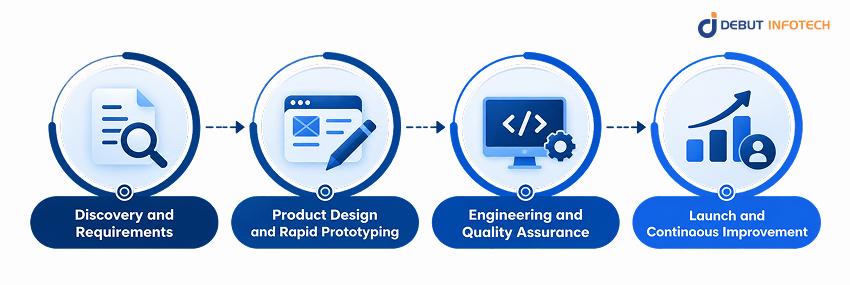
The role of generative AI should change as a product moves from idea to operation. During discovery, it organizes evidence. In design, it expands the options teams can examine. During development, it supports execution and quality checks. After launch, it helps interpret feedback. Treating these as distinct jobs prevents teams from handing strategic decisions to a model simply because it can produce a convincing response.
At the beginning of the AI product development lifecycle, generative AI can categorize interview transcripts, summarize support conversations, compare research findings, and convert workshop notes into draft problem statements or requirements. Its purpose is to make evidence easier to inspect, not to determine which opportunity deserves investment. Product managers should preserve links to original sources, examine conflicting feedback, and validate proposed requirements with stakeholders before prioritizing them.
During AI product design and development, teams can generate alternative user flows, interface copy, feature concepts, and early visual directions. AI-powered rapid prototyping can turn selected ideas into testable mockups or starter interfaces, allowing teams to examine usability and feasibility before building the full experience. The prototype should answer a specific question, such as whether users understand a workflow. Designers remain responsible for accessibility, brand consistency, technical constraints, and validation with real users.
Developers can use generative AI to explain unfamiliar code, create boilerplate, suggest refactoring approaches, draft API documentation, and generate initial test cases. QA teams can expand acceptance criteria into edge cases and regression scenarios. Generated work must still pass code review, automated testing, security checks, and the project’s definition of done. DORA’s 2025 research characterizes AI as an amplifier of the surrounding organization, which means weak delivery practices can also be amplified. Teams should therefore measure cycle time, rework, and escape defects rather than lines of generated code.
Once the product is live, generative AI can group support issues, summarize user reviews, explain recurring themes, draft release notes, and help teams explore product data conversationally. AI-powered product analytics should rely on governed metrics produced by the analytics system rather than calculations invented by the model. Generative AI can interpret verified findings and suggest hypotheses, but analysts and product owners should confirm those interpretations before changing the roadmap.
For every lifecycle stage, define the approved input, intended output, responsible reviewer, permitted next action, and success metric. This converts a broad AI ambition into a controlled capability whose value and risk can be evaluated.
High-value generative AI use cases in product development begin with identifiable user friction. A user may struggle to locate information, review lengthy documents, create an approved response, or complete a process spanning several systems. Generative AI is valuable when it improves that task against a measurable baseline. Before implementation, teams should confirm that the necessary data is accessible, errors can be contained, review responsibilities are clear, and success can be evaluated objectively.
| Product capability | User problem addressed | Required data | Output risk | Review requirement | Proof metric |
| Grounded knowledge assistant | Reliable answers are difficult to find across multiple resources | Approved content, metadata, and access permissions | Medium | Escalation for sensitive questions | Grounded answer rate, resolution time |
| Document intelligence | Users manually examine or restructure complex documents | Source files, extraction rules, schemas, and templates | Medium to high | Human approval for consequential output | Review time, correction rate |
| Contextual copilot | Users need guidance while completing a specific workflow | User context, policies, examples, and application state | Medium | Approval for external or high-impact output | Task completion, acceptance rate |
| Multimodal intake | Information arrives through text, images, audio, or forms | Representative inputs, validation rules, and destination fields | Medium to high | Review of uncertain or sensitive results | Processing time, exception rate |
| Tool-enabled agent | Repetitive work requires coordinated actions across systems | APIs, permissions, business rules, and audit records | High | Approval before sensitive or irreversible actions | Completion rate, execution errors |
Grounded assistants are often suitable early projects because their knowledge boundaries and source material can be defined. Document intelligence and copilots require stronger evaluation because missing information or an unsuitable draft may influence a business decision. Tool-enabled agents introduce greater operational risk, they can take action rather than only generate an answer. The model may recommend a step, but application rules should determine what is permitted, while protected backend services execute approved actions.
Not every feature associated with intelligence is a generative AI use case. Recommendation engines, fraud detection, demand forecasting, risk scoring, and classification commonly depend on predictive machine learning, statistical methods, or deterministic rules. A generative model may explain a prediction or provide a conversational interface, but it should not replace the underlying system unless testing demonstrates that it meets the required standard.
The best starting point is therefore not the most technically ambitious capability. It is the smallest use case that solves a valuable task, can be tested with representative data, and provides evidence for a responsible scale-or-stop decision.
A sound generative AI product architecture begins with product constraints, not a preferred model. Most teams should choose the least complex design that meets their quality, privacy, latency, availability, and cost requirements. In production, the interface manages the user experience, the application backend enforces identity and business rules, an orchestration layer supplies permitted context and tools, and the model generates a response. Systems of record should commit only authorized changes, while evaluation, security, observability, and cost controls operate across every layer.
| Architecture approach | When it fits | What it adds | What to plan for |
| Hosted model API with prompting | Prototypes and clearly bounded generation tasks | Quick implementation and access to capable models | Provider policies, latency, usage cost, and model changes |
| Retrieval-augmented generation | Answers based on current or private information | Source-backed context without retraining the model | Data ingestion, search quality, permissions, and citations |
| Fine-tuning | Consistent task behavior, terminology, tone, or structure | Greater specialization for a repeated task | Training data, evaluation, maintenance, and version changes |
| Open-weight or self-hosted model | Greater infrastructure control or predictable high-volume use | More deployment and customization flexibility | Hosting, scaling, optimization, patching, and support |
| Agentic orchestration | Multi-step workflows involving approved tools | The ability to coordinate actions across systems | Restricted permissions, error recovery, auditability, and human approval |
Prompting through a hosted model API is usually the fastest way to validate a low-risk concept. It works well when the application provides clear instructions and the task does not depend on private or frequently changing knowledge. Before production use, teams still need to review provider data handling, service limits, model changes, latency, and fallback behavior.
RAG is more appropriate when a response must draw from approved company information. It retrieves relevant content at runtime and adds it to the model’s context; it does not train the underlying model on those documents. Production RAG systems need reliable ingestion, indexing, retrieval, source permissions, and serving paths. Official cloud reference architectures similarly separate data preparation from the application’s response flow.
Fine-tuning serves a different purpose. It can improve task behavior, terminology, tone, or output structure when prompting and examples are insufficient. It is not the default solution for factual freshness, and it may still need RAG when answers depend on changing knowledge. Open-weight or self-hosted models can provide greater deployment control, but privacy is not automatic, the surrounding infrastructure, logging, access controls, and operational practices still determine how data is protected.
Agentic orchestration adds the most responsibility because the model can select tools and coordinate several steps. Tool permissions should follow least-privilege principles, sensitive actions should require approval, and deterministic application logic should enforce transaction limits. The model may propose an action, but trusted software should decide whether that action is allowed.
Start with prompting, add retrieval when the product needs governed knowledge, fine-tune only for a demonstrated behavior gap, and introduce agents only when multi-step automation provides enough value to justify the additional control and evaluation burden.
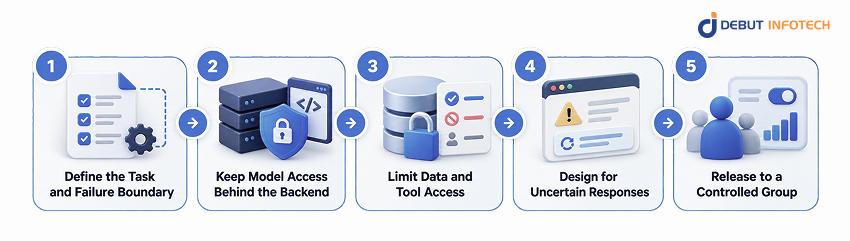
Adding generative AI rarely requires rebuilding an application from scratch. A safer approach is to place a bounded AI service behind the existing product and let its established identity, permissions, data, and business logic remain in control. For a mobile app, the client sends an authenticated request to the backend, the backend prepares the permitted context, calls the model, validates the result, and returns an appropriate response. This pattern is central to responsible AI integration in digital products.
Start with one user action, such as summarizing a document or answering a product question. Specify what a correct response looks like, which errors are tolerable, and when the product must decline, retry, or escalate to a person.
Model credentials, orchestration logic, retrieval services, and safety controls should remain on protected servers rather than inside a browser or mobile client. This prevents exposed API keys and gives the team one place to manage providers, rate limits, versions, and logging.
Send only the information needed for the current task. Apply the product’s existing user roles, tenant boundaries, and access policies before retrieving private content. If the model can use tools, give it the minimum permissions required and keep sensitive actions behind deterministic approval rules.
The interface should show when information was generated, provide sources when grounding matters, and make correction or escalation easy. The product also needs timeouts, output validation, retry limits, and a useful fallback when the model provider is slow, unavailable, or unable to answer confidently.
Use feature flags to test the capability with a limited user cohort. Track task completion, answer acceptance, latency, cost, escalation, and reported problems. Compare those results with the original non-AI workflow before expanding access.
The integration should also accommodate model and API changes. Version prompts and evaluation sets, monitor provider updates, and use caching only where responses can be reused safely. This keeps the AI feature maintainable without allowing it to bypass the controls that already protect the product.
Security cannot be added as a final filter after an AI feature is built. Once a model can access private data, generate user-facing output, or call connected tools, the wider product becomes part of the risk boundary. Teams need to define who may submit information, which data the model can receive, what it may return, which actions can follow, and who intervenes when something goes wrong.
NIST’s Generative AI Profile frames risk management as work that continues across design, development, deployment, and monitoring. NIST SP 800-218A also extends secure software-development practices to AI models and the systems that use them. These frameworks help teams assign ownership and document controls rather than relying on a model-level safeguard alone.
| Control area | Practical requirement | Risk reduced |
| Inputs and retrieved content | Treat external content as untrusted, separate instructions from data, and test adversarial prompts | Prompt injection and manipulated tool use |
| Data access | Apply identity, role, and tenant permissions before information reaches the model | Confidential or cross-user data exposure |
| Data handling | Minimize inputs, redact sensitive fields, encrypt data, and verify provider retention and training policies | Privacy breaches and unintended reuse |
| Model output | Check expected formats, encode content, and validate output before sending it to code, databases, or browsers | Insecure output handling and unintended execution |
| Connected tools | Use allowlists, least-privilege access, transaction limits, and approval gates | Excessive agency and unauthorized actions |
| Reliability and change control | Maintain evaluation sets, source references, monitoring, version records, and rollback procedures | Unsupported answers and regressions |
OWASP’s current guidance places risks such as prompt injection, sensitive information disclosure, improper output handling, and excessive agency among the central concerns for LLM applications. Controls should therefore be tested through normal functional testing, adversarial evaluation, and realistic permission scenarios. Logs must capture enough context to investigate an incident without creating another store of exposed prompts or sensitive data.
Privacy statements must also match actual data handling. The FTC has warned AI companies to honor the privacy and confidentiality commitments they make to users. Before launch, document retention, deletion, provider access, user consent, incident response, and model-change procedures. Products affecting healthcare, finance, employment, legal matters, safety, or other high-impact decisions should receive specialist security, domain, and legal review rather than relying on general development guidance.
There is no useful universal price for building a generative AI product. A narrow prototype using a hosted model and sample data requires a different level of work from a customer-facing feature connected to private systems. The estimate changes again when the product must support high traffic, regulated data, strict availability, or autonomous actions. Reliable AI product development cost estimation therefore begins with the workflow, architecture, risk, and operating requirements, not the model name.
Data readiness is often a major scope variable. Information may need to be cleaned, classified, permissioned, indexed, or connected across several systems before a model can use it safely. Architecture also matters. Prompting through a hosted API is generally simpler to implement than RAG, fine-tuning, self-hosting, or an agent that uses multiple tools. Each additional layer creates engineering, testing, monitoring, and maintenance work.
Product requirements add another dimension. A feature serving internal users at modest volume has different latency, concurrency, and support needs from a public application used throughout the day. Accuracy targets, evaluation-set creation, red-team testing, accessibility, audit trails, human-review workflows, and compliance requirements can all expand the delivery effort. Building into an existing product may save some interface work, but legacy integrations, undocumented systems, or inconsistent identity controls can increase the integration scope.
| Scope level | Primary objective | Typical cost drivers |
| Feasibility prototype | Test whether one use case can produce acceptable results with representative data | Model access, prompt design, sample integration, basic interface, and initial evaluation |
| Production feature | Deliver a dependable capability to real users within an existing or new product | Identity, data permissions, RAG or integrations, output validation, monitoring, fallbacks, security testing, and support |
| Enterprise or high-impact product | Operate reliably at scale or in a sensitive decision environment | Multiple systems, stronger governance, auditability, human oversight, availability targets, advanced evaluation, incident response, and infrastructure control |
Recurring costs deserve the same attention as the initial build. These may include model inference, cloud compute, vector search, storage, observability, human review, support, and regression testing when a provider or model changes. Usage assumptions should record expected request volume, average input and output size, peak concurrency, response-time targets, and the percentage of cases requiring escalation. Without those assumptions, an operating estimate can look precise while remaining unreliable.
If numerical ranges are published, they should identify the currency, geography, date, scope, exclusions, and usage assumptions. A content-page estimate is not a project quote. The most defensible approach is to price a defined use case after discovery, then model how costs change as usage, data sources, reliability, and governance requirements expand.
A focused prototype may take several weeks, while an integrated, production-ready product can require several months. The difference comes down to scope. A demo only needs to prove that a model can produce useful output. A live product must also protect data, enforce permissions, connect with existing systems, manage unreliable responses, and perform consistently under real usage. The AI product development lifecycle should therefore be planned around evidence rather than a fixed launch date.
A typical project moves through five stages:
Data availability, integration complexity, evaluation requirements, security reviews, regulatory obligations, and approval speed can all affect delivery. Adding AI to an existing application is not automatically quicker if its APIs, permissions, or data architecture require significant changes.
A credible timeline should give each stage a clear exit condition. The project advances only when the current phase provides enough evidence to support the next investment, preventing a convincing prototype from being mistaken for a launch-ready product.
Generative AI works best when a product must create, interpret, summarize, or discuss information in natural language. It is less suitable when every result must be exact, repeatable, and fully explainable. The central challenge with generative AI in product development is that fluent output can still be incomplete, inconsistent, or unsupported. That uncertainty may be manageable for drafting assistance, but not for every product function.
| Product requirement | Better default approach | Why it may be more suitable |
| Exact calculations or eligibility decisions | Deterministic rules engine | The same inputs produce the same auditable result |
| Forecasting, classification, or risk scoring | Predictive machine learning | The system is optimized for a defined prediction task |
| Precise record retrieval | Database query or conventional search | The product retrieves stored information without generating an answer |
| Fixed, approved communication | Templates and workflow automation | Wording and approval history remain controlled |
| Irreversible, high-impact decisions | Human-led process | Qualified reviewers retain judgment and accountability |
Even an appropriate use case can struggle with incomplete source data, ambiguous instructions, weak evaluation sets, unpredictable latency, rising inference costs, or changes to the underlying model. Bias, intellectual-property concerns, prompt attacks, and user overreliance introduce further risk. Governance controls can reduce these problems, but they cannot make a probabilistic model behave like deterministic software.
Strong generative AI use cases in product development should pass three tests: the task genuinely benefits from generated output, quality can be measured against representative examples, and mistakes can be detected or contained before causing harm. If any of these conditions is missing, a rules-based system, conventional automation, predictive model, or human workflow may offer better value.
In many products, the right answer is a hybrid design. The model interprets or drafts, deterministic software validates permissions and business rules, and a person reviews consequential outcomes. The practical question is not simply whether generative AI can perform a task, but which part of that task it should be trusted to handle.
A capable partner should explain more than how to connect an application to an AI model. The team should show why its proposed architecture fits the user problem, available data, risk level, and operating environment. Before you hire generative AI developers for product development, compare candidates using the same evidence and requirements rather than relying on proposals with different assumptions. Focus the evaluation on five areas:
When comparing generative AI development services, check whether the scope covers discovery, validation, integration, deployment, and post-launch improvement. A narrow proof of concept may leave the buyer responsible for the most difficult production work.
Be cautious of guaranteed accuracy, unexplained fixed estimates, vague claims of AI expertise, or recommendations made before the provider reviews your data and workflow. The right partner makes limitations visible, connects technical decisions to measurable product outcomes, and leaves your business with a system it can understand, operate, and improve.
A pilot is the point in AI-powered product development where an attractive concept must prove that it works as part of a real user journey. Its purpose is not to showcase the model’s best responses. It should provide enough evidence to decide whether the feature deserves to be scaled, revised, or discontinued.
Start with a testable hypothesis. For a defined user and task, state what should improve, how current performance will be measured, and what result would justify further investment. If the team cannot agree on the baseline or minimum success threshold, the pilot is not ready to begin. Create a short pilot charter that defines:
The pilot should test a narrow but complete workflow. That means connecting the user interface, approved data, model, validation rules, monitoring, and fallback process. Testing only a prompt inside a model playground may reveal response quality, but it says little about how the feature will perform within the actual product.
Build the evaluation set before repeatedly adjusting prompts or models. Include routine requests, ambiguous instructions, missing information, edge cases, and attempts to produce prohibited output. This prevents the team from changing its definition of success after seeing the results. Offline testing should come first, followed by limited access for internal users or a carefully selected customer group.
During the live test, measure more than model accuracy. Track task completion, user corrections, escalation frequency, response time, cost per successful outcome, and whether users trust the feature appropriately. Qualitative feedback can explain why a metric changed, but positive comments should not replace measurable evidence.
The pilot should end with a clear scale, revise, or stop decision. When the evidence supports further investment, convert the findings into a defined production scope, delivery plan, and ownership model.
A useful starting dataset includes representative user requests, approved source content, expected outputs, edge cases, metadata, and access permissions. Teams do not necessarily need a massive volume of data; relevance, quality, usage rights, and coverage matter more. The dataset should include difficult scenarios and known failure conditions, not only examples where the model is likely to perform well.
No. Many products can begin with prompt design, retrieval-augmented generation, tool connections, and application rules. Fine-tuning becomes useful when a product needs consistent behavior for a narrow task and the team has enough high-quality examples. It is not usually the best method for keeping frequently changing information current. Teams should test simpler approaches before investing in custom training.
It can, provided the product applies appropriate technical and contractual controls. The model should receive only the information required for the current task, based on the user’s permissions. Businesses should also review provider data-retention terms, encryption, access controls, audit records, and training policies. Sensitive implementations require security, privacy, and legal review before production use.
Begin with the performance of the existing workflow. Then measure changes in task completion, handling time, correction rates, conversion, support demand, or another relevant business outcome. Compare the resulting value with model usage, infrastructure, human review, maintenance, and support costs. Adoption alone does not demonstrate ROI; the feature must improve an outcome that matters to the organization.

Our Latest Insights
USA
2501 Chatham, Rd Suite R Springfield, IL 62704
+1-708-515-4004
info@debutinfotech.com
UK
7 Pound Close, Yarnton, Oxfordshire, OX51QG
+44-770-304-0079
info@debutinfotech.com
Canada
154 Eden Oak Trail, Kitchener, ON N2A 0H9
+1-708-515-4004
info@debutinfotech.com
INDIA
Sector 101-A, Plot No: I-42, IT City Rd, JLPL Industrial Area, Mohali, PB 140306
9888402396
info@debutinfotech.com