ON THIS PAGE
Progress0%






Our Global Presence :





AI is becoming integral to social media operations. Metricool's 2026 research found that 95% of surveyed social media professionals use AI, reflecting its growing role in content creation, analytics, and automation.
AI extends beyond marketing automation. Businesses are incorporating machine learning, NLP, computer vision, and generative AI into social platforms, customer engagement systems, and digital applications.
Personalization is reshaping user experiences. Recommendation engines analyze behavioral signals to deliver more relevant content, improve discovery, and support customer retention strategies.
Enterprise integration creates additional value. Connecting social media intelligence with CRM systems, customer support platforms, and analytics infrastructure allows organizations to use audience insights across business operations.
AI adoption requires technical planning. Data quality, API integrations, model accuracy, system scalability, privacy, and human oversight determine whether AI solutions remain effective beyond initial pilots.
Business impact must be measurable. Organizations should evaluate AI investments through customer engagement, operational costs, retention, conversion performance, and return on investment.
Social media has become an important business environment for customer engagement, product discovery, digital commerce, and market intelligence. Every interaction, from a product review to a video recommendation, produces information that can help businesses understand customer interests and changing expectations. However, turning that information into useful decisions is increasingly difficult.
Companies must analyze growing volumes of content, maintain consistent communication across platforms, respond to customer inquiries, and identify patterns that conventional reporting tools may overlook.
Artificial intelligence is changing how organizations manage these responsibilities. According to Metricool’s 2026 State of AI in Social Media Study, 95% of more than 700 surveyed social media professionals use AI in their work, with approximately three-quarters using it daily.
For businesses, the opportunity extends well beyond generating captions or scheduling posts. AI-powered applications can analyze customer sentiment, personalize content discovery, automate customer interactions, and connect social media intelligence with enterprise systems.
Technology companies are also developing intelligent social platforms with built-in recommendation engines, generative AI capabilities, and automated workflows. These developments are creating new opportunities for organizations that want to integrate AI into existing software or develop differentiated digital products.
This guide explains how AI in social media works, the technologies driving its adoption, its practical business applications, and the technical considerations involved in developing scalable AI-powered solutions.
AI in social media refers to the application of artificial intelligence technologies that analyze user behavior, interpret digital content, generate recommendations, automate workflows, and support intelligent interactions across social platforms and connected business applications. These capabilities rely on technologies such as machine learning, natural language processing, generative AI, computer vision, and predictive analytics.
For example, social networks use recommendation engines to identify content relevant to individual users. Businesses use AI-powered applications to analyze conversations, understand customer preferences, and automate selected engagement activities.
Meanwhile, SaaS companies can integrate AI into their own platforms to deliver capabilities such as intelligent content generation, personalized recommendations, and automated reporting.
The underlying process generally involves four stages:
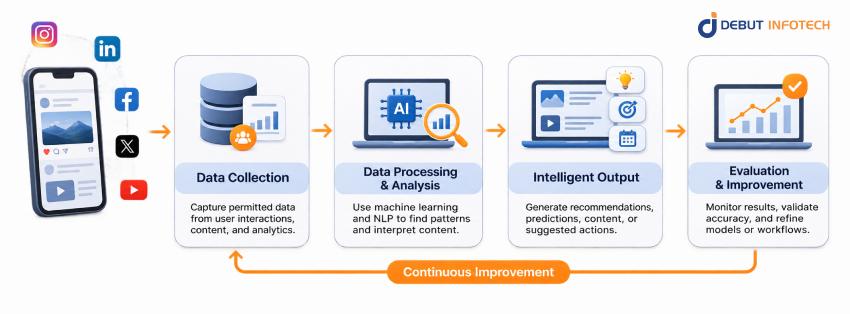
Different use cases require different architectures. A content recommendation engine may use behavioral models, while a conversational application may combine an LLM with a business knowledge base. An enterprise sentiment analysis system may require NLP pipelines connected to CRM and reporting tools.
Understanding these differences helps businesses select technologies that fit their objectives rather than implementing AI simply because it is available.
Artificial intelligence combines several technologies that perform different functions within digital platforms. Some influence what users discover, while others help businesses build intelligent applications, analyze information, and automate operations.
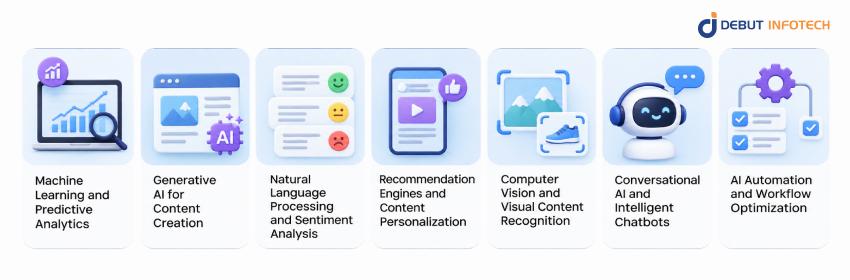
Machine learning identifies relationships in historical information and uses those patterns to produce predictions or classifications. Social platforms apply these techniques to understand content preferences, estimate engagement probabilities, and identify changes in user behavior.
For businesses, predictive analytics in social media can support more informed decisions about customer engagement, advertising performance, and digital product experiences.
Consider an online marketplace that operates a customer community. A predictive model could analyze permitted interaction data to identify users whose activity has declined significantly. The company could investigate whether those changes indicate customer dissatisfaction, reduced product interest, or another issue.
Common applications include:
Businesses developing these capabilities must consider data quality, training requirements, model evaluation, and changing user behavior. Our predictive analytics software development guide explains the broader engineering considerations involved in building predictive systems.
Generative AI uses trained models to produce new text, images, audio, video, and other content based on prompts or contextual information. Its applications extend beyond marketing teams to the platforms and software products businesses develop.
For example, a professional networking application could integrate a language model that helps users prepare profile descriptions, summarize discussions, and draft professional messages.
A business developing a social media management platform might incorporate AI-powered content creation for social media to support campaign briefs, captions, creative assets, and multilingual communication.
Potential applications include:
However, generative AI implementation requires decisions about model selection, prompt design, output validation, latency, and processing costs.
Businesses may also need retrieval-augmented generation to connect AI-generated responses with approved company information. Generative AI for social media should therefore be evaluated as an application capability rather than merely a writing shortcut.
For companies exploring related technologies, our generative AI in digital product development article examines how these systems support software products.
Natural language processing (NLP) enables software to analyze and interpret human language. Social media platforms generate large quantities of text through comments, reviews, public discussions, and customer messages. NLP systems help organizations classify this information, identify recurring topics, and extract insights from conversations that would otherwise require extensive manual review.
Social media sentiment analysis is one important application. Imagine a consumer electronics business launching a new product. Its customers begin discussing product quality, battery performance, pricing, and technical support across several channels.
An AI-powered sentiment analysis system could categorize those conversations and identify recurring concerns. The results could then be shared with product development, customer support, and marketing teams.
More advanced systems use aspect-based sentiment analysis to identify different opinions expressed within the same message. However, these models may misinterpret sarcasm, regional language, and ambiguous statements. Businesses should evaluate classification accuracy using representative data and maintain human review for consequential decisions.
Recommendation engines predict which content or experiences may be relevant to individual users. These systems are central to platforms such as TikTok, Instagram, and YouTube, where users encounter personalized content based on available behavioral signals.
Businesses can apply similar capabilities when developing community platforms, digital marketplaces, educational applications, and media products. For instance, an online learning platform could use recommendation models to suggest professional communities, educational videos, or discussions based on a user’s learning interests.
An e-commerce application could recommend relevant product content based on browsing patterns and permitted interaction history.
AI-based recommendations can support:
The technical challenge involves delivering useful recommendations without creating excessive repetition, unfair ranking outcomes, or privacy risks. Organizations must also evaluate recommendation quality, response time, and the availability of reliable training signals.
Computer vision allows AI systems to interpret information contained in images and videos. Social platforms use visual intelligence for content understanding, image classification, and moderation assistance.
Businesses can integrate similar technologies into applications where visual content plays an important role. A fashion marketplace, for example, could develop a visual search feature that allows customers to upload an image and discover related products. A content platform could use computer vision to categorize uploaded videos or identify potentially inappropriate visual material for further review.
Applications include:
Computer vision development requires suitable models, representative datasets, and infrastructure capable of processing visual information efficiently. Accuracy, privacy, and false-positive rates become particularly important when automated classifications affect user-generated content.
Conversational AI enables applications to interpret user requests and generate contextual responses. Businesses can integrate these systems into social messaging applications, digital communities, customer service platforms, and online marketplaces.
For example, an e-commerce company could develop an intelligent assistant that answers product inquiries, explains delivery policies, and guides customers toward relevant support options.
A B2B SaaS company could build a conversational interface that retrieves answers from approved documentation and assists users with common product questions. These systems may incorporate LLMs, retrieval-augmented generation, intent classification, and business application APIs.
Potential capabilities include:
AI-driven customer engagement works best when responses are grounded in reliable information and users can reach human representatives when necessary.
AI-enabled automation connects applications, data, and business processes to reduce repetitive work.
Traditional automation follows predefined instructions. Intelligent workflows can additionally interpret information, classify requests, generate recommendations, and support multi-step actions. For example, an enterprise could connect social media monitoring with its customer service infrastructure.
When a system identifies a potentially urgent customer complaint, it could create a ticket, attach relevant details, and route the issue to the appropriate team. The final response could remain subject to employee approval.
More advanced implementations may use AI agents to coordinate several tasks through connected applications. These systems require clear permissions, monitoring, failure handling, and boundaries around autonomous actions.
Our article on AI agents for social media management explores how agent-based capabilities are being applied to social media workflows.
AI in social media marketing supports more than content production. Organizations are applying intelligent technologies to develop applications, improve customer interactions, analyze market information, and connect digital experiences with enterprise operations.
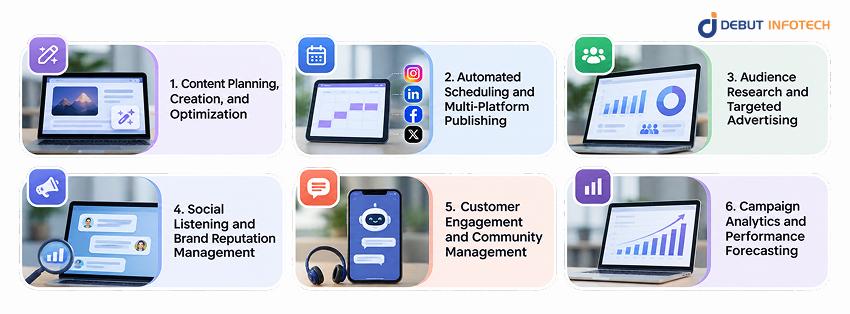
The following applications illustrate where businesses can create practical value.
Businesses use AI to research content topics, generate drafts, organize campaigns, and adapt materials for different audiences. For software providers, these capabilities also create opportunities to develop intelligent content management products.
A B2B marketing technology company could integrate an LLM into its platform to generate campaign concepts based on customer profiles, approved product information, and brand guidelines. The application could provide draft recommendations while allowing users to review, edit, and approve the final content. This requires an architecture that connects AI models with content repositories, user permissions, and workflow management systems.
Businesses managing multiple social channels often encounter problems with disconnected applications, inconsistent approvals, and manual publishing. AI-powered social media management systems can bring these operations into coordinated workflows.
For a SaaS provider developing such a platform, the technical requirements may include platform API integrations, secure authentication, publishing queues, scheduled execution, and error handling.
The application must also account for differences between supported social networks. For example, a failed publishing request should be recorded and handled without unintentionally creating duplicate posts. This is an engineering problem involving distributed workflows and application reliability, not simply a scheduling feature.
Machine learning helps businesses analyze permitted customer interactions and campaign data to identify meaningful audience patterns.
A retail enterprise might use AI to understand how customer segments respond to different product categories. A SaaS organization could analyze campaign interactions alongside CRM information to identify which content attracts qualified prospects.
Advertising platforms also use predictive systems to optimize delivery toward campaign objectives. Businesses developing custom analytics solutions can combine approved platform information with internal customer data to support more comprehensive reporting. However, organizations must ensure that data collection and processing comply with relevant privacy requirements.
Social media listening and monitoring allow businesses to understand conversations about their products, services, and industries. AI can classify public mentions, identify emerging topics, and flag unusual changes in conversation volume.
Consider an automotive company introducing a new vehicle feature. If users repeatedly report connectivity problems, an intelligent monitoring system could highlight the issue and provide supporting examples. The findings could be connected with customer support records or product quality dashboards. This creates an opportunity to integrate social intelligence into broader enterprise decision-making.
Businesses use conversational AI to support customer inquiries, classify requests, and provide contextual assistance.
An online marketplace could integrate an intelligent assistant into its seller community to answer common questions about product listings, payment processes, and platform policies.
An education platform could develop AI features that recommend relevant discussions or help users locate information. Such applications require user authentication, reliable knowledge retrieval, escalation procedures, and appropriate data protection. The goal is to improve access to support while preserving customer trust.
AI-driven social media analytics can combine information from advertising systems, social platforms, web analytics, and internal business applications. A B2B organization could connect campaign activity with CRM pipeline data to understand which campaigns contribute to qualified business opportunities.
Predictive models may also estimate future performance using historical information. However, generated insights should be treated as analytical support rather than proof of causation. Businesses should validate recommendations through suitable experiments, accurate attribution methods, and ongoing performance monitoring.
The benefits of AI in social media depend on how effectively organizations connect intelligent capabilities with business objectives. For enterprises and software companies, these benefits can extend across marketing operations, customer intelligence, digital product performance, and application scalability.
AI reduces repetitive work involved in drafting content, organizing campaign information, categorizing feedback, and preparing reports.
Metricool’s 2026 research found that 65% of surveyed professionals reported saving between one and six hours per week through AI. Although these are self-reported findings rather than guaranteed outcomes, they demonstrate why operational efficiency remains an important adoption driver.
Recommendation engines and behavioral analytics can help businesses deliver more relevant content and experiences. For organizations developing community platforms, personalization may improve content discovery and encourage users to return. However, businesses should evaluate engagement quality, retention, and customer satisfaction rather than focusing exclusively on interaction volume.
AI-assisted analytics can help organizations identify underperforming campaigns, compare audience responses, and allocate marketing resources more effectively. For example, a company may find that educational content generates fewer impressions than promotional material but produces more qualified inquiries. That information can support better decisions about campaign investment.
AI applications can incorporate approved brand guidelines, terminology, product information, and editorial requirements. This becomes valuable for enterprises managing multiple departments, locations, or business units. Human approval remains important for sensitive claims, regulated content, and customer-facing communications.
AI can process large volumes of unstructured customer feedback and organize it into useful categories. Instead of manually examining thousands of comments, business teams can review recurring concerns, supporting examples, and emerging patterns. When integrated with enterprise analytics systems, these insights can inform product development, customer service, and operational planning.
As organizations expand, managing additional platforms, campaigns, and customer interactions increases operational complexity. Custom AI-powered applications can support growth through reusable services, automated workflows, centralized reporting, and integration with existing infrastructure. The value of scalability lies in maintaining reliability and quality without requiring every additional workflow to be managed manually.
Several established platforms demonstrate how AI supports content discovery, personalization, and intelligent user experiences. For businesses planning their own applications, these examples illustrate the types of capabilities that can be developed and integrated into digital products.
TikTok uses recommendation systems to identify videos that may be relevant to individual users. According to TikTok’s official documentation, recommendations consider signals such as user interactions and content information. The platform demonstrates how machine learning can organize large content libraries around individual preferences.
Business takeaway: Companies developing content-driven applications can explore recommendation engines to improve discovery, provided they have appropriate data and clear measures of recommendation quality.
Meta uses machine learning models to rank content across Instagram experiences. Its Instagram Feed ranking documentation explains how models estimate the likelihood of actions such as liking, saving, or interacting with content. These systems illustrate how predictive models support personalized digital experiences.
Business takeaway: Ranking models can be relevant to community platforms, content applications, and digital marketplaces where large amounts of information must be presented according to user interests.
Pinterest uses machine learning and visual understanding technologies to support content and product discovery. Its visual approach demonstrates how image recognition and AI-based recommendation systems can work together. For e-commerce businesses, similar technologies can help customers discover products through visual characteristics and related content.
Business takeaway: AI-powered visual search can become a differentiated feature in applications where users explore products, styles, or ideas through images.
While established social networks demonstrate AI at consumer-platform scale, businesses can also develop specialized AI applications for clearly defined operational problems. One example is DrawPost, an AI-powered social media marketing automation platform designed and developed by Debut Infotech.
The project demonstrates how generative AI, intelligent workflow orchestration, brand intelligence, and cloud-based software engineering can be combined within a unified SaaS product.
Marketing teams and agencies often manage content planning, creative production, publishing, and campaign coordination through separate applications.
This creates several problems:
The project objective was to create a unified platform capable of coordinating these activities through AI-assisted workflows.
Debut Infotech designed DrawPost around an AI-first SaaS architecture that connects multiple models with conventional application services.
The implementation combines several technical components.
LLM-powered content intelligence: OpenAI GPT-4.1 supports the generation of structured content strategies, campaign themes, captions, and platform-specific content plans.
Brand intelligence: Anthropic Claude Haiku is integrated to support contextual understanding of brand voice, messaging requirements, and communication guidelines.
AI-powered visual generation: Replicate FLUX.2 Pro and Puppeteer support visual asset generation and HTML-to-image creative workflows.
Workflow orchestration: BullMQ, Redis, and scheduled execution services coordinate asynchronous content generation and publishing tasks.
Scalable application architecture: The platform uses Next.js, React, Node.js, Express.js, and Prisma ORM to connect the interface with backend services.
Cloud infrastructure: AWS services support application hosting, media storage, and content delivery, while messaging and caching technologies support system coordination.
These components demonstrate how AI-powered product development requires more than integrating a language model API. The engineering team must also manage data flow, background processing, application performance, external integrations, and operational reliability.
The published DrawPost case study identifies expected improvements of 60–70% in manual effort and approximately 40% in operational costs. These figures represent projected business impact rather than independently validated, mature production results. The case study also describes the platform’s progression toward beta onboarding, with ongoing improvements based on user feedback.
From an engineering perspective, the project demonstrates Debut Infotech’s capabilities in:
The broader business lesson: Organizations can combine multiple AI capabilities within a purpose-built application to solve complex operational challenges.
Explore the complete DrawPost AI development case study for additional technical details.
Developing an AI-powered social media application requires a structured process covering business requirements, data readiness, model selection, application architecture, security, and operational performance. The objective is not to add AI features indiscriminately. It is to build capabilities that solve identifiable problems and work reliably within the intended software environment.
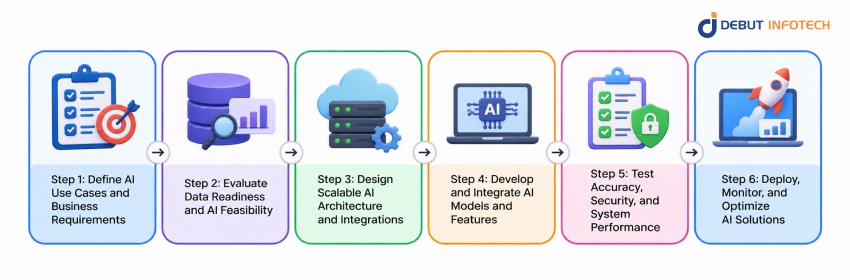
The development process begins by identifying the problem an AI system should address.
A media company might need personalized content recommendations. A consumer brand may want to analyze customer sentiment. A SaaS business might plan to develop an intelligent social media management platform. Each use case requires different data, models, interfaces, and performance standards.
Businesses should establish:
A clearly defined scope helps development teams distinguish essential features from capabilities that can be introduced later.
AI applications depend on the quality, accessibility, and suitability of their data. Before development, teams should examine available data sources, existing integrations, privacy restrictions, and the information required to support the intended functionality. For example, a recommendation engine may need historical interaction data, while an enterprise knowledge assistant requires approved and accessible information sources.
The feasibility assessment should identify missing data, integration constraints, and potential accuracy limitations. A proof of concept may then be used to validate whether the proposed technology can meet defined requirements.
Once feasibility is established, development teams define how AI capabilities will interact with the application and connected services. Architecture decisions may involve model hosting, API orchestration, databases, caching, asynchronous processing, and cloud infrastructure.
A social media application with automated publishing capabilities may require background job queues and retry mechanisms. A sentiment analysis platform may need data ingestion pipelines, classification services, and business intelligence integrations.
A conversational application may require an LLM, retrieval infrastructure, access controls, and a mechanism for escalating unresolved requests. The architecture should also support monitoring, system updates, and future expansion. Businesses developing mobile-first social applications must account for device compatibility, backend integration, and application performance.
Development teams implement the selected AI capabilities through suitable models, APIs, and application components.
Depending on the requirements, this may involve:
Model selection should consider accuracy, latency, cost, available deployment options, and data sensitivity. In many applications, integrating an established model through a controlled API is more practical than training a model from scratch. However, proprietary data requirements or specialized capabilities may justify fine-tuning or custom model development. Integration should be tested against real application workflows rather than evaluated only through isolated model demonstrations.
AI applications require conventional software testing alongside model-specific evaluation. A recommendation system should be tested for relevance, response time, and undesirable ranking behavior.
A conversational assistant should be evaluated for factual grounding, unauthorized disclosure of information, and escalation quality. A content generation system should be checked for unsupported claims, brand consistency, and inappropriate outputs.
Key evaluation areas include:
Automated tests should be complemented by representative human review, especially when outputs affect customers.
Production deployment should begin with appropriate monitoring and controlled rollout procedures. Teams must evaluate application performance under realistic usage conditions, monitor AI model costs, and identify changes in output quality.
AI applications may require updates when user behavior changes, connected services introduce new restrictions, or newer models become available. Continuous optimization can involve improving prompts, adjusting retrieval pipelines, refining prediction models, reducing latency, and strengthening operational controls.
For businesses planning custom implementations, an AI development services provider can cover the journey from feasibility assessment and architecture through integration, deployment, and ongoing optimization.
The return on investment from AI depends on the application’s purpose and the costs involved in developing, integrating, and operating it.
A business implementing a recommendation engine should measure different outcomes from one automating customer support or social media reporting.
| AI application | Key performance indicators | Business significance |
| Recommendation engines | Content relevance, retention, qualified engagement | Improved digital experience |
| Generative AI systems | Approved content output, review time, production cost | Operational productivity |
| Sentiment analysis | Classification accuracy, analysis time, issue detection | Customer intelligence |
| Conversational AI | Resolution rate, response accuracy, escalation quality | Service efficiency |
| Predictive analytics | Forecast error, conversion quality, decision impact | Better resource allocation |
| Workflow automation | Processing time, error rate, intervention frequency | Scalable operations |
Businesses should account for the total cost of ownership, not just the price of an AI model or software subscription. Potential costs include initial development, data preparation, API integrations, cloud infrastructure, model inference, monitoring, security, and ongoing maintenance.
Consider a business that spends $10,000 per month on a manual customer feedback analysis process. After developing an AI-assisted classification and reporting system, its recurring operating costs fall to $6,500 per month, including the relevant AI operating expenses. The estimated monthly operating benefit is $3,500.
If implementation requires an initial investment of $42,000, the simple payback period would be approximately 12 months, assuming those savings are sustained.
The simplified ROI formula is:
ROI (%) = [(Total financial benefits − Total AI investment and operating costs) ÷ Total AI investment and operating costs] × 100
These numbers are illustrative, not actual project outcomes.
Businesses should validate savings through operational records and account for variations in workload, model expenses, human review, and integration maintenance. For customer-facing platforms, additional measures such as retention, conversion quality, and customer satisfaction may be more meaningful than labor savings alone.
Building an AI-powered social media application involves more than selecting a model or connecting an API.
Businesses need a development partner capable of translating requirements into scalable application architecture, integrating intelligent capabilities with existing systems, and supporting reliable deployment. At Debut Infotech, we provide AI development and integration expertise for enterprises, startups, and software product companies looking to build intelligent digital solutions.
We design and develop AI-powered software applications around specific business requirements. Our capabilities include recommendation engines, conversational applications, predictive analytics, intelligent search, and workflow automation. We evaluate each use case against its data requirements, integration dependencies, and expected business outcomes.
We integrate large language models into business applications through secure APIs and suitable orchestration frameworks. Depending on project requirements, this can include content generation, contextual assistance, knowledge retrieval, and multimodal functionality. Model selection considers accuracy, latency, data sensitivity, and operational costs.
AI delivers greater value when it operates within existing business processes. Our engineering teams integrate AI capabilities with enterprise applications, databases, CRMs, third-party APIs, and cloud infrastructure. This allows businesses to incorporate intelligent functionality without necessarily replacing established systems.
We develop application infrastructure to support reliable processing, secure information handling, and future expansion. Our capabilities span frontend and backend engineering, data pipelines, cloud deployment, workflow orchestration, and system monitoring. These engineering disciplines are especially important for AI applications that handle high request volumes or coordinate multiple external services.
Our work on DrawPost demonstrates how multiple AI models, automation frameworks, and application services can be combined into a unified SaaS solution. The project provides a relevant example of translating an operational challenge into a functioning AI-powered platform. For businesses evaluating similar opportunities, that experience illustrates how AI engineering and conventional software development work together.
AI in social media is changing how organizations understand customers, personalize digital experiences, automate workflows, and build software products.
Technologies such as machine learning, natural language processing, computer vision, and generative AI are creating opportunities across marketing, customer engagement, content discovery, and enterprise intelligence.
However, business value depends on effective implementation.
Organizations must define clear objectives, evaluate data readiness, select appropriate models, establish secure integrations, and measure performance throughout the application lifecycle.
For companies planning custom social platforms, AI-powered SaaS products, or intelligent enterprise applications, the opportunity is to turn these capabilities into dependable solutions that address real operational needs.
Developing AI-powered social media applications begins with defining business requirements, identifying suitable AI use cases, and evaluating data availability. Development teams then design the architecture, integrate machine learning models or LLMs, and connect relevant platform APIs. Testing, security controls, and cloud deployment follow. Businesses can use professional AI development services to build scalable applications with capabilities such as personalization, intelligent analytics, and workflow automation.
Common AI adoption challenges in social media include data privacy, inaccurate model outputs, integration complexity, and high implementation costs. Businesses may also face difficulties maintaining authentic communication and complying with platform policies. Addressing these issues requires reliable data, secure architecture, model evaluation, human oversight, and continuous monitoring. A phased implementation approach helps organizations validate technical feasibility before expanding AI capabilities.
AI can assist with developing a social media strategy by analyzing audience behavior, identifying content opportunities, forecasting trends, and recommending campaign approaches. However, it cannot independently guarantee an effective strategy. Business objectives, market positioning, budget allocation, and customer relationships still require human judgment. Companies can integrate AI into strategic planning systems to support decisions while maintaining human responsibility for execution and performance.
Increasing AI adoption can improve communication through personalized recommendations, faster responses, and more relevant content. However, excessive automation and repetitive AI-generated posts may weaken audience trust. Businesses should combine AI-powered personalization with original perspectives, transparent communication, and human interaction. Maintaining editorial oversight and clearly defining which conversations require personal attention helps organizations preserve authenticity while benefiting from intelligent automation.
Artificial intelligence supports the social media market through content recommendations, targeted advertising, audience analytics, customer engagement, and automated moderation. Platforms use machine learning to personalize experiences, while businesses integrate AI into applications to improve operational efficiency. These capabilities also create opportunities for software companies to develop intelligent social networking platforms, marketing technology solutions, and customer intelligence systems.
AI-generated content can support social media growth when it improves content relevance, production efficiency, and audience engagement. However, generating more posts does not automatically increase reach or conversions. Repetitive, inaccurate, or generic content may reduce audience trust. Businesses should evaluate AI-assisted content through engagement quality, retention, qualified traffic, and conversions while ensuring that published material reflects their brand identity and expertise.
AI in social media marketing supports audience segmentation, content generation, predictive analytics, campaign optimization, and customer engagement. Businesses use machine learning to identify behavioral patterns and NLP to analyze conversations. Generative AI assists with content production, while automation systems coordinate repetitive workflows. Enterprises can also develop custom AI applications that connect social media intelligence with CRM, analytics, and customer service platforms.
Businesses use AI to improve social media engagement through personalized content recommendations, audience analysis, intelligent chatbots, and sentiment monitoring. Predictive models can identify engagement patterns, while conversational AI supports faster responses to customer inquiries. Organizations can also integrate recommendation engines and contextual assistance into their digital platforms. Measuring customer satisfaction, meaningful interactions, and retention helps determine whether these applications improve engagement.
AI helps businesses automate social media marketing by supporting content generation, publishing schedules, campaign reporting, customer inquiry classification, and performance monitoring. Advanced workflows can connect AI models with content management systems, analytics platforms, and CRM applications. Organizations developing custom solutions can incorporate AI agents and workflow orchestration to coordinate multiple tasks while maintaining approval controls, data security, and operational oversight.
AI analyzes audience behavior using machine learning models that identify patterns in engagement data, content preferences, and permitted interactions. Natural language processing evaluates comments, reviews, and discussions to identify topics and sentiment. Businesses can use these insights to understand customer concerns, personalize experiences, and improve decisions. Model accuracy should be validated because sarcasm, context, and incomplete data can affect interpretations.

Our Latest Insights
USA
2501 Chatham, Rd Suite R Springfield, IL 62704
+1-708-515-4004
info@debutinfotech.com
UK
7 Pound Close, Yarnton, Oxfordshire, OX51QG
+44-770-304-0079
info@debutinfotech.com
Canada
154 Eden Oak Trail, Kitchener, ON N2A 0H9
+1-708-515-4004
info@debutinfotech.com
INDIA
Sector 101-A, Plot No: I-42, IT City Rd, JLPL Industrial Area, Mohali, PB 140306
9888402396
info@debutinfotech.com